
Lowest Price Guaranteed
Slides
226
Last Updated
July 2025
View Count
11019
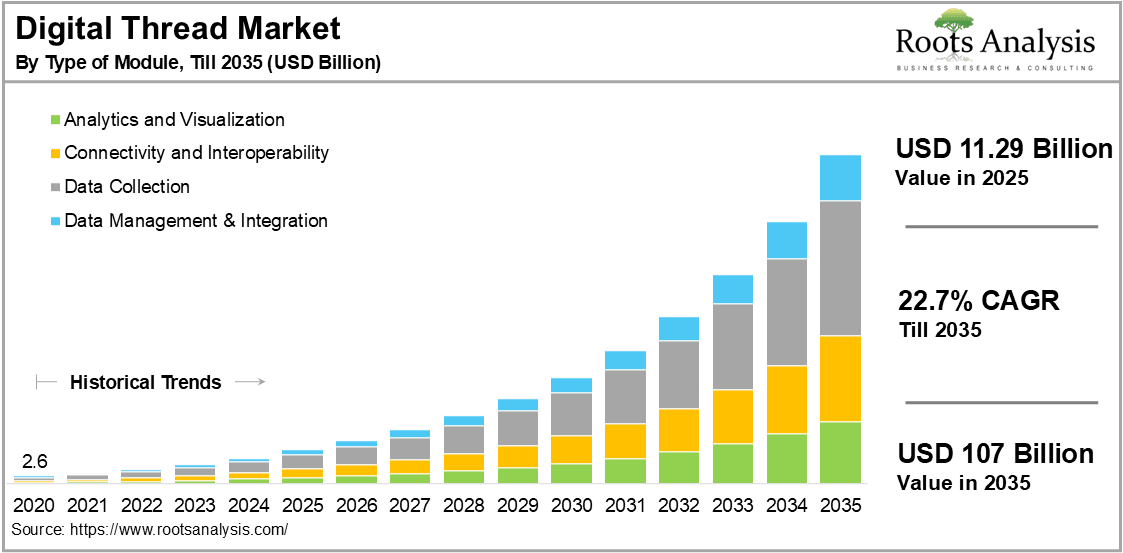
The digital thread market size is projected to grow from USD 11.29 billion in 2025 to USD 107 billion by 2035, representing a CAGR of 22.7%, during the forecast period till 2035.
 |
To learn more about this report, request a free sample copy
The new research study consists of digital thread industry analysis, detailed market forecast analysis, and providing actionable strategic recommendations.
Manufacturing tools interconnected and coupled with advanced features, such as enhanced collaboration and improved interoperability to control manufacturing have played a pivotal role in the growth of industrial automation with digital threads. Further, benefits of using digital threads for product lifecycle management include effective development, manufacturing, growth and maturity. Digital transformation in industries is surged by real-time tracking that can suggest changes and approvals for quality assurance. It is worth highlighting that digital twin technology has enhanced the technological approach by providing transparency in tool functionalities and predicting potential failures. In addition, trends in smart manufacturing and their relation to digital threads can be ascribed by the integration of artificial intelligence (AI) that enhances data analysis and insights and automation of processes.
The global digital thread technology demand is expected to grow significantly over the forecast period due to the rapid growth of smart factories and industry 4.0 in emerging economies like China and India. A more efficient supply chain and rapid response to errors have played a pivotal role in the future of the digital threads market. Additionally, continuous improvement through feedback and enhanced collaboration have fostered the growth of applications of digital threads in aerospace and defense. Further, configuration of complex products and predictive maintenance is majorly driving the growth in future outlook for digital thread. Interestingly, end-to-end product lifecycle traceability increasingly leverages technologies from the 3D metrology to validate designs and minimize deviations.
Recently, Graham Sheldon, Chief Product Officer at UiPath mentioned organizations can achieve more impactful business outcomes, accelerate transformation with automation, and gain added trust and compliance within their automation programs.
The global digital thread market research report presents an in-depth analysis of the various companies that are involved in offering digital threads, across different segments, as defined in the table below:
| Key Report Attributes | Details | |
| Historical Trend | Since 2020 | |
| Forecast Period | Till 2035 | |
| Market Size Value by 2025 | $ 11.29 Billion | |
| Market Size Value by 2035 | $ 107 Billion | |
| CAGR (Till 2035) | 22.7% | |
| Type of Technology |
|
|
| Type of Module |
|
|
| Type of Deployment |
|
|
| Type of Application |
|
|
| By End Users |
|
|
| Geographical Regions |
|
|
| Leading Market Players |
|
|
| PowerPoint Presentation (Complimentary) |
Available | |
| Customization Scope | 15% Free Customization | |
| Excel Data Packs (Complimentary) |
|
|
On the basis of the type of technology, the digital thread market is bifurcated into application lifecycle management (ALM), computer-aided design (CAD), computer-aided manufacturing (CAM), edge computing, enterprise resource planning (ERP), industrial communication, industrial sensor, manufacturing execution system (MES), material requirements planning (MRP), product lifecycle management (PLM), SCAD and service lifecycle management (SLM). The product life cycle management (PLM) segment is anticipated to dominate the segment with more than 30% market share in 2025.
Furtherly this segment is expected to witness a relatively faster (23.98%) digital thread market growth rate by 2035, this can be attributed to its capability to connect existing systems to control development, manufacturing and development cycle. In addition, real-time tracking and configuration of complex products have fostered the adaptation of digital thread for manufacturing efficiency.
Based on the type of module, the global digital thread market is split into analytics and visualization, connectivity and interoperability, data collection and data management and integration. Currently, according to our analysis the data collection is augmenting the segment's growth with over 40% of the market share. This can be attributed to the data capture approach that allows quality and production control. In addition, enhanced supply chain, rapid response and predictive maintenance have spurred the growth of digital threads market.
On the other hand, the connectivity and interoperability segment are expected to grow with a relatively higher (23.62%) CAGR in the near future. This can be attributed to its improved connectivity among machines and quality assurance. Further, real-time monitoring that suggests changes and approvals in manufacturing have boosted the demand for real-time data analytics in manufacturing processes.
On the basis of the type of deployment, the digital thread market is bifurcated into cloud based and on-premises. The on-premises segment is anticipated to dominate the segment with more than 40% of market share in 2025. Further this segment is expected to witness a relatively faster CAGR of 23.56% till 2035. This can be attributed to its security over confidential and crucial data. Moreover, impact of regulatory compliance on digital thread adoption acquires companies to retain ownership on its digital thread infrastructure.
On the basis of the type of application, the digital thread market is bifurcated into customer support, design and engineering, distribution, maintenance and services, manufacturing and supply chain management. The design and engineering segment is anticipated to dominate the segment with more than 40% of market share in 2025. Further, it is expected to witness a relatively faster CAGR of 23.64% due to its enhanced decision making that reduces time-to market for products. Moreover, it acquires reduced cost of networking devices that forwardly boost digital thread applications in manufacturing.
Based on the end users, the global digital thread market analysis is segmented into aerospace, automotive, chemicals, consumer goods, energy and power, food and beverages, machinery manufacturer, medical device, oil and gas, pharmaceutical and other end users. According to our analysis, machinery manufacturers will lead the segment with the major market share (40%) in 2025. This can be attributed to the need for advanced and less costly technologies that minimize the production cost and enhance the quality. Further, real-time data monitoring systems and controlled production lines have surged automation technologies in manufacturing.
However, the pharmaceutical segment is expected to grow with the relatively faster (23.98%) CAGR in the forecasted period due to complex manufacturing and regulatory compliance.
This segment highlights the distribution of the digital thread market across various geographical regions such as North America, Europe, Asia, Latin America, Middle East, North Africa, and the rest of the world. According to our global digital threads market analysis, Asia exhibits dominance in the market with over 40% of the digital thread market share in the global marketplace. This can be attributed to its rapid industrialization and growing rates of smart industries, particularly in countries like South Korea, India, Taiwan, and China.
However, North America is projected to grow with a relatively higher CAGR (23.97%) in the forecasted period. Primary reasons for this growth include IoT in digital thread, AI integration and investments in research and advancements.
The “Digital Thread Market, Till-2035: Industry Trends and Global Forecasts” report features an extensive study of the current market landscape, market size and future opportunity within digital thread market, during the given forecast period. The market report highlights the efforts of several stakeholders involved in this rapidly emerging segment of the digital thread solutions providers industry. Key takeaways of the global digital thread market report are briefly discussed below.
An increasing demand for 3D printers is majorly driving the digital thread industry. Further, advancements in data integration technologies and digital twin and digital thread integration have contributed to expansion of digital thread market. Moreover, digitals threads are favored for cost-reducing techniques and real-time monitoring that help in production of quality products have spurred the growth of industry 4.0 and digital thread.
With the presence of several small and large digital thread companies, the competitive landscape of the digital thread industry is experiencing intense competition and changing market dynamics. From large multinational companies to local digital thread players, companies are striving to enhance their competitive edge. In terms of market share, large enterprises and multinational companies are dominating the market. While small digital thread players are continuously improving their products to cater to niche markets, or they are offering specialized services. These industry players are focusing on adopting competitive strategies, such as developing innovative solution techniques, forming strategic alliances and partnerships to expand their portfolios and global footprint, investing in recent developments and new feature launches to enhance their digital thread offerings.
Despite strong market growth projection, the digital thread market faces numerous challenges in implementing digital threads. The most common challenge is tougher regulations such as California Consumer Privacy Act (CCPA) and General Data Protection (GDPR). In addition, diverse hardware and software can lead to uneasiness in interoperability. Notably, they are prone to hacking, as they work on networks to connect, attackers can intrude it easily hampering market growth.
Asia currently holds a substantial share of approximately 40% in the digital thread market opportunities. This dominance can be attributed to several factors, including rising trends of smart industries and rapid industrialization in emerging economies such as South Korea, India and China. In addition, IoT sensors and real-time data analytics have fostered the growth in digital thread for manufacturing efficiency. Notably, the role of AI in enhancing digital thread capabilities have contributed to expanding the domain. Moreover, substantial digital thread investments analysis in research and development has framed the future of digital threads in Asia.
Examples of key player involved in the digital thread market (which have also been captured in this market report, arranged in alphabetical order) Accenture, Autodesk, AVEVA, Bosch, Dassault Systems, DXC Technology, General Electric, HCL Technologies, Honeywell, IBM, Microsoft, NVIDIA, Oracle, PTC, Rockwell Automation, SAP and Siemens. This market report includes an easily searchable excel database of all the companies who have adopted the digital thread market.
The market report presents an in-depth analysis, highlighting the capabilities of various companies engaged in this domain, across different segments. Amongst other elements, the market report includes:
At Roots Analysis, we genuinely care about your success and understand that your business requirements are unique. While our market research reports provide valuable insights, we recognize that they might not cover every aspect you need to make well-informed strategic decisions. To account for that, we offer 15% free report customization tailored to your specific needs. Whether you require additional quantitative analysis, qualitative insights, or any other information related to the digital thread market, reach out us today at: support@rootsanalysis.com