
Lowest Price Guaranteed
Slides
174
Last Updated
May 2025
View Count
12170
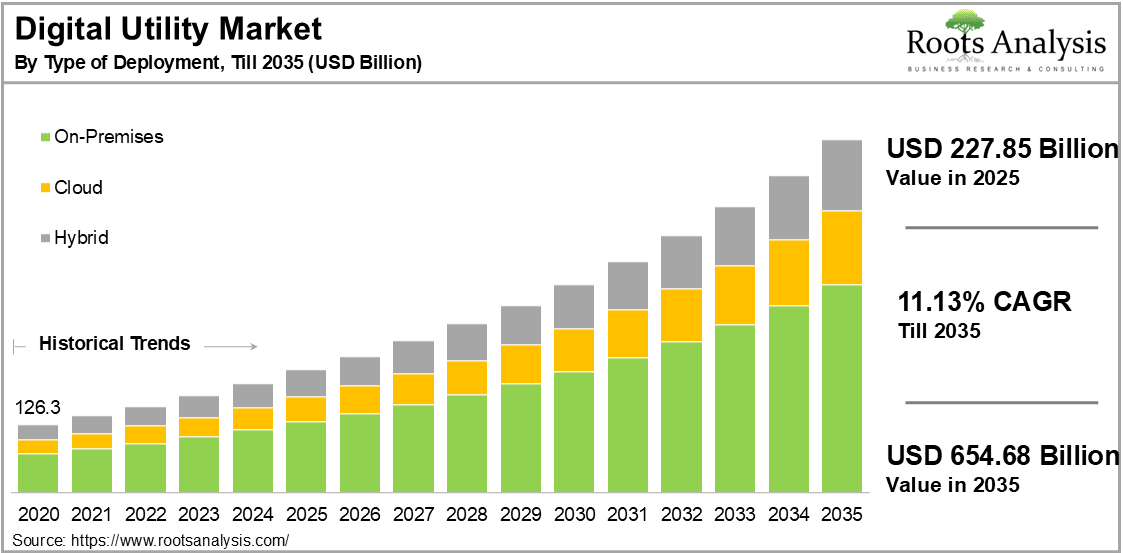
The digital utility market size is projected to grow from USD 227.85 billion in 2025 to USD 654.68 billion by 2035, representing a CAGR of 11.13%, during the forecast period till 2035.
 |
To learn more about this report, request a free sample copy
The new research study consists of digital utility industry analysis, detailed digital utility market analysis, mega trends, patent analysis, porter five forces, SWOT analysis, value chain analysis and other strategic frameworks.
Digital utility involves the integration of advanced technologies, data analytics, and communication systems into traditional utility infrastructures to improve efficiency, reliability, and sustainability. In the realms of electricity, water, and gas services, digital utility solutions utilize smart meters, sensors, and IoT devices to collect real-time data on consumption patterns and grid performance. This extensive data allows utilities to optimize resource management, quickly identify faults, and adapt more effectively to fluctuations in demand.
The utility sector is increasingly embracing innovative digital technologies, such as blockchain, artificial intelligence (AI), and machine learning to enhance operations, customer service, and collaboration with supply chain partners. These digital solutions empower users to manage energy generation and distribution more effectively, offering features like predictive maintenance and enhanced safety and efficiency, ultimately leading to improved customer satisfaction. The growth of this market is driven by factors, such as the rise in renewable energy projects and mandates for energy efficiency. Additionally, the urgent demand for green energy and rapid digitalization are significant catalysts for market expansion.
The digital utility market report presents an in-depth analysis of the various companies that are involved in offering digital utility solutions, across different segments, as defined in the table below:
| Key Report Attributes | Details | |
| Historical Trend | Since 2020-2024 | |
| Forecast Period | 2025-2035 | |
| Market Size Value in 2025 | $ 227.85 Billion | |
| Market Size Value by 2035 | $ 654.68 Billion | |
| CAGR (Till 2035) | 11.13% | |
| Type of Components |
|
|
| Type of Deployment |
|
|
| Types of Networks |
|
|
| Areas of Application |
|
|
| Type of Technology |
|
|
| Type of End-Users |
|
|
| Company Size |
|
|
| Geographical Regions |
|
|
| Leading Market Players | ||
| PowerPoint Presentation (Complimentary) |
Available | |
| Customization Scope | 15% Free Customization | |
| Excel Data Packs (Complimentary) |
|
|
Based on the type of components, the market is split into hardware, services and software. Among these categories, the hardware segment growth is expected to dominate the market with a share of 65.8%. This growth is attributed to the extensive use of smart meters, transformers, and other intelligent equipment essential for digital utility solutions.
On the other hand, the service segment is expected to witness rapid growth at a significant CAGR of 12.23% during the forecasted period. This growth is fueled by the advancements in data extraction and analytics for efficient customer management, as well as increasing consumer demand for renewable energy options and sustainable practices from utility providers.
The global digital utility market is segmented into various types of deployment, such as cloud, hybrid and on-premises. According to our digital utility industry analysis, the on-premises segment will augment the segment's growth with the largest market share of over 64.56% by the next decade. The market growth can be attributed to its established infrastructure and the control it offers utilities over their operations and data security.
On the other hand, it is worth highlighting that the cloud deployment segment is expected to witness the fastest CAGR of around 13.78% during the forecasted period. This growth can be attributed to the wide adoption of cloud deployment for their scalability, flexibility, and cost-effectiveness in managing digital utility operations. This shift towards cloud-based systems also reflect a broader trend of digital transformation within the utility sector which is being driven by the need for enhanced data management and operational efficiency.
The market is segmented into various types of networks such as energy storage, energy trading, power generation, retail, transmission & distribution. According to our digital utility market forecast, the transmission & distribution segment will augment the segment's growth with the largest market share of over 45.6% by the next decade. The market growth can be attributed to the significant investments required to modernize aging infrastructure and improve the efficiency of electricity delivery systems.
Furthermore, the retail segment is expected to witness a growth of CAGR of 14.84% during the forecast period. This growth is fueled by the rising consumer awareness of environmental issues and a growing demand for renewable energy options. Retail utilities are leveraging data analytics and customer management solutions to provide personalized services and sustainable practices that align with consumer preferences.
The market is segmented into various areas of application, such as asset management, smart grid and smart meeting. According to our digital utility statistics, the smart grid segment will augment the market's growth with a market share of 65.8% during the forecasted period. This growth can be owed to the critical role the smart grid segment plays in modernizing energy infrastructure and improving the efficiency and reliability of electricity distribution.
Furthermore, the smart metering segment is expected to witness the fastest CAGR of around 13.6% during the forecasted period. This growth can be attributed to the rise in demand for accurate billing, enhanced customer engagement, and better energy management solutions. Smart meters provide utilities and consumers with real-time data on energy consumption, enabling more informed decisions regarding energy usage and promoting energy efficiency, which is further propelling the market growth.
The market is segmented into various types of technology, such as artificial intelligence (AI), big data analytics, and the internet of things (IoT). According to our digital utility analysis, the artificial intelligence (AI) segment will augment the market's growth with a market share of 67.65% during the forecasted period. This growth can be owed to its ability to enhance operational efficiency, improve predictive maintenance, and facilitate data-driven decision-making within utility operators.
Furthermore, the internet of things (IoT) segment is expected to witness the fastest CAGR of around 14.86% during the forecasted period. This growth can be attributed to the increasing number of connected devices and sensors that facilitate real-time monitoring and management of energy resources. As utilities adopt IoT technologies, they can gather and analyze data more effectively, leading to improved resource management and enhanced customer engagement.
The market is segmented into various types of end-users, such as commercial, residential and retail. According to our digital utility analysis, the commercial segment will augment the market's growth with a market share of 67.65% during the forecasted period. This growth can be owed to the increasing adoption of digital utility solutions among businesses seeking to enhance operational efficiency and reduce energy costs. Commercial entities are leveraging advanced technologies to manage their consumption more effectively, optimize resource allocation, and implement sustainability initiatives.
Furthermore, the retail segment is expected to witness the fastest CAGR of around 12.85% during the forecasted period. This growth can be attributed to retailers’ growing reliance on data analytics to understand customer behavior and preferences better. By utilizing digital utility solutions, retailers can improve their energy management practices, leading to cost savings and enhanced customer satisfaction.
The market is fragmented into multiple types of enterprise namely large and small and medium enterprise. Currently, the large enterprise segment is anticipated to dominate the segment with 75.34% of the market share. However, small and medium enterprise segments are expected to witness a relatively higher (16.78%) growth rate until 2035. This is ascribable to their agility, innovation, focus on niche markets, and ability to adapt to changing customer preferences and market conditions.
This segment highlights the distribution of digital utility market share by region, such as North America, Europe, Asia, Latin America, Middle East and North Africa, and the rest of the world. According to our regional analysis, North America currently exhibits dominance with 37.69% of overall market share. The North America growth is driven by robust technological infrastructure, early adoption of smart grid technologies, and a strong emphasis on grid modernization. The region’s utilities prioritize digitalization to enhance operational efficiency, grid reliability, and sustainability.
The “Digital Utility Market, Till-2035: Industry Trends and Global Forecasts” report features an extensive study of the current market landscape, market size and future opportunity within the digital utility market forecast period. The market report highlights the efforts of several stakeholders involved in this rapidly emerging segment of the service providers industry. Key takeaways of the digital utility market report are briefly discussed below.
The global digital utility market growth is expected to be driven by widespread adoption of smart grid technologies, which significantly enhance the efficiency of electricity delivery through real-time monitoring and improved communication between utilities and consumers. A critical factor in this expansion is the implementation of advanced metering infrastructure (AMI), including smart meters, which enable utilities to collect real-time data on energy consumption. This capability empowers them to optimize energy distribution, quickly identify faults, and improve overall grid reliability.
Additionally, as the use of renewable energy sources increases, digital utility solutions become essential for integrating solar and wind power into the grid, effectively managing the variability of these resources to maintain grid stability. Overall, these advancements are transforming utility operations, promoting sustainability, and meeting the growing demand for digital utility solutions in energy management.
With the presence of several small and large companies, the market is experiencing intense competition and changing market dynamics. From large multinational companies to local players, companies are striving to enhance their competitive edge. In terms of market share, large enterprises and multinational companies are dominating the market. The key players are using strategies such as partnerships, acquisitions, ventures, innovations, novel product launches, R&D and geographical expansions in an attempt to solidify their position in the industry. Additionally, the increasing emphasis on sustainability is driving companies to invest in biodegradable materials and technologies, further intensifying the competitive landscape.
Despite the strong market growth projection, there are several challenges in implementing digital utility solutions. The most common challenge is the high initial investment required for implementing advanced technologies, such as applications of digital utility in smart grids and smart cities, which can be a barrier for many utilities, particularly smaller ones. Additionally, the integration of legacy systems with new digital solutions poses technical difficulties, often requiring substantial upgrades and modifications.
Cybersecurity concerns are also paramount, as increased connectivity and data exchange make utilities more vulnerable to cyberattacks, necessitating robust security measures to protect sensitive information and infrastructure. Furthermore, regulatory compliance can be complex and vary by region, complicating the deployment of digital utility solutions. Finally, there is a growing need for skilled personnel who can manage and operate these advanced technologies, creating a talent gap that utilities must address to fully leverage digital transformation. These challenges must be navigated effectively to realize the full potential of digital utility innovations.
With respect to regional industry insights, North America is likely to dominate the market for the forecasted period. The dominance of this region is majorly influenced by favorable government initiatives, stringent regulatory frameworks, and significant investments in research and development. Furthermore, the presence of key industry players and a proactive approach toward embracing innovative technologies solidify the region’s leadership in shaping the landscape of the digital utility market.
Examples of leading companies in the digital utility market (which have also been captured in this market report, arranged in alphabetical order) include ABB, Accenture PLC, Capgemini SA, Cisco Systems, Cognizant Technology Solutions, Eaton, General Electric, Honeywell International, IBM, Itron, Microsoft, Oracle, SAP SE, Schneider Electric, Siemens, Toshiba.
The market report presents an in-depth analysis, highlighting the capabilities of various companies engaged in this domain, across different segments. Amongst other elements, the market report includes:
At Roots Analysis, we genuinely care about your success and understand that your business requirements are unique. While our digital utility market research reports provide valuable insights, we recognize that they might not cover every aspect you need to make well-informed strategic decisions. To account for that, we offer 15% free report customization tailored to your specific needs. Whether you require additional quantitative analysis, qualitative insights, or any other information related to the digital utility market, reach out us today at: support@rootsanalysis.com