


 Download Free Sample
 Buy Now
Market Size
Disaster recovery as a service market size is forecasted to reach USD 111.42 billion by 2035, growing at a 20.84% CAGR from USD 20.28 billion in 2026.
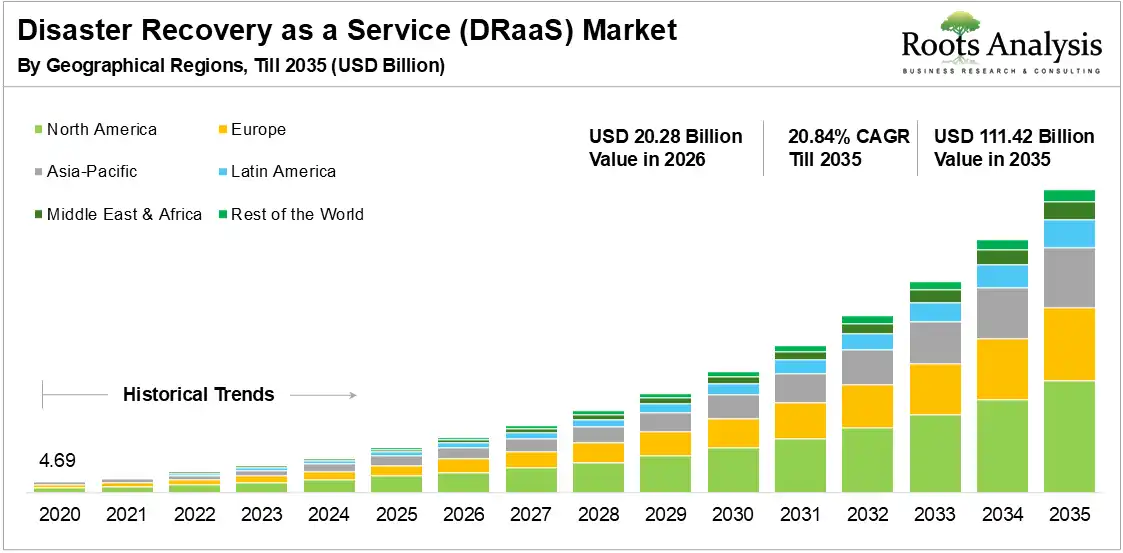
Would Like to Preview the Actual Report?
Market Report: Key Takeaways
- In terms of type of service, the managed DRaaS leads the market by holding 47.20% of the Disaster recovery as a service market share.
- Based on the type of service component, currently the recovery & backup services dominate the market, securing 41.85% of the market share.
- With respect to type of deployment, the public cloud taking the lead position, accounting for 66% of the overall revenue share in 2026.
- On the basis of enterprise size, the large enterprises currently dominate the market by holding 63.70% of the market share.
- Based on end user, the BFSI holds the largest share (23.15%) of the market in 2026.
- According to the regional analysis, North America holds the largest share (36.90%) of the market in 2026.
Market Outlook
Disaster recovery as a service is a form of cloud-based solution offered by third-party vendors to manage data backup and recover the lost data due to cyber breach. With increasing shift towards cloud-based services and digital infrastructure, the risk of data breach and cyberattacks has increased significantly. Cyberattacks are impacting almost all industrial verticals, such as healthcare, IT & Telecom, and other industries. In a press release, Anne Neuberger (US Deputy National Security Advisor for Cyber and Emerging Technologies) highlighted that the annual average cost of cybercrime will surpass USD 23 trillion in 2027.
To overcome challenges, there is a surge in the demand for disaster recovery as a service solutions. The benefits of using disaster recovery as a service includes faster data recovery, cost-reduction, faster implementation, and expert guidance. In addition, the increasing emphasis on strict data protection regulations are further increasing the demand for cloud-based disaster recovery services.
Given the growing need for data protection and recovery services, market players such as IBM, InterVision Systems, Microsoft, and Rackware are enhancing their initiatives to strengthen their services. For instance, in August 2025, Tata Consultancy Services has successfully enabled ICICI Lombard to achieve fully automated AWS multi-region disaster recovery switchover. Likewise, many market players are greatly emphasizing on data recovery services / solution which is likely to maintain long term competitiveness in disaster recovery as a service market.
Recent Developments
- In November 2025, ControlMonkey launched new Global Partner Program. This program will unify managed service providers, value-added resellers, and technology / integration partners under one framework to deliver cyber security compliance, automation, and resilience across enterprise cloud computing environment.
- In November 2025, Dell Technologies announced enhancements of its PowerProtect portfolio to deliver more faster, smarter and efficiency cyber resilience for businesses operation in hybrid and edge environments.
- In June 2025, Commvault, Pure Storage, and Kyndryl announced collaborative efforts to assist organizations in improving data recovery capabilities and specific data protection regulations. This collaboration combines Commvault’s data backup software, Pure Storage’s data storage hardware, and Kyndryl’s IT infrastructure.
Market Dynamics
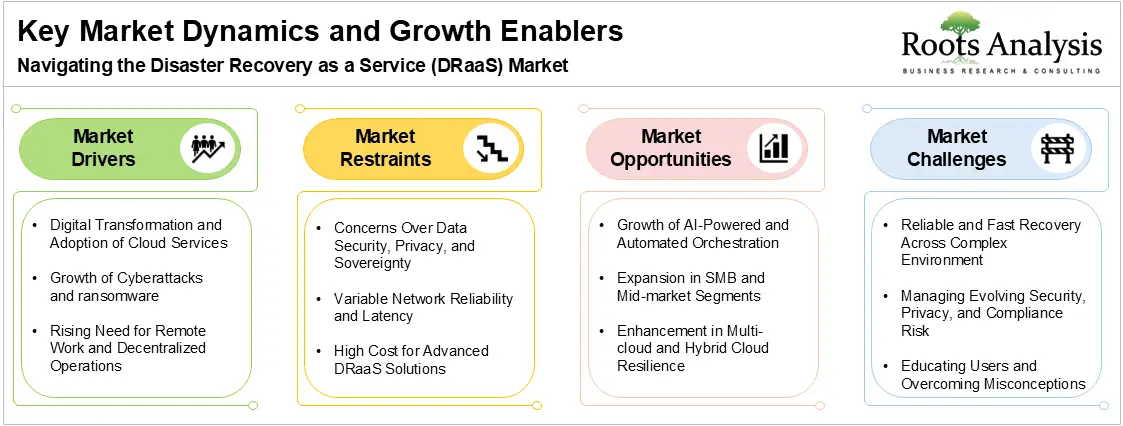
Key Market Drivers
- Digital Transformation and Adoption of Services: Business organizations are widely shifting their data storage workload to public / private clouds to enhance scalability. However, this cloud adoption poses a risk of data breaching, underscoring the demand for cloud-based disaster recovery as a service for business continuity and data protection.
- Growing of Cyberattacks and Ransomware: It is worth mentioning that the growing emphasis on the digital technologies for businesses has increased the severity of cyber incidents, such as malware and ransomware. In order to mitigate the concern, businesses are investing heavily in ransomware recovery services and solutions that offer rapid data restoration and failover.
- Rising Need for Remote Work and Decentralized Operations: Businesses are shifting to hybrid work models for remote work and decentralized operations. This hybrid model and decentralized operations require integration of cybersecurity with disaster recovery as a service to protect and restore data for a geographically dispersed workforces.
Key Market Challenges
- Reliable and Fast Recovery Across Complex Environment: With fast paced adoption of multi-cloud systems, maintaining instant failover, full application resilience and low RPOs / RTOs can be challenging. In addition, the variable network conditions, legacy workloads and diverse infrastructure can create challenges for the services providers.
- Managing Evolving Security, Privacy, and Compliance Risks: With evolving data privacy policies, cyberthreats, and regulatory framework, market players are required to invest in advanced multi-cloud disaster recovery strategies and solutions. However, the high investment can create a significant barrier for the market players.
- Educating Users and Overcoming Misconceptions: Many business organizations are still underestimating the need for DRaaS deployment in small and medium-sized enterprises (SMEs). Notably, small and medium-sized enterprises are still over-rely on backups for data recovery, which is not feasible, specifically during cyberthreats. Moreover, users also have misconception of the cost of disaster recovery as a services which create challenges in educating users about the importance of these services.
Pay Only for What You Need – The Best Way to Optimize
Market Segmentation
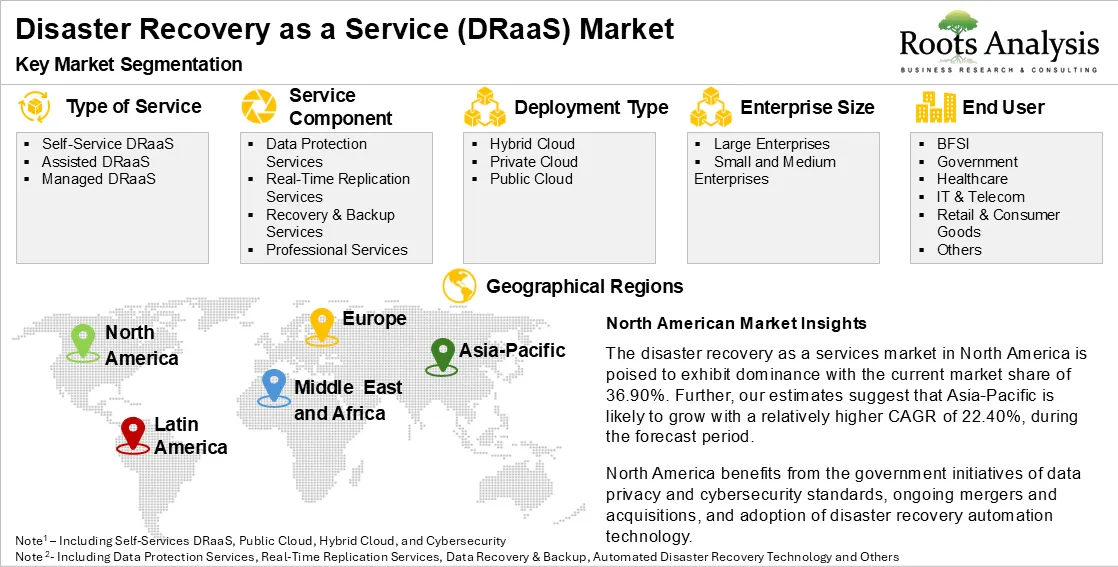
The disaster recovery as a service market report presents an in-depth analysis of the various companies that are involved in offering automated disaster recovery solutions, across different segments, as in the figure below:
Market Share Insights
Recovery & Backup Services Holds the Largest Share
Our DRaaS market forecast estimates that the recovery & backup services dominate the market, accounting for 41.85% of the market share. This dominance stems from the increasing data breaching and ransomware activities across various industrial sectors that surge the need for DRaaS for business continuity. In addition, the increasing reliance on automated solutions for a reliable data backup and recovery procedure has further fueled the data backup and recovery market.
However, real-time replication services is likely to grow at a CAGR of 29.03% during the forecast period. This can be ascribed to the growing demand of maintaining multiple copies of business data that is distributed across different networks. With real-time data replication and backup in DRaaS offerings, business organizations can ensure data replication across different technology platforms and better accessibility.
Managed DRaaS Sub-Segment Dominates the Market by Service Type
Based on our DRaaS market report, the managed DRaaS is accounting for the maximum share (47.20%) of the overall market share. This can be attributed to growing enterprises demand for managed disaster recovery services for monitoring and compliance reporting. Furthermore, the business enterprises required multi-cloud engineering and consistent data recovery execution which further propelled the disaster recovery planning market.
In the future, self-service DRaaS is anticipated to register a CAGR of 12.40% during the forecast period. The growing preferences for independent remote disaster recovery management for data recovery is likely to drive the demand for self-service DRaaS in the future.
Regional Forecast Estimates: North America’s Disaster Recovery as a Service Market Fueled By Increasing Technological Innovation
North America is accounting for the largest share (36.90%) of the market. This highest share is driven by the increasing technological advancements, and government’s imperative guidelines for data security and recovery protocol. In addition, the increasing adoption of disaster recovery automation technology across diverse industrial sectors, such as BFSI, healthcare, and IT & Telecom industry in this region.
In Asia-Pacific, the market is expected to grow at a CAGR of 22.40% during the forecast period. The consistent focus on data security compliance and government efforts to adopt cloud-computing data recovery and security services are fueling the data backup and recovery market in this region.
Want Information on Specific Region / Segment?
Key Market Insights
Disaster Recovery as a Service Market Competitive Ecosystem
The current market landscape of disaster recovery as a service industry is witnessing steer competition. Overall, the market features the presence of several small, mid-sized, and large companies.
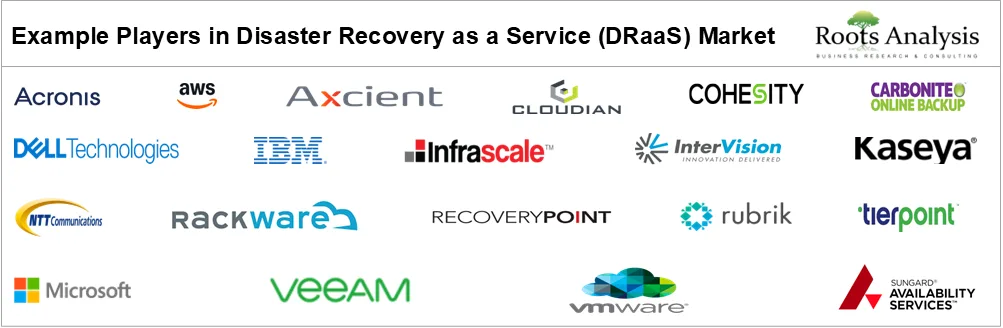
Some notable examples of the leading industrial players who are driving the disaster recovery as a service market growth include Acronis International, Amazon Web Services, Cloudian, Cohesity, Dell Technologies, IBM, Infrascale, InterVision Systems, Kaseya, Microsoft, RackWare, Recovery Point Systems, Rubrik, Sungard Availability Services, TierPoint, and VMware.
To leverage the competitive edge, these industrial players are encouraging technology innovation, investments, services expansion, partnerships, and collaborations. For instance, in June 2025, Harbor Solutions announced its strtageic expansion of its cyber recovery services into Australia and New Zealand in partnership with Rubrik. As market players continue to proliferate in the market, we believe that the market will remain competitive.
What are the Latest Technology Trends and Feature Enhancements in DRaaS?
- Integration of AI-Powered and Automated Recovery Orchestration: The future focus will be on the integration of artificial intelligence for automation in DRaaS solutions for rapid failover recovery. Notably, the integration of AI-powered algorithm and machine learning can improve operational resilience and streamline the recovery process. It also enable smarter event detection, predictive analytics, and automated failover, which ensure faster data recovery.
- Enhancement of Multi-cloud and Hybrid Cloud Resilience: Business organizations are running a mission-critical multi-cloud / hybrid workloads. These multi-cloud / hybrid workloads demands advanced DRaaS platforms to create cloud-agnostic disaster recovery strategies and eliminate the need for vendor lock-in and reducing single point of failure.
What are the Future Opportunities in Disaster Recovery as a Service Industry?
- DRaaS Deployment in Small and Medium-sized Enterprises (SMEs): In order to make DRaaS accessible to small and med-sized businesses, the disaster recovery service providers are greatly focused on the subscription-based models to make this technology more affordable. The aim is enhancing accessibility of DRaaS to SMEs, which further increases demand for disaster recovery beyond large enterprises.
- Specialized Industry Solutions and Compliance-driven Offerings: The disaster recovery planning market players will focus on tailored DRaaS services for various regulated industrial sectors, such as healthcare, government, finance, and utilities. This helps to meet with specific audit, legal and uptime requirements for data security and recovery.

Disaster Recovery as a Service Market: Scope of the Report
| Key Report Attributes | Details |
| Forecast Period | Till 2035 |
| Market Size 2026 | $ 20.28 Billion |
| Market Size 2035 | $ 111.42 Billion |
| CAGR (2026-2035) | 20.84% |
| Segments Covered |
|
Your Business is Unique – Why Shouldn’t Your Report Be?
Market Segments
Based on research, we have segmented the Disaster Recovery as a Service Market, 2025-2035 into type of service, type of service component, type of deployment, enterprise size, end user, geographical regions, and key players.
By Type of Service
- Self-Service DRaaS
- Assisted DRaaS
- Managed DRaaS
By Type of Service Component
- Data Protection Services
- Real-Time Replication Services
- Recovery & Backup Services
- Professional Services
By Type of Deployment
- Hybrid Cloud
- Private Cloud
- Public Cloud
By Enterprise Size
- Large Enterprises
- Small and Medium Enterprises
By End User
- BFSI
- Government
- Healthcare
- IT & Telecommunication
- Retail & Consumer Goods
- Others
By Geographical Regions
- North America
- US
- Canada
- Mexico
- Rest of North America
- Europe
- Austria
- Belgium
- Denmark
- France
- Germany
- Ireland
- Italy
- Netherlands
- Norway
- Russia
- Spain
- Sweden
- Switzerland
- UK
- Rest of Europe
- Asia-Pacific
- Australia
- China
- India
- Japan
- New-Zealand
- Singapore
- South Korea
- Rest of Asia-Pacific
- Latin America
- Brazil
- Chile
- Colombia
- Venezuela
- Rest of Latin America
- Middle East and Africa (MEA)
- Egypt
- Iran
- Iraq
- Israel
- Kuwait
- Saudi Arabia
- UAE
- Rest of MEA


