
Lowest Price Guaranteed
Slides
196
Last Updated
September 2025
View Count
14772
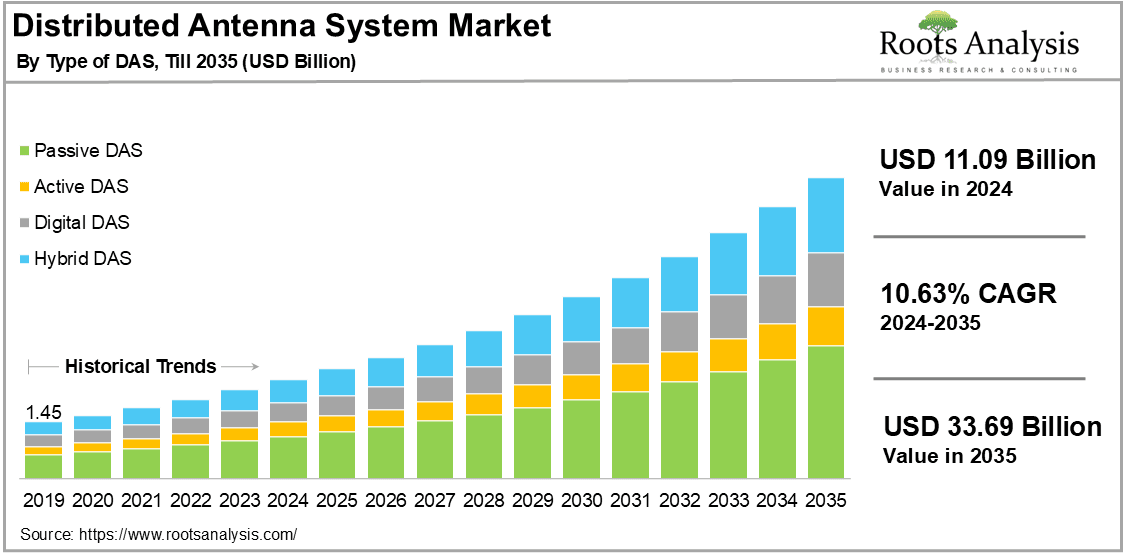
The distributed antenna system market size is projected to grow from 11.09 billion in 2024 to 33.69 billion by 2035, representing a CAGR of 10.63%, during the forecast period 2024-2035.
To learn more about this report, request a free sample copy
The new research study consists of industry trends, detailed market analysis, key market trends of distributed antenna system market, SWOT analysis, and value chain analysis.
Distributed Antenna Systems (DAS) are rapidly becoming the go-to solution for reliable, high-performance wireless coverage in large indoor and outdoor spaces. A DAS distributed antenna system is a network of spatially separated antenna nodes connected to a typical source via a transport medium that provides wireless service within a regional area or structure. In this DAS system, the digital signal gets transformed into radio frequency (RF) and radio frequency to digital with the help of an antenna to provide the cellular signal. Generally, this system is deployed either indoors or outdoors with compact nodes installation. In addition, the system is deployed to provide efficient network coverage and capacity in buildings and locations that have low network connectivity but are subject to high demand for wireless network services, such as stadiums, auditoriums, and concert halls.
Furthermore, as the demand for seamless connectivity continues to soar, the DAS antenna system market is expected to witness sustainable growth. Driven by the rising use of smartphones and data on several devices combined with other significant factors make it an increasingly attractive option for businesses and infrastructure providers. Along with this, continuous rising need for robust cellular and Wi-Fi coverage in places like stadiums and airports where DAS technology can offer reliable, ubiquitous connectivity, is likely to support the market growth. With regard to this, the RF venue DISTRO9 is revolutionizing the DAS antenna system by providing superior RF signal distribution for enhanced wireless coverage in large venues.
The rise of 5G technology is a significant stimulant for the DAS market, as the demand for high-bandwidth, low-latency wireless services continue to surge. DAS systems are uniquely equipped to handle the increased capacity and coverage requirements of 5G networks which makes them an important component of the next-generation wireless infrastructure. Consequently, the rising demand for enhanced network coverage, and the high adoption of cloud-based technology with advanced 5G technology, IoT, and increasing smart cities projects are anticipated to accelerate the market growth during this distributed antenna systems (DAS) market forecast 2024-2035.
The market report presents an in-depth analysis of the various manufacturers / service providers that are involved in offering distributed antenna system market across different segments, as defined in the table below:
| Key Report Attributes | Details | |
| Historical Trend | 2019-2023 | |
| Base Year | 2023 | |
| Forecast Period | 2024-2035 | |
| Market Size 2024 | $ 11.09 Billion | |
| Market Size 2035 | $ 33.69 Billion | |
| Growth Rate | CAGR 10.63% from 2024 to 2035 | |
| Type of Offering |
|
|
| Type of DAS |
|
|
| Type of Coverage |
|
|
| Type of Ownership Model |
|
|
| Type of By User Facility Area |
|
|
| Type of Vertical |
|
|
| Type of Frequency Protocol |
|
|
| Type of Network |
|
|
| Type of Signal Source |
|
|
| Type of End-User |
|
|
| Geographical Regions |
|
|
| Leading Market Players |
|
|
| PowerPoint Presentation (Complimentary) |
Available | |
| Customization Scope | 15% Free Customization | |
| Excel Data Packs (Complimentary) |
|
|
The globally distributed antenna system market is segmented into two types of offerings such as components / hardware (antenna nodes / radio nodes, bi-directional amplifiers, donor antenna, head-end units, radio units) and service (antenna nodes / radio nodes, installation services, pre-sales services, post-installation services. In terms of revenue, the component or hardware segment holds the major market share and is poised to be a leading segment till 2035. Hardware / components form the backbone of the system that ensures signal distribution and coverage, thereby dominating the segment and driving market growth. In addition, components, such as DAS antennas, remote radio units (RRUs), head-end units, and cables are essential for the functioning of DAS. Further, widespread demand for DAS systems in diverse applications, such as commercial buildings, public safety, healthcare, and transportation, ensures a consistent requirement for hardware components, boosting the growth of the market. The service offering is anticipated to register a significant CAGR in the coming years owing to the sophisticated system of distributed antenna that requires specialized services for design, installation, and integration. These services ensure that systems are correctly configured and optimized for performance, which will likely drive the market demand.
Based on the type of DAS technology, the distributed antenna system industry is bifurcated into active DAS, digital DAS, hybrid DAS, and passive DAS. Hybrid DAS is the leading segment that captures the maximum market share. This can be attributed to the combination of active and passive DAS, which creates more flexible and efficient wireless coverage solutions. The use of both active components, including amplifiers and passive components, such as coaxial cables, and splitters, optimize the signal distribution and coverage which fosters the growth of the market. However, with the growing penetration of 5G technology, the digital DAS antenna type is likely to grow at a faster CAGR over this forecast due to its innovative features of high performance, support for emerging technology, and long-term cost-effectiveness. Consequently, as the demand for reliable wireless coverage continues to rise, digital antenna systems will propel the growth market throughout the projection period.
This segment describes different types of coverage of the distributed antenna system market which include indoor and outdoor. DAS for indoor coverage holds the highest market share and is expected to lead the segment from 2024 to 2035. This dominance can be accredited to the growing need for enhanced in-building coverage owing to the augmenting use of mobile devices indoors, offices, hospitals, stadiums, shopping malls, and residential buildings which require reliable and strong network connectivity. In this context, the RF venue DISTRO9 is a game-changer in the DAS market that offers unparalleled signal distribution and reliability for large-scale venues. Thus, businesses and commercial establishments prioritize uninterrupted and strong indoor connectivity to enhance productivity and customer experience. These factors are driving the investment in indoor DAS antenna which is anticipated to push the segment with a higher CARG in the coming decade.
This segment underscores the type of ownership model in the global market for distributed antenna systems, such as carrier ownership, enterprise ownership, and neutral-host ownership. According to our projection, the neutral-host ownership model acquires the major share of the market, leading the segment. The feature of neutral-host DAS in sharing multiple wireless carriers to the same infrastructure makes it more cost-efficient for carriers, which ensures better service for end-users. Also, this multi-carrier mainly benefits large venues and commercial buildings. As a result, of its broader applicability and efficiency in multi-carrier environments, the segment is projected to grow at a substantial CAGR during the period 2024-2035.
The distributed antenna systems market is split into multiple user facility areas which include >500 K SQ, FT, 200-500 K SQ. FT, and <200 K SQ. FT. In terms of market impact and revenue, >500 K SQ dominates the segment that captures the largest market share as they require more extensive and sophisticated DAS solutions to meet coverage and capacity demands. These demands for specific facility areas vary on different types of locations, industry focus, and regulatory requirements. However, the medium range of 200-500 K SQ user facility area is likely to witness its potential growth at a noteworthy CAGR over this forecast with advancements in DAS technology and soaring demands for reliable indoor connectivity across various sectors.
The distributed antenna systems (DAS) market is fragmented into two types of verticals; these include commercial and public safety. In terms of market revenue, the commercial vertical is poised to be the leading segment that will obtain the highest market share in the coming decade. Several factors drive the segment's growth. Firstly, in the commercial vertical, telecommunications operators and service providers play a vital role in the DAS market as they often deploy DAS to enhance network coverage and capacity in urban areas, large buildings, and venues where cellular traffic is high. Additionally, the public safety vertical is projected to experience a faster growth rate due to the inflating demand for robust network connection in various public venues, such as conference and convention centers, shopping malls, theaters, and fairgrounds, where patrons and employees expect a seamless mobile data experience.
Based on the type of frequency protocol, the global market for distributed antenna systems is split into cellular, VHF / UHF, and others. As per market research, cellular DAS is expected to capture the maximum share of the market which will likely contribute to its dominance. The expanding adoption of the 5G network by 4G LTE mobile network operators worldwide has driven the demand for the cellular DAS segment as these frequencies enable high-speed data transmission and support for voice calls, which makes them important for modern cellular communication. Moreover, VHF / UHF, very high and ultra-high frequency are majorly used for radio communications, broadcasting, and public safety applications which is estimated to accelerate the growth of this protocol at a notable CAGR over this projection time frame.
The global market for distributed antenna systems features various types of networks, including public networks and private LTE / CBRS. According to our research, the public network leads the segment, holding the majority of the DAS market shares. Public cellular networks are typically operated by mobile network operators which provide extensive area coverage and accessibility to consumers, businesses, and government entities through commercial service plans. Furthermore, private LTE / CBRS is gaining traction with growing needs for enhanced security, control, and customization across various sectors, including industrial IoT and private enterprise networks which will drive the market growth at a higher CAGR.
This segment explains the different types of signal sources of the distributed antenna systems market namely, off-air antennas (repeaters), on-site base transceiver stations (BTS), and small cells). The off-air antennas are poised to acquire the major market share and will dominate the market segment in terms of revenue. Due to their cost-effectiveness, simplicity of integration, scalability across multiple carriers, and ability to leverage existing outdoor cellular networks, the off-air signal sources contribute to uplifting the growth of the market. They provide efficient indoor coverage solutions that meet the diverse connectivity needs of enterprises, public venues, and residential buildings. In addition, the increasing popularity of cord-cutting and streaming services has increased over-the-air TV reception which is contributing to raising the demand for off-the-air antennas. This is expected to drive the market growth at an exceptional CAGR in the coming decade.
The global distributed antenna system market is categorized based on the end-user which includes manufacturing end-users, healthcare, government, transportation, sports & entertainment, telecommunications, and other end-users. As per market research, sports & entertainment captures the largest market share and is expected to lead the segment till 2035. The growth of the segment can be ascribed to the augmenting demand for seamless wireless connectivity from sports and entertainment enthusiasts in order to stay connected with their friends & family through the increased adoption of social media platforms, which require high-speed connectivity. In addition, majorly, DAS serves extensive infrastructure sites, such as sports complexes and stadiums where these systems ensure consistent wireless coverage and allow emergency responders to retain communication throughout the crisis, particularly in densely populated areas. However, transportation will experience a substantial growth rate during this forecast period.
This segment highlights the distribution of the distributed antenna system market across various geographical regions, such as North America, Europe, Asia Pacific, Latin America, Middle East and North America, and the rest of the world. In terms of revenue, North America has been at the forefront of the global market for distributed antenna systems capturing the maximum market share. This dominance is primarily driven by the higher technological innovation and adoption of advanced wireless technology like 4 LTE and 5G which uplift the demand for improved indoor coverage solutions in the region. Moreover, in terms of exceeding demand, the Asia Pacific region is fueling the growth of the DAS market with a noteworthy CAGR in the region.
The “Distributed Antenna System (DAS) Market Till 2035: Distribution by Type of Offering (Component and Service), Type of DAS (Active DAS, Digital DAS, Hybrid DAS, Passive DAS), Type of Coverage (Indoor and Outdoor), Type of Ownership Model (Carrier Ownership, Enterprise Ownership, Neutral-host Ownership), Type of User Facility Area (>500 K SQ. FT, 200-500 K SQ. FT, <200 K SQ. FT), Type of Vertical (Commercial and Public Safety), Type of Frequency Protocol (Cellular, VHF / UHF, Others), Type of Network (Public Network and Private LTE/CBRS), Type of Signal Source (Off-Air Antennas (repeaters), On-Site Base Transceiver Station (BTS), and Small Cell), Type of End User (Manufacturing, Healthcare, Government, Transportation, Sports and Entertainment, Telecommunications, Other End-Users), and Geographical Regions (North America, Europe, Asia, Latin America and Middle East and North Africa and Rest of the World): Industry Trends and Global Forecasts” report features an extensive study of the current market landscape, market size and future opportunity within the distributed antenna system market during the given forecast period. The market report highlights the efforts of several stakeholders involved in this rapidly emerging segment of the service providers industry. Key takeaways of the distributed antenna system market report are briefly discussed below.
The market for distributed antenna systems is projected to evolve exponentially with continuous advancements and emerging trends such as the integration of 5G technology and neutral-host DAS. With the widespread 5G network, there is a surge in demand for DAS that supports 5G frequencies, including millimeter-wave bands. The advantages of this integration include high-speed data, low latency, and improved capacity in indoor environments, generating new opportunities for digital DAS. Therefore, DAS solutions are being designed to support multiple operators and multiple frequency bands, such as 4G LTE and 5G, within a single system. Besides, DAS allows multiple mobile network operators (MNOs) to share the same DAS infrastructure by reducing costs and simplifying deployment. As a result, this trend is particularly beneficial in venues with multiple carriers and high user density.
The competitive landscape of the DAS market features several multinational corporations, specialized DAS providers, telecommunications service providers, system integrators, and installers. With the presence of these firms, the distributed antenna system market is highly competitive. Thus, to stay ahead of the competition, companies employ various strategies like continuous R&D efforts for innovative technology, high product quality, and strategic partnerships. Additionally, they focus on mergers and acquisitions, as larger players seek to enhance their capabilities and expand their market presence. For instance, in January 2024, AFL, a global fiber optic cable manufacturer and service provider, acquired Forza Telecom (DGP), (a turnkey service and solutions provider in Walnut Creek, CA.) This acquisition enhances AFL's solutions portfolio with advanced indoor and outdoor distributed antenna systems capabilities.
The distributed antenna systems market growth is majorly driven by the exponential rise in mobile data traffic due to the proliferation of smartphones, tablets, and other connected devices necessitates the deployment of DAS to ensure reliable and high-capacity wireless coverage indoors. Along with this, increasing demand for building coverage and indoor connectivity coupled with the expansion of the 5G network and IoT integration are attributed to fostering the growth of the DAS market in the coming decade.
As per previous years' statistics, North America has been a prominent leader with the largest market share and is poised to continue to dominate the distributed antenna system market in the global marketplace. Numerous factors contribute to its leading position. Firstly, the highest penetration of mobile and data consumption with extensive demand for high-speed connectivity has boosted the rising need for enhanced indoor wireless coverage in North America. Secondly, large-scale venues like convention centers, airports, and stadiums have spiked in the requirement for strong distributed antenna systems to ensure seamless connectivity for a greater number of users. In addition, a supportive regulatory environment and high investment in 5G and IoT technology expand the ample growth of the market. Furthermore, Asia Pacific is one of the fastest emerging economies which is accelerating the growth of the DAS market. Further, owing to its speedy infrastructure development, including airports, public transportation, and skyscrapers that require strong indoor wireless connectivity is escalating the market demand. Also, rapid urbanization and the largest number of mobile users are projected to augment the market demand at an outstanding growth rate in the region.
Examples of key service providers involved in the distributed Antenna System Market (which have also been captured in this market report, arranged in alphabetical order) include American Tower, AT&T, Bird Technologies, Boingo Wireless, BTI Wireless, Comba Telecom Systems, Commscope, Corning, Dali Wireless, JMA Wireless, PBE Axell, Solid Technologies, Westell Technologies, Whoop Wireless, Zinwave. This market report includes an easily searchable Excel database of companies who are engaged in distributed antenna system market.
The market report presents an in-depth analysis, highlighting the capabilities of various companies engaged in this domain, across different segments. Amongst other elements, the market report includes: