


 Download Free Sample
 Buy Now
Market Size
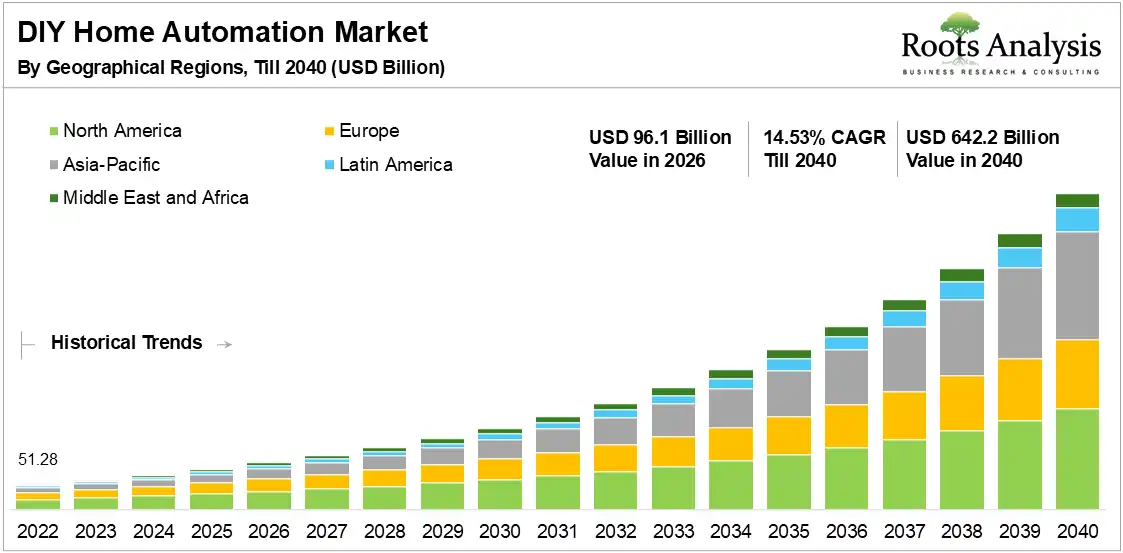
The global DIY home automation market is projected to reach USD 96.1 billion in 2026 and USD 642.2 billion by 2040, representing a CAGR of 14.53% during the forecast period 2026 to 2040.
See What’s in the Full Report – Request Your Complimentary Insights!
Market Report: Key Takeaways
- Leading Players Competitive Footprint: Top market players includes technology giants, such as Google, Apple, Amazon, Honeywell, and Samsung. These players are highly focused on AI interoperability and sustainable tech to make sophisticated home automation simple, and accessible for everyday self-upgraders.
- Innovation Hotspots: The prime innovation hotspots are energy-autonomous sensor commercialization, 5G integration into residential IoT, and generative AI personalization capabilities.
- Regional Insights: While North America leads the market, Asia-Pacific is likely to show robust growth during the upcoming years, due to rapid urbanization, increasing smart devices adoptions, and rising disposable income.
- Market Growth Across Connectivity Type: Wireless currently secure the highest share due to ease of installation, easy scalability, and low initial cost.
Market Overview
The DIY home automation market has evolved from a niche sector early-adopter offerings to widely accessible consumer solutions emphasizing targeted functionality over general convenience. Current growth is defined by a shift from high-cost, professional installations toward modular, interoperable systems that prioritize security and energy over general convenience..
This transition has broadened adoption across smart security, lighting, and energy management applications, moving beyond basic voice control to solutions that address concrete household needs. These changing industry dynamics reflect growing consumer expectations for seamless integration and practical utility in everyday home management.
Furthermore, the rising energy costs and standardized protocols like “Matter 1.5 Protocol” have strengthened interoperability, eased adoption trends, and reduced friction for consumers integrating multiple devices. Adjacent industries further shape the ecosystem; utility providers, for example, now offer rebates and bundled smart home packages.
A significant growth catalyst is the cross-sector collaboration between utility providers and hardware manufacturers to deploy smart home energy management systems (SHEMS). By integrating residential units into broader grid-efficiency initiatives, these partnerships, such as the 2025-2026 Schneider Electric and Tata Power infrastructure rollout, demonstrate how strategic alliances can convert standalone devices into essential components of the energy transition. Looking ahead, the market is poised to expand through AI-driven automation and ambient assisted living (AAL) technologies that support aging populations.
Pay Only for What You Need – The Best Way to Optimize
DIY Home Automation Market Size Estimation Methodology
- As a starting point, we defined the market scope for DIY home automation by segmenting key product categories, including security and monitoring, smart lighting, smart thermostats, and smart speakers, while distinguishing between professionally installed systems and consumer-installed products.
- Then we applied a hybrid forecasting approach, combining bottom-up estimates based on product-level adoption with top-down validation using household penetration rates and macroeconomic indicators.
- Thereafter, we performed demand-side analysis to identify consumer adoption trends across demographics and regions, considering factors such as disposable income, internet access, and housing trends like new construction versus retrofits.
- We calculated market size from the bottom up, using total installed base and annual unit shipments for each product segment, factoring in average selling price (ASP) and device replacement cycles.
- Future projections were developed using a technology adoption curve (S-curve), applying different penetration rates across regions based on economic development and technology readiness.
- Forecasts incorporated the influence of key technological drivers, including IoT standard adoption for interoperability, AI advancements for home management, and ongoing cost reductions in sensor technology.
Market Share Insights
Market Share by Application Area: Lighting Control Holds the Highest Share
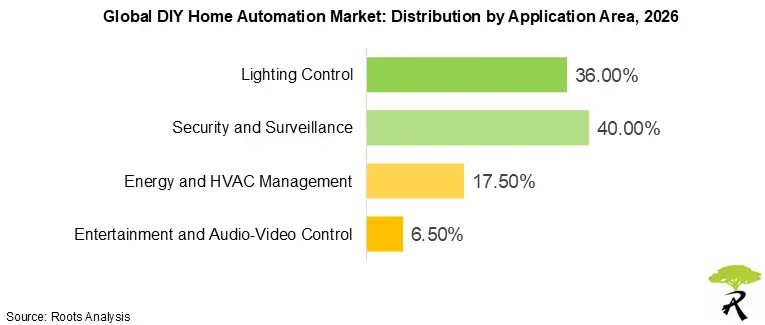
Lighting Control holds the largest DIY home automation market share at 26.0% in 2026. This sub-segment is maintaining its leadership due to its foundational role in DIY home automation adoption. Moreover, its widespread appeal stems from energy-efficient, modular LED systems that are easy to install and integrate with apps and voice controls, making lighting a primary entry point for new smart home users.
Recent innovations, including circadian rhythm–aligned settings, motion-triggered automation, and energy management integration, have strengthened adoption and user engagement, ensuring sustained market dominance.
Conversely, Energy and HVAC Management emerges as the fastest-growing segment with an 18.0% CAGR. This unprecedented growth is likely to be the result of rising demand for sustainable, cost-efficient climate control solutions.
AI-powered smart thermostats, predictive energy optimization, regulatory incentives, and growing consumer focus on carbon reduction accelerated adoption, particularly in regions with extreme weather patterns. These reasons collectively positioning this segment for rapid expansion and significant long-term impact on smart home ecosystems.
Market Share by Geographical Regions: North America Secure the Highest Share
Based on DIY smart home market forecast, North America holds the largest market share in 2026 at 40%. This highest share is driven by widespread consumer technology adoption, robust broadband infrastructure, and a strong culture of self-install smart devices.
High household penetration across security, lighting, and energy management categories reflects both early awareness and the availability of interoperable ecosystems, reinforcing the region’s dominant position. This leadership is also supported by extensive unit shipments and mature retail channels across the US. and Canada.
Asia Pacific region is expected to grow rapidly with a CAGR of 17.0%. This growth is due to the rapid urbanization, rising disposable incomes, and falling component costs that lower barriers to smart home adoption.
Moreover, consumers in China, India, Japan, and South Korea increasingly demand connected convenience and energy efficiency, supported by local manufacturing scale and a growing middle class. Together, these trends highlight strong adoption momentum, favorable competitive dynamics, and a robust growth outlook for both leading and fastest-growing regions.
Want Information on Specific Region / Segment?
Market Ecosystem Insights
Top 10 Market Leaders Shaping the Future of DIY Home Automation Industry
DIY smart home competitive landscape is dominated by tech giants and agile specialists who have moved away from complex, hardwired legacy systems toward modular and wireless solutions. These solutions will cater to the "convenience-first" persona, renters and homeowners looking for immediate utility without professional labor costs.
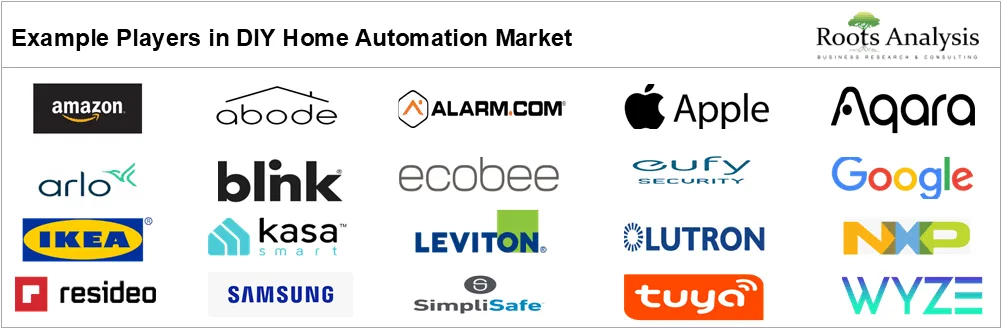
Top companies like Amazon, Apple, Google, Ring, Signify (Philips Hue), Abode Systems, Lutron, Silicon Labs, Leviton, and SimpliSafe are undertaking initiatives to launch new products and expand their product portfolio to meet the growing requirement of smart home solutions.
For instance, in October 2025, Amazon launched AI-enhanced Echo smart home lineup engineered for the future of AI.
Top 5 Startups Driving Innovation in DIY Home Automation Market
The DIY home automation startup landscape is among the most active in the broader smart home industry, characterized by focused niche innovation and agile product development. It is worth mentioning increasing ability to attract institutional capital as the market's addressable scale becomes undeniable.
Startups are not merely filling gaps left by incumbent giants, they are actively reshaping categories and forcing established players to respond with acquisitions and competitive product updates.
For instance, Schneider Electric & Freyr Energy entered into the partnership to integrate home automation with rooftop solar systems, allowing for real-time energy optimization through a single app.
Top DIY Home Automation Market Trends
- Advanced AI Integration for Proactive Automation: Moving beyond simple "if this, then that" automation scripts, AI integration can create truly intelligent home environments that predict user needs based on learned patterns and environmental data. This transition from reactive scheduling to proactive optimization offers a premium value proposition, enabling new subscription services (SaaS model) for advanced energy management and personalized comfort.
- Modular and Scalable Product Bundles: Manufacturers can capture a larger share of the market by offering pre-configured, scalable bundles tailored to specific use cases (e.g., "new apartment security bundle" or "energy savings starter pack"). This approach simplifies the purchasing decision for non-expert users, reducing choice paralysis and increasing conversion rates for whole-home solutions.
Have Questions? Let’s Get Them Answered.
Market Access Considerations
Ecosystem Interoperability and Standardization
Market access in DIY home automation depends on seamless integration with leading smart home ecosystems like Amazon Alexa, Google Home, and Apple HomeKit. Fragmented platforms create barriers for new entrants, requiring costly multi-platform development and certification. Unified standards such as “Matter 1.5 Protocol” are easing integration challenges, lowering entry barriers, and shifting competition toward features and pricing rather than ecosystem compatibility.
Consumer hesitation remains due to potential vendor lock-in and product obsolescence. Simplified interoperability encourages adoption but also intensifies competitive pressure as more players can enter without ecosystem-specific advantages.
Data Security, Privacy, and Trust
Concerns over data security and privacy especially for cameras, microphones, and data collection, pose major market access challenges. Compliance with regulations like GDPR and CCPA raises costs and limits entry for smaller players.
Consumer trust is essential, particularly for devices impacting safety or health. Success hinges on transparent data policies and robust security certifications, as breaches or negative publicity can quickly erode market share and damage brand reputation.
Distribution Channel Control and Platform Gatekeepers
Ecosystem owners such as Amazon, Google, and Apple dominate key distribution channels. New entrants face gatekeeper-controlled visibility, platform certification requirements, and private-label competition that shape market success.
Dependency on these gatekeepers increases marketing costs, enforces platform-specific pricing, and often favors integrated solutions. Scaling direct-to-consumer models without strong brand recognition remains challenging.
Cost-Value Proposition and Pricing Strategy
High upfront costs for comprehensive home automation systems limit adoption beyond early adopters. Consumers struggle to justify premiums over standard appliances, especially when benefits are incremental.
Manufacturers often use low-margin entry products, like smart speakers or single light bulbs, to attract users into broader ecosystems. Competitive pressure, particularly in commodity segments like smart plugs, drives price wars, compressing margins and necessitating clear ROI-driven differentiation.
Installation Complexity and Technical Skill Barrier
DIY products must be easy to install and configure; complex setups lead to higher support costs, returns, and negative reviews. Market access favors solutions with superior out-of-box experiences, simplified interfaces, and QR code-based pairing.
Advanced systems often require professional installation, limiting the pure DIY segment. Adoption plateaus when setup complexity exceeds user comfort, emphasizing the need for intuitive design to scale effectively.
How Stakeholders Benefit from the Key Focus Areas of Our DIY Home Automation Market Research Report
The DIY home automation market is experiencing rapid growth driven by rising consumer demand for smart, connected homes and cost-effective solutions. This report equips stakeholders with actionable insights to identify market opportunities, assess competitive dynamics, and make informed investment and strategic decisions. By highlighting adoption trends, technology innovations, and market gaps, the study supports successful commercialization, expansion, and partnership initiatives.
- Unmet Needs and Market Gaps in DIY Home Automation Market: The report identifies critical unmet needs, such as simplified integration, affordability, and interoperability challenges, revealing areas where demand outpaces current offerings. Strategy and product leaders can leverage these insights to design solutions that address gaps and capture emerging segments. Investors gain visibility into high-potential opportunities where market demand is under-served, enabling more precise allocation of capital.
- Funding and Investment Landscape in DIY Home Automation Market: This section analyses funding trends, venture activity, and investment flows across startups and established players. Financial stakeholders benefit from understanding where capital is concentrated and which segments show high scalability. The insights inform investment decisions, risk assessment, and strategic funding allocation for both new entrants and existing market participants.
- Player Landscape and Competitive Dynamics in DIY Home Automation Market: The report provides a detailed overview of key players, their market positioning, and competitive strategies. Strategy and corporate development teams can benchmark performance, identify competitive advantages, and anticipate market moves. Investors and business leaders can assess partnership or acquisition opportunities based on the competitive intensity and segment leadership.
- Technology Innovation and Adoption Trends in DIY Home Automation Market: Emerging technologies, such as AI-enabled devices, voice control, and IoT integration, are highlighted along with adoption rates across regions. Product and technology leaders benefit by aligning development roadmaps with proven innovation trends. Understanding adoption patterns allows stakeholders to prioritize commercialization initiatives and capture early-mover advantages.
- Partnerships and Collaboration Trends: The report outlines key alliances, joint ventures, and ecosystem collaborations shaping market growth. Business development teams gain insights into potential strategic partners and collaboration models. These insights guide partnership decisions that can accelerate market entry, expand distribution networks, and enhance technology integration.
- Market Segmentation and Geographic Coverage: Comprehensive analysis of segments by product type, application, and region highlights where demand is concentrated and growth is fastest. Strategy and expansion teams can target high-potential segments and geographies for market entry or portfolio expansion. Investors can use these insights to identify regions with the strongest growth outlook and scalable opportunities.
DIV Home Automation Market: Scope of the Report
| Key Report Attributes | Details | |
| Historical Trend | Since 2022 | |
| Forecast Period | Till 2040 | |
| Market Size 2026 | $ 96.1 Billion | |
| Market Size 2040 | $ 642.2 Billion | |
| CAGR (Till 2040) | 14.53% | |
| Segments Covered |
|
|
| Geographical Regions Covered |
|
|
| Key Sections Covered |
|
|
Market Segmentation
Based on the research, we have segmented the DIY home automation market into type of product, type of connectivity, application area, distribution channel, geographical regions, and key players.
Market Share by Type of Product
- Smart Lighting
- Smart Security and Surveillance Systems
- Smart Thermostats and HVAC Controls
- Smart Plugs and Switches
- Smart Speakers and Displays
- Smart Locks
- Doorbell Cameras
Market Share by Type of Connectivity
- Wired
- Wireless
- Wi-Fi
- Zigbee
- Z-Wave
- Bluetooth
- Thread / Matter
Market Share by Application Area
- Lighting Control
- Security and Surveillance
- Energy and HVAC Management
- Entertainment and Audio-Video Control
Market Share by Distribution Channel
- Online Retail
- Offline Retail
Market Share by Geographical Regions
- North America
- US
- Canada
- Mexico
- Rest of North America
- Europe
- Austria
- Belgium
- Denmark
- France
- Germany
- Ireland
- Italy
- Netherlands
- Norway
- Russia
- Spain
- Sweden
- Switzerland
- UK
- Rest of Europe
- Asia-Pacific
- Australia
- China
- India
- Japan
- New Zealand
- Singapore
- South Korea
- Rest of Asia-Pacific
- Latin America
- Brazil
- Chile
- Colombia
- Venezuela
- Rest of Latin America
- Middle East and Africa (MEA)
- Egypt
- Iran
- Iraq
- Israel
- Kuwait
- Saudi Arabia
- UAE
- Rest of MEA


