
Lowest Price Guaranteed
Slides
194
Last Updated
April 2025
View Count
11276
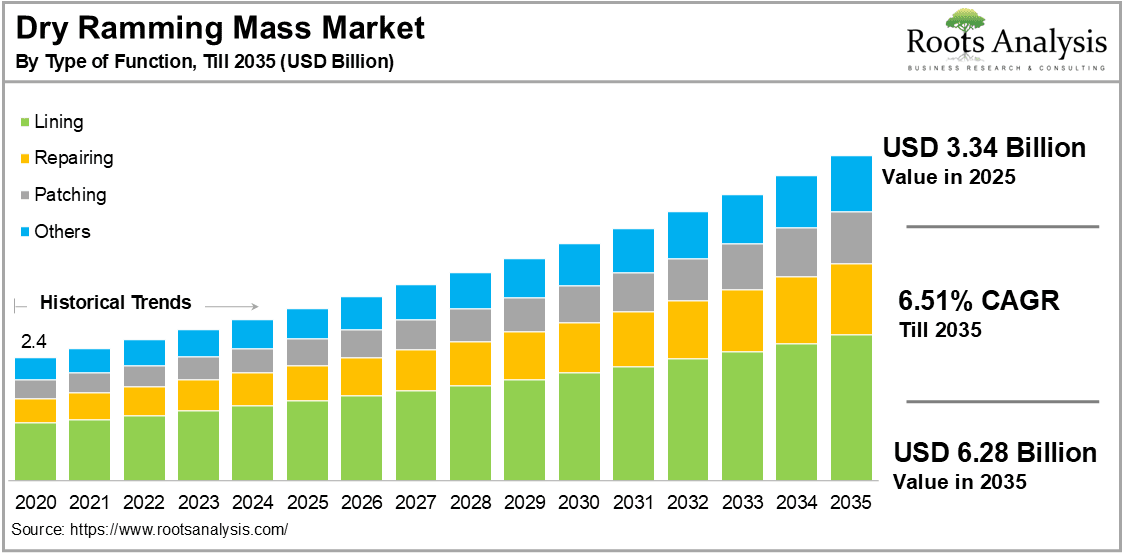
According to the global dry ramming mass market size and forecast, the market is projected to grow from USD 3.34 billion in 2025 to USD 6.28 billion by 2035, representing a CAGR of 6.51%, during the forecast period 2025-2035.
 |
To learn more about this report, request a free sample copy
The new research study consists of global dry ramming mass market analysis, detailed dry ramming mass market analysis, mega trends, patent analysis, porter five forces, SWOT analysis, value chain analysis and other strategic frameworks.
Dry ramming mass is a refractory material used in the construction and repair of furnaces and other high-temperature processing equipment. It is a dry, granular mixture composed of refractory aggregates, powders, and bonding agents. The term ramming refers to the method of installation, where the dry mix is manually or mechanically compacted (rammed) into place within the furnace lining or mold. Dry ramming mass is designed to withstand extreme temperatures and harsh conditions, providing thermal insulation and resistance to chemical and mechanical wear.
The dry ramming mass market is experiencing rapid growth due to several key factors. One of the main drivers of growth is the increasing demand for refractory materials in various industrial applications. Refractory materials are essential for lining furnaces, ladles, and other industrial vessels that operate at high temperatures. Another factor driving the market growth is the growing demand for energy-efficient refractory materials. As industries strive to reduce their energy consumption and associated costs, they are increasingly turning to dry ramming mass, which offers superior thermal conductivity and insulation properties.
The dry ramming mass market report presents an in-depth analysis of the various companies that are involved in offering dry ramming mass solutions, across different segments, as defined in the table below:
| Key Report Attributes | Details | |
| Historical Trend | Since 2020 | |
| Forecast Period | 2025-2035 | |
| Market Size Value in 2025 | $ 3.34 Billion | |
| Market Size Value by 2035 | $ 6.28 Billion | |
| CAGR (Till 2035) | 6.51% | |
| Type of Ramming Mass |
|
|
| Type of Function |
|
|
| Areas of Application |
|
|
| Type of Enterprises |
|
|
| Geographical Regions |
|
|
| Leading Market Players |
|
|
| PowerPoint Presentation (Complimentary) |
Available | |
| Customization Scope | 15% Free Customization | |
| Excel Data Packs (Complimentary) |
|
|
Based on the dry ramming mass types, the global dry ramming mass market is split into alumina ramming mass, chromite based ramming mass, magnesia based ramming mass, silica based ramming mass, zirconia based ramming mass and others. According to the dry ramming mass market forecast, the alumina ramming mass market growth is expected to be the maximum, capturing a market share of 58.4% by 2035. This can be attributed to its exceptional properties and versatility. Alumina-based formulations offer high refractoriness, thermal shock resistance, and chemical stability, making them ideal for lining various types of furnaces, including steel-making furnaces.
On the other hand, the silica based ramming mass segment is expected to witness the fastest CAGR of around 7.48% during the forecasted period. This growth can be attributed to its superior thermal conductivity, excellent corrosion resistance, and cost-effectiveness. It is widely used in induction furnaces for steel production and other high-temperature applications. Furthermore, the growing silica ramming mass demand is fueled by advancements in steel-making technologies, increasing infrastructure development, and the expansion of industries.
Based on the types of functions, the global dry ramming mass market is split into lining, patching, repairing and others. According to the dry ramming mass market forecast, the lining segment growth is expected to be the maximum, capturing a market share of 67.4% by 2035. This dominance is largely attributed to the fundamental role lining function plays in furnace maintenance and performance optimization. Dry ramming mass is primarily used in lining furnaces in various industries, such as steel, non-ferrous metals, and cement production. Its ability to withstand high temperatures, thermal shock, and chemical erosion ensures the longevity and efficiency of furnace operations. Consequently, this increases the demand for dry ramming mass for lining functions which further propels the market.
Furthermore, the repairing segment is expected to witness the fastest CAGR of around 8.8% during the forecasted period. As there is a regular wear and tear in the industrial furnaces during the operations, the need for frequent maintenance and repair becomes crucial to ensure optimal functioning of the furnace. Dry ramming mass is extensively used for repairing furnace linings, offering high temperature resistance and durability. The increasing emphasis on furnace maintenance and efficiency drives the growth of the repairing function segment in the dry ramming mass market.
Based on dry ramming mass applications, the global dry ramming mass market is split into blast furnace, electric arc furnace, foundries, non-steel and others. According to the dry ramming mass market forecast, the foundries segment growth is expected to be the maximum, capturing a market share of 67.4% by 2035. This dominance is largely attributed to the extensive use of dry ramming mass in foundry operations. Dry ramming mass is essential for lining induction furnaces and other foundry equipment used in metal casting processes. Its ability to withstand high temperatures, thermal shock, and mechanical stress makes it indispensable for maintaining furnace integrity and optimizing metal casting operations.
Furthermore, the blast furnace segment is expected to witness the fastest CAGR of around 8.85% during the forecasted period. This growth is driven by the essential use of blast furnaces in producing iron and steel, and the increasing demand for these metals across various industries. Dry ramming mass is crucial for lining blast furnaces, offering high temperature resistance and durability. Furthermore, advancements in blast furnace technology and increasing investments in steel production infrastructure also contribute to the rapid growth of this segment.
The global dry ramming mass market is fragmented into multiple types of enterprise namely large and small and medium enterprise. Currently, the large enterprise segment is anticipated to dominate the segment with 73.87% of the dry ramming mass market share. However, small and medium enterprise segments are expected to witness a relatively higher (9.28%) global dry ramming mass market growth rate until 2035. This is ascribable to their agility, innovation, focus on niche markets, and ability to adapt to changing customer preferences and market conditions.
This segment highlights the distribution of market share of dry ramming mass by region, such as North America, Europe, Asia, Latin America, Middle East and North Africa, and the rest of the world. According to our regional analysis of dry ramming mass markets, Asia currently exhibits dominance with 37.69% of the overall market share. This growth is owed to robust industrialization, particularly in the steel and metal industries. Rising infrastructure projects, rapid urbanization, and increased manufacturing activities in countries like China and India contribute to the escalating demand for refractory materials.
The “Dry Ramming Mass Market, Till-2035: Industry Trends and Global Forecasts” report features an extensive study of the current market landscape, market size and future opportunity within the dry ramming mass market, during the given forecast period. The market report highlights the efforts of several stakeholders involved in this rapidly emerging segment of the service providers industry. Key takeaways of the dry ramming mass market report are briefly discussed below.
According to dry ramming mass industry trends, the market is expected to be driven by the ability of alumina ramming mass to provide excellent resistance against corrosion and endure elevated thermal loads. Alumina ramming mass, composed of high-quality alumina aggregates, refractory clay, and binders, is highly effective for lining induction furnaces. It offers exceptional resistance to corrosion and can withstand high thermal loads, making it ideal for the steel and iron industries. This material enhances the longevity and performance of furnace linings by providing superior erosion resistance at elevated temperatures.
The demand for dry ramming mass is driven by both steel and non-steel industries, which require durable refractory materials to maintain operational efficiency. As global needs for steel and related products rise due to construction and infrastructure projects, the market for dry ramming mass is expected to grow. Manufacturers are actively developing advanced formulations to cater to these industries' specific requirements, further propelling market expansion.
With the presence of several small and large dry ramming mass companies, the competitive landscape of the dry ramming mass market is experiencing intense competition and changing dry ramming mass market dynamics. From large multinational companies to local dry ramming mass players, companies are striving to enhance their competitive edge. In terms of market share, large enterprises and multinational companies are dominating the market. With the help of advancements in dry ramming mass solutions, small dry ramming mass market players are continuously improving their products to cater to niche markets, or they are offering specialized dry ramming mass solutions. These industry players are focusing on adopting competitive strategies, such as developing innovative dry ramming mass solution techniques, forming strategic alliances and partnerships to expand their portfolios and global footprint, investing in recent developments and new feature launches to enhance their products offerings.
The dry ramming mass market faces several challenges in the dry ramming mass market that hinder its growth and widespread adoption. A primary concern is the fluctuation of raw material prices, which can impact dry ramming mass production costs and profitability for manufacturers. Additionally, the increasing emphasis on sustainability necessitates the development of eco-friendly alternatives, posing a challenge for companies to innovate while maintaining performance standards. Competition from alternative refractory materials may also limit market growth, as technological advancements could lead to the adoption of substitutes. Furthermore, the complexity of manufacturing processes and the need for skilled labor can create operational hurdles. Lastly, demand fluctuations from the steel and non-ferrous metal industries, influenced by global economic conditions, contribute to uncertainty in market dynamics.
With respect to regional dry ramming mass industry insights, Asia is likely to dominate the market for the forecasted period. The dominance of this region is majorly driven by its robust and well-established steel industry which is a significant consumer of dry ramming mass for furnace linings applications. Additionally, ongoing infrastructure development projects and technological advancements in steel production further drive the demand for dry ramming mass. Moreover, stringent environmental regulations necessitate the use of high-quality refractory materials, contributing to the dominance of the region.
Examples leading companies in the dry ramming mass market (which have also been captured in this market report, arranged in alphabetical order) include Arora Refractories, ASK Chemicals, Calderys, Casco Specialty Products, Compagnie de Saint-Gobain, Dalmia Bharat Refractories, Dense Refractories, Foseco, Galaxy Enterprise, Gita Refractories, Harbison Walker International, Henan Changxing Refractory Material, Henan Xinmi Changxing Refractory Material, Hubei Sinosteel Refractory, Ibiden, Imperial World Trade, Imerys, LMM, Magnesita Refratários, Minteq International, Morgan Advanced Materials, Nihon Refractories, Nippon Steel & Sumitomo Metal, Nisso Seisakusho, Norican Global, Refcast, RHI Magnesita, Rongsheng Group, Resco Products, RSP, Saint-Gobain, Shenghe Refractories, Showa Denko, Shree B. S. Mining, Shri Vinayak Industries, Sino-Foundry Refractory (Jiangsu), Sumitomo Metal Industries, Tama Refractory, TMM India, Vesuvius, Vishva Vishal Refractory, Wonjin Worldwide, Zhenan Refractories, Zhengzhou Sijihuo Refractory, Zibo Long Keter New Materials.
The market report presents an in-depth analysis, highlighting the capabilities of various companies engaged in this domain, across different segments. Amongst other elements, the market report includes:
At Roots Analysis, we genuinely care about your success and understand that your business requirements are unique. While our dry ramming mass research reports provide valuable insights, we recognize that they might not cover every aspect you need to make well-informed strategic decisions. To account for that, we offer 15% free report customization tailored to your specific needs. Whether you require additional quantitative analysis, qualitative insights, or any other information related to the dry ramming mass market, reach out us today at: support@rootsanalysis.com