
Lowest Price Guaranteed
Slides
188
Last Updated
November 2024
View Count
14741
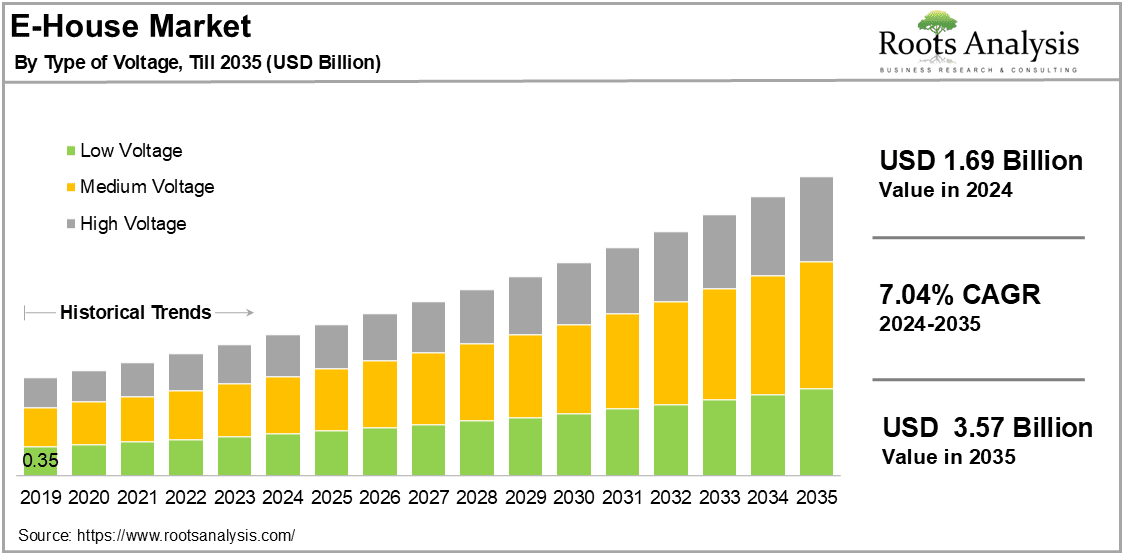
The E-House market size is projected to grow from $1.69 billion in 2024 to $3.57 billion by 2035, representing a CAGR of 7.04%, during the forecast period 2024-2035.
 |
To learn more about this report, request a free sample copy
The growing demand for sustainable and energy-efficient power solutions has generated new opportunities for the E-House market. E-Houses, also known as electronic houses, provide seamlessly integrate advanced technology, renewable energy, and energy-efficient systems to create an eco-friendly living experience. E-House structures come in various forms, such as compact, modular designs to larger, fully customizable structures, catering to different lifestyles and preferences. E-Houses are typically powered by a combination of renewable energy sources and the traditional grid, ensuring a reliable and sustainable power supply, often with the ability to operate independently from the grid. Additionally, E-Houses offer a fast-track project approach, allowing for rapid deployment and solving various project challenges while supporting sustainability goals. These modular, plug-and-play solutions from companies, including Siemens and ABB can be used to meet the specific power distribution needs of different industries and applications, representing a significant shift towards a more eco-friendly and advanced future. In January, Swartz Engineering designed a modular E-House that utilizes interlocking metal panels covered with sandwich panel technology.
Furthermore, with ongoing technological advancement in the E-House industry, including the adoption of renewable energy sources, such as solar and wind, that offer industries the chance to embrace cleaner and more sustainable alternatives. Further, features, including advanced monitoring and control systems, that optimize energy usage and enhance grid stability, are expected to be integrated and will enhance the performance of E-House. These technological enhancements, combined with the space-efficient designs, would help in boosting demand for advanced E-House in the near future.
The market report presents an in-depth analysis of the various manufacturers / service provides that are involved in offering E-House market, across different segments, as defined in the table below:
| Key Report Attributes | Details | |
| Historical Trend | 2019-2023 | |
| Base Year | 2023 | |
| Forecast Period | 2024-2035 | |
| Market Size Value in 2024 | $ 1.69 Billion | |
| Market Size Value by 2035 | $ 3.57 Billion | |
| Growth Rate | CAGR of 7.04% from 2024 to 2035 | |
| Type of E-House |
|
|
| Type of Component |
|
|
| Type of Voltage |
|
|
| Type of Applications |
|
|
| E-House Size |
|
|
| Type of Material |
|
|
| Type of Feature |
|
|
| Geographical Regions |
|
|
| Leading Market Players |
|
|
| PowerPoint Presentation (Complimentary) |
Available | |
| Customization Scope | 15% Free Customization | |
| Excel Data Packs (Complimentary) |
|
|
The global E-House market is segmented into different types of E-Houses namely, fixed E-House
and mobile substation. As per market research, the mobile substation is anticipated to be a leading segment with the largest E-House market share and is also expected to grow with fastest CAGR over the years. This can be attributed to high flexibility in transportation and ease in installation.
Based on the type of component, the E-House industry is bifurcated into busway, control panel, HVAC system, switchgear, transformer, ups and others. According to our prediction, switchgear dominates the E-House industry and is projected to gain the majority of the market share. Owing to its crucial role in E-House to protect and safeguard electrical infrastructure from any damage through irregular power supply. However, UPS is expected to have the fastest growth rate among other components due to its uninterrupted power supply feature in industrial applications.
This segment describes different types of voltages of the E-House market which include low voltage, medium voltage and high voltage. Currently, medium voltage is capturing the highest market share and is dominating the E-House market and is also expected to showcase fastest growth. This can be owed to growing utilization of E-House in different industries, including mining, oil and gas, renewable energy and utilities. It is worth highlighting that medium voltage E-House are most prevalent in such industries and can contribute to market growth.
This segment underscores the type of applications in the global market for E-House, such as industrial and utilities (chemicals, mining & minerals, oil & gas and others). Based on the type of application, the industrial is the leading segment and capturing the highest market share. This can be attributed to the fact that industrial e-households high demand for uninterrupted power supply in various industries, such as oil and gas sector, mining and manufacturing.
The global E-House market is divided into different E-Houses sizes, such as small size, medium size and large size. Based on E-House size, the medium size holds the largest market share. Medium size E-Houses are versatile and widely adopted, as they can cater to a wide range of industrial and utility applications. They offer a balance between the compact size and portability of small E-Houses, and the higher power capacity of large E-Houses. Considering these factors, the medium size segment is projected to continue to drive the market at a faster growth rate over this forecast period.
The global E-House market has a variety of materials, such as composite, concrete and steel. Based on the type of material, the steel sector dominates the market with the highest market shares and also is expected to grow with highest CAGR. This can be attributed to high structural integrity and durability, which is essential for E-House to withstand harsh environmental conditions and heavy loads. It is worth noting the scalability feature of steel, which allows to easily scale up or down depending on the size and complexity of the E-House.
The global E-House market is divided into different features, such as customized, modular and smart. Based on features, the modular drives the largest market shares. The modular offers various advantages, including optimal use of space, customization and flexibility, reduced construction time and cost-effectiveness. Considering these factors, the modular segment is projected to continue to drive the market at a faster growth rate over this forecast period.
This segment highlights the distribution of the E-House market across various geographical regions, such as North America, Europe, Asia, Latin America, Middle East and North Africa and rest of the world. In terms of revenue, Asia is a dominating region and captures the largest E-House market share and is likely to growth with fastest pace. The driving factor of the region’s growth can be ascribed to its rapid expanding industrialization and urbanization in countries, including China and India. Along with this, the rising demand for electricity plays a crucial role.
The “E-House Market, Till 2035: Distribution by Type of E-House (Fixed E-House and mobile substation), Type of Component (Busway, Control Panel, HVAC System, Switchgear, Transformer, UPS and Others), Type of Voltage (Low, Medium and High), Distribution by Applications (Industrial, Utilities (Chemicals, Mining and Minerals, Oil and Gas and Others), Type of E-House Size (Low, Medium and Large), Type of Material (Composite, Concrete and Steel) and Geographical Regions (North America, Europe, Asia, Latin America and Middle East and North Africa and Rest of the World): Industry Trends and Global Forecasts” report features an extensive study of the current market landscape, market size and future opportunity within the E-House market, during the given forecast period. The market report highlights the efforts of several stakeholders involved in this rapidly emerging segment of the service providers industry. Key takeaways of the E-House market report are briefly discussed below.
Ongoing technological advancement is one of the latest E-House market trends which has expanded the potential growth of the market. It is worth mentioning that the increasing demand for energy and power services, particularly in the upstream oil and gas sector, is a major driver. Also, investments has been made for new projects in E-House deployments to reduce risk and delivery times. Furthermore, rising interest in smart home has been observed in the recent years. Additionally, the digitalization of E-Houses, incorporating more intelligent systems, and the adoption of E-Houses as a more sustainable alternative to traditional equipment, will likely generate lucrative opportunities for market players and expand the market outlook during the forecast period.
With several small and large E-House manufacturing companies, the market is experiencing intense competition and changing market dynamics. From large multinational companies to local E-House manufacturers, companies are striving to enhance their competitive edge. In terms of market share, large enterprises and multinational companies are dominating the market. While small E-House manufacturers are continuously improving their products to cater to niche markets, or they are offering specialized services. These industry players are focusing on adopting competitive strategies, such as developing innovative products that integrate smart grid technologies and renewable energy sources, forming strategic alliances and partnerships to expand their product portfolios and global footprint, investing in recent developments and new product launches to enhance their offerings.
One of the major driving factors of the E-House market is increasing demand for E-Houses in sectors such as oil and gas, power, transportation and mining. Additionally, the increasing need for rapid deployment and cost-effective power infrastructure, industrial projects, is driving the E-House market growth. Apart from this, growing technological advancements, the growing need for renewable energy sources and the support of E-Houses in expanding to new locations or setting up new sites are some other significant E-House market drivers that will likely foster the growth of the market during this forecast period.
With regard to regional insights, the Asia region is expected to grow at the fastest growth rate with the maximum market share and is likely to dominate the E-House industry. The rapidly expanding industrialization in developing countries, such as China, India, and Japan is substantially influencing market growth and driving the demand for E-House market.
Examples of key players involved in the E-House market (which have also been captured in this market report, arranged in alphabetical order) include ABB, CR Technology Systems, Delta Star, Dijitalist Marketing, Eaton, EKOS Eclectic, Electroinnova, General Electric, LS Electric, Meidensha, Powell Industries, Schneider Electric, Siemens, TGOOD, Unit Electrical Engineering, WEG. This market report includes an easily searchable Excel database of all the companies who have adopted the E-House market.
The market report presents an in-depth analysis, highlighting the capabilities of various companies engaged in this domain, across different segments. Amongst other elements, the market report includes:
At Roots Analysis, we genuinely care about your success and understand that your business requirements are unique. While our market research reports provide valuable insights, we recognize that they might not cover every aspect you need to make well-informed strategic decisions. To account for that, we offer 15% free report customization tailored to your specific needs. Whether you require additional quantitative analysis, qualitative insights, or any other information related to the supply chain analytics market, reach out us today at: support@rootsanalysis.com