
Lowest Price Guaranteed
Slides
217
Last Updated
May 2025
View Count
11240
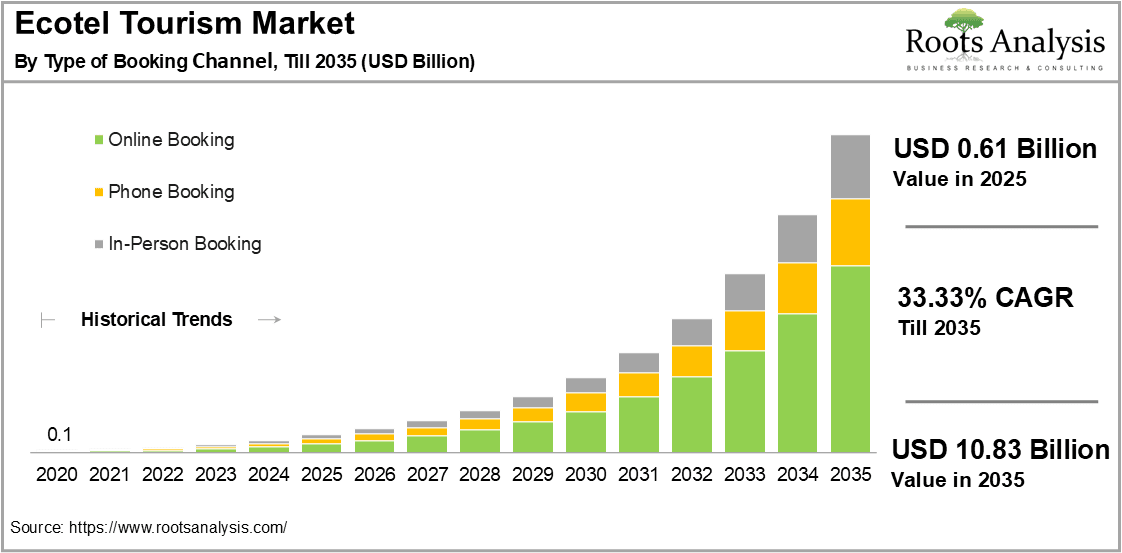
The ecotel tourism market size is projected to grow from USD 0.61 billion in 2025 to USD 10.83 billion by 2035, representing a CAGR of 33.33% during the forecast period till 2035.
 |
The new research study consists of ecotel tourism market and trends analysis, detailed market forecast analysis, and provide actionable strategic recommendations.
As sustainability is becoming a norm for the entire business industry, the tourism & hospitality sector is tapping into this trend where the ecotel tourism market is achieving record-breaking growth. The term Ecotel is derived from a combination of eco referring to ecology and hotel. Ecotel tourism is a niche segment of the tourism industry that emphasizes serving eco-friendly accommodation and sustainable travel experiences.
The hospitality sector focuses on environmental conservation, social responsibility, and economic sustainability. The goal of the ecotel is to minimize the environmental impact while providing a comfortable and memorable stay for guests through eco-friendly hotels, lodges, resorts, and other accommodations. Also, service providers employ renewable energy, water conservation practices, and waste reduction & management solutions which support the objective of this industry.
As an effect, the ecotel tourism industry is speedily gaining traction with a hike in demand for sustainable travel experiences. A fundamental shift in traveler preferences is reshaping the landscape of the tourism industry where responsible travel choices have become a necessity. The heightened environmental awareness campaigns and an increasing number of eco-friendly hotels that cater to the growing demographic, amplify the scope of the sustainable tourism market.
Further, the emerging market trends highlight that travelers are actively seeking green resorts and eco-lodges that emphasize sustainability without compromising on comfort or luxury. The growth of this market is unlikely to stop driven by the spike in global tourism, a surge in the popularity of glamping (glamorous camping), and renewable energy solutions which are lifting the market prospects.
Despite this progress, some considerable challenges such as the high cost of sustainable infrastructure and regulatory compliances need to be addressed for the potential growth of the industry during this forecast period.
The ecotel tourism market report presents an in-depth analysis of the various companies that are involved in offering ecotel tourism, across different segments, as defined in the table below:
| Key Report Attributes | Details | |
| Historical Trend | Since 2020 | |
| Forecast Period | Till 2035 | |
| Current Market Size | $ 0.61 Billion | |
| Market Size Value by 2035 | $ 10.83 Billion | |
| CAGR (Till 2035) | 33.33% | |
| Type of Accommodation |
|
|
| Type of Traveler |
|
|
| Type of Tour |
|
|
| Type of Booking Channel |
|
|
| Type of Consumer Orientation |
|
|
| Geographical Regions |
|
|
| Leading Market Players |
|
|
| PowerPoint Presentation (Complimentary) |
Available | |
| Customization Scope | 15% Free Customization | |
| Excel Data Packs (Complimentary) |
|
|
The global ecotel tourism market features a variety of accommodations wherein eco-lodges are gaining higher demand and are likely to hold the maximum (~41%) of the market share by 2035. The immersive natural experience, sustainability focusses and appeal to eco-conscious travelers are the factors contributing to the segment growth. Eco-lodges are commonly located in pristine natural settings similar to mountains and rainforests and offer guests a close connection to nature, thereby, elevating the market scope.
Meanwhile, eco-friendly hotels are booming at an excellent pace, driving the market by catering to travelers in cities and towns and offering sustainable options for both leisure and business travelers. Therefore, the growth of the eco-hotel segment is estimated to ascend at a noteworthy (35.64%) CAGR in the near future.
This segment of the ecotel market is bifurcated into adventure travelers, business travelers, family travelers, leisure travelers, and others. Among the given categories, the leisure traveler segment has been fostering the market position by capturing (~39%) of the current market share and will continue to hold this position till the forecast period. Preference for eco-resorts and lodges in scenic and natural settings for relaxation, rejuvenation, and unique experiences is the key driving factor behind this growth.
This segment incorporates a diverse range of travelers, from couples and soto to groups of friends which makes it the largest segment. Moreover, the adventure traveler segment exhibits excellent growth and is expected to experience a notable (34.78%) CAGR owing to soaring demand for thrilling experiences and alignment with nature as adventure travelers are drawn to eco-tourism for activities such as trekking, diving, and wildlife safaris.
On the basis of the type of tour, the market is split into domestic and international. As per our projection, the domestic tour segment is anticipated to drive the market with a majority of (65%) share of the market and will likely retain this position till 2035. Cost-effectiveness and convenience are the major factors of this growth as domestic travel is often more affordable than international travel. Its shorter travel distance and familiar environments make domestic trips more accessible and appealing, thereby, leading the industry.
However, the international segment is also gaining momentum and is growing rapidly with widening global awareness. International travelers seek exotic and unique eco-tourism experiences. Also, high net-worth individuals generally prefer international luxury eco-lodges and hotels. Consequently, the international tour segment is predicted to register (36.44%) CAGR throughout this forecast period.
This segment describes multiple types of booking channels such as online booking, in-person booking, and phone booking. As per this ecotel tourism market forecast report, the online booking segment is the largest shareholder and is projected to hold (~50%) of the market share by 2035. This trend is likely to continue owing to the broader range of online travel agencies which offer a vast inventory of eco lodges and make it easy for travelers to compare options. Their user-friendly features to filter eco-certified hotels, and sustainability badges promote segment growth.
However, the phone booking segment is growing at a moderate pace and is estimated to witness (a 35.57%) growth rate during this projection timeframe. This growth can be accredited to the rising trend of apps which are becoming popular because of their convenience and user-friendly interface.
The distribution of the market based on consumer orientation is segmented into corporate groups, eco-conscious families, and millennials & Gen Z. According to our ecotel tourism market analysis, the millennials & Gen Z segment is leading the market and is poised to hold (~49%) of the market share by 2035. This category of consumers is highly aware of environmental concerns related to climate change, plastic pollution, and biodiversity loss.
Due to this, they are willing to pay for eco-friendly accommodations, luxury eco-hotels, and green resorts. Also, they seek authentic, nature-based experiences and prioritize destinations that promote community-based tourism and cultural heritage preservation. Additionally, the eco-conscious family segment is anticipated to rise at a higher CAGR of (37.11%) in the upcoming years due to their preference for family-oriented eco-accommodations that offer educational and engaging activities for children along with value, safety, comfort, and sustainability.
This segment highlights the distribution of the ecotel tourism market across various geographical regions, such as North America, Europe, Asia, Latin America, the Middle East and North Africa, and the rest of the world. As per ecotel tourism market research, Europe is predicted to dominate the market with (~48%) share and will retain its dominance till 2035.
Additionally, the market for ecotel tourism is expanding incredibly in the Asian region and exhibiting promising growth driven by the availability of diverse ecosystems. Asia is some of the world’s most biodiverse regions including rainforests, coral reefs, mountains, and wildlife reserves which are present in countries like Malaysia, Thailand, and India and offer stunning natural attractions that are ideal for the green tourism industry.
The rising awareness of sustainability, and heightening environmental issues such as deforestation and plastic pollution has spurred the demand for sustainable travel options. Furthermore, the growing middle class and economic growth of China, India, and other Southeast Asian countries is also a major factor that has raised the travel demand, supporting the ecotel tourism market outlook. As a result, Asia is expected to grow at the fastest (38.95%) growth rate during this forecast period.
The “Ecotel Tourism Market, Till-2035: Industry Trends and Global Forecasts” report features an extensive study of the current market landscape, market size and future opportunities within the ecotel tourism market, during the given forecast period. The market report highlights the efforts of several stakeholders involved in this rapidly emerging segment of the service providers industry. Key takeaways of the ecotel tourism market report are briefly discussed below.
The increasing consumer trend for sustainable accommodation has driven the ecotel tourism market growth. A spike in the segment of travelers, particularly, millennials and Gen Z which prioritize eco-friendly practices and are willing to pay a premium for sustainable experience, augmenting the market demand. This can be attributed to the rise of environmentally conscious tourism which is driving travelers to seek sustainable destinations, eco-friendly accommodations, and responsible travel experiences that minimize their ecological footprint.
Besides this, governments around the globe are taking green tourism initiatives and encouraging hotels to use sustainable building materials by providing incentives and subsidies for renewable energy in hospitality, waste reduction practices, and sustainable construction. Apart from this, continuous technological advancements in solar, wind, and geothermal energy are making it easier and more cost-effective for hotels to reduce their carbon footprint and are expected to broaden the ecotel market outlook in the forthcoming years.
Currently, several global players, regional operators, and niche eco-friendly brands are operating in the market. Leading brands such as Marriott International, Hilton Worldwide, Jetwing Surg, El Nido Resort, Senova, Accor Group, and others are boosting the competitive landscape of the green tourism industry. The key players are employing various competitive strategies such as gaining sustainable certification, adopting innovative eco-friendly practices, collaboration & partnership, luxury experience offering, community engagement, and digital marketing & branding that help them reinforce their market position and acquire significant market share.
Along with key drivers, the market faces some challenges such as the high cost of sustainable infrastructure and regulatory compliance which can obstruct the growth of the market. Illustratively, building eco-friendly accommodations often needs substantial upfront investment in renewable energy systems, water conservation technologies, and other sustainable materials for the construction of energy-efficient accommodations.
Also, obtaining eco-friendly certifications such as LEED and Green Key can be costly and time-consuming for service providers which can deter the adoption of sustainable practices and halt the market development.
With regard to regional ecotel market insights, Europe is projected to hold the largest (~48%) share and will dominate the market for ecotel tourism. Europe stands as an industry leader in sustainable hospitality practices with strong government policies, eco-certification, and incentives for eco-friendly hotels. This is due to the fact that European travelers are highly conscious of their environmental impact, thus, fortifying the eco-friendly accommodation market in the region. In addition to this, the diverse natural landscape from Nordic countries to the Mediterranean makes the region the most wanted holiday destination and offers a far-reaching sustainable travel experience with forest, mountains, and coastal areas.
Besides this, programs such as EU Ecolabel, and Green Key promote & standardize eco-friendly practices and play a significant role in the hospitality industry which will likely contribute to maintaining this growth of sustainable tourism market in the future as well.
Examples of key players involved in the market for ecotel tourism (which have also been captured in this market report, arranged in alphabetical order) include Accor Group (France), Bambu Indah (Indonesia), El Nido Resorts (Philippines), Garonga Safari Camp (South Africa), Jetwing Surf (Sri Lanka), Kachi Lodge (Bolivia), Karinji Eco Retreat (Australia), Marriott International (US), Mashpi Lodge (Ecuador), Pacuare Lodge (Costa Rica), Radisson Hotel Group (US), Rewa Lodge (Guyana), Scandic Hotels (Sweden), Soneva Kiri (Thailand), and Three Camel Lodge (Mongolia). This market report includes an easily searchable excel database of all the companies who have adopted the ecotel tourism market.
The market report presents an in-depth analysis, highlighting the capabilities of various companies engaged in this domain, across different segments. Amongst other elements, the market report includes:
At Roots Analysis, we genuinely care about your success and understand that your business requirements are unique. While our market research reports provide valuable insights, we recognize that they might not cover every aspect you need to make well-informed strategic decisions. To account for that, we offer 15% free report customization tailored to your specific needs. Whether you require additional quantitative analysis, qualitative insights, or any other information related to the ecotel tourism market, reach out us today at: support@rootsanalysis.com