


 Download Free Sample
 Buy Now
Market Size
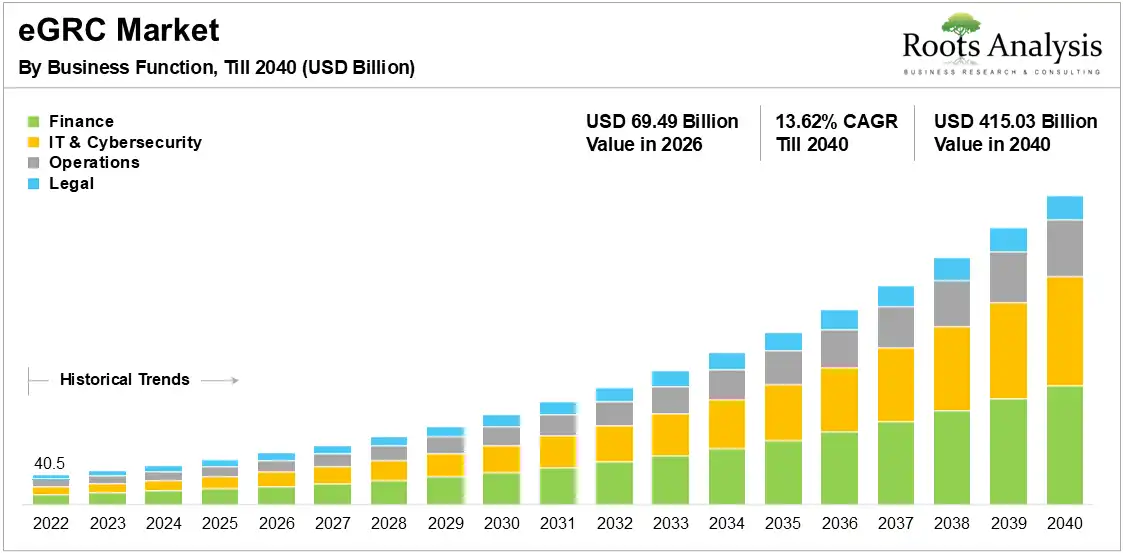
The eGRC market size is projected to grow from USD 69.49 billion in 2026 to USD 415.03 billion by 2040, representing a 13.62% CAGR during the forecast period 2026 to 2040.
See What’s in the Full Report – Request Your Complimentary Insights!
Market Report: Key Takeaways
- In terms of components, software holds the highest share (69.5%) in 2026 and simultaneously represents the fastest-growing segment, projecting a 13.9% CAGR through 2040 for automated scaling.
- With respect to eGRC modules, risk management dominates (28.5%) the 2026 landscape and projects the highest CAGR of 1.3% during the forecast period to support continuous monitoring.
- Based on business functions, finance captures the largest share (35.0%) in 2026, whereas IT and cybersecurity exhibit rapid growth, advancing at a 15.2% CAGR till 2040.
- Amongst deployment modes, on-premises captures the maximum share (69.5%) in 2026; however, cloud-based deployment showcases the steepest growth curve at a 14.2% CAGR till 2040 for distributed access.
- By organization size, large enterprises account for the majority of current deployments, though SMEs are adopting solutions rapidly with 14.2% CAGR driven by increasing regulatory pressures.
- Focusing on verticals, BFSI holds the leading baseline share (27.5%), whereas healthcare expands fastest at a 15.8% CAGR, driven fundamentally by strict AI governance macro mega trends.
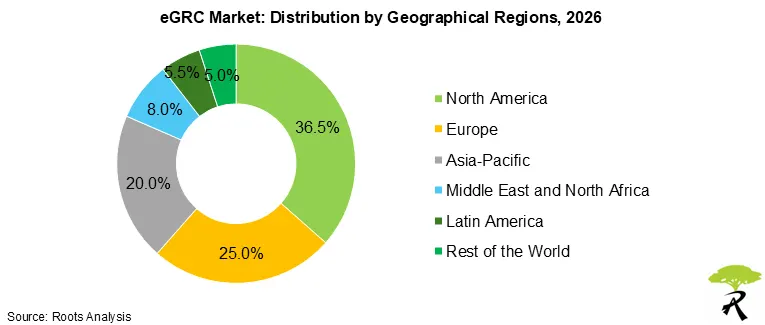
- In terms of geographical regions, North America maintains the highest market share (36.5%), while Asia-Pacific presents the fastest growth opportunity, expanding at a 16.5% CAGR till 2040.
eGRC Market Outlook
The eGRC market is undergoing a fundamental structural shift, moving away from fragmented, department-level tools toward integrated, enterprise-wide risk management platforms. Automated, cloud-based systems have replaced manual spreadsheets and reactive audit processes, enabling real-time data synchronization across legal, IT, and financial functions. This transition reflects a broader industry dynamic: as organizations operate across increasingly decentralized environments, the demand for centralized policy orchestration and continuous risk visibility has become non-negotiable. In response, vendors are delivering modular, platform-as-a-service architectures that allow enterprises to scale compliance capabilities without inheriting legacy infrastructure constraints.
Regulatory complexity is the most powerful growth driver reshaping adoption trends today. The 2025 enforcement of the Digital Operational Resilience Act in the European Union has compelled financial entities to deploy sophisticated eGRC tools for incident reporting and third-party risk oversight, opening significant opportunities in vendor risk management and supply chain resilience. ESG disclosure mandates are simultaneously pulling the eGRC ecosystem into non-financial reporting domains. The accelerated uptake of automated regulatory tracking across Asia-Pacific, driven by government-led digital transformation initiatives, signals that market expansion is now moving well beyond its traditional Western base.
Artificial intelligence and predictive analytics are defining the future direction of the eGRC market. Platforms are evolving into proactive intelligence layers capable of anticipating compliance failures through continuous control monitoring rather than reacting after the fact. The 2025 surge in AI governance modules, built specifically to manage risks associated with generative AI deployments, illustrates this growth outlook clearly. With legal and compliance functions projected to increase platform investment through 2026, eGRC is positioned to remain a critical driver of enterprise resilience and strategic risk decision-making.
Pay Only for What You Need – The Best Way to Optimize
eGRC Market Size Estimation Methodology
- As a starting point, the eGRC market was structured by defining its key segments, covering software vs. services, cloud vs. on-premises deployment, and core functional areas such as risk management, compliance management, audit management, and ESG reporting.
- Then, adoption trends were examined across heavily regulated industries like BFSI, healthcare, and energy, as well as emerging sectors, to understand how deeply eGRC solutions have penetrated different markets and what is driving growth in each.
- Next, the impact of major global regulations, such as GDPR, CSRD, and SEC cybersecurity disclosure rules, was assessed to understand how compliance mandates have historically influenced software procurement and spending decisions.
- Thereafter, publicly available financial data from leading GRC vendors, including annual reports and investor disclosures, was reviewed to establish a reliable baseline for total market revenue and the split between software and services.
- Building on this, direct interviews were conducted with GRC practitioners, Chief Risk Officers, CISOs, and solution providers to validate real-world enterprise spending, licensing trends, and typical technology replacement cycles.
- From the ground up, market sizing was developed by estimating the total number of potential buyer organizations per region and scoring their likelihood to adopt eGRC solutions based on company size and digital maturity.
- In parallel, these bottom-up estimates were cross-checked against broader IT spending forecasts and macroeconomic indicators, such as GDP growth and digital transformation budgets, to ensure the overall market forecast remained realistic and well-grounded.
- Additionally, a separate growth layer was modeled to capture the shift from manual, legacy GRC processes toward AI-powered risk prediction and automated compliance monitoring, reflecting the next phase of market evolution.
- For regional distribution, the global eGRC market forecast was allocated across six major geographic regions by weighing factors such as local regulatory complexity, economic stability, and the concentration of multinational enterprises.
- Finally, in order to assess the sensitivity of our assumptions, we conducted a multivariate sensitivity and scenario analysis (base, optimistic, and conservative) on some of the most important parameters of our forecast methodology, evaluating the potential impact of variables such as global economic conditions and the pace of AI-related regulatory developments.
eGRC Market Share Insights
eGRC Software Market Share Analysis: The Shift to AI-Augmented SaaS Infrastructure
- Software dominates the eGRC market, holding a 69.5% share in 2026 and projected to expand to 72.0% by 2040, while simultaneously ranking as the fastest growing sub-segment at a 13.9% CAGR.
- This dual leadership signals an irreversible migration from manual, service heavy auditing to scalable, cloud-native environments. Embedded deeply within critical BFSI and healthcare architectures, software-as-a-service (SaaS) risk suites offer corporate boards predictable subscription economics and frictionless deployment that legacy models cannot deliver.
- Surging regulatory mandates, board level cyber defense directives, and stringent ESG reporting standards are forcing capital allocation directly into automated controls. The integration of agentic AI and intelligent regulatory mapping severely compresses implementation cycles, unlocking rapid mid-market penetration and cementing software as the primary defensive moat for corporate governance.
eGRC Market Size by Business Function: Financial Services Compliance Software in Demand
- Finance leads the eGRC market with a 35.0% share in 2026, projected to grow to 38.5% by 2040, driven by mandatory compliance frameworks like SOX and IFRS that demand continuous audit oversight, internal controls, and regulatory reporting.
- The BFSI sector’s mature infrastructure enables seamless platform integration, reducing compliance penalties, which can reach millions annually, while automating reporting cycles at scale. This structural dependency on precision and accountability ensures finance retains its dominant position across the forecast period.
- Conversely, IT & cybersecurity emerges as the fastest growing segment, with a 15.2% CAGR through 2040, fueled by escalating ransomware incidents, hybrid cloud migrations, and expanding data privacy regulations like GDPR. Investment in AI-driven eGRC platforms with machine learning capabilities is accelerating enterprise-wide adoption, with events such as the February 2026 MGM Resorts breach reinforcing the urgency of unified governance frameworks and real-time risk visibility.
Want Information on Specific Region / Segment?
North America to Capture Largest Share in 2026 while Asia-Pacific to Grow at a Higher CAGR
- Regional market analysis for eGRC in North America indicates that the region leads the global market with a 36.5% share in 2026, driven by stringent regulatory frameworks such as SOX and HIPAA, a mature ecosystem of multinational corporations, and advanced digital infrastructure that supports scalable, cloud-based compliance deployments.
- Asia-Pacific region emerges as the fastest-growing segment, expanding at a 16.5% CAGR through 2040, fueled by rapid digital transformation, evolving mandates like India’s DPDP Act and Singapore’s MAS TRM, and accelerating investment in AI-driven compliance tools. The region is transitioning from early adoption to broad commercialization, with mid-market and digital-native firms scaling SaaS eGRC solutions amid rising cyber threats. The Asia-Pacific region’s growth outlook signals a decisive shift in global eGRC adoption trends.
Market Ecosystem Analysis
eGRC Market Competitive Landscape
The eGRC competitive architecture exhibits aggressive polarization. Market dominance is captured through advanced agentic AI deployments and unified risk intelligence. Consequently, the ecosystem is strictly bifurcated between legacy software conglomerates expanding broad structural moats and agile, cloud-native disruptors hyper focusing on automated evidence collection.
Leading software conglomerates are neutralizing fragmented solutions by embedding generative intelligence into core architectures. The primary catalyst is surging enterprise demand for programmatic enforcement. In April 2026, ServiceNow released its Zurich platform, deploying the AI Control Tower to structurally govern algorithmic systems. Simultaneously, IBM fortified its operational ecosystem in March 2026 via a strategic triad with Yubico and Auth0, establishing an industry first governance model for high risk AI actions.
To solidify absolute competitive moats, dominant vendors are shifting from reactive audits to predictive intelligence. OneTrust scaled its Fall 2025 Release globally, embedding AI agents directly into corporate applications. Additionally, MetricStream executed an April 2026 platform update accelerating proactive risk insights, following its January 2026 connected intelligence predictions. This OEM impact is profound; securing lucrative tier-one enterprise contracts now mandates natively integrated, continuous compliance suites over isolated legacy point-solutions to maintain absolute market dominance.
Startup Activity and Innovation Landscape
The dynamic startup ecosystem leverages targeted cloud-native disruption to capture critical mid-market whitespace. The fundamental catalyst driving venture momentum is the commercialization of agentic automation to eliminate manual policy mapping. In April 2026, StandardFusion deployed an agile infrastructure specifically engineered to transition mid-tier organizations away from spreadsheet-dependent frameworks. ValidMind established a pivotal niche in March 2025, providing financial institutions with an AI-driven model risk management environment to stress-test complex algorithms.
To build sustainable competitive moats, disruptors aggressively prioritize continuous control testing over static reporting. Sprinto capitalized on strict enterprise readiness demands by deploying an autonomous Autopilot engine for SOC 2 evidence collection. Similarly, Hyperproof elevated its compliance operations architecture in February 2026 with real-time automated failure identification across distributed cloud networks. For legacy OEMs, this agile proliferation threatens mid-market retention, as startups consistently deliver highly compressed implementation cycles and automated governance platforms.
Impact of AI and Machine Learning on eGRC Market Growth
Artificial intelligence and machine learning are fundamentally restructuring enterprise risk economics, acting as the primary growth catalyst for the eGRC ecosystem. By transitioning compliance from reactive reporting to continuous, predictive monitoring, cognitive algorithms drastically reduce manual auditing friction. Software OEMs are now strictly compelled to embed generative intelligence directly into core operational architectures to secure lucrative long term enterprise contracts.
This technological integration establishes an absolute competitive moat. Market share heavily consolidates developers deploying autonomous regulatory mapping. For instance, recent deployments of intelligent platforms like Archer Evolv and MetricStream AiSPIRE in late 2025 and 2026 utilize horizon scanning to seamlessly filter global mandates. Consequently, legacy providers lacking native machine learning frameworks will rapidly lose strategic relevance across international markets.
Your Business is Unique – Why Shouldn’t Your Report Be?
Market Access Considerations
Regulatory Fragmentation and Harmonization
Market access in the eGRC sector is shaped by the conflict between local regulatory mandates and global harmonization efforts. Frameworks like the EU AI Act and GDPR simplify European entry, but vendors must still address region-specific rules, such as Saudi Arabia's Vision 2030 norms or SEC AI disclosure requirements. Platforms that rapidly integrate new regulatory templates hold a decisive competitive advantage over slower moving rivals.
Cybersecurity and Data Privacy Mandates
Data residency and sovereignty requirements represent a structural gatekeeper for eGRC providers, particularly those offering cloud-based or SaaS delivery models. As cyber threats and ransomware incidents escalate, the baseline for market participation has shifted from simple functionality to rigorous privacy by design architectures that meet standards like ISO 27001 or specific national cyber security guidelines. This influences market access by favoring established providers with the capital to maintain high-tier security certifications and localized data centers. For new entrants, the substantial cost of proving compliance with these non-negotiable security protocols creates a steep economic barrier that restricts their ability to compete for government and financial sector contracts.
Interoperability and Legacy Infrastructure Readiness
The commercial viability of eGRC solutions is increasingly dependent on their ability to integrate with heterogeneous and often antiquated IT environments. Enterprises frequently operate on siloed legacy systems that do not naturally support the real-time data flows required for continuous risk monitoring. Consequently, market access is not just a factor of software capability but of ecosystem readiness, where the ease of API integration determines the speed of adoption. Vendors that cannot demonstrate seamless interoperability with major ERP and CRM systems find their sales cycles significantly extended, as high implementation friction remains a top reason for procurement abandonment among mid-to-large-scale enterprises.
Total Cost of Ownership (TCO) and Value Demonstration
The eGRC market is transitioning from a “reactive penalty avoidance" sell to a “proactive strategic value” proposition, which fundamentally changes pricing and procurement dynamics. High upfront costs for licensing, customization, and infrastructure upgrades remain a major barrier for small and medium enterprises (SMEs), effectively siloing the market into high-end enterprise players and fragmented niche providers. To improve commercialization and expand their reachable market, vendors are shifting toward value-based pricing models that emphasize ROI through reduced audit cycles and lower compliance overhead. Competition is increasingly defined by who can most clearly quantify the "cost of inaction," as CFOs demand evidence that eGRC investments will lead to tangible capital optimization rather than just administrative box-ticking.
How Stakeholders Benefit from the Key Focus Areas of Our eGRC Market Report
The enterprise governance, risk, and compliance (eGRC) market is at a pivotal inflection point, driven by accelerating regulatory complexity, digital transformation mandates, and heightened organizational accountability across industries. This report equips decision-makers with the intelligence needed to navigate competitive pressures, evaluate investment opportunities, and align product or market strategies with where the market is genuinely moving. Whether the goal is market entry, portfolio expansion, or technology commercialization, the insights in this study provide a structured foundation for high-confidence decisions.
- eGRC Market Landscape and Competitive Dynamics: The report delivers a structured assessment of the competitive landscape, profiling established platform vendors, emerging challengers, and niche specialists alongside their positioning, capabilities, partnership ecosystems, and strategic direction. It surfaces where competitive concentration creates risk for buyers and where fragmentation creates opportunity for new entrants or consolidators. Strategy and corporate development teams gain the context needed to benchmark their own positioning, anticipate competitive moves, and evaluate where differentiation is achievable versus where scale already determines outcomes. The analysis moves beyond company lists to reveal the strategic logic shaping how the market is being contested.
- Unmet Needs and Market Gaps in eGRC: The report maps the critical gaps between current eGRC capabilities and the compliance, risk visibility, and audit automation demands that organizations across regulated industries are struggling to fulfill. It identifies underserved verticals, feature deficits in legacy platforms, and the workflows where manual processes continue to create exposure and inefficiency. Product and technology leaders gain a precise view of where investment will generate the strongest commercial return. For corporate development teams, these gaps represent entry points for differentiation or acquisition rather than head-to-head competition with established players.
- Technology Innovation and Adoption Trends: The report examines how artificial intelligence, automation, real-time risk monitoring, and cloud-native architectures are reshaping eGRC platform capabilities and buyer expectations. It distinguishes between technologies at the proof-of-concept stage and those already influencing enterprise procurement decisions at scale. Technology and product leaders can use this intelligence to prioritize development roadmaps, assess build-versus-integrate tradeoffs, and align innovation investments with adoption trajectories that have measurable commercial momentum. The analysis also identifies the regulatory and organizational triggers accelerating technology uptake across key sectors.
- Funding and Investment Landscape in Enterprise GRC Industry: The report tracks capital flows across the eGRC ecosystem, covering venture funding rounds, strategic acquisitions, and private equity activity, alongside the segments and geographies attracting the highest investor interest. It contextualizes this activity against broader regulatory tailwinds and enterprise digitization budgets to surface where sustainable growth is being backed with real capital. Investors and financial stakeholders can use this data to benchmark deal activity, assess valuation trends, and identify scalable platforms ahead of broader market recognition. The funding landscape analysis also signals which technology categories are transitioning from early-stage experimentation to institutional adoption.
- Partnership and Collaboration Trends in eGRC Industry: The report analyzes how platform vendors, system integrators, regulatory bodies, and enterprise buyers are forming alliances to accelerate eGRC deployment, extend solution coverage, and reduce implementation friction. It identifies the partnership models generating measurable commercial outcomes and the ecosystem roles that remain structurally underdeveloped. Business development teams can use this analysis to identify collaboration opportunities, structure go-to-market agreements, and assess which ecosystem positions create sustainable leverage. For technology providers, the data clarifies where partner-led distribution is outperforming direct sales efforts and why.
- eGRC Market Segmentation and Geographic Coverage: The report segments the eGRC market by deployment model, organization size, industry vertical, and functional application, while mapping demand patterns, regulatory intensity, and competitive density across North America, Europe, Asia-Pacific, and emerging regions. This layered segmentation allows stakeholders to move beyond aggregate market size figures and evaluate where specific opportunity pockets align with their strategic priorities. Market entry and expansion leaders gain the geographic intelligence needed to sequence regional moves based on regulatory readiness, buyer sophistication, and competitive white space. Investors benefit from the ability to assess which segments offer the most defensible growth profile relative to current market penetration levels.
Have Questions? Let’s Get Them Answered.
eGRC Market: Scope of the Report
| Key Report Attributes | Details | |
| Forecast Period | Till 2040 | |
| Market Size in 2026 | USD 69.49 Billion | |
| Market Size in 2040 | USD 415.03 Billion | |
| CAGR (Till 2040) | 13.62% | |
| Segments Covered |
|
|
| Geographical Regions Covered |
|
|
| Key Sections Covered |
|
|
Market Segmentation
The eGRC market report presents an in-depth analysis, highlighting the capabilities of various stakeholders, based on different segments such as component, eGRC module, business function, deployment mode, organization size, vertical, geographical regions, and key players.
Market Share by Component
- Software
- Services
Market Share by eGRC Module
- Audit Management
- Compliance Management
- Policy Management
- Privacy & Data Governance
- Risk Management
Market Share by Business Function
- Finance
- IT & Cybersecurity
- Legal
- Operations
Market Share by Deployment Mode
- Cloud
- On-premises
Market Share by Organization Size
- Large Enterprises
- Small and Medium Enterprises (SMEs)
Market Share by Vertical
- BFSI
- Energy & Utilities
- Government
- Healthcare
- IT & Telecom
- Manufacturing
- Retail & E-commerce
- Transportation & Logistics
Market Share by Geographical Regions
- North America
- US
- Canada
- Mexico
- Rest of North America
- Europe
- Austria
- Belgium
- Denmark
- France
- Germany
- Ireland
- Italy
- Netherlands
- Norway
- Russia
- Spain
- Sweden
- Switzerland
- UK
- Rest of Europe
- Asia-Pacific
- Australia
- China
- India
- Japan
- New Zealand
- Singapore
- South Korea
- Rest of Asia-Pacific
- Latin America
- Argentina
- Brazil
- Chile
- Colombia
- Venezuela
- Rest of Latin America
- Middle East and North Africa (MENA)
- Egypt
- Iran
- Iraq
- Israel
- Kuwait
- Saudi Arabia
- UAE
- Rest of MENA
- Rest of the World


