
Lowest Price Guaranteed
Slides
201
Last Updated
May 2025
View Count
10975
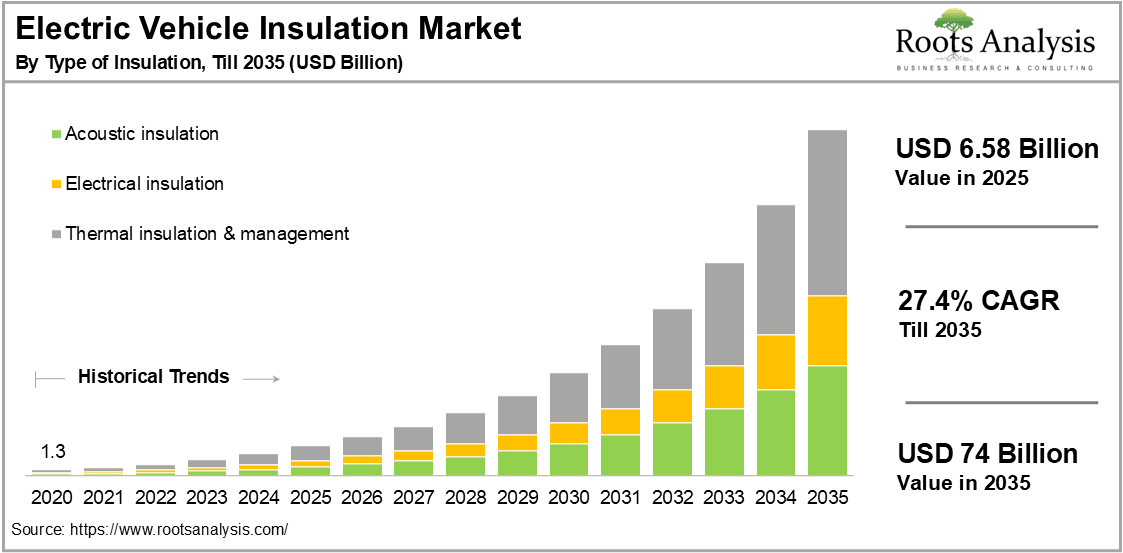
The global electric vehicle insulation market, valued at USD 4.78 billion in 2024, is projected to reach USD 6.58 billion in 2025 and USD 74 billion by 2035, representing a CAGR of 27.4 % during the forecast period.
 |
The new research study consists of electric vehicle insulation industry analysis, detailed market forecast analysis, and providing actionable strategic recommendations.
Electric vehicle adoption rates due to rising environmental concerns have emerged as a game changer in the automobile sector, but these vehicles are prone to runaway heating that leads to potential explosion. To secure vehicles from such tragedies, electric vehicle insulation is on a surge. By assembling materials, such as mica or polyester integrated with resin, electric vehicle insulation is manufactured. These offer enhanced mechanical protection and heat dissipation.
Technological advancements in EV manufacturing including sustainable materials in insulation such as phase change materials (PCMs) for efficient heat absorption and release to manage thermal stress have played a major role in the expansion of the market. Further, these are lightweight that forwardly helps in easy implementation and enhances performance. These are used to dissipate generated heat so that circuits or other crucial components stay healthy as heat may reduce efficiency. Notably, rapid adoption of carbon fiber composites to improve range and efficiency have framed the market.
The global electric vehicle insulation market size is expected to grow significantly over the forecast period due to the dynamic supportive regulations. Further, the need for thermal management innovation while fast charging will play a major role in the expansion of the lightweight insulation solutions market. In addition, marine batteries have high density and longer life cycle that equips battery performance optimization. The growth of the domain can be described by the capability of preventing short-circuits and electromagnetic interference (EMI). Consequently, rising investments in development and advancements will contribute to the expansion of the electric vehicle insulation charger market.
Recently, João Pedro Azevedo, CEO of Amorim Cork Composites mentioned the electric vehicle insulation sector has undergone major transformations over the last few years, which has resulted in great opportunities in terms of innovation.
The global electric vehicle insulation market research report presents an in-depth analysis of the various companies that are involved in offering electric vehicle insulation, across different segments, as defined in the table below:
| Key Report Attributes | Details | |
| Historical Trend | Since 2020 | |
| Forecast Period | Till 2035 | |
| Current Market Size | $ 6.58 Billion | |
| Market Size Value by 2035 | $ 74 Billion | |
| CAGR (Till 2035) | 27.4% | |
| Type of Product |
|
|
| Type of Propulsion |
|
|
| Type of Insulation |
|
|
| Type of Function |
|
|
| Area of Application |
|
|
| Geographical Regions |
|
|
| Leading Market Players |
|
|
| PowerPoint Presentation (Complimentary) |
Available | |
| Customization Scope | 10% Free Customization | |
| Excel Data Packs (Complimentary) |
|
|
On the basis of the type of product, the electric vehicle insulation market is bifurcated into ceramic, foamed plastics, thermal interface materials and other products. The foamed plastics segment is anticipated to dominate the segment with more than 40% market share of electric vehicle insulation in 2025. This can be due to easy implementation and excellent thermal resistance. It is worth highlighting that they are manufactured with eco-friendly blowing agents forwardly aiding lower greenhouse gas emissions.
On the other hand, the thermal interface materials segment is expected to witness a relatively faster (28.14%) electric vehicle insulation market growth rate by 2035. This can be attributed to the expansion of life cycle of components by efficiently dissipating the heat. In addition, these provide high electric insolation and heat sink that ensures preservation of crucial areas or components.
On the basis of the electric vehicle insulation types of propulsion, the marine propulsion battery market is bifurcated into battery electric vehicle (BEV), fuel cell electric vehicle (FCEV), hybrid electric vehicle (EEV) and plug-in hybrid electric vehicle (PEHV). The battery electric vehicle (BEV) segment is anticipated to dominate the segment with more than 45% of market share in 2025. This can be attributed to fewer moving parts that neglect the need for oiling and equip effortless maintenance. Further, less costly refilling in comparison to gasoline, solar and free recharging is majorly driving the domain.
However, the plug-in hybrid electric vehicle segment is expected to witness a relatively faster (27.53%) electric vehicle insulation market growth rate by 2035. This can be attributed to an easy shift between electric and gasoline powered vehicles that saves expenses on shorter trips. Moreover, rising government initiatives and lower tax rates are contributing to the expansion of the market.
Based on the type of insulation, the global electric vehicle insulation market report is segmented into acoustic insulation, electrical insulation and thermal insulation & management. According to our analysis, thermal insulation & management is leading the segment with the major market share (50%). This can be attributed to enhanced safety such as thermal fusers, over-temperature alerts and automatic shut down systems. In addition, cooling and heating systems for better battery operations in various weather conditions have framed the dominance.
On the other hand, the acoustic insulation segment is expected to grow with the relatively faster (29.62%) CAGR in the forecasted period. This can be ascribed to their high applications in hybrid electric vehicles. Further, these are light-weight and 100% recyclable making them favorable choice as a sustainable insulation system.
Based on the type of application, the global electric vehicle insulation market report is segmented into battery pack, interiors, under bonnet and other applications. According to our analysis, battery pack lead the segment with the major market share (40%). This can be due to higher energy density that supports longer trips. Moreover, enhanced thermal insulation and fire-resistance has spurred the market growth.
On the other hand, interiors is expected to grow with a relatively higher CAGR of 28.38%. This can be due to their capability for reducing noise, vibration and harshness that equips enhanced travelling experience. It is worth highlighting that the usage of materials such as polyimide foams and mica sheets are extremely lightweight and recyclable that are continuously driving the market.
This segment highlights the distribution of the electric vehicle insulation market across various geographical regions such as North America, Europe, Asia, Latin America, Middle East, North Africa, and the rest of the world. According to our electric vehicle insulation market analysis, Asia exhibits dominance in the market with over 40% of the electric vehicle insulation market share in the global marketplace. This can be attributed to government regulations on electric vehicles to minimize the environmental impact of gasoline vehicles.
However, North America is projected to grow with a relatively higher CAGR (29.83%) in the forecasted period. Primary reasons for this growth include demand for safe and secure electric vehicle trips is majorly driving the market growth. It is worth highlighting that rising research and development for advancements in EV insulation will contribute to the expansion of the market.
The “Electric Vehicle Insulation Market, Till-2035: Industry Trends and Global Forecasts” report features an extensive study of the current market landscape, market size and future opportunity within electric vehicle insulation market, during the given forecast period. The market report highlights the efforts of several stakeholders involved in this rapidly emerging segment of the service providers industry. Key takeaways of the global electric vehicle insulation market report are briefly discussed below.
An increasing demand for electric vehicles is majorly driving the electric vehicle insulation industry. Further, enhanced maintenance and life duration of battery is continuously aiding the market growth. The capability of reducing noise, vibration and harshness (NVH) is boosting market growth. These advanced materials for EV insulation are extremely lightweight and do not add any extra weight to the vehicle.
It is worth highlighting that they are 100% recyclable that showcase the environmental impact of EV insulation. Notably, supportive government initiatives will play a pivotal role in the growth of the market. Consequently, rapid growth in hybrid electric vehicles will nurture the growth of the domain.
With the presence of several small and large electric vehicle insulation companies, the competitive landscape of the electric vehicle insulation industry is experiencing intense competition and changing market dynamics. From large multinational companies to local electric vehicle insulation players, companies are striving to enhance their competitive edge.
In terms of market share, large enterprises and multinational companies are dominating the market. While small electric vehicle insulation players are continuously improving their products to cater to niche markets by analyzing consumer preferences, or they are offering specialized services. These industry players are focusing on adopting competitive strategies, such as developing innovative solution techniques, forming strategic alliances and partnerships to expand their portfolios and global footprint, investing in recent developments and new feature launches to enhance their electric vehicle insulation offerings.
Despite the strong market growth projection, numerous market challenges for electric vehicle insulation have risen. The most common challenge is quality downgrading and worsening performance due to rapid testing of new materials. Further, extremely high electric stress and temperature may reduce efficiency hamper market growth.
Asia currently holds a substantial share of approximately 40% in the electric vehicle insulation market opportunities. This dominance can be attributed to several factors, including supportive government
Initiatives, such as China’s 14th five-years plan and South Korea’s Green New Deal.
Further, the presence of prominent players such as Autoneum is expanding the market through innovation and rapid advancements. In addition, Asia dominates global market trends in electric vehicles. It is worth highlighting that rapid investments in research and development have played a pivotal role in dominance.
Examples of key player involved in the electric vehicle insulation market (which have also been captured in this market report, arranged in alphabetical order) include 3M, Alder Pelzer, Autoneum, BASF, DuPont, Elmelin, Hilti, ITW, Morgan Advanced Materials, Pyrophobic Systems, Saint-Gobain, Unifrax, Von Roll and Zotefoams. This market report includes an easily searchable excel database of all the companies who have adopted the electric vehicle insulation market.
The market report presents an in-depth analysis, highlighting the capabilities of various companies engaged in this domain, across different segments. Amongst other elements, the market report includes:
At Roots Analysis, we genuinely care about your success and understand that your business requirements are unique. While our market research reports provide valuable insights, we recognize that they might not cover every aspect you need to make well-informed strategic decisions. To account for that, we offer 15% free report customization tailored to your specific needs. Whether you require additional quantitative analysis, qualitative insights, or any other information related to the electric vehicle insulation market, reach out us today at: support@rootsanalysis.com