
Lowest Price Guaranteed
Slides
218
Last Updated
May 2025
View Count
9507
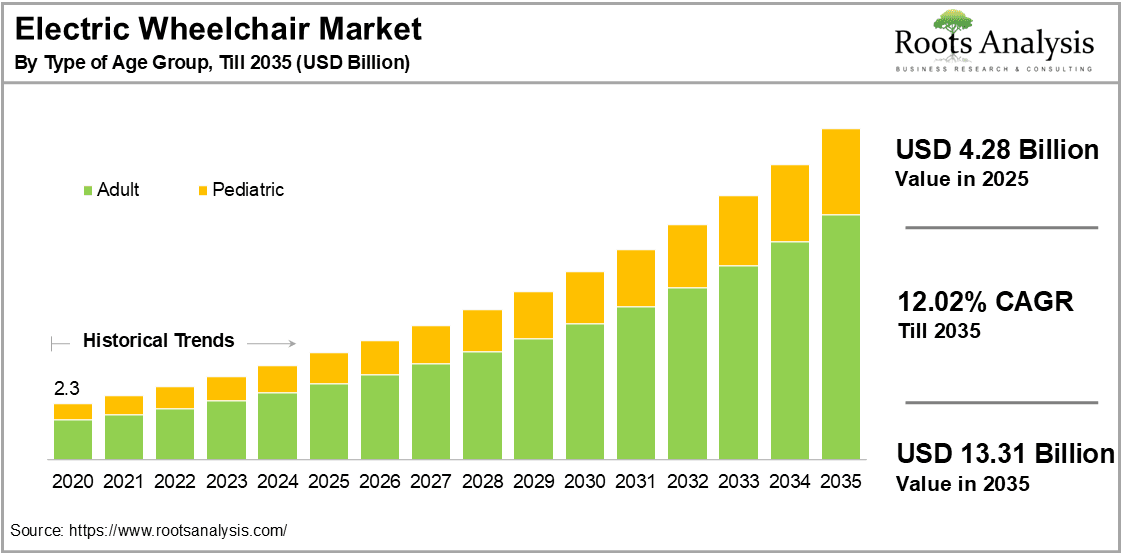
The global electric wheelchair market, valued at USD 3.76 billion in 2024, is projected to reach USD 4.28 billion in 2025 and USD 13.31 billion by 2035, representing a CAGR of 12.03% during the forecast period.
 |
The new research study consists of electric wheelchair industry analysis, detailed electric wheelchair market forecast analysis and providing actionable strategic recommendations.
According to the World Health Organization more than 80 million people across the globe are likely to require wheelchairs. Electric wheelchairs are a mobility aid designed for individuals with limited mobility, enabling them to navigate their environment with ease. These wheelchairs are powered by electric motors and rechargeable batteries, eliminating the need for manual propulsion. Notably, the advantages of electric wheelchairs include enhancing independence by allowing users to move without assistance, reduce physical strain associated with manual wheelchairs, and provide greater stability and safety on various terrains.
Some of the advancements in electric wheelchair technology include AI and sensor technologies enables features like obstacle avoidance, voice control, and real-time diagnostics, enhancing user independence and safety. It is worth highlighting that advancements in materials science have led to the use of lightweight yet durable materials like carbon fiber and magnesium alloys, making wheelchairs more portable and easier to maneuver. Notably, innovations in navigation systems, such as GPS integration and collision-avoidance technology, facilitate smoother and safer travel.
In January 2025, Yamaha Motor announced the development of the JWG-1, a new wheelchair electric power unit, and launched in Japan.
The electric wheelchair market research report presents an in-depth analysis of the various companies that are involved in offering electric wheelchairs, across different segments, as defined in the table below:
| Key Report Attributes | Details | |
| Historical Trend | Since 2020 | |
| Forecast Period | Till 2035 | |
| Current Market Size | $ 4.28 Billion | |
| Market Size Value by 2035 | $ 13.31 Billion | |
| CAGR (Till 2035) | 12.03% | |
| Type of Product |
|
|
| Type of Age Group |
|
|
| End-User |
|
|
| Geographical regions |
|
|
| Leading Market Players |
|
|
| PowerPoint Presentation (Complimentary) |
Available | |
| Customization Scope | 15% Free Customization | |
| Excel Data Packs (Complimentary) |
|
|
Based on the type of product, the global electric wheelchair market is split into center wheel drive, front wheel drive, rear wheel drive, standing electric wheelchair and other products. According to our analysis the aliphatic segment will augment the segment's growth with over 45% of the electric wheelchair market share during this forecast period.
Further, this segment is expected to grow with a relatively higher (12.87%) CAGR in the near future. This can be attributed to its exceptional maneuverability and stability, making it highly suitable for indoor environments. Notably, center wheel drive wheelchairs provide a lower center of gravity, which enhances stability and reduces the risk of tipping, especially on uneven surfaces.
On the basis of the type of age group, the electric wheelchair market is bifurcated into adult and pediatric. The adult segment is anticipated to dominate the segment with more than 65% of electric wheelchair market size in 2025. Further, this segment is expected to witness a relatively faster electric wheelchair market growth rate of (12.54%) until 2035.
This can be ascribed to the increasing elderly population, driven by longer life expectancy and lower fertility rates, and significantly contributes to this trend. Notably, government initiatives and subsidies also support their adoption, further increasing demand among seniors.
The market is fragmented into multiple end user namely home care settings and hospitals & clinics. Currently, the home care settings segment is anticipated to dominate the segment with 45.34% of the market share of electric wheelchair. Further, this segment is expected to witness a relatively higher (13.78%) growth rate until 2035.
his is ascribed to growing geriatric population and preference for aging in place have increased demand for mobility aids at home. Additionally, advances in technology, such as AI-powered navigation, enhance user independence and comfort, boosting adoption in home settings.
This segment highlights the distribution of the electric wheelchair market across various geographical regions such as North America, Europe, Asia, Latin America, Middle East and North Africa, and the rest of the world. According to our electric wheelchair market analysis,
North America exhibits dominance in the market with over 35% of the electric wheelchair market share in the global marketplace. However, Asia is projected to grow with a relatively higher CAGR of 14.24% in the forecasted period. Primary reasons for this fastest pace growth, fueled by a rapidly aging population in countries like Japan, South Korea, and China increases demand for mobility aids. Rising disposable incomes and improved healthcare infrastructure also contribute to this growth.
The “Electric Wheelchair Market, Till-2035: Industry Trends and Global Forecasts” report features an extensive study of the current market landscape, market size and future opportunity within electric wheelchair market, during the given forecast period. The market report highlights the efforts of several stakeholders involved in this rapidly emerging segment of the service providers industry. Key takeaways of the global electric wheelchair market report are briefly discussed below.
The electric wheelchair market is driven by various drivers including the growing geriatric population and the rise in disabilities and chronic diseases significantly contribute to the demand for these devices. Notably, technological advancements, such as programmable control systems and AI integration, enhance user experience and independence, attracting more consumers. Moreover, increased healthcare spending and the impact of the pandemic have accelerated the use of electric wheelchairs in both personal and healthcare settings.
With the presence of several small and large electric wheelchair manufacturing companies, the market is experiencing intense competition and changing dynamics. From large multinational companies to electric wheelchair players, companies are striving to enhance their competitive edge. In terms of market share, large enterprises and multinational companies are dominating the market. While small electric wheelchair manufacturing players are continuously improving their products to cater to niche markets, or they are offering specialized services.
These industry players are focusing on adopting competitive strategies, such as developing innovative solution techniques, forming strategic alliances and partnerships to expand their portfolios and global footprint, investing in recent developments and new feature launches to enhance their electric wheelchair offerings.
Despite strong market growth projection, the market share of electric wheelchair market faces numerous challenges. The most common challenges include high costs, including initial purchase and ongoing maintenance expenses, make these devices unaffordable for many, especially in developing economies. Additionally, technical issues such as component failures and limited battery life can cause inconvenience and restrict usage.
Infrastructure challenges, including inadequate sidewalks and public building accessibility, further limit mobility. Moreover, low healthcare reimbursements and economic constraints reduce purchasing power, while insufficient training for users and caregivers can lead to inefficient use.
North America electric wheelchair market currently holds a substantial share of approximately 35% in the electric wheelchair market opportunities. This dominance can be attributed to its robust healthcare infrastructure, which supports innovation and adoption of advanced mobility solutions. Notably, the region's aging population and high incidence of mobility impairments drive demand for these devices. Financial support from programs like Medicaid and Medicare increases accessibility, while significant healthcare spending and the presence of major industry players further enhance the market.
Examples of key player involved in the electric wheelchair market (which have also been captured in this market report, arranged in alphabetical order) include Drive Medical, Invacare, Matsunaga Manufactory, Meyra Group, Miki Kogyosho, Nissin Medical, OttoBock Healthcare, Permobil, Pride Mobility Products and Sunrise Medical. This market report includes an easily searchable excel database of all the companies who have adopted the electric wheelchair market.
The market report presents an in-depth analysis, highlighting the capabilities of various companies engaged in this domain, across different segments. Amongst other elements, the market report includes:
At Roots Analysis, we genuinely care about your success and understand that your business requirements are unique. While our market research reports provide valuable insights, we recognize that they might not cover every aspect you need to make well-informed strategic decisions. To account for that, we offer 15% free report customization tailored to your specific needs. Whether you require additional quantitative analysis, qualitative insights, or any other information related to the electric wheelchair market, reach out us today at: support@rootsanalysis.com