
Lowest Price Guaranteed
Slides
244
Last Updated
July 2026
View Count
13311
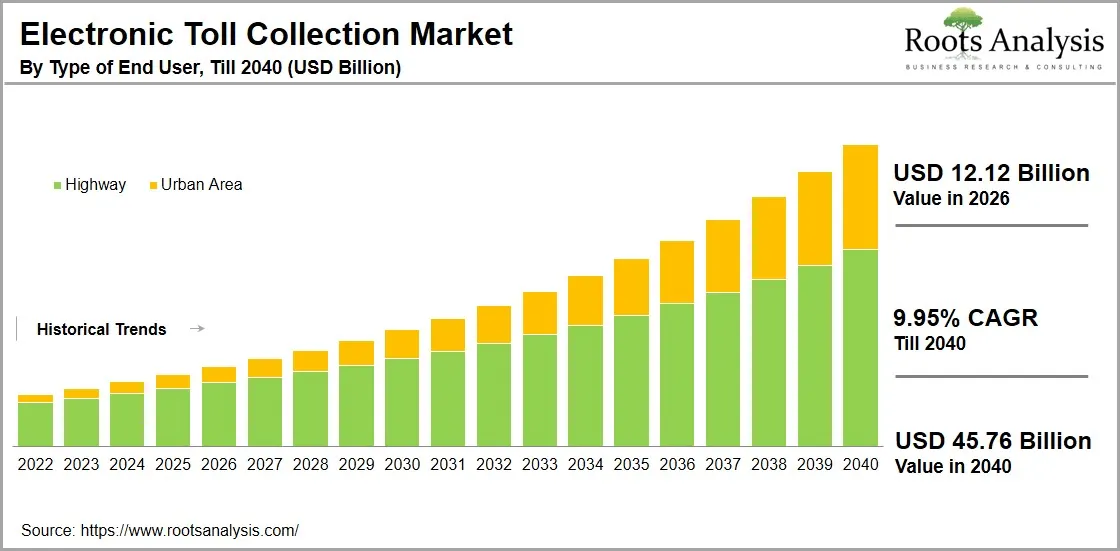
The electronic toll collection market size is projected to grow from $12.12 billion in 2026 to $45.76 billion by 2040, representing a CAGR of 9.95%, during the forecast period 2026-2040.
To learn more about this report, request a free sample copy
The new research study consists of industry trends, detailed market analysis, key market trends of electronic toll collection market, SWOT analysis and value chain analysis.
Electronic toll collection (ETC) systems have revolutionized the way tolls are collected, offering significant advantages over traditional methods. ETC systems utilize various technologies to identify vehicles and collect tolls toll including number plate recognition (ANPR), radio communication (RFID) and global navigation satellite systems (GNSS). Recently, the Indian government planed to launch a GPS-based toll collection system on national highways as a pilot project, in addition to the existing FASTags system.
ETC helps in traffic congestion, funding for road infrastructure and faster commute for people. Further, it also provides cost savings, with ETC lanes handling more vehicles per hour compared to manual or automatic coin machine lanes. Additionally, ETC systems can reduce emissions by minimizing vehicle idling and acceleration, making them a more environmentally friendly option.
The technology is adaptable and can be integrated with smartphone apps, allowing for real-time toll payments and enhanced user convenience. Also, can provide certain concessions for green vehicle, low-income individuals and can be integrated with any future technology. Notably, India recorded a 46% year-over-year increase in toll collections through FASTag systems.
Furthermore, with ongoing technological transformative period, driven by innovations, such as open road tolling and GPS based toll collection, will further streamline the tolling process. In addition, helping vehicles to pass through toll points without slowing down or stopping, as toll would be collected through GPS tracking your vehicle.
Thus minimizing traffic congestion and air pollutant emissions. It is worth mentioning that the rise in internet and smart phone penetration has helped in integration of mobile applications for real-time toll payments is also expected to become more prevalent, providing drivers with greater convenience and flexibility.
Additionally, the development of smart cities that leverages data analytics and artificial general intelligence will enable better traffic management and dynamic pricing strategies. Therefore, making toll collection more efficient and responsive to real-time conditions, these factors would help in boosting electronic toll collection demand for electronic toll collection in the near future.
The market report presents an in-depth analysis of the various manufacturers / service provides that are involved in this market across different segments, as defined in the table below:
| Key Report Attributes | Details | |
| Historical Trend | Since 2022 | |
| Base Year | 2025 | |
| Forecast Period | 2026-2040 | |
| Market Size Value in 2026 | $ 12.12 Billion | |
| Market Size Value by 2040 | $ 45.76 Billion | |
| Growth Rate | CAGR of 9.95% from 2026 to 2040 | |
Type of Electronic Toll Collection |
|
|
| Type of Technology |
|
|
| Type of End-User |
|
|
| Type of Offering |
|
|
| Geographical Regions |
|
|
| Leading Market Players |
|
|
| PowerPoint Presentation (Complimentary) |
Available | |
| Customization Scope | 15% Free Customization | |
| Excel Data Packs (Complimentary) |
|
|
The global electronic toll collection market is segmented into different types of electronic toll collection, namely automatic vehicle identification system, automatic vehicle classification system, violation enforcement system and others. As per market research, automatic vehicle identification system is anticipated to be a leading segment with the largest electronic toll collection market share and is also projected to grow at the fastest pace. The growth is driven by the rising adoption of FASTag, which allows for the easiest and most convenient way to collect toll tax.
This segment describes different types of technology of the market which include cell phone tolling, dedicated short range communication (DSRC), global navigation satellite system (GNSS) / GPS, radio frequency identification (RFID), video analytics and others. Currently, radio frequency identification (RFID) is capturing the highest market share and is dominating the electronic toll collection market.
This can be ascribe to its feature of precise vehicle identification capabilities, automated toll collection, widespread adoption, technological maturity and cost-effectiveness. However, global navigation satellite system (GNSS) / GPS is expected to grow at the fastest pace over the forecasted period. This can be attributed to growing demand for GPS tolling systems and is about to be implemented in many developing countries, including India.
Based on the type of end-user, the electronic toll collection industry is bifurcated into highway and urban area. According to our prediction, the highway segment dominates the electronic toll collection industry and is projected to gain the majority of the market share. Owing to the increasing focus of governments and transportation authorities on improving toll collection efficiency and traffic flow on highways, the expansion of highway infrastructure in emerging economies, and the generally higher traffic volumes on highways compared to urban areas.
This segment describes different types of offering of the electronic toll collection market which include back-office, hardware and other services. Currently, the back-office is capturing the highest market share and is also expected to grow at the highest CAGR during the forecast period. This can be attributed to expanding support to the growing adoption of automated tolling systems worldwide.
This segment highlights the distribution of the electronic toll collection market across various geographical regions, such as North America, Europe, Asia, Latin America, Middle East and North Africa and rest of the world. In terms of revenue, North America is a dominating region and captures the largest electronic toll collection market share. Owing to the advanced transportation infrastructure and the presence of major industry players, such as Cubic Corporation, Raytheon.
However, Asia, is expected to grow with fastest CAGR over the forecasted period. The driving factor of the region’s growth can be ascribed to rising digitalization and industrialization, the large population, extensive road network, supportive regulatory environment, and high adoption rates in developing Asian nations.
The electronic toll collection (ETC) market is experiencing rapid electronic toll collection growth driven by the urgent need to mitigate traffic congestion, reduce road accidents, and enable faster and more efficient toll collection through the adoption of cashless tolling systems. It is worth mentioning that the market is dominated by transponder-tag-based tolling systems using RFID technology and prepaid payment methods, with public-private partnerships playing a key role in the nationwide development of highways and expressways.
With the presence of several small and large electronic toll collection companies, the market is experiencing intense competition and changing market dynamics. From large multinational companies to local electronic toll collection players, companies are striving to enhance their competitive edge. In terms of market share, large enterprises and multinational companies are dominating the market.
While small electronic toll collection players are continuously improving their products to cater to niche markets, or they are offering specialized services. These industry players are focusing on adopting competitive strategies, such as developing innovative extracting techniques, forming strategic alliances and partnerships to expand their portfolios and global footprint, investing in recent developments and new feature launches to enhance their offerings.
Major driving factors of the electronic toll collection market include advancements in industrial automation, rising demand for cashless transactions and technological advancements, including adoption of AI. Rapid urbanization and traffic congestion are pushing for more efficient toll collection methods, while the environmental benefits of reduced vehicle emissions enhance the appeal of ETC systems.
Apart from this, many governments are investing in transportation infrastructure to improve mobility and reduce traffic congestion. For instance, initiatives, including President Joe Biden's proposed infrastructure overhaul are likely to support the expansion of electronic tolling systems in the US. These above-mentioned factors will likely foster the growth of the electronic toll collection market during this forecast period.
With regard to regional insights, the North America region is likely to dominate the electronic toll collection industry and is expected to grow with the highest CAGR over the forecasted period. The region's robust infrastructure, coupled with the widespread adoption of systems like E-ZPass, continues to underpin market growth. Furthermore, the high volume of road-based freight transportation acts as a critical catalyst, further accelerating the demand for electronic toll collection solutions.
Examples of key players involved in the electronic toll collection market (which have also been captured in this market report, arranged in alphabetical order) include Conduent, Cubic, EFKON, Feig Electronic, Kapsch TrafficCom, Raytheon Technology, Siemens, Star Systems, Thales and TransCore. This market report includes an easily searchable Excel database of all the companies who have adopted the electronic toll collection market.