
Lowest Price Guaranteed
Slides
188
Last Updated
December 2024
View Count
10258
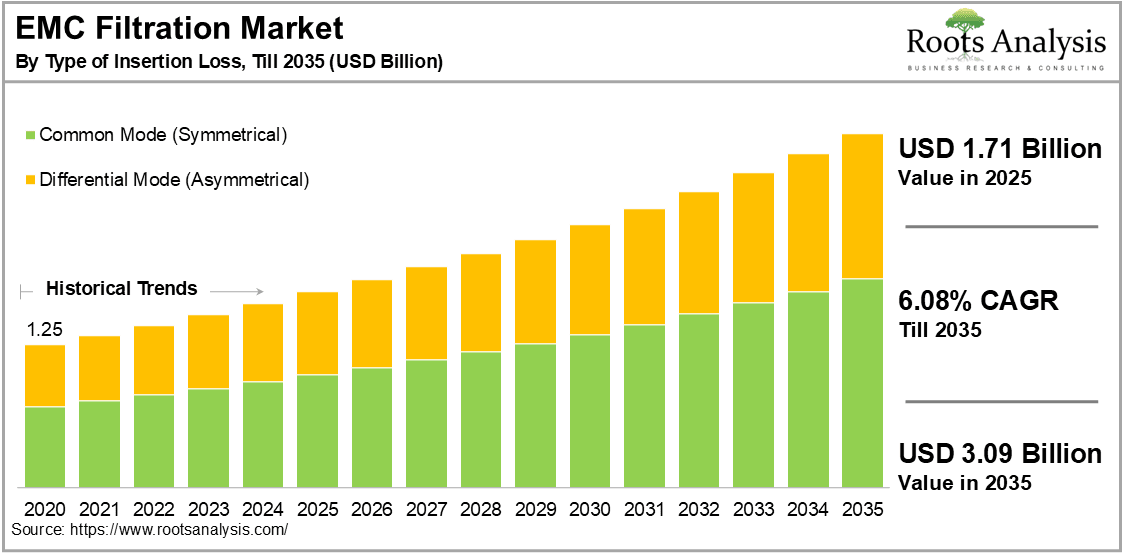
According to the global EMC filtration market size forecast, the market is projected to grow from USD 1.71 billion in 2025 to USD 3.09 billion by 2035, representing a CAGR of 6.08%, during the forecast period 2025-2035.
 |
To learn more about this report, request a free sample copy
The new research study consists of EMC filtration analysis, detailed EMC filtration market analysis, mega trends, patent analysis, porter five forces, SWOT analysis, value chain analysis and other strategic frameworks.
The global EMC (electromagnetic compatibility) filtration market is a crucial component of the broader electronics and electrical industry, playing a pivotal role in ensuring the reliable and efficient operation of electronic devices and systems. EMC filtration refers to the use of specialized filters and components designed to mitigate the effects of electromagnetic interference (EMI) and electromagnetic compatibility (EMC) issues, which can disrupt the performance and functionality of electronic equipment.
The increasing complexity and proliferation of electronic devices, coupled with the growing reliance on advanced technologies in various industries, have fueled the demand for robust EMC filtration solutions. These solutions are necessary in maintaining the integrity and reliability of electronic systems, preventing interference, and ensuring compliance with EMC standards and regulations. The market is witnessing a steady growth in the recent years, driven by the adoption of electronic devices, the growing focus on energy efficiency and power quality, and the ongoing development of cutting-edge technologies in sectors ,such as automotive, industrial automation, and consumer electronics.
The EMC filtration industry report presents an in-depth analysis of the various companies that are involved in offering EMC filtration solutions, across different segments, as defined in the table below:
| Key Report Attributes | Details | |
| Historical Trend | Since 2020 | |
| Forecast Period | 2025-2035 | |
| Market Size Value in 2025 | $ 1.71 Billion | |
| Market Size Value by 2035 | $ 3.09 Billion | |
| CAGR (Till 2035) | 6.08% | |
| Type of Product |
|
|
| Areas of Application |
|
|
| Type of Insertion Loss |
|
|
| Type of Services |
|
|
| Type of Technology |
|
|
| Type of Component |
|
|
| Type of End-Users |
|
|
| Company Size |
|
|
| Geographical Regions |
|
|
| Leading Market Players |
|
|
| PowerPoint Presentation (Complimentary) |
Available | |
| Customization Scope | 15% Free Customization | |
| Excel Data Packs (Complimentary) |
|
|
Based on the type of product, the global EMC filtration market is split into customer filters, EMC filters, power quality filters, single phase EMC filters, three-phase EMC filters, and others. Among these categories, the EMC filters market growth is expected to be the maximum, capturing a market share of 38.34% by 2035. This growth is the result of its crucial role in protecting electronic systems by eliminating unwanted noise and avoiding electromagnetic interference.
These filters, being the most significant ones in the EMC filtration market, propel the market growth due to the applications of EMC filtration in automotive, telecommunications, consumer electronics, and healthcare industries. Furthermore, it is worth highlighting that the power quality filters segment is expected to witness the fastest CAGR of around 10.56% during the forecasted period. This growth is driven by the increasing importance of energy efficiency and the requirement for reliable power sources in industrial and commercial sectors.
The global EMC filtration market is segmented into various areas of application, such as automobile, building technologies, commercial, consumer electronics, data centers, energy and utilities, EV charging, home appliances, industrial, medical equipment, military and aerospace, oil and gas, renewable energies, smps/power supplies, smart infrastructure, telecom, UPS and others. According to our EMC filtration industry analysis, the commercial segment will augment the segment's growth with the largest market share of EMC filtration of over 30.56% by the next decade.
This growth can be attributed to the extensive applications of EMC filtration in offices, retail environments, and commercial facilities where effective electromagnetic compatibility is crucial to ensure reliability. Furthermore, the consumer electronics segment is expected to witness the fastest CAGR of around 8.7% during the forecasted period. This growth is driven by stringent EMC guidelines and standards that are increasingly enforced in this sector, alongside the proliferation of electronic devices requiring compliance with electromagnetic compatibility standards.
The global EMC filtration market is segmented into various types of insertion loss, such as common mode (symmetrical) and differential mode (asymmetrical). According to our global EMC filtration analysis, the common mode (symmetrical) segment will augment the market's growth with a market share of 78.65% by 2035. This can be attributed to its critical role in effectively reducing common-mode electromagnetic interference (EMI), which is prevalent in various electronic applications, particularly in industrial and commercial sectors. Furthermore, it is also worth highlighting that the differential mode (asymmetrical) segment is expected to witness the fastest CAGR of around 7.56% during the forecasted period. This growth is the result of the increasing complexity of electronic systems and the rising demand for advanced filtering solutions that can address differential mode noise effectively.
The market is segmented into various types of services, namely consulting, installation, maintenance, and testing. According to our EMC filtration market forecast, the consulting segment will augment the market's growth with a market share of 54.65% during the forecasted period. This growth can be attributed to the increasing complexity of electronic systems and the need for expert guidance to ensure compliance with stringent electromagnetic compatibility (EMC) regulations across various industries. On the other hand, the testing segment is expected to witness the fastest CAGR of about 7.56% during the forecasted period. This growth is driven by the rising demand for thorough testing of electronic devices to ensure they meet regulatory standards and perform reliably in their intended environments.
The market is segmented into various types of technology, such as surface mount technology, thick film technology, thin film technology, and through-hole technology. According to our EMC filtration market analysis, the surface mount technology segment is anticipated to gain the maximum market share of around 45.78% over this forecast period. This can be attributed to its advantages, including smaller size, lower manufacturing costs, and ease of integration into modern electronic devices. SMT is widely used in consumer electronics and industrial applications, making it a preferred choice for manufacturers. On the other hand, the thick film technology segment will witness the fastest CAGR of around 8.95% during the forecasted period. This can be attributed to the increasing demand for high-performance and reliable filtering solutions in various applications, including automotive and telecommunications.
The market is segmented into various components, such as capacitors, inductors, resistors, and transformers. According to our EMC filtration market analysis, the capacitors segment is anticipated to gain a maximum market share of around 62.78% over this forecast period. This growth is the result of their effectiveness in attenuating high-frequency noise and their essential role in maintaining signal integrity across electronic systems. On the other hand, the inductors segment is expected to witness the fastest CAGR of around 8.9% during the forecasted period. The growth is attributed to the increasing complexity of electronic devices and the need for enhanced filtering solutions that can effectively manage both common-mode and differential-mode noise.
The market is segmented into various end-users, such as aftermarket, and OEMs. According to our EMC filtration market analysis, the OEM segment is anticipated to gain a maximum market share of around 72.78% over this forecast period. This growth is the result of the increasing integration of EMC filters in new electronic products and systems during the manufacturing process. On the other hand, the aftermarket segment is expected to witness the fastest CAGR of around 7.9% during the forecasted period. The growth is attributed to the rising need for retrofitting existing equipment with effective EMC solutions to comply with updated regulations and improve performance.
The global EMC filtration market is fragmented into multiple types of enterprise namely large and small and medium enterprise. Currently, the large enterprise segment is anticipated to dominate the segment with 73.34% of EMC filtration market share. However, small and medium enterprise segments are expected to witness a relatively higher (9.28%) EMC filtration market growth rate until 2035. This is ascribable to their agility, innovation, focus on niche markets, and ability to adapt to changing customer preferences and market conditions.
This segment highlights the distribution of regional analysis of EMC filtration markets, such as North America, Europe, Asia, Latin America, Middle East and North Africa, and the rest of the world. According to our EMC filtration market regional outlook, Asia currently exhibits dominance with 37.69% of overall market share. This growth is owed to the rapid demand for EMC filters in electronics and expansion of the electrical industries in countries like China, India, and Japan. The region’s flourishing manufacturing sectors, particularly in industries such as automotive, consumer electronics, and industrial automation are significant contributors in the global EMC filtration market growth.
The “EMC Filtration Market, Till-2035: Industry Trends and Global Forecasts” report features an extensive study of the current market landscape, market size and future opportunity within the EMC filtration market, during the given forecast period. The market report highlights the efforts of several stakeholders involved in this rapidly emerging segment of the service providers industry. Key takeaways of the EMC filtration market report are briefly discussed below.
According to EMC filtration industry trends, the market is expected to be driven by the increasing adoption of electronic devices and stringent regulatory standards. The rapid increase in electronic devices across multiple industries is a key factor propelling the growth of the EMC filtration market. With the swift digital transformation of processes and the emergence of technologies such as IoT, 5G, and edge computing, the demand for electronic devices has surged dramatically. Furthermore, stringent regulatory requirements aimed at ensuring electromagnetic compatibility and mitigating electromagnetic interference in electronic systems are also contributing to the market's expansion. Governments around the world are enforcing strict regulations to guarantee that electronic products meet EMC standards, particularly in critical sectors such as automotive, aerospace, healthcare, and telecommunications.
With the presence of several small and large companies, the competitive landscape in the EMC filtration industry is experiencing intense competition and changing market dynamics. From large multinational companies to local players, companies are striving to enhance their competitive edge. In terms of market share, large enterprises and multinational companies are dominating the market. The key players are using strategies such as partnerships, acquisitions, ventures, innovations in EMC filtration, novel product launches, R&D and geographical expansions in an attempt to solidify their position in the industry.
For instance, in August 2024, JLR announced the opening of a new testing facility to test the next generation vehicles for electrical and radio interference. In reference to this, Peter Philips, Senior Manager at JLR stated that the importance of testing our vehicles for electromagnetic compatibility cannot be underestimated. Opening the new testing facility is an important step forward for the business and will also play a crucial role in helping us deliver quality, legal and customer satisfaction.
Despite the strong market growth projection, there are several challenges in electromagnetic compatibility. One significant obstacle is the high implementation costs associated with EMC filtration systems, which can be prohibitively expensive for many organizations, particularly small and medium-sized enterprises. Implementing effective EMC filtration often requires significant initial investments in specialized equipment, materials, and engineering expertise. The need for customization to tackle specific electromagnetic interference (EMI) challenges in various electronic systems further increases the overall costs associated with implementation. Additionally, the ongoing maintenance and operational expenses linked to EMC filtration systems contribute to the financial burden, which can discourage some organizations from pursuing these solutions, even when they acknowledge the necessity of mitigating EMI.
With respect to regional EMC filtration industry insights, Asia is likely to dominate the market for the forecasted period. The dominance of this region is owed to the rising advancements in EMC filtration technology, stringent government regulations, and the increasing manufacturing and usage of electrical and electronic devices driven by a large population. Additionally, government and regulatory bodies, such as CISPR standards, enforce stringent EMC regulations, mandating the use of EMC filters in various electronic products to minimize EMI and ensure product safety and reliability.
Examples of leading companies in EMC filtration market (which have also been captured in this market report, arranged in alphabetical order) include Amphenol, Astrodyne, Chokes International, Curtis Industries, DEM, Delta, EPCOS, ETS, Emitech Micro, Ferrishield, High & Low, Kemet, Laird Performance, Littelfuse, Murata, Murrelektronik, Ohmite, Panasonic, PREMO, REO, Rohde & Schwarz, Schaffner Holding, Schurter Holding, Sinexcel, Soshin Electric, TDK, TE Connectivity, Total EMC, Tri-Mag, Würth Elektronik, YAGEO.
At Roots Analysis, we genuinely care about your success and understand that your business requirements are unique. While our EMC filtration research reports provide valuable insights, we recognize that they might not cover every aspect you need to make well-informed strategic decisions. To account for that, we offer 15% free report customization tailored to your specific needs. Whether you require additional quantitative analysis, qualitative insights, or any other information related to the EMC filtration market, reach out us today at: support@rootsanalysis.com