
Lowest Price Guaranteed
Slides
168
Last Updated
December 2024
View Count
11697
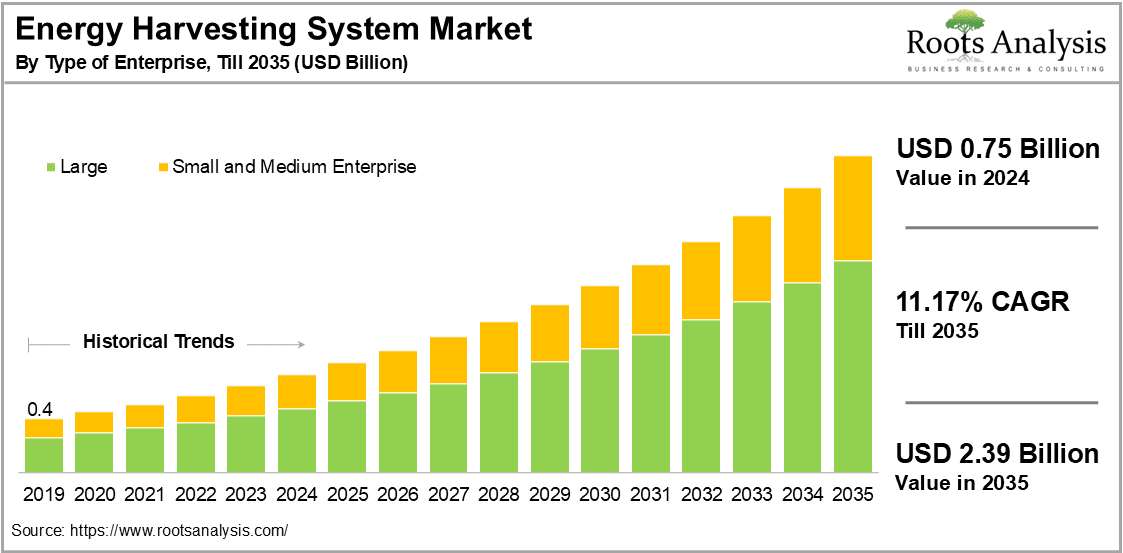
The energy harvesting system market size is projected to grow from USD 0.75 billion in 2024 to USD 2.39 billion by 2035, representing a CAGR of 11.17%, during the forecast period till 2035.
 |
To learn more about this report, request a free sample copy
The new research study consists of industry analysis, detailed market analysis, mega trends, patent analysis, porter five forces, SWOT analysis, value chain analysis and other strategic frameworks.
In 2023, global energy consumption growth rate increased by 2.2%, which historically was 1.5% between 2010-2019. This signifies the emergence of energy harvesting system and has proven to be one of the efficient ways for reliable and sustainable and renewable energy solutions. Functioning of energy harvesting system typically involves capturing ambient energy, such as solar, thermal, kinetic, and vibrational energy and convert it into usable electrical power. Few of the major advantages of energy harvesting system include eliminate the need for wired power sources, reduce maintenance costs associated with battery replacement, and enhancement of the sustainability of electronic devices. It is worth noting that utilization of energy harvesting system in major industries is on surge due to rapid penetration of renewables technologies and rising awareness among masses.
The energy harvesting system market is emerging as a critical component in the global shift towards sustainable energy market innovation and digital advancement to reach higher renewable energy solutions. Innovations, such as hybrid systems combining flexible organic solar cells with triboelectric nanogenerators (TENGs) have emerged, significantly boosting energy output by capturing both solar and mechanical energy simultaneously. Consequently, smart grid technologies and energy storage solutions are addressing the intermittent challenges associated with renewable sources. Further, as the demand for energy generation continues to grow, the energy harvesting system market is anticipated to witness noteworthy growth during this forecast period. Notably, Moira Cyphers, ACP Director of Atlantic Offshore & Eastern State Affairs mentioned that focusing on improving battery storage systems will facilitate the renewable energy integration strategies, leading to a more sustainable energy future.
The energy harvesting system market research report presents an in-depth analysis of the various service providers that are involved in offering energy harvesting system solutions, across different segments, as defined in the table below:
| Key Report Attributes | Details | |
| Historical Trend | Since 2019 | |
| Forecast Period | Till 2035 | |
| Market Size Value in 2024 | $ 0.75 Billion | |
| Market Size Value by 2035 | $ 2.39 Billion | |
| CAGR (Till 2035) | 11.17% | |
| Type of Technology |
|
|
| Type of Component |
|
|
| Type of Application |
|
|
| Type of Enterprise |
|
|
| Geographical Regions |
|
|
| Leading Market Players |
|
|
| PowerPoint Presentation (Complimentary) |
Available | |
| Customization Scope | 15% Free Customization | |
| Excel Data Packs (Complimentary) |
|
|
Based on the type of technology, the global energy harvesting system market is split into light, radio frequency, thermal and vibration. Currently, among the categories, the vibration-based energy harvesting solutions segment is expected to gain more than 55% of the market share. This can be ascribed to its adaptability and efficiency in converting ambient mechanical vibrations into electrical energy. However, the light segment is expected to grow at a relatively higher (12.37%) growth rate over the forecasted year. This can be attributed to rising global demand for renewable energy solutions, driven by environmental concerns and government initiatives aimed at reducing emissions.
The global energy harvesting system market is fragmented into multiple type of component, namely battery, capacitor, controller and transistor. Currently, the transistor segment is anticipated to dominate the segment with more than 45% of the energy harvesting system market share. Further, this segment is expected to grow with a relatively higher CAGR in the forecasted period. The prominent reason for this dominance includes their fundamental role in converting various forms of ambient energy capture technologies such as solar, thermal, mechanical, and electromagnetic into electrical power.
The global energy harvesting system market is fragmented into multiple types of application, namely automation, consumer electronics, industrial and transportation. Currently, the consumer electronics segment is anticipated to dominate the segment with more than 45% of energy harvesting system market share. Further, this segment is expected to grow with a relatively higher (16.25%) CAGR in the forecast period. This can be attributed to the rapid proliferation of portable and wearable devices that require efficient and sustainable power solutions. As consumer demand for smart gadgets such as fitness smartwatches, and wireless sensors continues to rise manufacturers are increasingly incorporating energy harvesting technologies.
Based on the types of enterprise, the global energy harvesting system market is segmented into large and small and medium enterprise. According to our analysis, the large enterprises are leading the segment with more than 65% of market shares and are expected to growth with a relatively higher CAGR in the forecasted period. This can be attributed to its capacity to invest in advanced energy harvesting system and techniques, benefit from government initiatives, increase economies of scale, and drive business growth.
This segment highlights the distribution of energy harvesting system across various geographical regions, such as North America, Europe, Asia, Latin America, Middle East and North Africa, and the rest of the world. According to our analysis, North America exhibits dominance in the market with more than 40% of the energy harvesting system market share in the global marketplace. This can be attributed to its robust technological infrastructure and significant investment in innovation, which fosters the rapid development and integration of these systems. However, Asia Pacific growth in energy harvesting systems is expected to grow with a relatively higher (13.74%) CAGR in the forecasted period. Prominent reasons for this growth include region’s rising electricity demand driven by industrialization and urbanization, coupled with a growing focus on energy-efficient devices and smart building applications of energy harvesting in countries such as India, China and Japan
The "Energy Harvesting System Market, Till-2035: Industry Trends and Global Forecasts" report features an extensive study of the current market landscape, market size and future opportunity within their energy harvesting system market dynamics, during the given forecast period. The market report highlights the efforts of several stakeholders involved in this rapidly emerging segment of the service providers industry. Key takeaways of the energy harvesting system market report are briefly discussed below.
The demand for renewable energy is increasing, which will mark energy harvesting system to be crucial innovation in the renewable energy generation sector. Key driving factors include increasing energy harvesting system technological advancements such as IoT integration in energy harvesting, increasing awareness about sustainability and encouraging energy harvesting technology investment opportunities. Further, the rise in government support and initiatives promoting energy harvesting system innovation will play a crucial role in shaping the future of energy harvesting system market. Notably, the need for low-maintenance power solutions in remote environments and integration into building automation technologies further contribute to the growth of energy harvesting systems.
With the presence of several small and large energy harvesting system companies, the market is experiencing intense competition and changing market dynamics. From large multinational companies to local energy harvesting system players, companies are striving to enhance their competitive edge. In terms of market share, large enterprises and multinational companies are dominating the market. While small energy harvesting system players are continuously improving their products to cater to niche markets, or they are offering specialized services. These industry players are focusing on adopting competitive strategies, such as developing innovative energy harvesting system techniques, forming strategic alliances and partnerships to expand their portfolios and global footprint, investing in recent developments and new feature launches to enhance their energy harvesting system offerings.
Despite strong market growth projection, the energy harvesting system market faces numerous challenges, including high capital costs, complex infrastructure and maintenance issues. Notably, some of the other challenges are as integration with existing infrastructure can be complex and costly and supply chain disruptions have hindered production and delivery. Additionally, fluctuating policies and regulations can create an unpredictable environment for investors in the energy harvesting system sector, lack of education and skilled labor can reduce energy harvesting system adoption across regions. Addressing these mentioned challenges in energy harvesting system deployment is essential for expansion of energy harvesting system market growth in the near future.
With respect to regional energy harvesting system market insights, North America is likely to dominate the market for energy harvesting system. Primarily, due to its strong technological leadership, substantial adoption across sectors like home automation and healthcare, and increasing demand in consumer electronics, particularly for smart devices. The region's ongoing advancements as energy harvesting systems are increasingly integrated into medical devices, allowing for autonomous operation without frequent battery replacements. Notably, government policies promoting renewable energy solutions and heightened environmental awareness further support this growth.
Examples of key players involved in the energy harvesting system market (which have also been captured in this market report, arranged in alphabetical order) include ABB, Advanced Linear Devices, Analog Devices, Cedrat Technologies, EnOcean, Honeywell, Kinergizer, Laird Connectivity, Microchip Technology, Mide Technology, Perpetua Power, Powercast, Renesas Electronics, STMicroelectronics, Texas Instruments and Xidas. This market report includes an easily searchable excel database of all the companies who have adopted the energy harvesting system market.
The market report presents an in-depth analysis, highlighting the capabilities of various companies engaged in this domain, across different segments. Amongst other elements, the market report includes:
At Roots Analysis, we genuinely care about your success and understand that your business requirements are unique. While our market research reports provide valuable insights, we recognize that they might not cover every aspect you need to make well-informed strategic decisions. To account for that, we offer 15% free report customization tailored to your specific needs. Whether you require additional quantitative analysis, qualitative insights, or any other information related to the energy harvesting system market, reach out us today at: support@rootsanalysis.com