


 Download Free Sample
 Buy Now
Market Size
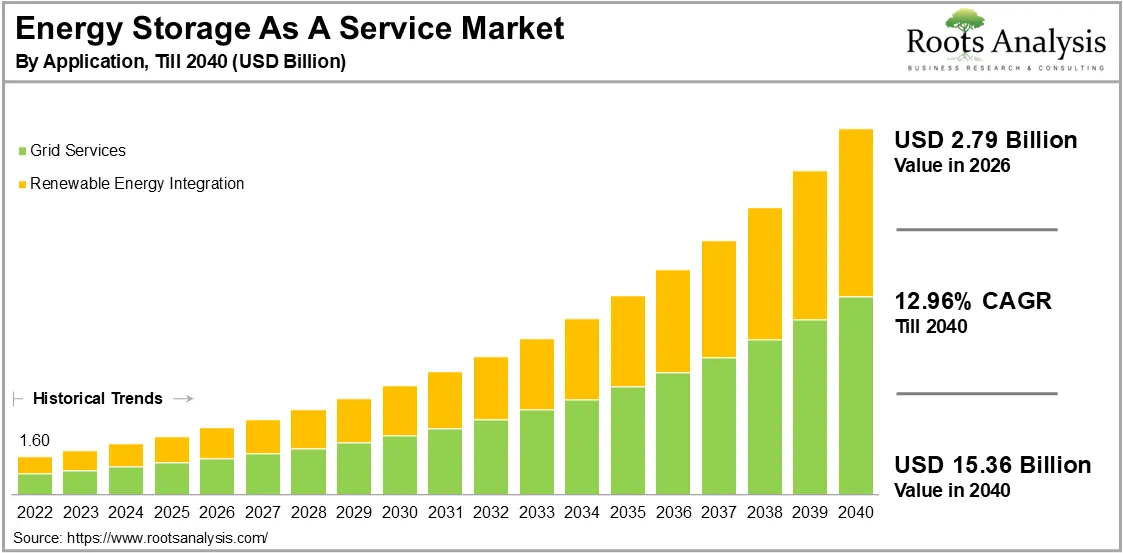
The global energy storage as a service market, valued at USD 2.43 billion in 2025, is projected to reach USD 2.79 billion in 2026 and USD 15.36 billion by 2040, with a CAGR of 12.96% during the forecast period 2026 to 2040.
See What’s in the Full Report–Request Your Complimentary Insights!
Market Report: Key Takeaways
- In terms of service, customer energy management services secure 32.10% of the overall revenue share of the global market.
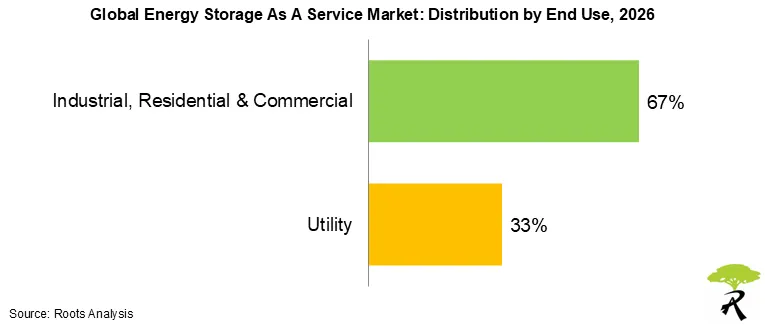
- In terms of end use Industrial, Residential & Commercial hold the largest share (67%) of energy storage as a service market.
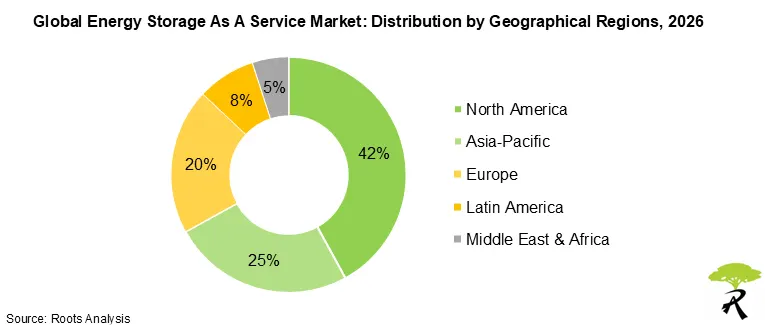
- In terms of leading region, North America holds the largest share with 42% share of the market.
- Key market drivers are the rising renewable energy adoption and grid modernization.
Market Overview
Energy storage as a service (ESaaS) refers to a subscription-based model where third-party providers own, operate, and maintain energy storage systems, such as advanced batteries, on behalf of customers, eliminating the need for upfront capital investment. This third-party energy storage ownership approach combines hardware like lithium-ion or flow batteries with sophisticated energy storage performance contracting, enabling facilities to access storage benefits through flexible agreements that outline performance, payments, and operational terms. By outsourcing procurement, installation, monitoring, and upkeep, ESaaS lowers entry barriers for diverse users while ensuring optimized system performance.
ESaaS supports critical functions like peak shaving, where systems store excess energy during low-demand periods and discharge it to flatten grid draws, reducing demand charges. It facilitates energy arbitrage by capitalizing on price fluctuations, storing low-cost electricity for high-price discharge, alongside participation in ancillary markets for frequency regulation and reserves. ESaaS applications in peak load management and demand response extend to backup power, renewable integration, and demand response, enhancing grid stability and enabling commercial, industrial, and utility sectors to balance intermittent sources without operational disruptions.
The surge in renewable energy deployment, coupled with net-zero ambitions, demands flexible energy storage solutions to manage variability, positioning ESaaS as a vital enabler for grid modernization and long-duration solutions. Policy frameworks like the EU’s Clean Energy Package promote storage across the electricity value chain, while evolving technologies, such as diverse systems including pumped hydro and thermal storage, bolster reliability and scalability. Corporate pushes for sustainable, cost-effective energy strategies further accelerate adoption, as ESaaS aligns with operational efficiency amid rising electrification and decentralized grids.
Pay Only for What You Need – The Best Way to Optimize
Recent Developments
- In May 2025, ABB introduced battery energy storage as a service to simplify renewable energy adoption.
Market Share Insights
Customer Energy Management Services to Lead the ESAAS Market
According to the energy storage as a service market report, customer energy management services dominate with the largest revenue share, around 32.10%. This leadership stems from its integration of energy storage systems with advanced tools like smart meters, sensors, and data analytics, enabling optimized consumption, cost reductions, and sustainability contributions for commercial and industrial users.
Ancillary services are projected for high CAGR expansion (11.9%), driven by utilities’ shift from fossil fuels to battery storage for voltage control and spinning reserves, enhancing grid efficiency with volatile renewable inputs.
Industrial, Residential & Commercial Sub-Segment to Shape the Future of ESaaS
Industrial, Residential & Commercial dominates the end-use segment, holding over 67% share. The energy storage as a service solutions for commercial and industrial users segment leads due to high energy demands in commercial buildings for applications like district energy systems, alongside industrial needs for constant power, backups, and cost reductions via charge management. Residential adoption further boosts its position through optimized renewable integration and tariff management in smart homes.
The dominance persists because these users require tailored, scalable solutions for operational stability, unlike utilities’ broader grid focus. Commercial and industrial entities prioritize resilience against disruptions and efficiency gains, driving larger deployments and also fueling the commercial ESaaS market.
Want Information on Specific Region / Segment?
Regional Energy Storage As A Service Market Forecast Suggests Dominance of Asia-Pacific
North America dominates the energy storage as a service market, with a 42% revenue share in the current year. This leadership arises from robust demand in smart buildings, building automation, and commercial sectors, alongside rising energy needs in automotive, aerospace, and healthcare industries.
Supportive government policies, public-private investments in renewables, and electric vehicle adoption further solidify its position, particularly in the U.S. and Canada. Strict environmental regulations and net-zero goals accelerate ESaaS deployment for grid reliability and efficiency.
Asia-Pacific grows fastest due to rapid industrialization, high energy consumption, and untapped markets in China, India, Japan, and South Korea.
Market Dynamics
Market Drivers
- Rising Renewable Energy Adoption and Grid Modernization: The increasing deployment of solar and wind energy fuels demand for adaptable, scalable ESaaS solutions to manage intermittency and maintain grid stability. This trend makes renewable energy storage as a service a critical driver for cleaner, more resilient power infrastructure.
- Declining Battery Costs and Technological Advancements: Reducing prices of advanced battery technologies like lithium-ion and flow batteries, alongside enhanced energy management software, are making ESaaS more cost-effective and efficient for utilities, commercial enterprises, and industrial users.
- Supportive Government Policies and Incentives: Government programs offering incentives, tax credits, net metering, and renewable integration mandates across North America, Europe, and select APAC regions are accelerating the adoption of energy storage solutions and ESaaS business models.
Market Challenges
- Grid Integration and Interconnection Complexity: Lengthy and intricate procedures for linking energy storage systems to existing grids, particularly in regions where utilities have limited experience, pose challenges for smooth service implementation.
- Ensuring Long-term Performance and Reliability: Maintaining consistent service quality, battery health, and financial performance over multi-year contracts requires advanced technology, detailed analytics, and stringent monitoring.
- Fragmented Regulations and Delayed Policy Alignment: Inconsistent regulatory frameworks and slow policy updates create obstacles for scaling, complicating market standardization and hindering cross-border expansion of ESaaS models.
Key Market Insights
Competitive Landscape of Key Market Players
The competitive landscape in the ESaaS market is dominated by a handful of vertically integrated energy storage service providers leveraging advanced battery technologies, AI-driven optimization, and strategic partnerships to deliver turnkey solutions. Fluence Energy leads with its focus on grid-scale deployments and long-term service contracts, often collaborating with utilities for frequency regulation and renewable integration, and fueling the grid-scale ESaaS market.
Tesla Inc. excels in scalable, software-enabled systems that enable energy arbitrage and residential-commercial applications, bolstered by its ecosystem of solar and storage hardware. Siemens Energy and AES Corporation round out the top tier, with Siemens emphasizing modular ESaaS models for industrial efficiency and AES prioritizing utility-scale stability through innovative financing and operations.
Market Trends in ESaaS for Grid Stability and Renewable Integration
ESaaS trends emphasize battery energy storage systems (BESS) for grid stability, prioritizing availability over capacity with software-defined controls for reliable dispatch. Modular, hardware-agnostic systems at the grid edge enable scalability, adapting to market rules and revenue stacking amid rising renewables. Hybrid systems integrate with SCADA for balancing commercial and grid compliance needs, reducing curtailment and responding to disturbances.
Cost-Benefit Analysis of EsaaS VS Traditional Energy Storage Ownership
ESaaS offers lower upfront capital costs via subscription models, shifting ownership risks to providers and enabling scalability without large investments. Benefits include access to advanced software, remote monitoring, and maintenance, reducing operational expenses compared to traditional ownership's full CapEx and upkeep burdens.
Traditional models suit long-term users with predictable needs but expose owners to technology obsolescence and supply chain vulnerabilities. ESaaS excels in flexibility for volatile renewables, stacking revenues from grid services while guaranteeing availability, yielding faster ROI through efficiency gains. Overall, ESaaS provides superior cost predictability and risk mitigation for most end-users amid rapid tech evolution.
Regulatory Frameworks for Energy Storage as a Service Providers
Regulations increasingly recognize ESaaS for grid stability, with U.S. Inflation Reduction Act and DOE programs boosting domestic supply chains and long-duration projects. UK's Energy Act 2023 introduces cap-and-floor schemes and connection reforms to reduce bottlenecks and enhance investor certainty.
IEA recommends integrating storage into energy planning, revising market designs for flexibility rewards, and incentivizing recycling. Reforms in ISOs like PJM and ERCOT accelerate deployment via surplus interconnection rules and revenue models for dispatchable resources. Globally, COP29 pledges and EU policies prioritize storage in net-zero goals, addressing permitting delays and interconnection constraints. Providers benefit from tailored incentives but face evolving standards for safety, data, and performance metrics.
Market Segmentation
Energy Storage as a Service Market: Scope of the Report
| Key Report Attributes | Details | |
| Historical Trend | Since 2022 | |
| Forecast Period | Till 2040 | |
| Market Size 2026 | USD 2.79 Billion | |
| Market Size 2040 | USD 15.36 Billion | |
| CAGR (Till 2040) | 12.96% | |
| Segments Covered |
|
|
| Key Players Profiled |
|
|
| PowerPoint Presentation (Complimentary) |
Available | |
| Customization Scope | 15% Free Customization | |
| Excel Data Packs (Complimentary) |
|
|
Market Segments
Based on the research, we have segmented energy storage as a service market into service, service-delivery model, technology, ownership model, application, end use, geographical regions, and leading players.
By Service
- Ancillary Services
- Bulk Energy Services
- Consulting Services
- Customer Energy Management Services
- Distribution Infrastructure Services
- Energy Efficiency & Optimization
- Energy Storage Management
- Energy Supply Services
- Maintenance & Operation
- Microgrid-As-A-Service
- Transmission Infrastructure Services
By Service-Delivery Model
- Pay-For-Service
- Leasing and Rental Models
- Others
By Technology
- Lithium-Ion Batteries
- Flow Batteries
- Flywheels
- Supercapacitors
- Pumped Hydro Storage
- Others
By Ownership Model
- Customer-Owned
- ESCO-Owned
By Application
- Grid Services
- Renewable Energy Integration
By End User
- Industrial, Residential & Commercial
- Utility
By Geographical Regions
- North America
- US
- Canada
- Mexico
- Rest of North America
- Europe
- Austria
- Belgium
- Denmark
- France
- Germany
- Ireland
- Italy
- Netherlands
- Norway
- Russia
- Spain
- Sweden
- Switzerland
- UK
- Rest of Europe
- Asia-Pacific
- Australia
- China
- India
- Japan
- New-Zealand
- Singapore
- South Korea
- Rest of Asia-Pacific
- Latin America
- Brazil
- Chile
- Colombia
- Venezuela
- Rest of Latin America
- Middle East and Africa (MEA)
- Egypt
- Iran
- Iraq
- Israel
- Kuwait
- Saudi Arabia
- UAE
- Rest of MEA
Have Questions? Let’s Get Them Answered.


