
Lowest Price Guaranteed
Slides
165
Last Updated
August 2026
View Count
12556
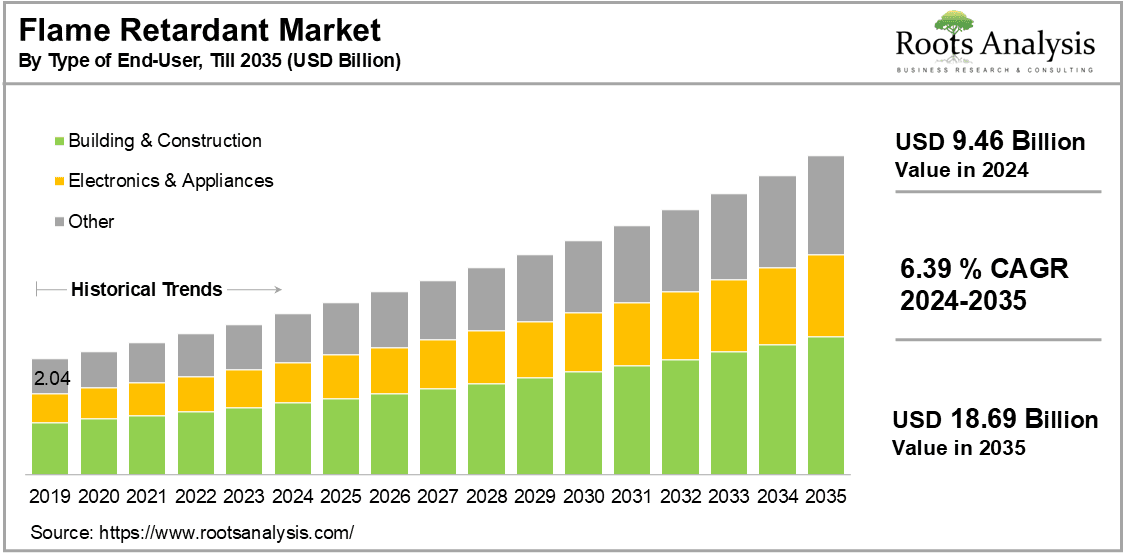
The flame retardant market size is projected to grow from $9.46 billion in 2024 to $18.69 billion by 2035, representing a CAGR of 6.39% during the forecast period 2024-2035.
 |
To learn more about this report, request a free sample copy
The new research study consists of industry trends, detailed market analysis, key market trends of the flame-retardant market, SWOT analysis, and value chain analysis.
A flame retardants are chemical additives which are added to manufactured material including plastics, textiles, and surface coating due to its significance in reducing the flammability of material or prevent the spread of fire. These flame retardants are largely used in many consumer and industrial products to minimize the ability of material to ignite. These substances can be found in three basic types of organic flame retardants, namely bromine, chlorine, and phosphate. Driven by the importance of such chemicals, numerous industries are adding these substances into in the manufacturing of various product, such as furniture fabrics, clothing circuit boards, cables, and interior components which are more prone to catching fire.
According to the US Fire Administration and National Fire Protection Association’s report, in 2019, around 1.3 million fire cases were registered in the US which caused $14.8 billion in property damage. Therefore, the implementation of flame retardant has become indispensable part of fire protection system. Further, it has become essential for every industry as several global and regional safety and regulatory authorities, including REACH and EPA impose stringent regulations for fire safety which is becoming a key factor to accelerate the market growth. However, the growing concerns of the harmful impact of toxic man-made hazardous chemical that have adverse effects on human health and environment, compelled the industry players to develop environment friendly materials. Therefore, the flame retardant market is witnessing a global shift towards environmentally friendly materials like non-halogenated which is likely to expand the ample growth of the flame retardant market during this forecast period.
The market report presents an in-depth analysis of the various service providers that are involved in offering flame retardant market, across different segments, as defined in the table below:
| Key Report Attributes | Details | |
| Historical Trend | 2019-2023 | |
| Base Year | 2023 | |
| Forecast Period | 2024-2035 | |
| Market Size Value in 2024 | $ 9.46 Billion | |
| Market Size Value by 2035 | $ 18.69 Billion | |
| Growth Rate | CAGR of 6.39% from 2024 to 2035 | |
| Type of Product |
|
|
| Type of Application |
|
|
| Type of End User |
|
|
| Geographical Regions |
|
|
| Leading Market Players |
|
|
| PowerPoint Presentation (Complimentary) |
Available | |
| Customization Scope | 15% Free Customization | |
| Excel Data Packs (Complimentary) |
|
|
This segment highlights a variety of products available in the global flame retardant market such as aluminum hydroxide, brominated flame retardants, chlorinated flame retardant, magnesium hydroxide, nitrogen-based flame retardant, and phosphorous flame retardant. On the basis of products, brominated flame retardants are estimated to lift the flame retardant market growth during the forecast period, till 2035 and will capture the major market share. Owing to its high efficiency in fire protection in suppressing and delaying the spread of flames, the product gains higher demand from various applications including textiles, building materials, and electronics which support the brominated flame retardant market demand. Nevertheless, the greater use of nitrogen-based flame retardants in plastic industry due to its benefits in fire resistance, are widely being used in the composition of polymers like polyethylene, polypropylene, and polyurethane. Thus, the nitrogen-based flame retardants will likely expand at a significant CAGR in the coming decade.
There are a variety of applications in the flame retardant market which include epoxy resins, ETP, polyolefins, PVC, rubber, styrenics, and UPE. According to our projection, the polyolefins segment fosters the market growth with the majority of the market share and this dominance is expected to continue in the future as well. The dominance of this segment is ascribed to the widespread use of polyolefin across various applications such as packaging, automotive parts, electrical cables, and construction materials, therefore, propelling the demand for flame retardants. Whereas the PVC segment is likely to grow at a higher CAGR during this projection timeframe due to extensive use in building and construction materials from pipes, and flooring to window profiles where flame retardants play a crucial role in such application. Therefore, the segment will continue to augment the market growth.
The global flame retardant market has miscellaneous end-use industries such as building & construction, electronics & appliances, industrial, textiles, and transportation. According to market research, building & construction industry occupies the largest market share and is anticipated to lead the segment over this forecast period. Due to rising demand for fire safety in building materials, the construction industry raises the demand for flame retardants as strict safety rules in building codes need the use of these products in several materials to improve fire resistance. On the other hands, the electronics & appliances industry is poised to register a faster CAGR over this projection period owing to a greater need for safety in electronic appliances for component protection as well as to prevent fire hazardous due to overheating, electrical faults or short circuits. component protection.
This segment highlights the distribution of the flame retardant market across various geographical regions such as North America, Europe, Asia, Latin America, the Middle East, North Africa, and the Rest of the World. in terms of market revenue, Asia acquires the majority of the flame retardant market share and is expected to continue lead the market for flam retardant throughout this forecast period. Additionally, Europe is expected be the second leading region in the flame retardant market owing to the a high use of flame retardant products from automotive industries coupled with the strict regulation standards. Also, the existence of European companies in the global market substantially propels the market expansion in the region.
The “Flame Retardant Market, Till-2035: Industry Trends and Global Forecasts” report features an extensive study of the current market landscape, market size and future opportunity within their flame retardant market, during the given forecast period. The market report highlights the efforts of several stakeholders involved in this rapidly emerging segment of the service providers industry. Key takeaways of the flame retardant Market report are briefly discussed below.
One of the latest flame retardant industry trends is the increasing focus on non-halogenated flame retardants in plastics. Non-halogen flame retardants incorporate phosphorus, nitrogen, silicon, boron, iron, and aluminum containing flame and these flame retardants need a higher load level and generally require extra adjustment to retain the mechanical properties of the plastics. Also, this shift is driven by the rising demand for eco-friendly and safer flame retardant additives as they include phosphorus, nitrogen-based and mineral flame retardants. Thus, such flame retardants are gaining traction in the market due to their environmental advantages and low cost. In addition, the growing restrictions on hazardous chemicals, owing to their lethal impact on human and environment, in several region from Europe to North America encouraging the use of eco-friendly chemical material. Consequently, these developing industry trends are expected to generate ample opportunities for the flame retardant market scope in the future.
With the presence of numerous industry players and emerging startup companies, the flame retardant market is highly competitive. Global market players along with regional companies changing the market dynamic with their diverse range of products to meet various applications’ requirements. Some of the prominent companies, such as Clariant, Lanxess, ICL, BASF and others leads the market with their non-halogenated solution which focus on environmental safety. Also, they adopt heavy investing in R&D to develop innovative product and sustainable practices to meet stringent regulatory standards. Moreover, key players leverage advanced technology to provide enhanced fire resistance properties and comply with evolving safety standards.
Essentially, the strict fire safety regulations and standards around the world are boosting the flame retardant market growth. Several governments around the world and regulatory bodies, such as REACH in Europe and EPA in the US along with other regional local safety authorities, are enforcing stringent rules and regulations to reduce fire-related dangers. Thus, this is leading to a higher demand for flame retardants across various industries from electronics, and automotive to construction to meet compliance with fair safety standards. Furthermore, the expansion of the end-use industries including textiles, aerospace, electronics and others is expected to strengthen the market prospects as these industries are major consumers of flame retardants. Moreover, rising awareness of fire safety and ongoing technological advancements are further projected to enhance the potential growth of the market in the upcoming decade.
With regard to regional analysis, Asia exhibits dominance in the global flame retardant market this dominating position can be attributed to the swift industrial growth and urbanization in the countries like China, India, and other Southeast Asian countries. This rapid industrial development has led to an upsurge in infrastructure development, manufacturing, and construction activities which has fueled the demand for flame retardants in several industries. Along with this, the expanding automotive industry, growing electronics and electrical sector, and availability of raw materials are further fortifying the market expansion in the region, therefore, the region is holding the leading position in the global marketplace.
Examples of key service providers involved in the flame retardant market (which have also been captured in this market report, arranged in alphabetical order) include ADEKA (Japan), Albemarle (US), Avient (US), BASF Germany), Budenheim (Germany), Clariant (Switzerland), DSM (Netherlands), DuPont (US), FRX Innovation (US), Hangzhou JS (China), Huber Engineered Materials (US), ICL (Israel, Italmatch Chemicals (Italy), Lanxess (Germany), MPI Chemie (Netherlands), Nabaltec (Germany), Nippon Chemical (Japan), Polyplastics (Japan), Shandong Brother Sci. & Tech. (China), Thor Group (UK), Tosoh Corporation (Japan), and Zhejiang Wansheng (China). This market report includes an easily searchable Excel database of all the companies who have adopted the flame retardant market.
The market report presents an in-depth analysis, highlighting the capabilities of various companies engaged in this domain, across different segments. Amongst other elements, the market report includes:
At Roots Analysis, we genuinely care about your success and understand that your business requirements are unique. While our market research reports provide valuable insights, we recognize that they might not cover every aspect you need to make well-informed strategic decisions. To account for that, we offer 15% free report customization tailored to your specific needs. Whether you require additional quantitative analysis, qualitative insights, or any other information related to the flame retardant market, reach out us today at: support@rootsanalysis.com