
Lowest Price Guaranteed
Slides
244
Last Updated
June 2026
View Count
16629
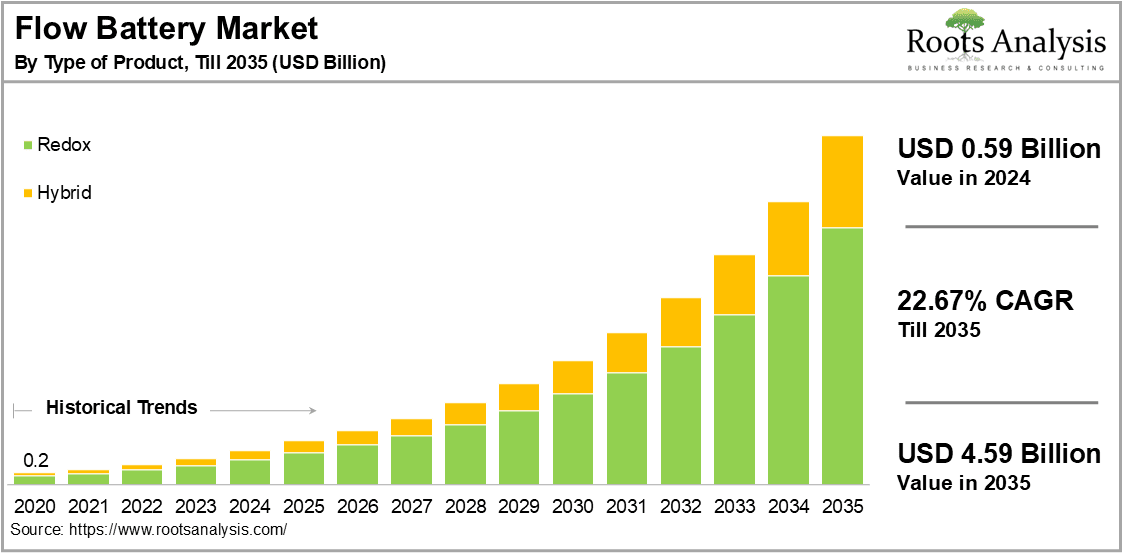
Flow battery market size is forecasted to reach USD 4.59 billion by 2035, growing at a 22.67% CAGR from USD 0.72 billion in 2026.
The new research study consists of global flow battery analysis, mega trends, patent analysis, porter five forces, SWOT analysis, value chain analysis and other strategic frameworks.
 |
To learn more about this report, request a free sample copy
A flow battery is a rechargeable energy storage system where liquid electrolytes flow through one or more electrochemical cells from external tanks. These batteries are predominantly used in stationary applications and are typically water-based. They are ideal for storing surplus energy generated by renewable sources like wind and solar, enabling its use during periods of low production or high demand. This helps stabilize power grids and improve the reliability of renewable energy systems.
Additionally, flow batteries can provide backup power during outages, be deployed quickly, and deliver continuous power for extended durations, making them valuable for critical infrastructure and grid management. Flow batteries offer several advantages over conventional batteries, including scalability, long cycle life, low maintenance, sustainability, energy arbitrage, and peak shaving.
The market is witnessing significant growth as the demand for electric vehicle (EV) charging stations increases. The widespread use of flow batteries in these stations is fueling the market growth as these batteries have rapid charging capabilities, scalability, cost optimization, and environmental benefits. However, their high manufacturing and installation costs remain a significant challenge compared to cheaper alternatives like lead-acid or lithium-ion batteries.
The flow battery market report presents an in-depth analysis of the various companies that are involved in offering flow battery solutions, across different segments, as defined in the table below:
| Key Report Attributes | Details | |
| Historical Trend | Since 2020 | |
| Forecast Period | Till 2035 | |
| Current Market Size | $ 0.59 Billion | |
| Market Size 2035 | $ 4.59 Billion | |
| CAGR till 2035 | 22.67% | |
| Type of Product |
|
|
| Type of Material |
|
|
| Type of Storage |
|
|
| Areas of Application |
|
|
| Type of Ownership |
|
|
| Type of Enterprise |
|
|
| Geographical Regions |
|
|
| Leading Market Players |
|
|
| PowerPoint Presentation (Complimentary) |
Available | |
| Customization Scope | 15% Free Customization | |
| Excel Data Packs (Complimentary) |
|
|
The global flow battery market is segmented into various types of products, such as hybrid and redox. According to our global flow battery market size analysis, the redox segment will augment the segment's growth with the largest market share of over 72.56% by the next decade. This dominance is largely due to their wide range of applications in utilities, industrial and commercial sectors. Redox flow batteries, particularly vanadium-based systems, are highly regarded for their scalability, long life cycle, and ability to handle large-scale energy storage needs. Their robust performance in renewable energy integration and grid stabilization has made them the preferred choice for utility-scale projects.
On the other hand, it is worth highlighting that the hybrid flow battery is expected to witness the fastest CAGR (23.8%) during the forecasted period. This rapid growth is driven by their enhanced energy density and cost-effectiveness compared to traditional redox systems. Hybrid flow batteries combine the benefits of conventional flow batteries with improved efficiency, making them suitable for emerging applications such as EV charging stations and off-grid power solutions.
The market is segmented into various types of materials such as vanadium, and zinc-bromine. According to our flow battery growth forecast, the vanadium segment will augment the segment's growth with the largest market share of over 78.9% by the next decade. This dominance is attributed to the widespread use of vanadium redox flow batteries (VRFBs) in grid-scale energy storage applications. VRFBs are highly valued for their scalability, long cycle life, high energy efficiency, and ability to maintain stable performance over numerous charge and discharge cycles.
On the other hand, it is worth highlighting that the zinc-bromine segment is expected to witness the fastest CAGR of around 23.96%. This dominance can be attributed to the high energy density and relatively lower costs of zinc-bromine flow battery compared to vanadium-based systems. They offer advantages such as environmental friendliness, ease of recycling, and reduced corrosion issues, which are driving their adoption in various applications, including grid-level energy storage.
The market is segmented into various types of storage such as compact and large scale. According to our flow battery market analysis, the large scale segment will augment the segment's growth with the largest market share of over 71.6% by the next decade. This dominance can be attributed to the scalability of large-scale batteries over their smaller counterparts. Flow batteries often benefit from economies of scale; as the system size increases, the cost per unit of energy capacity decreases. As a result, they also prove to be cost effective for larger installations where the initial investment can be justified by the increased capacity and longer cycle life.
On the other hand, its worth highlighting that the compact segment is expected to witness the fastest CAGR (24.6%) during the forecasted period. This growth can be attributed to their compactness and portability which provides them applications in EV charging stations, residential buildings, and the telecommunications sector, among others.
The market is segmented into various areas of application such as defense, EV charging stations, industrial & commercial, utilities and other applications. According to our flow battery market analysis, the utilities segment will augment the segment's growth with the largest market share of over 31.6% by the next decade. This dominance can be attributed to various factors, including the flow battery’s pivotal role in grid integration, supporting grid resilience, reducing energy transmission expenses, realizing environmental advantages, and offering remarkable scalability.
On the other hand, it is worth highlighting that the EV charging stations segment is expected to witness the fastest CAGR (24.7%) during the forecasted period. This growth can be attributed to the increasing production and adoption of electric vehicles which is expected to boost demand, subsequently leading to an increase in the number of EV charging stations. Flow batteries are effective for EV charging stations as they are compact, highly scalable, and environmentally friendly.
The market is segmented into various types of ownership such as customer owned, and third-party owned. According to our flow battery market analysis, the customer-owned segment will augment the segment's growth with the largest market share of over 81.6% by the next decade. This dominance can be attributed to the preference of many end-users, such as commercial and industrial, to own and manage their energy storage systems directly.
On the other hand, the utility-owned segment is expected to witness the fastest CAGR (23.87%) during the forecasted period. The rapid growth is driven by increasing demand for utility-scale storage ancillary services and the need to deliver peak loads efficiently using flow battery-powered energy storage systems (ESS) rather than expanding power lines and transformers.
The market is fragmented into two types of enterprises, namely large and small and medium enterprises. Currently, the large enterprise segment is expected to dominate the segment with 73.18% of the market share as demand for flow battery is rising among large enterprises.
However, small and medium enterprise segments are expected to witness a relatively higher (23.78%) flow battery market growth rate until 2035. This is ascribable to their agility, innovation, focus on niche markets, and ability to adapt to changing customer preferences and market conditions.
This segment highlights the distribution of flow battery market share by regions, such as North America, Europe, Asia, Latin America, Middle East and North Africa, and the rest of the world. According to our regional analysis, Asia currently exhibits dominance with 37.69% of overall market share. This dominance can be attributed to the high adoption of flow batteries in major economies including China and Japan. The adoption of these batteries is rapidly increasing in these economies, particularly in utility, industrial, and commercial applications. In addition, various government investments are further fueling the flow battery market in this region.
The “Flow Battery Market, Till-2035: Industry Trends and Global Forecasts” report features an extensive study of the current market landscape, market size and future opportunity within the flow battery market forecast period. The market report highlights the efforts of several stakeholders involved in this rapidly emerging segment of the service providers industry. Key takeaways of the global flow battery market report are briefly discussed below.
The global flow battery market growth is expected to be driven by several key factors including the growing global adoption of renewable energy sources like wind and solar, which require efficient and scalable energy storage solutions to manage intermittent energy generation. Flow batteries, with their long cycle life, high energy density, and scalability, are well-suited for grid-level applications and renewable energy integration.
Favorable government policies promoting clean energy storage and increasing investments in renewable projects further accelerate market growth. Additionally, the rising demand for backup power in critical infrastructure, the expansion of electric vehicle (EV) charging stations, and advancements in flow battery technologies contribute to the robust growth of the market.
According to the flow battery market competitive landscape analysis, with the presence of several small and large companies, the market is experiencing intense competition and changing market dynamics. From large multinational companies to local players, companies are striving to enhance their competitive edge. In terms of market share, large enterprises and multinational companies are dominating the market. The key players are using strategies such as partnerships, acquisitions, ventures, innovations, novel product launches, R&D and geographical expansions to solidify their position in the industry.
Despite the strong market growth projection, there are several challenges in the flow battery market. One of the primary obstacles is the high initial cost of manufacturing, installation, and maintenance, which makes flow batteries less competitive compared to more established technologies like lithium-ion and lead-acid batteries. Additionally, the reliance on expensive and scarce raw materials, such as vanadium, contributes to cost volatility and supply chain instability.
Flow batteries also struggle with lower energy density, limiting their application in space-constrained environments. Furthermore, limited technological advancements in materials and system designs have slowed efficiency improvements, while a lack of awareness about the technology among potential users has delayed widespread adoption in residential and commercial sectors.
With respect to regional industry insights, Asia is likely to dominate the market for the forecasted period. This dominance is attributed to the region's rapid industrialization, increasing focus on renewable energy integration, and significant investments in energy storage technologies, particularly in countries like China, Japan, and South Korea. The abundance of vanadium resources in China also supports the manufacturing and deployment of vanadium redox flow batteries, further solidifying Asia-Pacific's position as the largest market for flow batteries.
Examples of leading flow battery manufacturers (which have also been captured in this market report, arranged in alphabetical order) include Amp Nova, CellCube, Elestor, Enerox, EnSync Energy Systems, ESS Tech, EverFlow, Gen3, Gildemeister Energy Solutions, H2, Invinity Energy Systems, Jenabatteries, Kemiwatt, Largo, Le System, Lockheed Martin, Nanoflowcell Holdings, Primus Power, Redflow, Redt Energy, SCHMID, Storen Technologies, Stryten Energy, Sumitomo Electric, Vanadis Power, Vflowtech, ViZn Energy Systems, VisBlue A/S, VoltStorage, Volterion Dortmund, and VRB Energy.
The market report presents an in-depth analysis, highlighting the capabilities of various companies engaged in this domain, across different segments. Amongst other elements, the market report includes:
At Roots Analysis, we genuinely care about your success and understand that your business requirements are unique. While our flow battery market research reports provide valuable insights, we recognize that they might not cover every aspect you need to make well-informed strategic decisions. To account for that, we offer 15% free report customization tailored to your specific needs. Whether you require additional quantitative analysis, qualitative insights, or any other information related to the flow battery market, reach out us today at: support@rootsanalysis.com