


 Download Free Sample
 Buy Now
Market Size
The global fungal computer interface market is projected to grow from USD 12.76 million in 2028 to USD 672 million by 2040, representing an overall CAGR of 39.14% during the forecast period 2028-2040. This sharp growth trajectory highlights the sector’s accelerated development and its potential to reshape future technological landscapes.

See What’s in the Full Report - Request Your Complimentary Insights!
Key Market Trends and Enablers
- DARPA Initiatives: Since 2021, DARPA’s $80M annual funding for mycelium electronics has driven early-stage validation and seed investments, serving as one of the key market drivers that catalyze innovation and accelerate market development in fungal substrate computing technologies.
- AI-driven Fungal Network Design: Leveraging AI in the development of fungal computer interfaces (FCI) is an emerging technology trend that allows fungal networks to dynamically adjust to environmental inputs and optimize their performance in real-time.
- Use of FCI in Biosensors and Wearables: This integration is rapidly expanding the living electronics market by driving growth in IoT and smart infrastructure through advanced devices equipped with environmental sensing and health monitoring capabilities.
- EU FUNGAR Grant: Since 2023, the EU FUNGAR grant supports pioneering research on living fungal mycelium as biocomputing interfaces, driving innovation and advancing intelligent fungal system architectures in biocomputing.
- NIH BRAIN Initiative: Since 2022, the NIH BRAIN initiative provides targeted neurotechnology funding up to USD 3 million per project, fostering development of unconventional live electronic interfaces, such as brain-fungi-machine interfaces, catalyzing breakthroughs in neurotechnology and bio-hybrid systems.
- Industry Attractiveness Index: The fungal computer interface (FCI) market is emerging as a promising sustainable computing solution, leveraging natural electrical signaling of fungal mycelium for ultra-low energy parallel processing. Supported by strong government funding and growing private sector interest, this nascent field shows significant growth potential, mirroring trends in adjacent neurotechnology fields like brain-computer interface.
Market Overview
The fungal computer interface market focuses on leveraging the unique electrical properties and network structures of fungal mycelium to create mycelium-based neural interfaces. These biodegradable, self-growing, and energy efficient systems have potential applications across biosensors, neuromorphic computing platforms, biohybrid robotics control, and large scale ecological sensing.
The fungal mycelium industry is gaining traction from industry players and investors due to ongoing research advancements in fungal bio-signal processing and rising need for sustainable technologies. These factors are emerging as key market drivers. Additionally, the increasing trend towards using fungal mycelium as biohybrid computer interfaces and mycelium biocomposites is contributing to the market growth of fungal computer interface industry.
The future of fungal computer interface technology lies in advancing biocomputing architectures, and adaptive live electronic interfaces that outperform conventional silicon-based devices in scalability of fungal computer interface architectures, fault tolerance, and environmental sustainability. These interfaces offer a promising post-silicon computing solution with enhanced resilience and a significantly reduced ecological footprint, suitable for intelligent sensing and machine learning applications with fungal biosignal data.
Market Share Insights
Market Share by Type of Interface: Non-Invasive Interfaces to Lead the Industry
- In the fungal computer interface market, the non-invasive interfaces sub-segment is expected to witness the highest market share. On the other hand, the hybrid bio digital interface devices are expected to witness the fastest CAGR during the forecast period.
- The non-invasive sub-segment’s ease of use, safety, and key application across areas, such as medical and consumer sectors, are the properties which significantly fuel the market growth.
Market Share by Key Geographical Regions: North America to Propel in the Advanced Research Sector in the Coming Years
- The fungal computer interface market forecast projections suggest that North America is expected to dominate the market upon commercialization. On the other hand, Asia-Pacific will be witnessing the fastest CAGR in the forecast period.
- Factors such as high clinical trial activity focused on biohybrid interfaces and neurological device applications, and strong intellectual property frameworks encouraging patent filings, are some of the factors fueling the North American market growth.
Want Information on Specific Region / Segment?
Research Milestones Augmenting Fungal Computer Interface Industry
- In April 2025, Simons Foundation highlighted fungal and biohybrid computing as exciting new research areas through their Pivot Fellowship program, which supports experienced researchers crossing into emerging fields.
- In August 2024, Cornell University researchers engineered biohybrid robots that use biochemical electric signals from fungi to sense and respond to their environment, showcasing early proof-of-concept advances.
- In 2023, a European Union funded research project “Fungateria” was launched for the development of engineered living materials using fungal-bacterial consortia with controlled growth and electrical signal processing capabilities. This enables fungal-based sensing and signal processing algorithms in fungal computing systems, directly advancing FCI technology.
Fungal Computer Interface Market Ecosystem
The current landscape of the FCI market is strongly steered by leading academic institutes pioneering research in fungal electrical signaling, biohybrid robotics, and living architectural materials.
Alongside them, emerging biofabrication companies are beginning to translate these discoveries into commercial potential, developing bioelectronic communication channels via fungal networks and forging collaborations backed by government grants, venture capital, and private equity. Together, academic and industry players are shaping the evolution toward viable mycelium computing solutions and global adoption.
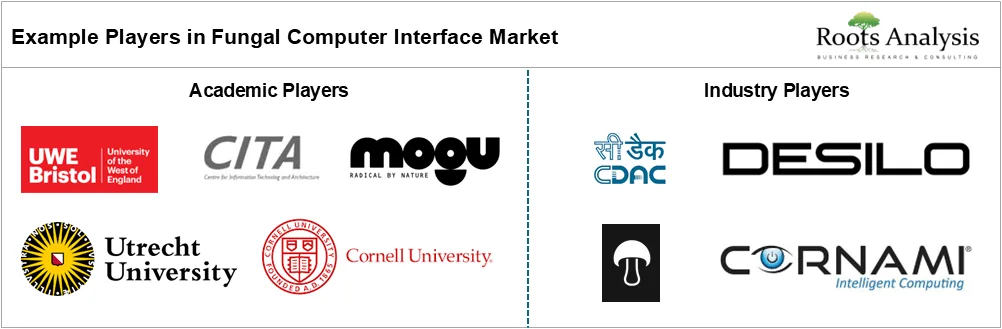
Top 5 Academic Institutes Driving Innovation
University of the West of England (UWE)
The Unconventional Computing Laboratory (UCL) at the UWE in Bristol, UK, is the leader in fungal biocomputing and unconventional computing. It led the EU-funded Fungal Architectures project in collaboration with various universities.
Key Contribution: UCL discovered the electrical signaling in fungi for computation, developed fungal based intelligent buildings, and pioneered fungal biosensors and logic gates for architectural biocomputing.
In this context, Professor Andrew Adamatzky, a pioneering researcher on fungi computer interface and the founder of UCL stated that, “We’re the first lab to report about spiking activity of fungi measured by microelectrodes, and the first to develop fungal computing and living fungi as electronic circuits.”
Utrecht University
The Utrecht University, in Netherlands, is an expert in fungal biology and mycology. The university was a key partner in the EU FUNGAR project.
Key Contribution: Utrecht University provided expertise in fungal biology to integrate fungi and mycelium as living material into structural mycelium composites. Apart from this the university also provided its proficiency in electrophysiology to harness electrical signaling for embedded processing fungal biocomputing applications. These research efforts have supported key application areas, such as biohybrid sensors, sustainable structural materials, and living computing systems
Centre for Information Technology and Architecture (CITA)
CITA, in Denmark, is a pioneer of architectural innovation and bio-design. The center was another academic partner in the FUNGAR project which also designed the fungal living architecture.
Key Contribution: CITA developed architectural and design frameworks for fungal biomaterials, along with authoring design rules for growing fungal computational buildings.
MOGU
MOGU, in Italy, is an industry leader in mycelium fibers-based materials, who was also a partner in the FUNGAR project.
Key Contribution: MOGU was involved in scaling biosensor technologies for smart buildings, fueling the growth of biocomputing technologies market as well as commercializing fungi and mycelium materials for sustainable construction.
Cornell University
Cornell University, based in USA, is a pioneer in biohybrid robotics and fungal interface integration in environmental monitoring and autonomous control.
Key Contribution: Cornell developed biohybrid robots which were controlled by electrical impulses generated from fungal mycelium. Their research demonstrated the integration of living mycelial yeast with robotic systems to sense environmental stimuli.
Key Companies Pioneering Progress in Fungal Computer Interface Market
Center of Advanced Development and Computing (C-DAC)
Based in India, C-DAC is a public sector leader in advanced computing, bioinformatics, and sensory interfaces.
Key Contribution: C-DAC collaborated with AI for Good Global Summit for AI-based health apps and has various partnerships with research institutes, including Institute of Bioinformatics, IITs and Pharma industry.
Mycosoft
Based in the US, Mycosoft is focused on mycelium-based neural interface platforms with fungal electrical signal processing.
Key Contribution: The company has strategic partnerships with AI and neuromorphic computing firms, pilot projects on fungal biohybrid specialized sensors. Along with this it’s also involved in seed funding rounds involving AI-focused venture capitalists and biotech investors.
Cornami
The company is a USA based market player specializing in advanced architecture for secure, biocomputing & AI-enhanced hardware interfaces.
Key Contribution: The company has industry partnerships on encrypted AI and is highly active in next-gen hardware for confidential / parallel-processed biocomputing.
DESILO
Another USA based market player and a developer of biocomputing interfaces and bioelectronic sensing platforms.
Key Contribution: DESILO has active collaborations with neural interface startups, and sensor partnerships for VOC / bio-agent detection.
Pay Only for What You Need – The Best Way to Optimize
Investor’s Edge
Roots Analysis’ View on Investment Opportunities in Fungal Computer Interface Industry
Investing in the fungal computer interface domain offers promising future opportunities but requires careful consideration due to its emerging, specialized nature. Here are key strategic insights for potential investors:
- High Innovation Potential: The sustainable and biohybrid nature of fungal computer interface can potentially disrupt the conventional computing paradigms, as FCI technology is a pioneering new class of biological computing. Hence, the market has a high investment potential.
- Supportive Funding Ecosystem: The fungal computing interface market has attracted significant supportive funding of over $120 million from major programs such as the EU Horizon Europe, the NSF, and DARPA. This strong backing acts as a major market driver by de-risking early research and accelerating innovation, making FCI a promising sector for long-term investment.
- Sustainability and Green Tech Appeal: Fungal computing interfaces use renewable, biodegradable substrates that significantly reduce e-waste compared to silicon electronics. Mycelium-based electronics can lower carbon footprints, supporting global net-zero goals by replacing fossil-based materials with sustainable biofabrication technology, aligning perfectly with rising ESG investment trends.
Market Access Challenges
Regulatory and Safety Standards in Fungal Computing Technology
Biological computing, which uses living fungal materials is poised to face market challenges, including regulatory hurdles, such as safety certifications, biocompatibility standards, and environmental release concerns. For instance, the USFDA regulates biocompatibility and biosafety standards for biologically active products to ensure safety prior to market release.
Technology Maturity and Commercial Viability
The FCI market is still in early research and development phases, with many technologies at proof-of-concept or pilot prototypes stage. Existing prototypes face critical technical hurdles, such as unstable signal coherence, low data fidelity, short functional lifespans of fungal substrates, and integration challenges with electronic systems. New entrants must plan for long development cycles and technology risks before market-ready solutions emerge.
Market Awareness and Adoption Risks
FCI technology is a novel and niche market with limited understanding among potential users, investors, and industry stakeholders. Building market awareness, demonstrating tangible benefits over existing technologies, and developing user acceptance represent key market challenges and significant market adoption barriers for fungal computer interfaces.
Market Segmentation
Fungal Computer Interface Market: Scope of the Report
| Key Report Attributes | Details | |
| Forecast Period | Till 2040 | |
| Market Size 2028 | $ 12.76 Million | |
| Market Size 2040 | $ 672 Million | |
| CAGR (Till 2040) | 39.14% | |
| Segments Covered |
|
|
Your Business is Unique – Why Shouldn’t Your Report Be?
Market Segments
Based on research, we have segmented the Fungal Computer Interface Market, 2028-2040 into type of interface, technology stack, commercialization stage, application, end user, geographical regions, and key players.
By Type of Interface
- Hybrid Bio-Digital Devices
- Invasive / Embedded Interfaces
- Non-Invasive Interfaces
By Technology Stack
- Embedded Processing & Algorithms
- Electrophysiology Interfaces
- Engineered Living Materials
- Mycelium Substrates
- Printed / Organic Electronics Integration
By Commercialization Stage
- Early Commercial Rollouts
- Pilot Deployments
- R&D & Proof-of-Concept
By Application
- Biohybrid Robotics
- Environmental Sensing
- Smart Agriculture
- Smart Cities and Infrastructure
- Others
By End User
- Agriculture and Food Companies
- Building and Construction Companies
- Industrial OEMs
- Research & Academic Institutes
- Others
By Geographical Regions
- North America
- US
- Canada
- Mexico
- Rest of North America
- Europe
- Austria
- Belgium
- Denmark
- France
- Germany
- Ireland
- Italy
- Netherlands
- Norway
- Russia
- Spain
- Sweden
- Switzerland
- UK
- Rest of Europe
- Asia-Pacific
- Australia
- China
- India
- Japan
- New-Zealand
- Singapore
- South Korea
- Rest of Asia-Pacific
- Latin America
- Brazil
- Chile
- Colombia
- Venezuela
- Rest of Latin America
- Middle East and Africa (MEA)
- Egypt
- Iran
- Iraq
- Israel
- Kuwait
- Saudi Arabia
- UAE
- Rest of MEA


