


 Download Free Sample
 Buy Now
Market Size
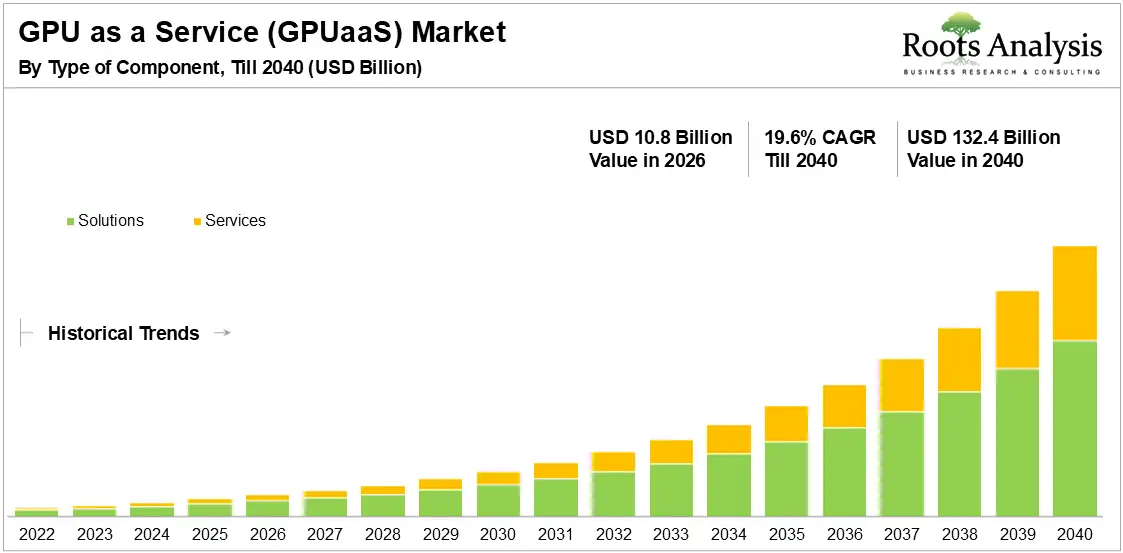
The global GPU-as-a-Service (GPUaaS) market reached USD 10.8 billion in 2026 and will grow to USD 132.4 billion by 2040, registering a CAGR of 19.6% over the forecast period 2026 to 2040, driven by accelerating enterprise AI model training and inference workloads.
See What’s in the Full Report – Request Your Complimentary Insights!
Market Report: Key Takeaways
- Based on component, solutions capture 71.0% market share in 2026, whereas services register a 22.5% CAGR through 2040, driven by rising enterprise outsourcing demand.
- In terms of deployment model, public cloud captures 63.0% market share in 2026, whereas hybrid cloud registers a 24.3% CAGR through 2040, driven by data sovereignty requirements.
- With respect to business model, infrastructure-as-a-service (IaaS) captures 48.0% market share in 2026, whereas Fractional GPU Services register a 25.5% CAGR through 2040, driven by lower-cost AI infrastructure access.
- Based on enterprise size, large enterprises capture 72.0% market share in 2026, whereas SMEs register a 23.4% CAGR through 2040, driven by democratized AI deployment tools.
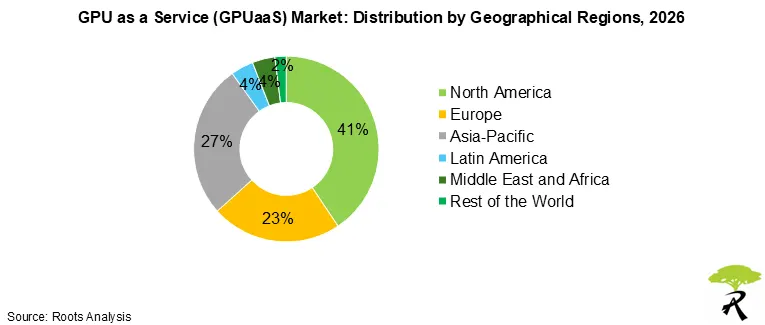
- Based on geographical regions, North America captures 41.0% market share in 2026, whereas Asia-Pacific registers a 24.0% CAGR through 2040, driven by sovereign AI infrastructure investments.
GPU-as-a-Service Market Outlook
GPUaaS has moved from a niche GPU rental layer into a core AI infrastructure market. Demand no longer comes mainly from isolated developers testing models. It now comes from enterprise teams that need elastic training, inference, and burst capacity without locking capital into owned clusters. Supply constraints still matter, but the bigger shift is commercialization around capacity aggregation, platform orchestration, and cloud marketplace access.
Growth today is driven by generative AI rollout, AI agent workloads, and the need to control GPU utilization costs. Sovereign AI infrastructure is also becoming a policy pressure point, especially where governments and regulated buyers want local compute control. Oracle expanded OCI bare metal and GPU infrastructure capacity with NVIDIA Blackwell systems in March 2025. That mix is widening demand beyond hyperscalers and frontier model labs.
Through 2040, the GPU-as-a-Service market stays high-growth, but the growth engine becomes more segmented. Public cloud keeps scale, while hybrid cloud, fractional provisioning, and marketplace models expand faster because buyers want portability and lower unit cost. CoreWeave expanded AI cloud capacity agreements with Meta and Anthropic in May 2026. The market outlook remains constructive as demand keeps outrunning efficient supply.
Pay Only for What You Need – The Best Way to Optimize
GPU-as-a-Service Market Size Estimation Methodology
- As a starting point, we anchored the GPU-as-a-Service market model on hyperscaler capex disclosures, neocloud expansion announcements, and GPU supply signals from NVIDIA-related cloud launches. Those inputs show where new capacity actually enters the market. They also help separate headline demand from spend that is already committed to training clusters and inference capacity. This step sets the revenue base and the pace of supply normalization.
- Moving forward, we compared server shipment data and semiconductor fab output to estimate how much accelerator inventory can reach cloud platforms each year. That step matters because GPUaaS growth depends on physical availability, not only software demand. We then aligned those supply estimates with the 2026 baseline of USD 10.8 billion and the 2040 value of USD 132.4 billion. It also keeps the model grounded in deliverable hardware, not wishful demand.
- Building on this, we mapped deployment mix using the segment shares in the inputs, then translated them into revenue weightings for public cloud, private cloud, and hybrid cloud. We treated hybrid growth as a distinct adoption curve because sovereignty, portability, and regional control change buying behavior. That matters most in regulated sectors and multi-region enterprise AI programs. The resulting mix shows where buyers will pay for control versus pure elasticity.
- Drawing upon these, we used colocation leasing rates, utility billing data, and construction cost indices to reflect the economics of operating GPU clusters at scale. Those data points help capture facility-level costs that affect pricing, utilization, and margin structure. They also explain why managed services and fractional GPU models gain share as buyers seek lower entry costs. This cost layer is essential for separating premium infrastructure from commoditized compute.
- The projected value was then calibrated against end-user demand patterns across IT, telecommunications, healthcare, life sciences, and automotive workloads. We weighted those segments by enterprise adoption intensity, model training frequency, and inference growth. That produced a forecast that reflects where GPUaaS demand concentrates, not just where cloud capacity exists. It also highlights which verticals can absorb higher GPU utilization without slowing deployment.
- Finally, we checked the output against recent developments, including marketplace launches, sovereign GPU offerings, and fractional provisioning moves from 2025 and 2026. This step reduced the risk of overestimating mature segments and underestimating faster-moving channels. It also kept the forecast aligned with actual commercialization behavior across the GPU cloud market. The final curve therefore reflects both infrastructure economics and buyer behavior.
GPU-as-a-Service Market Share Insights
Market Share by Type of Component
- Solution sub-segment accounts for 71% of the overall revenue share in 2026. This sub-segment dominate because enterprises prioritize scalable GPU provisioning, orchestration, workload balancing, and AI infrastructure optimization. Large hyperscalers already operate mature GPU software ecosystems supporting enterprise-grade deployment and multi-tenant acceleration.
- CoreWeave expanded AI cloud capacity agreements with Meta and Anthropic in May 2026, reinforcing enterprise demand for integrated GPU infrastructure platforms.
- Meanwhile, services segment is likely to grow at a CAGR of 22.5% during the forecast period 2026-2040. Managed services will expand rapidly as enterprises struggle with GPU optimization, distributed training architecture, and inference cost management. Organizations increasingly outsource deployment operations because internal AI infrastructure talent remains limited.
- Accenture launched expanded AI Refinery services for NVIDIA enterprise deployments in March 2025, accelerating managed GPU adoption across regulated industries.
Market Share by Deployment Model
- Public cloud deployment model dominates the market with a share of 63% in 2026. Public cloud deployment leads because hyperscalers offer unmatched GPU inventory, elasticity, developer ecosystems, and global AI infrastructure availability.
- Startups and enterprises continue prioritizing rapid AI experimentation without large upfront capital commitments. Google Cloud expanded NVIDIA Blackwell GPU availability across global AI infrastructure regions in April 2025.
- Meanwhile, hybrid cloud will grow at a CAGR of 24.3% during the forecast period 2026-2040. Hybrid cloud adoption will accelerate because enterprises require data sovereignty, cost optimization, and workload portability across environments.
- Regulated sectors increasingly combine on-premise inference with public cloud training infrastructure. IBM introduced hybrid AI infrastructure expansion capabilities for enterprise GPU orchestration in February 2025.
Want Information on Specific Region / Segment?
North America to Capture Largest Share in 2026 while Asia-Pacific to Grow at a Higher CAGR
- Regional analysis shows that North America leads the market with 41% of the market share in 2026. North America leads because the region hosts major hyperscalers, AI model developers, semiconductor firms, and venture-backed GPU cloud providers. Strong capital availability and mature AI software ecosystems further reinforce regional dominance.
- CoreWeave announced expanded AI infrastructure investment and multi-gigawatt deployment growth in May 2026.
- Meanwhile, Asia-Pacific is likely to register a CAGR of 24.0% through 2040. Asia-Pacific will expand rapidly because governments and enterprises continue investing aggressively in sovereign AI infrastructure. Regional cloud providers also accelerate localized GPU capacity deployment supporting domestic AI ecosystems.
- Malaysia announced large-scale AI infrastructure expansion initiatives supporting GPU data center investments in January 2025.
Market Ecosystem Analysis
GPU-as-a-Service Market Competitive Landscape
The GPU-as-a-Service market is consolidating around vertically integrated AI infrastructure ecosystems where hyperscalers, GPU vendors, and AI-native cloud providers increasingly bundle compute, networking, orchestration software, and inference optimization into unified platforms. NVIDIA currently shapes the market’s architectural direction through tight integration of GPUs, networking, AI software, and cloud partnerships, while hyperscalers compete through large-scale infrastructure procurement and proprietary AI stacks.
The primary commercial force reshaping competitive behavior is the global shortage of AI-ready compute capacity for training and inference workloads. This has accelerated long-term GPU reservation agreements, AI factory expansion, liquid-cooled infrastructure deployment, and strategic partnerships between GPU providers and specialized cloud operators.
Top GPU-as-a-Service Providers and Their Recent Updates
Large cloud providers are accelerating GPU infrastructure procurement to secure long-duration enterprise AI workloads and reduce compute supply bottlenecks. For instance, in March 2026, Amazon Web Services and NVIDIA Corporation expanded their AI infrastructure collaboration through an agreement covering one million NVIDIA GPUs for AWS data centers through 2027. The agreement also included NVIDIA networking technologies and inference-focused architectures, strengthening AWS positioning for large-scale enterprise AI deployments.
- Meanwhile, Oracle Corporation emerged as an early deployment partner for NVIDIA’s Vera CPU rack systems announced during GTC 2026. Oracle’s adoption supports high-density AI cloud infrastructure optimized for liquid-cooled AI clusters and large inference environments.
- Alibaba Cloud was also identified among hyperscale adopters of NVIDIA’s next-generation Vera AI infrastructure platform in 2026. The move reflects intensifying competition among global cloud providers to deploy AI-native compute architectures optimized for large model inference efficiency.
AI-native GPU cloud providers scaling multi-gigawatt AI factory infrastructure specialized GPU cloud operators are differentiating through rapid AI infrastructure deployment, flexible compute leasing models, and direct alignment with frontier AI developers.
Startup Activity and Innovation Landscape
The GPU-as-a-Service market continues to attract substantial capital inflows, with AI-native cloud providers securing landmark strategic partnerships and infrastructure agreements. Key developments between September 2025 and February 2026 underscore accelerating investment momentum across North American and European hyperscale compute segments, driven by surging enterprise demand for large-scale AI training and inference workloads. Some of the notable initiatives include:
- CoreWeave: In March 2026, CoreWeave has secured over USD 8.3 billion in committed capital and agreements with NVIDIA, cementing its position as the leading AI-native GPU cloud provider in North America. This investment will strengthen the AI-native GPU cloud segment supporting large enterprise training and inference workloads across North America through vertically integrated AI infrastructure scaling.
- Nebius Group: In February 2026, the company has announced an AI infrastructure expansion and accelerated capital expenditure growth. Expand GPU cloud infrastructure capacity through new international data center deployments and increased AI processor procurement. Accelerates the European and multi-region neocloud GPU infrastructure segment serving enterprise AI developers requiring sovereign and geographically distributed compute capacity.
GPU-as-a-Service Market Trends
Capacity Aggregation Turning GPU Supply into a Sellable Platform Layer
GPU supply is becoming a tradable inventory layer rather than a private asset bundle. CoreWeave expanded AI cloud capacity agreements in May 2026, including work tied to Meta and Anthropic. That lowers distribution friction and strengthens providers that can package capacity, billing, and access controls together.
Capacity aggregation also rewards operators that already control large enterprise relationships and cloud contracts. CoreWeave’s multi-gigawatt expansion in May 2026 shows how scale becomes a commercial moat. The implication is a stronger position for providers that can guarantee supply and reliability.
Fractional GPU Provisioning Broadening SME Access and Compressing Unit Costs
GPU utilization is moving from full-instance allocation to shared capacity models. Akash Network expanded decentralized GPU marketplace infrastructure supporting fractional AI compute workloads in April 2026. That shift expands the buyer base and creates room for smaller platforms to compete on price and flexibility.
Decentralized compute is also making low-friction experimentation commercially viable. The same Akash-linked deployment with Razer in April 2026 shows how peer-to-peer GPU access can support image generation at very low marginal cost. The implication is sharper price competition and faster adoption of pay-as-you-go GPU services.
Your Business is Unique – Why Shouldn’t Your Report Be?
Market Access Considerations
GPU Supply Commitments and Allocation Priority
Access starts with securing GPUs before competitors lock them up. Providers with direct supply agreements, hyperscaler ties, or marketplace distribution can scale faster because capacity is the primary bottleneck. Oracle expanded OCI bare metal and GPU infrastructure capacity with NVIDIA Blackwell systems in March 2025, while CoreWeave expanded AI cloud capacity agreements in May 2026. That pattern favors capital-rich incumbents and slows unfunded entrants. It also turns supply visibility into a competitive asset.
Sovereign Hosting and Data Residency Expectations
Regional hosting rules shape who can sell into regulated industries. Google Cloud expanded sovereign cloud and AI infrastructure initiatives across Asia-Pacific in April 2025, and Malaysia announced large-scale AI infrastructure expansion initiatives supporting GPU data center investments in January 2025. Providers that cannot offer jurisdiction-specific deployment lose access to public-sector, telecom, and healthcare deals. The result is slower commercialization for global-only platforms and stronger positioning for local operators.
Power, Cooling, and Facility Economics
GPUaaS access also depends on the cost of running dense compute continuously. Utility billing data and construction cost indices matter because high power draw and specialized facilities decide whether pricing stays competitive. CoreWeave’s May 2026 expansion, including multi-gigawatt growth, shows the scale needed to compete. Operators that can secure power and build efficiently gain margin room and faster scaling. Those economics directly shape who can price into enterprise deals.
Marketplace Integration and Developer Reach
Distribution now depends on whether a provider can sit inside the developer workflow. Akash Network expanded decentralized GPU marketplace infrastructure supporting fractional AI compute workloads in April 2026, which shows how marketplace access lowers customer acquisition friction. Providers that integrate billing, orchestration, and discovery reach market faster, while isolated infrastructure vendors face higher sales costs and weaker positioning. Marketplace access therefore becomes a sales channel, not just a technical feature.
How Stakeholders Benefit from the Key Focus Areas of Our GPU-as-a-Service Market Report
The market matters now because enterprise AI training, inference, and sovereign compute requirements are driving real capital allocation. Buyers need clearer views on where supply is constrained, where margins are expanding, and which delivery models can scale without heavy infrastructure risk. This report helps strategy teams, investors, and technology leaders separate durable growth from headline activity.
- Unmet Needs and Market Gaps in GPU-as-a-Service (GPUaaS) Market: This section identifies where current GPU cloud offerings still miss buyer requirements, especially around cost control, residency, and orchestration. It helps procurement leads and solution owners decide whether to buy, build, or partner. The output supports decisions on which workloads still need a better-fit GPU delivery model.
- Funding and Venture Investment Opportunities in GPU-as-a-Service (GPUaaS) Market: This section maps where capital is flowing, which provider models are attracting strategic money, and where financing can still create advantage. It helps investors and corporate development teams judge which operators have enough runway to scale through supply scarcity. The decision it supports is whether to back capacity, software, or marketplace layers.
- Technology Innovation and Adoption Trends: This section tracks shifts such as fractional GPU provisioning, marketplace distribution, sovereign GPU offerings, and hybrid deployment behavior. It helps infrastructure teams and product leaders decide which architecture choices are becoming standard. The decision it supports is which feature set can win the next wave of enterprise buyers.
- GPU-as-a-Service (GPUaaS) Market Competitive Landscape and Industry Analysis: This section compares hyperscalers, neocloud specialists, and regional providers on scale, positioning, and partnership depth. It helps commercial leaders decide where to compete and which rivals create the highest execution risk. The decision it supports is whether to attack broad cloud demand or defend a niche deployment model.
- Mapping Strategic Partnerships and Ecosystem Synergies: This section shows how GPU supply, cloud channels, software layers, and enterprise relationships combine into go-to-market leverage. It helps business development teams identify which alliances expand capacity or reduce customer acquisition cost. The decision it supports is which partnership can accelerate market entry without overbuilding infrastructure.
GPU-as-a-Service Market: Scope of the Report
| Key Report Attributes | Details | |
| Forecast Period | Till 2040 | |
| Market Size 2026 | USD 10.8 Billion | |
| Market Size 2040 | USD 132.4 Billion | |
| CAGR (Till 2040) | 19.6% | |
| Segments Covered |
|
|
| Geographical Regions Covered |
|
|
| Key Sections Covered |
|
|
Source: Roots Analysis
Market Segmentation
The GPU-as-a-service market report presents an in-depth analysis, highlighting the capabilities of various stakeholders, based on different segments such as component, deployment model, business model, enterprise size, application, end-user, geographical regions, and leading players.
By Type of Component
- Solutions
- Services
By Type of Deployment Model
- Public Cloud
- Private Cloud
- Hybrid Cloud
By Type of Business Model
- Infrastructure-as-a-Service (IaaS)
- Platform-as-a-Service (PaaS)
- Bare Metal GPU Services
- Fractional GPU Services
By Enterprise Size
- Large Enterprises
- Small and Medium-Sized Enterprises (SMEs)
By Application
- AI and Machine Learning
- High-Performance Computing (HPC)
- Data Analytics
- Rendering and Visualization
- Gaming and Streaming
- Blockchain and Cryptocurrency
- Scientific Simulation
- Others
By End User
- IT and Telecommunications
- Healthcare and Life Sciences
- BFSI
- Media and Entertainment
- Automotive
- Manufacturing
- Government and Defense
- Research and Academia
- Others
By Geographical Regions
- North America
- Europe
- Asia-Pacific
- Latin America
- Middle East and Africa
- Rest of the World


