


 Download Free Sample
 Buy Now
Market Outlook
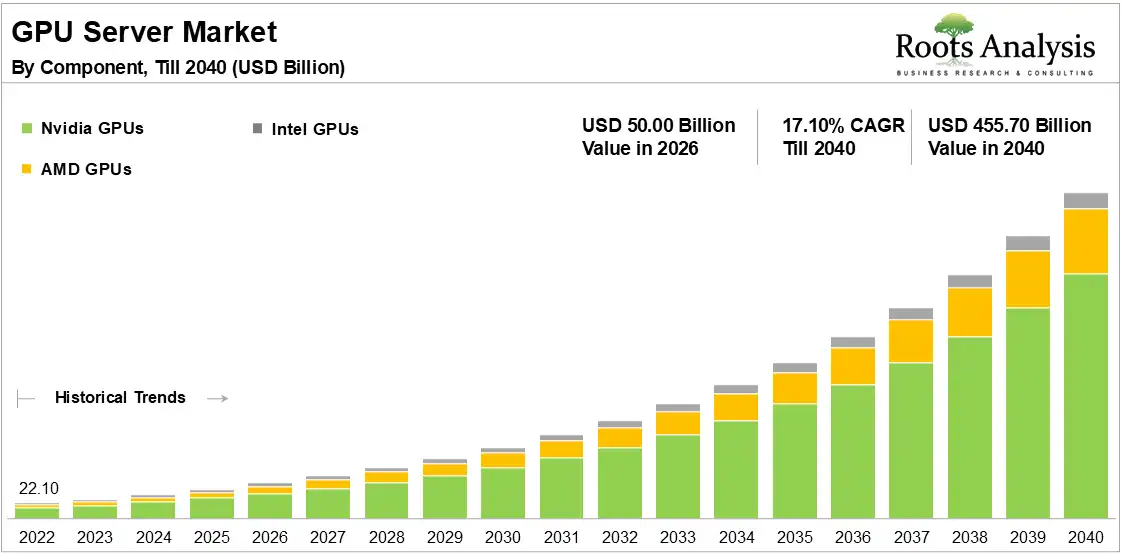
The GPU server market is projected to reach USD 50 billion in 2026 and USD 455.70 billion by 2040, representing a 17.10% compounded annual growth rate (CAGR) during the forecast period 2026 to 2040.
See What’s in the Full Report – Request Your Complimentary Insights!
The GPU server market refers to high performance computing platforms designed for parallel workloads by combining multiple advanced graphics processing units (GPU) with conventional CPUs. These systems deliver the processing density required for complex, data intensive tasks across on-premises data centres and cloud deployments. Market scope includes rack mounted servers, specialized accelerator hardware, software and interconnect technologies needed to scale large computing clusters, with value creation anchored in improved computational efficiency for advanced use cases.
Market growth is driven primarily by the rapid adoption of artificial intelligence (AI) and machine learning (ML) across industries. As large language models and generative AI workloads grow in scale and complexity, they require levels of parallel processing that exceed the capabilities of standard CPU-based infrastructure. This shift, reflected across the AI server market analysis, is driven by increasing demand from core applications (such as data analytics, scientific modeling, and high-performance data center operations) with hyperscale cloud providers and AI research organizations acting as the primary buyers.
Recent momentum in the enterprise AI adoption rate is underscored by hyperscale investments, including Microsoft’s multi-billion-dollar commitment to expand AI supercomputing infrastructure to support large-scale generative AI initiatives for partners such as OpenAI. Further, innovation in the GPU server market is shaped by the shift toward heterogeneous computing architectures and a stronger focus on power efficiency.
Technical progress in this domain centres on optimizing high speed interconnects, including InfiniBand and NV Link, to enable efficient scaling of GPU clusters, alongside broader adoption of advanced liquid cooling to manage rising thermal loads. Strategic investments in next generation cooling solutions signal a move toward higher density data center designs, supporting a positive industry outlook despite ongoing supply chain constraints for high end GPUs.
Market Report: Key Takeaways
- Leading Players Competitive Footprint: Key players in the GPU server industry include Advanced Micro Devices, Advantech, Amazon Web Services, Applied Digital, Cherry Servers, Cisco, CoreWeave, Dell Technologies, E2E Networks, Exxact Corporation, Gigabyte Technology, Hewlett Packard Enterprise, Hyperstack, IBM, Lambda, Lenovo, Nvidia, OVHcloud, Quanta Cloud Technology, RunPod hold strong market positions with extensive geographic presence in various regions.
- Startup Ecosystem and Innovation Hotspots: Early-stage companies in the GPU server market are prioritizing scaling from prototypes to high volume production amid robust venture funding exceeding $50 million for leaders like Positron AI. These startups advance by focusing on efficiency gains, cost optimization through alternatives to traditional data center GPUs, and US based manufacturing to address AI infrastructure demands and supply constraints.
- Regional Penetration and Adoption Trend: GPU server market share by manufacturers is expanding as rapid data center buildouts and a growing number of hyperscale facilities gain momentum, supported by strong government initiatives in AI infrastructure. Adoption is accelerating in cloud and hyperscale projects, where NVIDIA based architectures deliver superior parallel processing yields.
- IT & Telecommunication holds Highest Market Segment: The IT & telecommunication segment holds the maximum market share of 28.00% in 2026, based on the market distribution by end user vertical. The growth is anchored by telecoms’ low latency 5G services and content networks demanding GPU throughput.
- Opportunities in GPU Server Market include expansion into edge AI and inference focused workloads, diversification through custom AI accelerators and adoption of open standards, and continued growth of integrated AI hardware, software platforms that support hybrid cloud and on-premises AI deployments.
Recent Industry Developments
- October 2025: Core Weave announced partnership with Poolside to deliver advanced AI cloud services that support Poolside’s mission to build artificial general intelligence and power the deployment of agents across the enterprise. In this agreement Core weave, will provide Nvidia’ GB300 NVL72 systems, including more than 40,000 GPUs.
- May 2025: Data Volt announced $20 billion partnership with Supermicro. The deal covers ultra-dense GPU server platforms, racks, and DLC-2 liquid cooling tech for net-zero AI campuses in Saudi Arabia and the US.
- March 2025: AMD completed $4.9 billion acquisition of ZT Systems gaining rack scale AI expertise, a new class of end-to-end AI solutions based on the combination of AMD CPU, GPU and networking silicon capabilities.
- February 2025: South Korean government has planned to boost its national AI infrastructure by acquiring 10,000 high-performance GPUs and is working with private companies to accelerate the launch of a national AI computing center. This move comes as global AI investment surges, with major initiatives in Europe and the US and amid tightened US export controls that exempt South Korea from advanced AI chip restrictions.
Pay Only for What You Need – The Best Way to Optimize
Market Dynamics
Key Market Drivers
- Generative AI Arms Race and LLM Training: The accelerating commercial rollout of generative AI and large language models across multiple sectors is creating unprecedented demand for compute intensive training and fine-tuning workloads. These tasks are inherently parallel and closely aligned with GPU architecture rather than CPUs, a shift highlighted across generative AI hardware market trends that is compelling hyperscale cloud operators and AI-focused enterprises to invest heavily in large and tightly coupled GPU server clusters.
- Advancements in High-Performance Computing and Scientific Simulation: Scientific research domains, including advanced simulations and data-intensive modelling, are adopting more complex computational frameworks to shorten discovery cycles. These workloads depend on massive parallelism and accelerated processing, driving research institutions and industrial users to replace or augment existing systems with high-density GPU servers to achieve faster and more accurate outcomes.
- Evolution of High-Speed Interconnect Technologies: Advances in high-bandwidth, low-latency interconnects are enabling thousands of GPUs to operate as a single, cohesive compute fabric. This evolution reduces communication overhead between accelerators, making large-scale distributed training viable and unlocking model sizes and training efficiencies that were previously impractical.
Market Restraints
- High Capital Expenditure and Supply Chain Concentration: The upfront cost of acquiring advanced GPU hardware represents a significant barrier for many enterprises. Dependence on a concentrated supplier base further amplifies risk, exposing buyers to pricing power imbalances, extended procurement timelines, and vulnerability to supply disruptions for mission critical infrastructure.
- Specialized Infrastructure and High-Power Density: GPU servers operate at substantially higher power and thermal densities than traditional systems, often necessitating liquid cooling and reinforced power delivery. These infrastructure requirements, reflected in rising cloud service provider infrastructure spending, increase both capital and operating expenses and limit deployment options for organizations operating within legacy or capacity-constrained data center environments.
- Maturation of Traditional Deep Learning Use Cases: Several established deep learning applications have reached a stage of performance maturity, limiting the incremental benefits delivered by successive GPU generations. This trend is most pronounced in non-generative workloads, where modest performance gains are likely to extend hardware refresh cycles and constrain near-term upgrade demand, even as long-term adoption remains structurally positive.
Market Share Insights
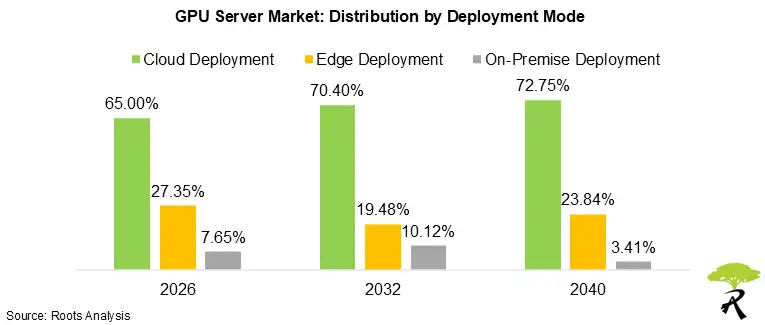
Market Share by Deployment Mode: Cloud Deployment Hold the Largest Market Share
- According to our GPU server market analysis, Cloud deployment holds the largest market share of 65.00%. The growth is driven by hyperscale’s offering elastic GPU capacity, rapid GenAI scaling, and reduced upfront capital requirements.
- There is a growing industrial demand for cloud deployment through their compatibility with existing hyperscale data center architectures and cost-efficient scalability. For instance, QCT introduced new AI servers supporting both Nvidia Blackwell GPUs and AMD instinct MI300X accelerators, showcasing a diverse portfolio for various AI and data center applications.
- The GPU server market forecast indicates that cloud deployment adoption significantly boosts through high-density GPU server configurations for commercial rollout, aligning with large-scale capacity expansions across North America and Asia-Pacific for infrastructure and AI policy initiatives.
- For instance, Dell Technologies announced new PowerEdge servers optimized for generative AI workloads, including the PowerEdge XE9680 and XE9640, featuring Nvidia H200 and H100 GPUs.
Market Share by Geographical Regions: North America Dominates the Industry While Asia-Pacific to Grow at a Faster Pace Through 2040
- The regional analysis suggests that North America is expected to hold the largest GPU server market share of 35.00% while Asia Pacific is expected to witness the fastest CAGR 18.50%.
- The Asia Pacific dominance is due to early adoption of AI technologies like machine learning and generative AI, in the presence of hyperscale’s and cloud services by AWS, Azure, and Google Cloud drives over 80% of workloads to North American facilities.
- In the Asia-Pacific region, the GPU Server is experiencing the fastest growth, with a CAGR of 18.50%, driven by governments and enterprises across China, Japan, and South Korea accelerate AI infrastructure investments and manufacturing digitization. Regional policy support and sovereign AI initiatives continue to act as strong growth catalysts.
Want Information on Specific Region / Segment?
Market Ecosystem Insights
Leading Players Competitive Footprint
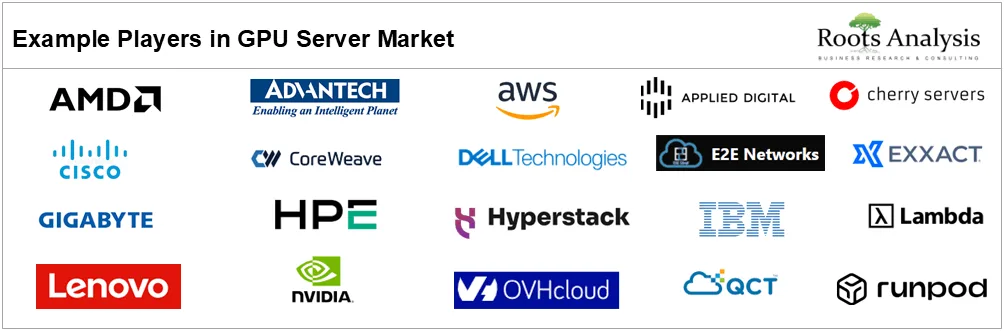
Leading players in the GPU server market domain include industry giants such as Advanced Micro Devices, Advantech, Amazon Web Services, Applied Digital, Cherry Servers, Cisco, CoreWeave, Dell Technologies, E2E Networks, Exxact Corporation, Gigabyte Technology, Hewlett Packard Enterprise, Hyperstack, IBM, Lambda, Lenovo, Nvidia, OVHcloud, Quanta Cloud Technology, RunPod which hold strong market positions through their extensive product portfolios and global reach.
Collaborations and expansions remain key growth strategies, with players accelerating innovation, market penetration, and scalability. For instance, AMD detailed its strategy for accelerating the AI server market with the AMD instinct MI300 series, highlighting key partnerships with Microsoft, Meta, and Oracle Cloud.
Similarly, Lenovo announced an expansion of its collaboration with Nvidia, introducing new enterprise solutions for generative AI powered by Nvidia AI Enterprise software and Lenovo think system servers.
Startup Activity and Innovation Hotspots
GPU server market competitive strategy analysis report suggests reflects rapid technological evolution, with early-stage companies prioritizing high-efficiency GPU architectures, energy-optimized cooling designs, and compact scalable systems tailored for AI, edge computing, and hyperscale data centers. Their breakthroughs in performance-per-watt metrics, modular rack solutions, and integration with next-gen interconnects complement enterprise, cloud, and specialized high-performance computing applications, intensifying competitive dynamics and fast-tracking the shift from prototype innovation to widespread commercial deployment.
Recent launches include investments focused on commercialization, production scaling, and R&D for higher efficiency. For instance, Core Weave announced plans to expand its US data center footprint, committing to investing over $12 billion in new AI infrastructure to support high-performance GPU cloud services.
Additionally, there are other startups such as those providing technological advancements, expansions and innovations such as Exxact released new liquid cooled server solutions focusing on direct to chip cooling technology to handle the thermal demands of next generation NVIDIA GPUs in high-density rack configurations.
Funding and Investment Momentum
The GPU server industry revenue forecast is evident in the strong funding and investment momentum across the market. Funding inflows for manufacturing facilities, GPU silicon integration, and performance optimizations are surging in the GPU server market.
These funds support accelerated development and deployment in the GPU server market by delivering essential capital for pilot production lines, interconnect engineering to reduce latency losses, and compatibility upgrades with existing data center infrastructure, aligning with North America's dominance and hyperscale cloud deployments. Key investors include companies, such as Lambda raised USD 320 million in series C funding from investors including B capital and Crescent Cove aimed at accelerating the deployment of its AI computing services and expanding its infrastructure.
For instance, Vertiv acquired Cool Tera Systems to enhance its liquid cooling portfolio for high performance computing and AI applications focusing on solutions required for high density GPU servers. Similarly, VAST data raised USD 118 million in a funding round led by fidelity management & research (FMR) to accelerate product development for its data platform specifically designed for high-performance AI and HPC workloads.
Your Business is Unique – Why Shouldn’t Your Report Be?
GPU Server Market: Scope of the Report
| Key Report Attributes | Details | |
| Historical Trend | Since 2022 | |
| Forecast Period | Till 2040 | |
| Market Size 2026 | $ 50.00 Billion | |
| Market Size 2040 | $ 455.70 Billion | |
| CAGR (Till 2040) | 17.10% | |
| Segments Covered |
|
|
Market Segmentation
Based on research, we have segmented the GPU server market into component, deployment mode, end use sector, application, geographical regions, and key players.
Market Share by Component
- AMD GPUs
- Intel GPUs
- Nvidia GPUs
Market Share by Deployment Mode
- Cloud Deployment
- Edge Deployment
- On-Premises Deployment
Market Share by End Use Sector
- BFSI
- Government & Defense
- Healthcare
- IT & Telecommunication
- Manufacturing
- Research & Academia
- Retail
Market Share by Application
- Artificial Intelligence (AI) and Machine Learning (ML)
- Cloud Computing
- Data Analytics
- Gaming
- High-Performance Computing (HPC)
Market Share by Geographical Regions
- North America
- US
- Canada
- Mexico
- Rest of North America
- Europe
- Austria
- Belgium
- Denmark
- France
- Germany
- Ireland
- Italy
- Netherlands
- Norway
- Russia
- Spain
- Sweden
- Switzerland
- UK
- Rest of Europe
- Asia-Pacific
- Australia
- China
- India
- Japan
- New-Zealand
- Singapore
- South Korea
- Rest of Asia-Pacific
- Latin America
- Brazil
- Chile
- Colombia
- Venezuela
- Rest of Latin America
- Middle East and Africa (MEA)
- Egypt
- Iran
- Iraq
- Israel
- Kuwait
- Saudi Arabia
- UAE
- Rest of MEA


