


 Download Free Sample
 Buy Now
Market Size
The global gravity energy storage market, valued at USD 1.00 billion in 2025, is projected to reach USD 1.59 billion by 2026 and USD 45.90 billion by 2040 with a CAGR of 27.18% during the forecast period 2026 to 2040.

Would Like to Preview the Actual Report?
Market Report: Key Takeaways
- In terms of type of technology, tower-based gravity energy storage holds the highest share (72%) of the market.
- On the basis of energy capacity, below 500 kWh dominate highest in the current market.
- Based on component, mechanical holds the highest share in the market.
- With respect to application, load balancing dominates the industry. Notably, microgrids grow at a high CAGR during the forecast period 2026-2040.
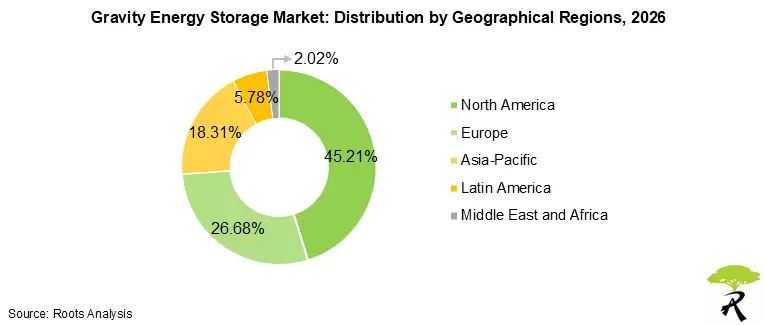
- In terms of geographical regions, currently, North America holds the highest market share, while Asia-Pacific is expected to grow at a relatively high CAGR.
Market Overview
Gravity energy storage is a long-duration technology that relies on the vertical movement of heavy weights to store or release potential energy. The stored energy is then seamlessly coupled with electricity conversion systems. This technology offers long duration and environment friendly alternative to traditional storage systems.
Vertical lifting of heavy objects / mass, such as concrete blocks, leads to the conversion. Later, the reconversion into electricity happens through lowering of the mass. In lieu of electrochemical storage, this storage is durable due to the usage of gravitational force. Gravity storage is simple but very powerful principle for gravity energy storage for renewable integration. With excess energy, surplus electricity is used to lift heavy masses. Moreover, the storage medium contributes to a favorable lifecycle assessment, since these are inert and non-degrading.
The potential of gravity-based storage is already applicable and tested in several pioneering projects. Companies like Energy Vault deploy se gravity energy storage systems and provide critical grid services, such as renewable energy firming and frequency regulation, for utility, microgrids and industrial applications. This technology addresses renewable integration, supporting solar and wind at lower lifetime cost than lithium-ion batteries, for longer duration applications.
As the demand for energy solutions grows, innovators are exploring gravity-driven systems as a promising option for efficient and long-term energy storage to minimize environmental footprints and operational expenditure.
Unlock Deeper Insights – Schedule Your Personalized Workshop Today!
Recent Industry Developments
- In December 2025, Naxion Energy introduced sodium-ion-based energy storage systems in 3.5 kW, 5 kW and 10 kW models, for the commercial, residential and industrial sectors.
- In November 2025, Energy Vault Holdings announced the framework supply agreement with EU Green Energy for the deployment of up to 1.8 GWh of battery energy storage systems in next four years, supporting the acceleration of renewable energy portfolio development and enhancement of grid facility across Europe to expand its developing energy markets.
- In August 2025, Energy Vault received Foreign Investment Review Board (FIRB) approval and completed the acquisition of Stoney Creek battery energy storage system project in Northern New South Wales.
Market Share Insights
Storage Duration Dominates the Gravity Energy Storage Market Through 2040
Based on storage duration, the global gravity energy storage market sis segmented into short duration (less than 1 hour), medium duration (1–4 hours), and long duration (more than 4 hours). Among these categories, the short duration segment currently holds the dominant position, capturing highest market share. This is due to its important role in providing grid stability services, such as frequency regulation, grid stabilization, short-term peak shaving, leveraging solid gravity energy storage technology, batteries and flywheels.
However, the medium duration segment is growing faster in the upcoming years, driven by the increasing deployment of renewable energy sources and the need for flexible and cost-effective energy storage solutions. This energy systems are ideally suited for applications like load shifting and peak shaving and are best served by technologies, such as pumped hydro storage, compressed air energy storage, and thermal energy storage.

In the End-User Sector, Utility is leading the Gravity Energy Storage Market
Within the end user sector, utilities drive the largest share of 55% in the gravity-based energy storage market. Utilities are leveraging gravity energy storage to enhance grid reliability and integrate renewable energy. These systems are deployed by utilities to ensure service continuity, particularly in areas vulnerable to extreme weather or grid instability, and to meet regulatory requirements for energy storage capacity.
The industrial sector is experiencing fastest growth, driven by the need for reliable backup power, peak shaving, and energy cost optimization in the gravity energy storage industry. Industries value the energy storage as these have the ability to run parallel with or operate independently during blackouts. This ensures uninterrupted operations and safeguarding critical systems from energy disruptions.
Regional Market Growth: North America Dominates the Current Gravity Energy Storage Industry
The industry is distributed across North America, Europe, Asia, Latin America, Middle East and North Africa, and rest of the world. Currently, North America dominates with highest gravity energy storage market size. This is due to the region’s innovation and investment hub in renewable energy and supporting government policies and by meeting the demand for energy storage solutions.
Within North America, US is the leading country in the market, driven by high demand from companies like Energy Vault and Sustainable Energy Solutions. They are driven by strong policy support, advanced research capabilities, and increasing grid modernization initiatives.
Asia-Pacific is expected to grow at a substantially faster pace during the forecast period, driven by renewable energy consumptions, urbanization, substantial investments in grid infrastructure, and the presence of leading technology innovators. The competitive landscape is evolving with both domestic and international players entering the market. Companies are focusing on innovative solutions to enhance energy efficiency and reliability, positioning themselves to capitalize on the region's demand for energy storage solutions.
Want Information on Specific Region / Segment?
Market Dynamics
Key Market Drivers
- Rising Renewable Penetration and Need for Long-duration Storage: Growing shares of solar and wind are increasing demand for long-duration gravity energy storage, grid-scale storage with systems positioned as efficient options for multi-day balancing and stability services.
- Favorable Lifecycle Economics and Low Operating Costs: Gravity energy storage solutions use mechanical components and low-cost materials (concrete blocks, rock, mine shafts), offering long lifetimes, cost-effective gravity-based energy storage and limited degradation compared with electrochemical batteries and commercial properties.
- Technology Advances and High-profile Project Developers: Innovations in gravity storage concepts (multi-weight tower systems, underground shafts) and activity by project developers such as Energy Vault, Advanced Rail Energy Storage, and Gravity Power are advancing the technology and increasing investor confidence.
Your Business is Unique – Why Shouldn’t Your Report Be?
Market Challenges
- Environmental, Social, and Permitting Issues: Market growth of gravity energy storage driven by decarbonization policies and demand for long-life, low-maintenance storage technologies in large structures may face environmental impact and complex permitting particularly where visual impact, land use, or subsurface risks are involved.
- Regulatory Classification and Market Design Fit: In many authorities, market rules and tariff structures are still optimized for batteries creating uncertainty on how sustainable non-chemical energy storage solutions is remunerated for capacity, flexibility, and technologies.
- Exposure to Macro-economic and Supply-chain Disruptions: In the energy infrastructures and project economics tariffs on (steel, rare inputs, generators/electronics, and broader cost inflation) in construction can delay investment decisions for gravity energy storage systems for long-duration grid-scale renewable integration.
Key Market Insights
Competitive Landscape of Key Players in Gravity Energy Storage Market
The industry is fragmented and is experiencing intense competition and changing dynamics, with the presence of several small and large energy storage companies. The industry spans from technical innovation, commercial projects in gravity energy storage using decommissioned mines, towers, and vertical shafts for sustainable energy storage and sustaining their strong position in the global marketplace.
Major players in the gravity energy storage industry include ABB, Advanced Rail Energy Storage (ARES), Energy Cache, Energy Vault, GE Renewable Energy, Gravitational Energy, Gravitricity, Gravity Power, Gravity Storage, Green Gravity, Heindl Energy, Highview Power, Pumped Hydro, RheEnergise, and Storworks Gravity.
Innovations and technological advancement among the companies leads to growth in solid gravity energy storage technology, and applications to provide effective and eco-friendly resourceful environment. Notablym Pumped Hydro is one of the leading company in global gravity energy storage, by working actively on grid storage and by actively meeting the demand for long-duration mechanical energy storage. Electricity grids transition to renewable energy and pumped hydro is taking on a new role by storing excess wind and solar power, and ensuring long-duration grid stability.
Strategic investments and fundings are observed in this industry. In November 2025, Adani Green Energy, through its subsidiary Adani Saur Urja, received letter of award to provide 500 MW of pumped hydro energy storage capacity. With a rapidly growing clean-energy portfolio spread across multiple states, the company aims to support India’s transition to sustainable power and has set ambitious targets to expand its renewable generation capacity in the coming years.
Cost-effective Gravity-based Energy Storage for Peak Shaving and Load Shifting in Power Grids
Gravity storage for peak shaving and load shifting is enabled by converting cheap-off peak or surplus renewable electricity into stored gravitational energy. This is then released at high price or demand, alleviating grid stress and optimizing energy costs. A key market trends is the adoption of low-maintenance gravity energy systems, which utilizes solid masses or high-density fluids as storage media. These offer minimal performance degradation as compared with lithium-ion batteries, thereby allowing high capital cost to be spread across longer operational span.
Gravity-based energy enables peak shaving and load shifting by:
- Charging During Low Demand: During off-peak times of excess wind / solar or pump lift masses move uphill absorbing generation and preventing curtailment, which can lower material cost and reduce exposure to critical-mineral price volatility.
- Scalability in Load Shifting: The process of grid-scale gravity energy storage shifts energy consumption from peaks to off-peak times, reducing energy cost for utilities and consumer. With large-scale grid applications, robust solutions for renewable energy systems are used to make it more effective and stronger contender in the competitive landscape of the gravity energy storage market.
Alternative Solutions for Lithium-ion Storage, as Solid Mass and Underground Gravity Battery
Both gravity-energy storage vs battery storage aim to provide long-duration, low-degradation storage for applications like peak shaving and load shifting. Moreover, both aid in avoiding critical mineral dependency and lifecycle limitation which is inherent to conventional lithium-ion batteries.
- Solid-mass gravity battery system store energy by lifting dense material and recovering it as they descend through the generators. These systems are typically tower-based, building-integrated and can be scaled from tens of MWh per installation. Compared with lithium-ion, they offer very long life with minimal fadedness and use abundant materials, those are useful in grid peak shaving and load shifting rather than high-power, short-duration services.
- Uunderground gravity battery management system includes water-piston system or dense fluids pumped to higher levels converting electricity into gravitational potential energy. Often using underground mine shaft gravity storage to reduce land use and visual impact. This system serves as an alternative to both pumped hydro and lithium-ion farms for grid balancing.
Market Segmentation
Gravity Energy Storage Market: Scope of the Report
| Key Report Attributes | Details | |
| Historical Trend | Since 2022 | |
| Forecast Period | Till 2040 | |
| Market Size 2026 | $ 1.59 Billion | |
| Market Size 2040 | $ 45.90 Billion | |
| CAGR (Till 2040) | 27.18% | |
| Segments Covered |
|
|
| Key Players Profiled |
|
|
| PowerPoint Presentation (Complimentary) |
Available | |
| Customization Scope | 15% Free Customization | |
| Excel Data Packs (Complimentary) |
|
|
Market Segments
Based on research, we have segmented the gravity energy storage market into technology, energy capacity, storage duration, component, installation method, application, end use sector, geographical regions, and key players.
Market Share by Technology
- Mechanical Gravity Storage
- Hydraulic Gravity Storage
- Pumped Hydro Storage
- Tower-Based Gravity Energy Storage
Market Share by Energy Capacity
- Below 500 kWh
- 500 kWh to 1 MWh
- above 1 MWh
Market Share by Storage Duration
- Short Duration (less than 1 hour)
- Medium Duration (1–4 hours)
- Long Duration (more than 4 hours)
Market Share by Component
- Mechanical
- Electrical
- Power Conversion System
- Others
Market Share by Installation Method
- Underground Installation
- Above Ground Installation
- Modular Vertical Structures
Market Share by Application
- Frequency Regulation
- Load Balancing
- Backup Power
- Renewable Integration,
- Peak Shaving
- Black Start Capability
- Microgrids
Market Share by End Use Sectors
- Utilities
- Industrial
- Commercial
- Residential
- Others
Market Share by Geographical Regions
- North America
- US
- Canada
- Mexico
- Rest of North America
- Europe
- Austria
- Belgium
- Denmark
- France
- Germany
- Ireland
- Italy
- Netherlands
- Norway
- Russia
- Spain
- Sweden
- Switzerland
- UK
- Rest of Europe
- Asia
- China
- India
- Japan
- Singapore
- South Korea
- Rest of Asia
- Latin America
- Brazil
- Chile
- Colombia
- Venezuela
- Rest of Latin America
- Middle East and North Africa (MENA)
- Egypt
- Iran
- Iraq
- Israel
- Kuwait
- Saudi Arabia
- UAE
- Rest of the MENA
- Rest of the World
- Australia
- New Zealand
- Other countries
Have Questions? Let’s Get Them Answered.


