
Lowest Price Guaranteed
Slides
192
Last Updated
June 2026
View Count
13672
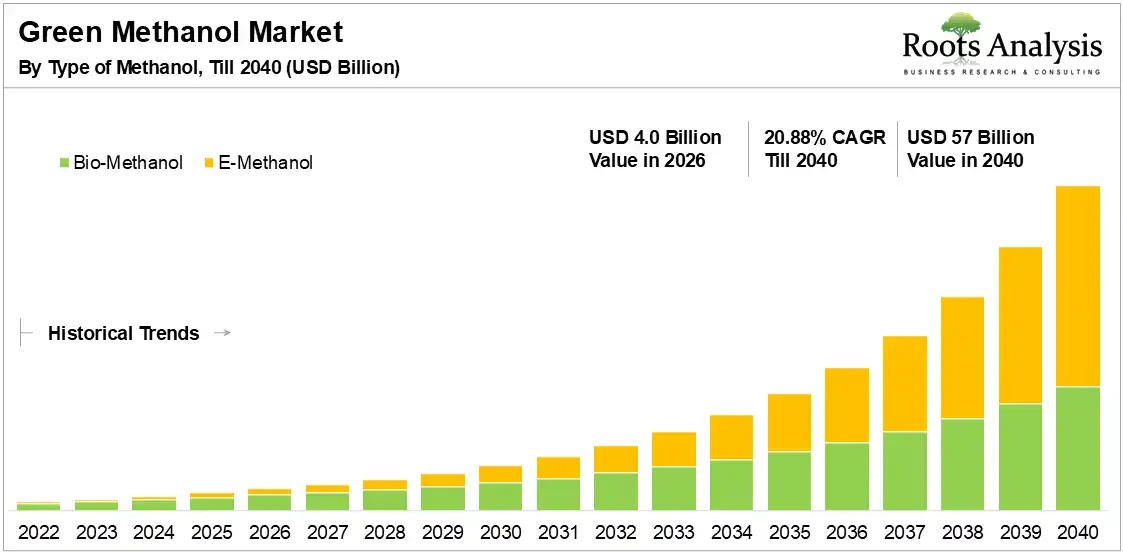
The green methanol market size is projected to grow from USD 4.0 billion in 2026 to USD 57 billion by 2040, representing a CAGR of 20.88% during the forecast period till 2040.
 |
To learn more about this report, request a free sample copy
The new research study consists of the green methanol market and trends analysis, detailed market forecast analysis, and provides actionable strategic recommendations.
In today’s urgency to find alternatives to fossil fuels, green methanol is emerging as the most promising solution to address challenges in reducing carbon emissions. Green methanol is a type of methanol produced from renewable and sustainable sources which is a core feature that makes it an eco-friendly alternative to traditional fossil-fuel-based methanol. It plays a major role in reducing greenhouse gas emissions (GHG) and supporting the transition to a low-carbon economy.
In recent years, the bourgeoning need for sustainable fuel alternatives has spurred the green methanol market growth. Numerous key drivers are expected to emerge and propel the market forward. Illustratively, the rising global emphasis on sustainability and decarbonization has led governments and industries to search for cleaner energy solutions. Here, the regulatory impact on green methanol production is playing a vital role due to government policies and incentives that promote renewable energy and carbon reduction solutions. In addition, the wide range of applications of green methanol ranging from transportation fuels to feedstock in chemical production, are likely to maximize the market prospects. The versatility of this renewable resource positions it favorably in an increasingly eco-conscious marketplace, where industries are actively seeking alternatives that align with their sustainability goals.
Hence, more and more companies are investing in the industry to leverage the sustainable benefits of green methanol. For instance, in October 2024, Maersk launched Vioneo, a new company focused on producing fossil-free plastics using green methanol. The company planned to invest around $1.64 billion in building a 300,000 t/y plant in Belgium which is expected to begin operations by 2028. At the launch of the company, Vioneo’s chairperson, Jan Secher, stated that the company aims to revolutionize the plastics industry by proving that large-scale, cost-effective plastic production is possible without fossil materials. Overall, taking these factors into account, the market for green methanol is projected to grow at an extraordinary rate during this forecast period.
The green methanol market report presents an in-depth analysis of the various companies that are involved in offering green methanol, across different segments, as defined in the table below:
| Key Report Attributes | Details | |
| Historical Trend | Since 2020 | |
| Forecast Period | Till 2040 | |
| Market Size Value in 2026 | $ 4.0 Billion | |
| Market Size Value by 2040 | $ 57 Billion | |
| CAGR (Till 2040) | 20.88% | |
| Type of Feedstock |
|
|
| Type of Methanol |
|
|
| Type of Derivative |
|
|
| Type of Application |
|
|
| Geographical Regions |
|
|
| Leading Market Players | ||
| PowerPoint Presentation (Complimentary) |
Available | |
| Customization Scope | 15% Free Customization | |
| Excel Data Packs (Complimentary) |
|
|
The global green methanol market is categorized into various types of feedstock such as biomass, carbon capture & storage, and municipal waste. According to our projection, the biomass segment is estimated to hold the largest (~48%) of the market share by 2040. The advantages of biomass, derived from organic materials such as forestry waste, agriculture waste, and residue, provide a renewable resource for methanol production. Besides, biomass also offers a waste-to-value capability that not only aids the market but also contributes to waste management and circular economy.
However, the carbon capture & storage segment is projected to expand at a substantial CAGR of (32.04%) over this projection timeframe. This feedstock plays a pivotal role in e-methanol production, where it is captured from industrial emissions or direct air capture and converted into methanol by using green hydrogen. Consequently, the excessive demand for carbon-captured technologies will foster segment growth.
The distribution of the market based on the type of methanol is fragmented into bio-methanol and e-methanol. According to our green methanol market analysis, the bio-methanol segment is predicted to hold the highest (~63%) of the market share by 2040. The sustainability and environmental benefits of bio-methanol are key driving factors inflating the demand for bio-methanol. Methanol can be produced from a variety of feedstocks including agriculture, residues, wood, and municipal waste. Hence, as the demand for green fuels rises, the growth of the bio-methanol segment will continue to expand in the future as well.
Nevertheless, the e-methanol segment is expected to rise at a notable CAGR of (31.16%) during this forecast period. E-methanol utilizes carbon dioxide as a major feedstock where it captures and reuses it in a circular process. These carbon capture and storage technologies reduce the carbon footprint and help tackle global climate change. Furthermore, the growing use of green hydrogen for methanol synthesis can also enhance market growth.
This segment of the market underscores the type of derivatives such as Dimethyl Ether & MTBE, Formaldehyde, Gasoline, MTO, and Solvents. As per market research, the formaldehyde segment is projected to capture the largest (~45%) of the green methanol market share by 2040. The segment is likely to retain this dominance due to the high demand for formaldehyde across a wide range of applications. Formaldehyde is an essential ingredient in manufacturing resins, plastic, adhesives, and coatings which are commonly used in industries such as construction, automotive, and furniture.
While the Methanol-to-Olefins (MTO) segment is anticipated to register a higher CAGR of (32.78%) during this forecast period. This growth can be ascribed to the surged demand for olefins. Due to being a vital building block for the production of plastics and synthetic materials. Also, the growing inclination towards sustainable chemical production will likely advance the market development.
Based on the type of application, the market is segmented into chemical, fuel, and power generation. According to this green methanol market forecast report, the fuel application dominates the segment and is anticipated to occupy the largest share (~47%) by 2040. Global efforts to achieve net-zero carbon emissions are a major factor bolstering segment growth. The ability to substantially reduce greenhouse gas emissions compared to traditional fuels makes green methanol a critical alternative in sustainable energy transition. Also, the applications in transportation and shipping further support the segment’s growth as it complies with strict International Maritime Organization (IMO) regulations.
On the other hand, the chemical segment is expected to grow at the fastest CAGR of (33.30%) during this projection period. Green methanol is a key raw material for the production of various chemicals such as formaldehyde, acetic acid, and MTBE which are used in manufacturing plastics, adhesives, and solvents. Therefore, the growing chemical feedstock uses of green methanol for diverse applications is likely to spur the growth of the market.
This segment highlights the distribution of the green methanol market across various geographical regions, such as North America, Europe, Asia, Latin America, the Middle East and North Africa, and the rest of the world. As per market research, North America is poised to hold the largest (~48%) of the market share till 2040 due to their strong emphasis on environmental sustainability initiatives. Furthermore,
Asia Pacific growth in green methanol is redefining the future of sustainable energy sources. Therefore, Asia is expected to witness a remarkable (35.12%) CAGR during this forecast period.
The accelerated industrialization in Southeast Asian countries including China and India is lifting the demand for cleaner energy resources similar to green methanol. Apart from this, the rising need for energy security and sustainable solutions are pushing the industries and consumers to adopt green methanol low-carbon fuel. As a result, government initiatives and policies to reduce carbon emissions and promote renewable energy is impressively propelling the production and adoption of green methanol in Asia. For instance, in November 2024, India’s largest power-producing company National Thermal Power Corporation (NTPC) inaugurated the world’s first CO2-to-methanol conversion plant to promote green technologies.
Prominently, the growing environmental concern related to climate change and its devastating effects has led to a surge in demand for cleaner and renewable fuels, which is the major key driver. Renewable fuels such as ethanol burn more cleanly than gasoline and minimize greenhouse gas emissions, thus, fostering the green methanol market growth. Owing to this, governments around the world are playing a crucial role in promoting low-carbon fuel adoption like bioethanol through regulations and incentives. Additionally, the abundance of feedstocks such as corn, sugarcane, and cellulosic biomass has aided in the high production of bioethanol. Therefore, the availability of various biomass feedstock in green methanol is making it a viable alternative to fossil fuels and augmenting the market demand. Moreover, ongoing advancements in production technologies is also attributed to this significant growth. The development of cellulosic ethanol technology has enhanced the efficiency and reduced the cost of the production which is further driving market growth.
Leading companies including Carbon Recycling International, SunGAs, OCI, Cargil Corporation, and many more are changing the competitive landscape of the green methanol industry. These companies are driving the market development with their heavy investment in R&D to improve ethanol production efficiency. Further, leading key players are constantly striving to secure substantial market share by employing collaboration & partnership and mergers and acquisition strategies which also help them expand market reach.
Despite being a sustainable fuel alternative, the growth of the market for green methanol can be constrained due to infrastructure limitations which pose challenges in scaling production. The present infrastructure of ethanol production, distribution, and utilization is not as developed as that for conventional fuels. As a result, scaling up production to meet growing demand with cost-effectiveness is a barrier that can obstruct the market evolution. Addressing these challenges is crucial to expand and realize its full potential.
With regard to regional insight, North America green methanol market holds a significant portion of the global marketplace. Government policies promoting renewable fuels in the region are a leading factor behind the region’s dominance. Particularly, the US government has implemented policies and incentives to encourage the use of renewable fuels. These policies and mandates for renewable energy consumption and emissions reduction targets in the energy sector have made green methanol an attractive alternative to fossil fuels, supporting the market demand. Along with this, the well-established industrial base with advanced carbon capture and storage technologies has augmented the large-scale production of green methanol, substantially fostering the market growth in the region. Furthermore, the growing demand for sustainable energy solutions across the region continue to drive the significant investment opportunities in green methanol for private and public investors which will likely continue boost the market development and growth in the upcoming years.
Examples of key players involved in the market for green methanol (which have also been captured in this market report, arranged in alphabetical order) include ANDRITZ (Austria), AVAADA (India), AVEL Energy, Carbon Recycling International (Iceland), Cepsa (Spain), Enerkem (Canada), Methanex Corporation (Canada), Mitsubishi (Japan), OCI (Netherlands), Proman (Switzerland), Södra (Sweden), SunGas Renewables (US), Thyssenkrupp Uhde (Germany), Veolia (France), and WASTEFUEL (US). This market report includes an easily searchable excel database of all the companies who have adopted the green methanol market.