


 Download Free Sample
 Buy Now
Market Size
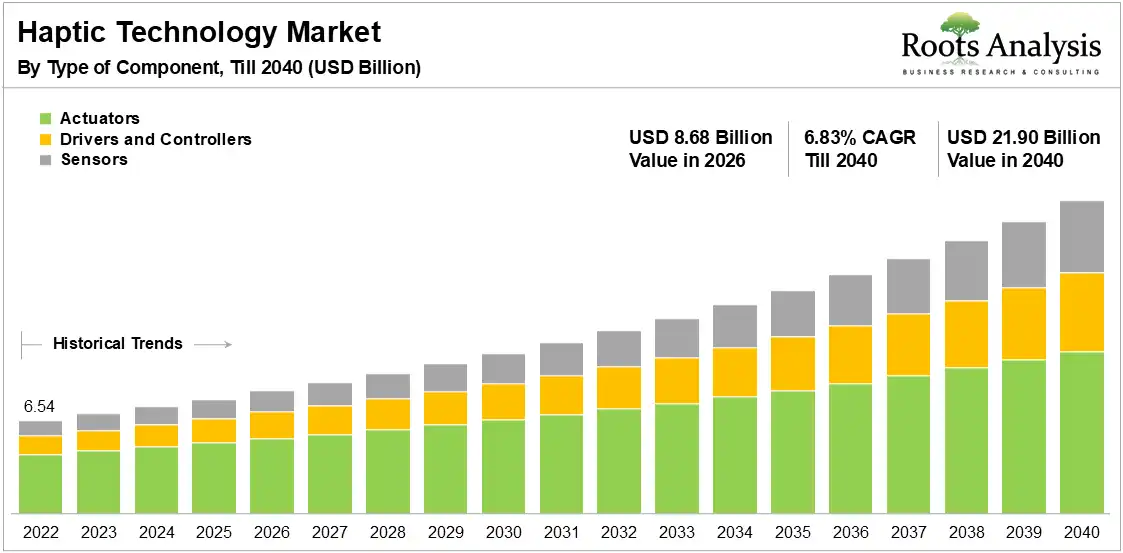
The global haptic technology market is projected to reach USD 8.68 billion in 2026 and USD 21.90 billion by 2040, representing a CAGR of 6.83% during the forecast period 2026 to 2040.
See What’s in the Full Report – Request Your Complimentary Insights!
Market Report: Key Takeaways
- Leading Players Competitive Footprint: The haptic feedback market competitive landscape indicates a mix of tech giants and startup companies. Companies in this market focus on product innovation, portfolio expansion, strategic partnerships, and investments in technologies. Notable examples include AAC Technologies, Boréas Technologies, Johnson Electric, Novint Technologies, and TDK.
- Innovation Hotspots: Multimodal sensing platforms such as Synaptics Astra are advancing AI-native edge perception, enabling context-aware and personalized haptic experiences. In healthcare, haptic-enabled remote solutions are gaining traction, offering tangible potential across tele-diagnosis, tele-rehabilitation, and remote surgical training applications.
- Regional Insights: While APAC remains the production hub (growing at a rapid pace during the forecast period), North America dominates the market for high-value IP and medical research.
- Market Growth Across Type of Feedback: Tactile feedback mechanisms, encompassing vibration, skin-stretch, and electrotactile stimulation, dominate the global market. Their dominance stems from pervasive integration across the consumer electronics buyer segment:
Market Overview
The haptic technology market is shifting from a niche feature in consumer devices to a core element of advanced human-machine interfaces. Industry dynamics now reflect a move beyond simple vibration alerts toward immersive, high-definition tactile feedback. This transition stems from advances in actuator design, particularly the evolution from eccentric rotating mass motors to linear resonant actuators and piezoelectric technologies. As performance improves, adoption trends are expanding into sectors that demand precision and reliability, including automotive, healthcare, and extended reality environments. Market trends indicate that tactile feedback is becoming integral to system design rather than an optional enhancement.
Strong haptic technology market growth drivers are emerging from user experience expectations and safety-focused regulations across adjacent industries. The expansion of the XR ecosystem and spatial computing platforms require realistic touch feedback to support intuitive digital interaction. At the same time, automotive safety initiatives around ADAS are accelerating integration of haptic signals in steering systems and seating to reduce distraction during system transitions. For instance, 2025 automotive developments emphasize non-visual, intuitive alerts to improve safety in semi-autonomous driving. These shifts reinforce ecosystem-wide momentum and create measurable investment opportunities.
Future growth outlook centers on miniaturization, energy efficiency, and artificial intelligence enabled adaptive feedback, while structural market trends point to rising demand for high-realism solutions in tele-operation, precision robotics, and immersive training systems. For instance, 2025 research focuses on integrating AI-driven haptics into surgical robotics to deliver real-time tactile input during minimally invasive procedures. As adoption broadens, haptics will play a strategic role in bridging digital systems with physical experience.
Pay Only for What You Need – The Best Way to Optimize
Haptic Technology Market Size Estimation Methodology
- As a starting point, we identified key haptic technology components, specifically actuators, drivers and controllers, and sensors, alongside feedback types (tactile and force) and actuator technologies for analysis across major end-use sectors like consumer electronics, gaming, healthcare, and automotive.
- Then we examined the ongoing transition from basic ERM motors to advanced LRA and piezoelectric technologies, mapping adoption rates across premium to entry-level devices to understand technology maturity, macroeconomic trends, and product life cycles.
- Thereafter, we collected segment-wise end-device shipment volumes, technology penetration rates, and prevailing component average selling prices (ASPs) through primary research with manufacturers and system integrators, cross-validating our bottom-up findings against top-down industry data and secondary sources.
- Using these data and insights, we calculated the global haptic technology market size and projected the future market opportunity, driven by historical growth trends and the increasing integration of high-definition and AI-driven haptics into emerging applications like AR/VR, industrial controls, and surgical robotics.
- The overall opportunity associated with the global market was further distributed across different market segments, allocating demand by type of component, type of feedback, type of actuator technology, application, and geographical regions.
- Finally, in order to assess the sensitivity of our assumptions, we conducted a multivariate sensitivity analysis on some of the most important parameters of our forecast methodology.
Market Share Insights
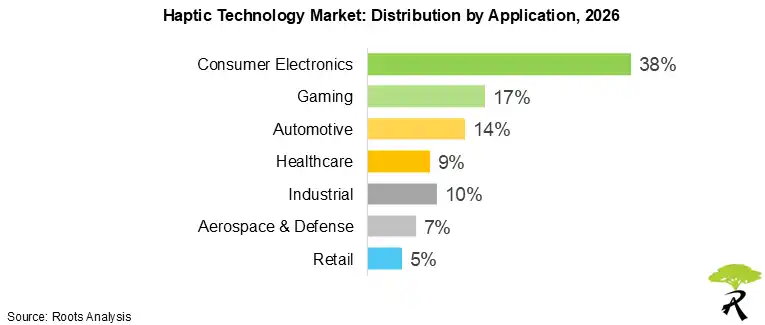
Market Share by Application: Consumer Electronics Holds the Highest Share
Consumer Electronics holds the largest haptic technology market share at 38.0% in 2026, making it the leading segment in the haptic technology market. Its dominance stems from deep integration of haptic actuators in smartphones, wearables, tablets, and emerging XR devices, supported by mature East Asian supply chains and strong OEM cost optimization. Standardized linear resonant actuators and piezo solutions enable large-scale deployment without significantly raising device costs, reinforcing steady adoption trends.
Conversely, the role of haptic technology is expected to grow in healthcare applications at a faster CAGR of 13.8% through 2040. This is due to haptics technology shift from simulation tools to real-time clinical applications in robotic surgery, minimally invasive procedures, and remote rehabilitation. Regulatory focus on patient safety, combined with rising installations of advanced robotic platforms, is accelerating commercialization in healthcare industry.
Geographical Regions Insight: North America Leads the Market While Asia-Pacific to Grow Rapidly Through 2040
Based on the haptic technology industry outlook, North America leads the haptic technology market with a 34.0% market share in 2026. This growth is supported by early commercialization across XR devices, automotive HMI systems, defense simulation, and advanced medical applications. North America region also benefits from a mature semiconductor ecosystem, strong Tier-1 automotive integration, and sustained federal defense funding that reinforces demand for high-fidelity tactile solutions. Established supply chains and deep R&D capabilities continue to anchor its competitive dynamics, despite a gradual share shift over time.
Asia-Pacific region is anticipated to be the fastest-growing segment, with a CAGR of 13.8%, through 2040. Growth is fueled by large-scale consumer electronics manufacturing, rapid smartphone OEM integration, government-backed XR investments, and accelerating automotive electrification. Compressed product development cycles and expanding industrial automation further strengthen its growth outlook, positioning Asia-Pacific as the primary engine of future adoption trends in the global haptic technology market.
Market Ecosystem Insights
Top 10 Market Leaders Shaping the Future of Haptic Technology Industry
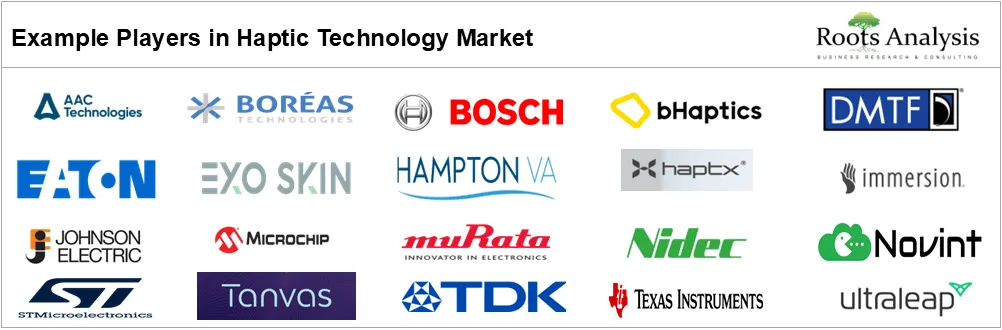
Our haptic technology market key players analysis highlights that the industry is highly consolidated with tech giants, undertaking strategic initiatives, such as partnerships, collaborations, and product launch.
Examples of key companies, include AAC Technologies, Synaptics, Texas Instruments, TDK, Nidec, onsemi, Cirrus Logic, Johnson Electronic, Microchip Tech and 3D Systems. While Texas Instruments launched world's smallest MCU (1.38mm2) for wearables in March 2025, TDK entered into partnership with McLaren Racing for F1/sim-racing haptic components. These initiatives are likely to maintain long-term competitiveness in the industry.
Top 5 Startups Driving Innovation in Haptic Technology Market
The haptic technology startup ecosystem is a vibrant, globally distributed network of innovation-driven companies that are reshaping the boundaries of tactile interaction. With more than 150 companies tracked globally, the startup landscape is maturing from proof-of-concept hardware into commercially deployable platforms.
Innovative initiatives among these startups include:
- Touchless Interaction: Ultraleap is leveraging mid-air ultrasound to create tactile buttons that can be felt in the air, a feature currently being trialed in automotive dashboards and high-hygiene public environments.
- High-Definition Sensory Feedback: Actronika is pushing the boundaries of sensory touch, utilizing vibrotactile patterns to replicate the feel of materials like brushed aluminum or rough leather on a flat screen.
- Assistive and Bionic Tech: PSYONIC is developing bionic prosthetics that provide sensory responses to amputees, while Dot Incorporation is using piezoelectric actuators to create real-time braille displays for the visually impaired.
Have Questions? Let’s Get Them Answered.
Market Access Considerations
Standardization and Interoperability Challenges
The haptic technology market lacks universal standards for performance and interoperability, limiting seamless market access. Inconsistent feedback across devices weakens user trust and slows adoption drivers, particularly among developers seeking scalable solutions.
Without common protocols, developers must tailor effects to specific hardware, raising commercialization challenges and integration costs. This fragmented competitive landscape favors incumbents with proprietary ecosystems and established partnerships, creating high entry barriers and delaying broader market scaling.
Cost-Value Proposition in Integration
Based on the haptic technology market analysis, high integration costs remain a core commercialization challenge in the haptic technology market. Advanced actuators, drivers, and software increase total product costs in price-sensitive segments such as smartphones, wearables, and automotive HMI systems.
Market access depends on proving clear value through improved user experience, enhanced safety, or premium positioning. Pricing dynamics require economies of scale in manufacturing, making significant upfront R&D and production investments essential for competitive participation.
Ecosystem Maturity and Platform Integration
Market access for haptic solutions depends heavily on the maturity of host platform ecosystems, such as virtual reality, gaming, and automotive infotainment. Adoption drivers are closely tied to platform readiness and the strength of developer support infrastructure.
Robust software development kits (SDKs) and content tools accelerate integration and reduce haptic solutions related commercialization challenges. Conversely, proprietary systems controlled by dominant players restrict interoperability, complicate entry strategies for smaller firms, and reinforce barriers within the competitive landscape.
Regulatory and Safety Certification Requirements
The regulatory environment varies by application, directly shaping market access pathways. Consumer electronics face limited oversight, while automotive HMI, medical simulation, and surgical robotics demand strict adherence to performance and functional safety standards such as ISO 26262.
Compliance requires extensive testing, certification, and validation cycles, increasing costs and extending timelines. These requirements heighten entry barriers for non-specialized providers and influence competitive positioning based on certification capabilities.
How Stakeholders Benefit from the Key Focus Areas of Our Haptic Technology Market Research Report
The haptic technology market is gaining strategic importance as immersive digital experiences, wearable devices, automotive interfaces, and advanced robotics accelerate demand for tactile feedback solutions. Our report delivers actionable insights that support informed decisions across strategy development, capital allocation, product innovation, and market expansion.
- Unmet Needs and Market Gaps in Haptic Technology Market: The report identifies critical unmet needs across device miniaturization, power efficiency, realistic tactile simulation, and integration with AR / VR and wearable platforms. It highlights performance limitations in existing actuator technologies and software-hardware synchronization challenges that restrict user experience quality. These insights enable product leaders to prioritize innovation areas while helping investors identify whitespace opportunities with high scalability potential.
- Funding and Investment Landscape in Haptic Technology Market: The haptic feedback sensors and drivers market study analyse recent investment activity, venture capital inflows, strategic acquisitions, and R&D funding patterns shaping the competitive environment. It maps capital concentration across application areas such as gaming peripherals, medical simulation, automotive HMI systems, and immersive computing. This perspective supports investors in assessing risk-adjusted growth opportunities while enabling corporate development teams to evaluate acquisition or partnership targets.
- Player Landscape and Competitive Dynamics in Haptic Technology Market: The report provides a detailed assessment of established manufacturers, emerging startups, and technology integrators competing across hardware and software layers. It evaluates product portfolios, innovation pipelines, geographic presence, and strategic positioning to clarify the evolving competitive landscape. These insights support benchmarking, competitive positioning, and market entry planning. Decision-makers can identify consolidation trends, potential disruptors, and defensible niches within the broader growth outlook.
- Technology Innovation and Adoption Trends in Haptic Technology Market: The analysis tracks innovation across actuator technologies, electroactive polymers, ultrasonic haptics, AI-driven feedback systems, and advanced control algorithms. It assesses adoption drivers such as immersive user experience demand, next-generation automotive interfaces, and growth in virtual training environments. Technology leaders benefit from clear signals on emerging standards and integration pathways, while investors gain insight into scalable innovation themes. The report links technological progress to realistic commercialization opportunities and adoption timelines.
- Partnerships and Collaboration Trends in Haptic Technology Market: The study examines strategic alliances between component manufacturers, device OEMs, software developers, and platform providers. It highlights ecosystem development across AR/VR, automotive infotainment, robotics, and healthcare simulation markets. Understanding collaboration patterns enables business development teams to identify high-value partnership opportunities and accelerate go-to-market strategies. These insights also help organizations reduce development risks and strengthen competitive advantage through ecosystem integration.
- Market Segmentation and Geographic Coverage in Haptic Technology Market: The report delivers detailed market segmentation by technology type, component, application, end user, and region, supported by growth forecasts and revenue projections. It evaluates regional adoption trends across North America, Europe, Asia-Pacific, and emerging markets, identifying high-growth geographies and regulatory considerations. This segmentation clarity enables targeted expansion strategies and efficient resource allocation. Stakeholders can align product portfolios with region-specific demand patterns and optimize global market entry decisions.
Get an Instant Quote in 10 Minutes. Lowest Price Guaranteed
Haptic Technology Market: Scope of the Report
| Key Report Attributes | Details | |
| Historical Trend | Since 2022 | |
| Forecast Period | Till 2040 | |
| Market Size 2026 | $ 8.68 Billion | |
| Market Size 2040 | $ 21.90 Billion | |
| CAGR (Till 2040) | 6.83% | |
| Segments Covered |
|
|
| Geographical Regions Covered |
|
|
| Key Sections Covered |
|
|
Market Segmentation
Based on research, we have segmented the haptic technology market into type of component, type of feedback, type of actuator technology, application, geographical regions, and key players.
Market Share by Type of Component
- Actuators
- Drivers and Controllers
- Sensors
Market Share by Type of Feedback
- Tactile Feedback
- Force Feedback
Market Share by Type of Actuator Technology
- Eccentric Rotating Mass Actuators
- Linear Resonant Actuators
- Piezoelectric Actuators
- Other Actuators
Market Share by Application
- Consumer Electronics
- Gaming
- Automotive
- Healthcare
- Industrial
- Aerospace & Defense
- Retail
Market Share by Geographical Regions
- North America
- US
- Canada
- Mexico
- Rest of North America
- Europe
- Austria
- Belgium
- Denmark
- France
- Germany
- Ireland
- Italy
- Netherlands
- Norway
- Russia
- Spain
- Sweden
- Switzerland
- UK
- Rest of Europe
- Asia-Pacific
- Australia
- China
- India
- Japan
- New Zealand
- Singapore
- South Korea
- Rest of Asia-Pacific
- Latin America
- Brazil
- Chile
- Colombia
- Venezuela
- Rest of Latin America
- Middle East and Africa (MEA)
- Egypt
- Iran
- Iraq
- Israel
- Kuwait
- Saudi Arabia
- UAE
- Rest of MEA


