


 Download Free Sample
 Buy Now
Market Size
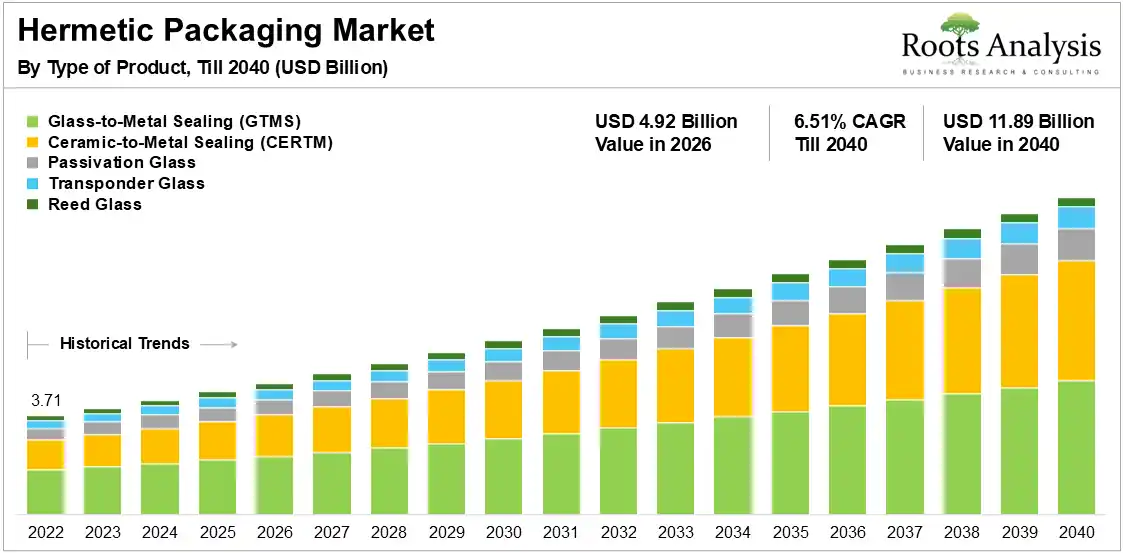
The global hermetic packaging market is projected to grow from USD 4.92 billion in 2026 to USD 11.89 billion by 2040, representing a CAGR of 6.51% during the forecast period 2026 to 2040.
See What’s in the Full Report – Request Your Complimentary Insights!
Market Report: Key Takeaways
- In terms of product type, the glass-to-metal seals market size accounts for the dominant 45% share, while the ceramic hermetic packaging market projects the highest CAGR (7.4%) through 2040.
- Based on configuration, multilayer ceramic packages dominate the current industry (capturing 38.5% market share) due to superior thermal management in high-power microelectronics.
- Laser welding is anticipated to exhibit the fastest CAGR of 17.5% through 2040 among the different sealing processes; this is driven by precision in temperature-sensitive applications.
- Sensors represent the dominant application share (26%) in 2026, while laser integration accelerates rapidly (with a CAGR of 20.2% till 2040) to support next-generation optical communication architectures.
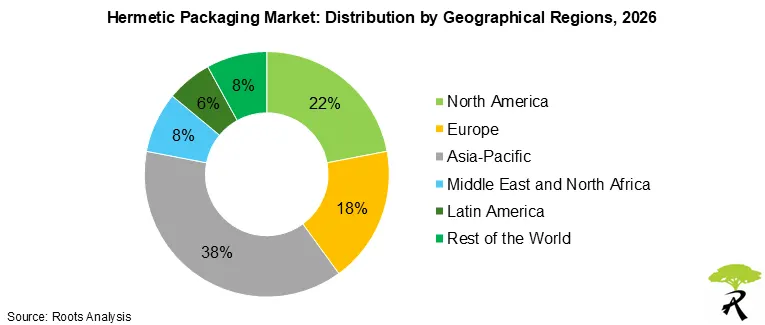
- In 2026, Asia-Pacific captures the largest global industry share (38.0%) and is projected to experience the most accelerated CAGR of 17.2% through 2040.
- Electric vehicle expansion, AI-driven data centers, and defense modernization act as primary mega trends driving long-term hermetic packaging acceleration.
- Global market penetration is rapidly widening as adoption structurally shifts from exclusive aerospace niches into mass-volume industrial IoT architectures.
Market Overview
The hermetic packaging market is undergoing a clear transition from a niche capability to a foundational element supporting mission-critical infrastructure across industries. Current hermetic packaging market trends reflect rising dependence on highly reliable components operating in harsh environments as miniaturized electronics and advanced sensors expand across aerospace and medical applications. Industry dynamics have shifted beyond traditional glass-to-metal seals toward advanced material combinations, including ceramic-to-metal designs and specialty alloys that deliver stronger thermal stability and ultra-low leak performance under demanding conditions.
Market expansion is strongly influenced by investment momentum and policy-driven innovation across next-generation systems. Key growth drivers include the rapid deployment of LEO satellite constellations, where hermetic sealing technology protects components exposed to temperature extremes and radiation. Adoption trends continue to strengthen as projects such as Amazon’s Project Kuiper accelerate demand for scalable, high-reliability packaging used in transponders and sensors. At the same time, stringent regulatory requirements, particularly in medical device standards and aerospace reliability protocols (AS9100), ensure consistent growth by mandating hermetic protection for critical components and implantable devices.
The long-term trajectory indicates accelerated growth, driven by a convergence of technological advancements and emerging high-performance sectors, including quantum computing and next-generation 6G communication infrastructure, where sensitive components require absolute environmental protection.
Pay Only for What You Need – The Best Way to Optimize
Hermetic Packaging Market Size Estimation Methodology
- As a starting point, we established the market scope by identifying core hermetic packaging technologies, including glass-to-metal seals (GTMS), ceramic-to-metal seals (CTMS), and feedthroughs, alongside critical material configurations like Kovar and titanium for major end-use sectors where reliability in harsh environments is essential.
- Then we examined the adoption rates of specific end-technologies, evaluating the ramp-up phases for emerging applications such as LiDAR sensors and advanced medical devices, as well as the replacement cycles for legacy systems, to understand technology maturity, macroeconomic trends, and shifting manufacturing cost structures.
- Thereafter, we collected segment-wise shipment volumes, application-specific component requirements, and prevailing average selling price (ASP) trends through primary research with key stakeholders (including packaging manufacturers, material suppliers, and OEMs) and using secondary sources, such as technical white papers, and regulatory standards like MIL-STD-883.
- Using these data and insights, we calculated the global hermetic packaging market size and projected the future market opportunity till 2040. This was achieved through a bottom-up methodology that multiplied validated end-component shipment volumes by package-specific ASPs, factoring in historical growth rates, sector-specific spending, and technological advancements.
- The overall opportunity associated with the global market was distributed across distinct market segments, including type of product, configuration, sealing process, application, end use industry, geographical region, and key players.
- Finally, in order to assess the sensitivity of our assumptions, we conducted a multivariate sensitivity and scenario analysis (base, optimistic, and conservative) on some of the most important parameters of our forecast methodology, evaluating the potential impact of fluctuating raw material costs, shifting adoption rates, and market disruptions.
Hermetic Packaging Market Share Insights
Why is the Current Hermetic Industry Dominated by Applications across Sensors?
- Growth patterns across hermetic packaging applications reflect a clear shift in competitive dynamics toward optoelectronic and sensor-centric devices, where hermeticity provides non-negotiable performance and reliability advantages. Validating this transition, sensors represent the largest application segment in the hermetic packaging market, accounting for 26.0% market share in 2026.
- The strong market share of sensors reflects the rapid proliferation of sensing technologies across automotive, industrial, telecom, and energy systems, where hermetic packaging is essential for protecting sensitive components operating in harsh environments. Increasing integration of sensors in ADAS platforms, electric vehicles, and industrial monitoring systems further strengthens adoption, as hermetic sealing technology ensures long-term reliability against moisture, pressure, and temperature variations.
- Concurrently, the laser application segment is accelerating at a faster CAGR of 20.2% from 2026 to 2040, fueled by the explosive bandwidth demands of AI-driven optical communication and perception-based automotive systems. High-reliability applications, ranging from advanced telecom optical circuit switching (OCS) to solid-state LiDAR emitters and aerospace defense networks, depend heavily on precision glass-to-metal and ceramic hermetic packaging. These advanced hermetic enclosures are mandatory to preserve optical clarity, maintain thermal stability, and ensure uninterrupted data transmission across next-generation optical infrastructures.
Want Information on Specific Region / Segment?
Market Share Analysis by Geographical Regions: Asia-Pacific Region to Capture Largest Share in the Hermetic Industry Through 2040
- The hermetic packaging market share analysis suggests that the Asia-Pacific (APAC) region dominates by capturing 38.0% market share in 2026. It is also positioned for aggressive, sustained expansion, growing with an industry-leading CAGR of 17.2% through 2040.
- Asia-Pacific’s high market share reflects strong adoption trends driven by the region’s dominance in semiconductor manufacturing and rapidly expanding electric vehicle production, where reliable hermetic components are critical for protecting sensitive electronics from harsh operating environments. Mature, large-scale manufacturing ecosystems across China and India have successfully optimized production cost curves, operating 15–20% below global averages. This distinct pricing advantage strengthens Asia-Pacific’s competitive edge, facilitating the high-volume deployment of advanced hermetic feedthroughs and packaging solutions across both semiconductor and automotive supply chains.
- The region’s long-term market dominance is further supported by continued investment in electronics supply chains and government-backed semiconductor initiatives. Notably, India’s ongoing tech budget allocations and the $15 billion commitment (announced in the Union Budget 2026-27) to the India Semiconductor Mission (ISM) 2.0 are accelerating massive new fab investments, including Tata Group and CG Power fabs to produce high-value components.
- Concurrently, regional automotive powerhouses are driving unprecedented component demand; for instance, BYD’s integration of hermetic seals across its record-breaking 4.6 million EV and hybrid battery packs delivered in 2025 underscores the massive industrial scale fueling the APAC hermetic packaging sector.
Market Growth Trends in North America and Europe
- Our hermetic packaging market forecast estimates suggest that North America and Europe will capture 22.0% and 18.0% of the global hermetic packaging market share in 2026, respectively. Their growth outlook remains comparatively slower despite maintaining strong installed bases in aerospace, defense, and automotive electronics.
- This regional stagnation is primarily driven by increasing structural constraints, higher labor costs, and severe regulatory bottlenecks that have stalled domestic semiconductor infrastructure expansion. Specifically, the delayed materialization of facility funding under the US CHIPS and Science Act, combined with major cancellations of planned European mega-fabs, most prominently Intel’s strategic abandonment of its Magdeburg and Wroclaw facility investments announced in July 2025, have severely deferred new fabrication capacity. These delays directly slow the regional demand curve for advanced hermetic packaging components.
Factors Driving Hermetic Sector Growth in MENA and Latin America
- Latin America and Middle East and North Africa are expected to record steady market share gains as adoption expands across oil and gas infrastructure, domestic defense modernization programs, and expanding consumer electronics penetration. Notably, Latin America is poised to grow with a 16.0% CAGR, driven by rising consumer spending and infrastructure development that supports downstream electronics demand.
- Concurrently, the MENA region is accelerating at a 16.3% CAGR, fueled by aggressive strategic industrial partnerships and sovereign wealth investments in energy and defense. Notably, strict localization mandates such as Saudi Arabia’s Vision 2030, which targets 50% localization of military spending, are driving unprecedented demand for hermetic packaging. This strategic transition from importer to domestic manufacturer is financially reinforced by the Saudi defense budget expanding to $72.5 billion in 2025.
- Further, the Saudi Arabia’s Public Investment Fund-backed Alat initiative is deploying a massive $100 billion investment by 2030 to establish robust domestic electronics and semiconductor supply chains. This concentrated capital deployment necessitates the localized production of sensitive radar modules, sensors, and electronic warfare systems, all of which strictly require advanced hermetic packaging to ensure component survivability in harsh, extreme-temperature operational environments.
Market Ecosystem Analysis
Hermetic Packaging Market Competitive Landscape
The global hermetic packaging market ecosystem comprises massive industrial material conglomerates and specialized sealing providers, complemented by emerging tech startups. While established enterprise giants leverage extensive capital and manufacturing infrastructure to dominate high-volume sectors, specialized startups drive niche innovation across next-generation energy storage and optoelectronics.
Enterprise Giants Drive Hermetic Packaging Industry Expansion Through Strategic Scaling
Large material science and technology corporations, including SCHOTT, Kyocera Corporation, Egide Group, Materion Corporation, Murata Manufacturing, AMETEK Interconnects, and Hermetic Solutions Group (acquired by Qnnect), are aggressively scaling their manufacturing footprints and diversifying product architectures to maintain dominance. By embedding advanced hermetic capabilities into high-growth sectors like AI infrastructure and aerospace defense, these giants create formidable, structural barriers to entry.
- SCHOTT: Accelerating its strategic market positioning, SCHOTT announced substantial capacity expansions across its customizable MEMS lid portfolios, directly engineering high-reliability glass-to-metal packaging to support the explosive optical and thermal demands of next-generation AI and cloud data center architectures.
- Kyocera Corporation: Driving innovation for clean energy infrastructure, Kyocera announced the accelerated development of its proprietary liquid hydrogen ceramic hermetic seals, engineered to deliver absolute structural integrity and extreme-environment protection for next-generation hydrogen mobility and storage.
- Egide Group: Focusing on mission-critical defense and aerospace applications, Egide aggressively modernized its US manufacturing infrastructure to commercialize advanced hermetic packages and heat dissipation solutions tailored specifically for next-generation thermal batteries and specialized military firing systems.
Emerging Startups Expand Market Boundaries Through Next-Generation Architectures
Specialized innovators and venture-backed startups, such as Kitea Health, PHIX Photonics Assembly, Forge Nano, Silitronics, and highly specialized micro-packaging divisions like SCHOTT Primoceler, are aggressively disrupting traditional packaging boundaries. They achieve this by pioneering novel atomic layer deposition (ALD), specialized glass-to-glass laser sealing, and photonic integrated circuit (PIC) encapsulation. By securing vital strategic capital and partnerships, these emerging innovators commercialize highly specialized hermetic techniques that established legacy players are now seeking to acquire or integrate.
- Silitronics: Accelerating the commercialization of optoelectronics, Silitronics formed a strategic alliance with ficonTEC and Quantifi Photonics. Showcased at OFC 2024, the partnership deploys fully automated, high-volume photonic integrated circuit (PIC) assembly lines, delivering the robust hermetic module packaging required for next-generation AI and optical interconnects.
- PHIX Photonics Assembly: Driving the commercialization of optoelectronics, PHIX expanded its specialized contract manufacturing infrastructure, offering advanced hermetic sealing, including deep-vacuum laser welding and polarization-maintaining fiber feedthroughs, specifically tailored for complex Photonic Integrated Circuits (PICs).
- Forge Nano: Disrupting traditional semiconductor enclosures, this startup aggressively scaled its proprietary Atomic Layer Deposition (ALD) technology to commercialize highly uniform, pin-hole free thin films, enabling ultra-precise hermetic packaging directly at the wafer level.
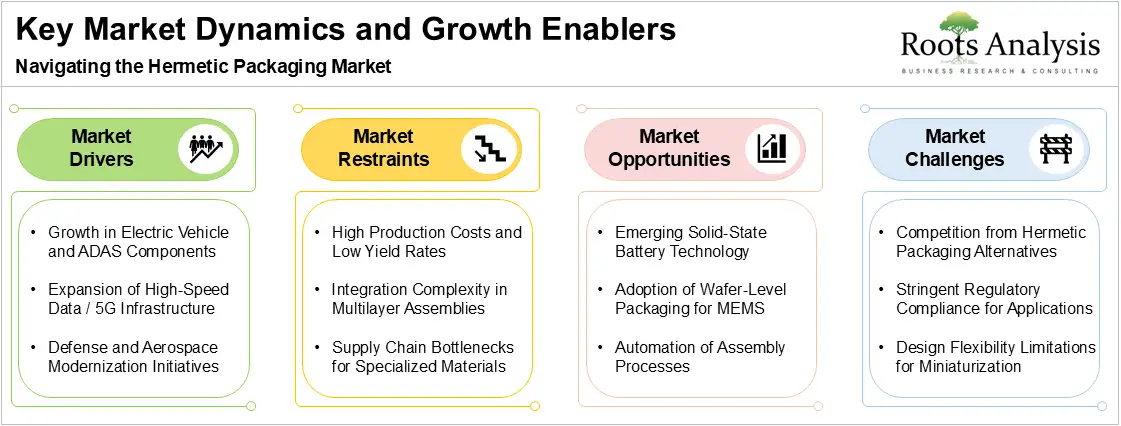
Key Hermetic Packaging Market Growth Drivers, Restraints, Challenges and Opportunities
Market Access Considerations
Regulatory and Qualification Hurdles in High-Reliability Sectors
Market access in the hermetic packaging market is strongly shaped by a strict regulatory environment across aerospace, defense, and medical implant sectors. Qualification timelines of 1-3 years and compliance with standards such as MIL-STD-883 or FDA biocompatibility rules significantly slow entry and raise commercialization challenges.
This creates a significant entry barrier where established players with a proven track record hold a strong advantage. Adoption drivers remain conservative, as buyers prioritize proven suppliers, certification history, and operational reliability over pricing dynamics or untested innovation. This risk-averse purchasing behavior strengthens incumbents’ positions and limits rapid adoption for new entrants seeking competitive positioning.
Cost-Value Proposition and Pricing Dynamics
Pricing dynamics in hermetic packaging reflect high manufacturing precision and specialized material costs, even though packaging represents a small share of total system expense. Market access depends on clearly linking pricing to failure prevention and long-term reliability benefits within critical applications.
The competitive landscape therefore splits into two models: price-driven competition in industrial uses and value-based pricing in mission-critical sectors. Commercialization success relies on targeting applications where failure costs outweigh upfront investment, as adoption drivers and price sensitivity differ significantly across industries.
Technology Shift to Miniaturization and Wafer-Level Packaging
Miniaturization trends in hermetic packaging are reshaping market access as micro-electromechanical systems (MEMS) and photonics applications demand smaller, high-reliability packaging formats. Adoption drivers increasingly favor advanced solutions such as wafer-level packaging (WLP) and innovative sealing materials that maintain performance while reducing size and system complexity.
This technology shift pressures established manufacturers to adapt legacy production lines within a changing regulatory environment. At the same time, emerging players can leverage new technology requirements to overcome traditional qualification barriers and enter evolving application segments more quickly.
Ecosystem Integration and Supply Chain Resilience
Market access is closely tied to ecosystem participation, as hermetic packaging operates within a deeply integrated B2B value chain. Suppliers must align with semiconductor manufacturers and system integrators while securing approval through vendor qualification processes and AVLs, creating operational dependencies that shape commercialization challenges.
Supply chain resilience is equally critical. Limited availability of specialized materials such as Kovar alloys and high-purity ceramics introduces risk, requiring strong partnerships and logistics capabilities to maintain competitiveness and ensure consistent adoption within established manufacturing ecosystems.
Your Business is Unique – Why Shouldn’t Your Report Be?
How Stakeholders Benefit from the Key Focus Areas of Our Hermetic Packaging Market Report
The hermetic packaging market is gaining strategic importance as industries demand higher reliability, longer product lifecycles, and protection for sensitive electronic and medical components. This report enables stakeholders to make informed strategic and investment decisions by translating market trends, technology evolution, and competitive dynamics into actionable insights. The analysis supports commercialization planning, geographic expansion, and adoption of advanced packaging technologies in rapidly evolving end-use sectors.
- Unmet Needs and Market Gaps in Hermetic Packaging Market: The report identifies critical performance, cost, and scalability gaps across applications such as aerospace electronics, medical implants, and high-reliability semiconductors. It highlights areas where existing solutions fail to meet durability, miniaturization, or environmental protection requirements. These insights help organizations prioritize product development and market entry strategies aligned with real demand. Decision-makers can target underserved segments with stronger commercialization potential and differentiated offerings.
- Hermetic Packaging Industry Analysis for Funding and Investments: The study analyzes investment activity, capital flow patterns, and emerging funding priorities shaping market expansion. It clarifies which technology segments and regional markets attract the highest investor confidence and long-term growth outlook. Stakeholders gain visibility into scalable opportunities while improving risk evaluation and resource allocation decisions. Financial planners and strategic leaders can align investments with high-growth adoption drivers and industry momentum.
- Hermetic Packaging Market Landscape and Competitive Dynamics: The report provides a structured view of the competitive landscape, including market positioning, strategic capabilities, and differentiation approaches among key participants. It explains how competition is evolving through innovation, pricing strategies, and supply chain integration. Organizations benefit by benchmarking their capabilities and identifying competitive white spaces. This intelligence strengthens expansion planning, partnership evaluation, and defensive strategy development.
- Technology Innovations and Adoption Insights: The analysis tracks innovation trends influencing packaging performance, material science advancements, and next-generation sealing technologies. It connects technological adoption patterns with industry-specific requirements and regulatory expectations. Product and technology leaders can use these insights to align R&D investments with future commercialization opportunities. The report reduces uncertainty around technology transitions and accelerates informed innovation decisions.
- Partnership and Collaboration Trends in Hermetic Packaging Market: The report examines collaboration models emerging across manufacturers, material suppliers, and end-use industries to accelerate innovation and market penetration. It highlights how partnerships enable faster product validation, cost optimization, and ecosystem expansion. Stakeholders gain clarity on where alliances create competitive advantage and reduce market entry barriers. Business development teams can identify collaboration pathways that strengthen long-term growth strategies.
- Hermetic Packaging Market Segmentation and Geographic Coverage: Comprehensive segmentation analysis reveals demand patterns by application, material type, end-use industry, and regional markets. The report explains how growth dynamics vary across geographies based on industrial development, regulatory environments, and technology adoption rates. Stakeholders can prioritize high-value regions and tailor go-to-market strategies with greater precision. This structured market view supports expansion planning, revenue forecasting, and efficient allocation of operational resources.
Hermetic Packaging Market: Scope of the Report
| Key Report Attributes | Details | |
| Forecast Period | Till 2040 | |
| Market Size 2026 | $ 4.92 Billion | |
| Market Size 2040 | $ 11.89 Billion | |
| CAGR (Till 2040) | 6.51% | |
| Segments Covered |
|
|
| Geographical Regions Covered |
|
|
| Key Sections Covered |
|
|
Market Segmentation
The global hermetic packaging market report presents an in-depth analysis, highlighting the capabilities of various stakeholders, based on different segments such as type of product, configuration, sealing process, application, end use industry, geographical regions, and key players.
Market Share by Type of Product
- Ceramic-to-Metal Sealing (CERTM)
- Glass-to-Metal Sealing (GTMS)
- Passivation Glass
- Reed Glass
- Transponder Glass
Market Share by Configuration
- Metal Can Packages
- Multilayer Ceramic Packages (MLCP)
- Pressed Ceramic Packages
Market Share by Sealing Process
- Brazing
- Compression Sealing
- Epoxy Sealing
- Glass Frit Sealing
- Laser Welding
- Solder Sealing
Market Share by Application
- Airbag Ignitors
- Lasers
- MEMS Switches
- Oscillators
- Photodiodes
- Sensors
- Transistors
Market Share by End Use Industry
- Aerospace & Defense
- Automotive
- Consumer Electronics
- Industrial
- Medical Devices
- Telecommunications
Market Share by Geographical Regions
- North America
- US
- Canada
- Mexico
- Rest of North America
- Europe
- Austria
- Belgium
- Denmark
- France
- Germany
- Ireland
- Italy
- Netherlands
- Norway
- Russia
- Spain
- Sweden
- Switzerland
- UK
- Rest of Europe
- Asia-Pacific
- Australia
- China
- India
- Japan
- New-Zealand
- Singapore
- South Korea
- Rest of Asia-Pacific
- Middle East and North Africa (MENA)
- Egypt
- Iran
- Iraq
- Israel
- Kuwait
- Saudi Arabia
- UAE
- Rest of MENA
- Latin America
- Brazil
- Chile
- Colombia
- Venezuela
- Rest of Latin America
- Rest of the World


