
Lowest Price Guaranteed
Slides
164
Last Updated
November 2025
View Count
13686
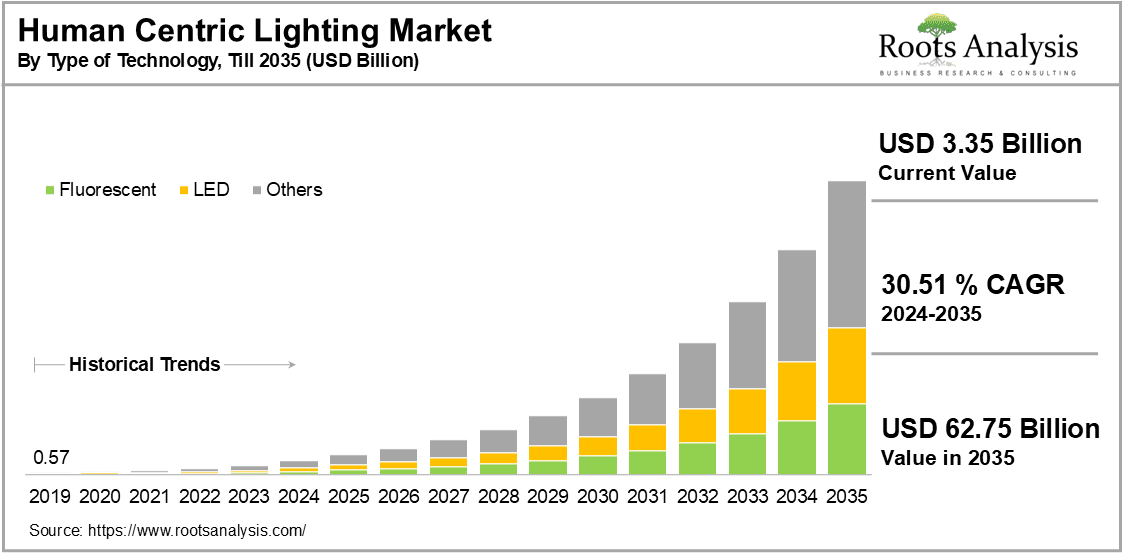
The human centric lighting market size is projected to grow from $3.35 billion in 2024 to $62.75 billion by 2035, representing a CAGR of 30.51% during the forecast period 2024-2035.
 |
To learn more about this report, request a free sample copy
The new research study consists of industry trends, detailed market analysis, key market trends of the human centric lighting market, SWOT analysis, and value chain analysis.
Amid global evolution, the lighting system from Edison’s empty glass bulb to advanced LEDs has altered the human interaction with indoor environments with enhanced comfort and efficiency. Human centric lighting is an innovative lighting solution that offers lighting conditions in harmony with the biological clock. These lighting solutions support the human circadian rhythm, and overall well-being and mimic the natural changes in daylight throughout the day. The purpose of human centric lighting is to improve comfort and enhance mood and productivity in its users. Its advanced features such as cool, bright lights in the morning stimulate energy while warm, dim light in the evening aids in preparing the body for rest.
In the light of this development, the human centric lighting market is evolving rapidly driven by the global embrace of human centric lighting across various setting including commercial spaces, offices, schools, healthcare facilities and home to create positive atmosphere to improve coziness, well-being and performance. Driven by this, by recognizing its promises and potential, more and more industry players are investing in research and development to manufacture advanced human centric lighting solutions that offer better control over light intensity. Also, leading brands are integrating these lighting systems with smart building technologies like the internet of things, and artificial intelligence to provide more energy efficiency and personalized lighting experience. Consequently, with the continuous technological advancements, rising awareness of health and well-being coupled with widespread adoption of human centric light across several industry, the human centric lighting market is predicted to flourish with an exceptional CAGR during the forecast 2024-2035.
The market report presents an in-depth analysis of the various service providers that are involved in offering human centric lighting market, across different segments, as defined in the table below:
| Key Report Attributes | Details | |
| Historical Trend | 2019-2023 | |
| Base Year | 2023 | |
| Forecast Period | 2024-2035 | |
| Market Size Value in 2024 | $ 3.35 Billion | |
| Market Size Value by 2035 | $ 62.75 Billion | |
| Growth Rate | CAGR of 30.51% from 2024 to 2035 | |
| Type of Offering |
|
|
| Type of Technology |
|
|
| Type of Installation |
|
|
| Type of End User |
|
|
| Geographical Regions |
|
|
| Leading Market Players | ||
| PowerPoint Presentation (Complimentary) |
Available | |
| Customization Scope | 15% Free Customization | |
| Excel Data Packs (Complimentary) |
|
|
This global human centric lighting market has various types of offerings namely, hardware, software, and services. As per our research, hardware segment which categorized into controllers and fixtures, is expected to lead the segment where in fixture captures the highest market share. This can be ascribed to the heightening demand for customized and aesthetically pleasing lighting solutions across various sectors, particularly in commercial places such as retail stores, showroom and more. The precise control of these lighting systems, color, and directions aids in enhancing the market growth. On the other hand, the service segment is poised to witness a notable CAGR during this forecast period owing to in increasing adoption of human centric light solution which require installation services, design and implementation services to help individuals or organizations.
The segment highlights the different types of technology available in the human centric lighting market such as fluorescent, LED, and others. Based on the technology, the LED segment exhibits dominance in the market with the major market share. This trend is expected to continue in the future as well due to unique features of LED technology like energy-efficient, tunable lighting solutions, and versatility. Also, its longer lifespan and lower energy consumption fuel its demand in the marketplace. As a result, LED technology is likely to expand at a substantial CAGR throughout this projection period.
The human centric lighting market is distributed based on two types of installation; new installations and retrofit installations. According to market research, the new installation boosts the segment growth and is anticipated to continue to retain its dominance due to growing new building constructions and the implementation of human centric lighting systems from the ground which is more cost-effective than retrofitting existing setups. Also, the rapid urbanization and infrastructure development for commercial spaces particularly in developing countries escalating the market opportunities. However, the retrofitting segment is expected to grow at a steady growth rate driven by the rising trend of home automation and popularity of smart LED lighting systems.
The global human centric lighting market features several end user industries such as commercial, educational, healthcare, industrial, residential, and others. As per our research, the residential sector occupies the majority share of the market and will continue to lead the segment till 2035. This growth of the segment is ascribed to the rapid adoption of smart home technologies in the residential sector where these lighting solutions are being integrated with smart home ecosystems and providing convenience to users to control lighting systems through mobile apps, and automated schedules of voice assistants. Nevertheless, the commercial segment is expected to experience a faster growth rate due to the advantage of human centric lighting in commercial places like office, healthcare institution where these solutions enhance workers productivity and safety in industrial spaces.
This segment highlights the distribution of the Human Centric Lighting Market across various geographical regions such as North America, Europe, Asia, Latin America, the Middle East, North Africa, and the rest of the world. As per our research, North America leads the market with the maximum human centric lighting market share, and this trend is expected to continue till 2035. Moreover, Asia is predicted to grow at an excellent CAGR throughout this forecast period driven by rapid urbanization, industrialization, and the rising adoption of smart homes with increasing disposable income in the region.
The “Human Centric Lighting Market, Till-2035: Industry Trends and Global Forecasts” report features an extensive study of the current market landscape, market size and future opportunity within their human centric lighting market, during the given forecast period. The market report highlights the efforts of several stakeholders involved in this rapidly emerging segment of the service providers industry. Key takeaways of the human centric lighting market report are briefly discussed below.
The integration of smart home and building system with human centric lighting is one of the latest industry trends which significantly boosting the potential growth of the human centric lighting market. Therefore, manufacturers are developing advanced human centric lighting solutions that are increasingly being integrated with smart home, smart cities and building automation systems. The benefits of these lighting solutions in offering personalized lighting control, energy efficiency and seamless interaction with other smart devices like sensors and voice assistance elevating the popularity of the human centric lighting solutions which will likely generate new opportunities for market expansion during this forecast period.
The competitive landscape of human centric lighting market is categorized by the presence of all types of companies from global leaders to innovative startup companies which are operating in the market. However, global leaders such as Signify, Acuity Brands, OSRAM, and others lead the market through their wide range of product portfolios and offer comprehensive lighting solutions that cater to various sectors' requirements. In addition, these companies constantly invest in research and development to introduce an innovating range of lighting solutions. Also, they adopt competitive strategies, such as collaboration, partnership, mergers, and acquisitions to expand their market reach in different geographical regions.
Substantially, the key driver of the human centric lighting market growth is the technological advancements in lighting solutions such as LED technology and tunable dynamic lighting system which have enabled the development of more sophisticated human centric lighting solution. Besides, the rising awareness of the impact of lighting on human health and mood is likely to drive market growth as these lighting solutions can align with natural circadian rhythms and provide better sleep patterns. Along with this, the mounting adoption of these lighting solutions in workplaces and commercial spaces are considerably fueling the human centric lighting market demand which is expected to continue expand in the near future.
With regard to regional analysis, the higher adoption of advanced technologies including sensor devices coupled with human centric lighting substantially contribute to North America’s leading position in the global market for human centric lighting. Furthermore, the strong presence of established companies, headquartered in North America stimulates the market scope through their efforts in R&D to develop advanced human centric lighting technologies which also boost the market demand. Moreover, higher investment in smart buildings and infrastructure is further expected to strengthen the market growth in the region.
Examples of key service providers involved in the human centric lighting market (which have also been captured in this market report, arranged in alphabetical order) include Acuity Brands (US), Cree (US), Eaton (Ireland), Fagerhult (Sweden), Glamox (Norway), Helvar (Finland), Hubbell (US) LEDVANCE (Germany), Leadarson IoT Technology (China), Legrand (France), Lutron Electronics (US), NormaGrup Technology (Spain), OSRAM Licht (Germany), Schneider Electric (France), Seoul Semiconductor (South Korea), Signify Holdings (Netherlands), TRILUX (Germany), Waldmann Lighting (Germany), Wipro (India), and Zumtobel (Austria). This market report includes an easily searchable Excel database of all the companies who have adopted the human centric lighting market.
The market report presents an in-depth analysis, highlighting the capabilities of various companies engaged in this domain, across different segments. Amongst other elements, the market report includes:
At Roots Analysis, we genuinely care about your success and understand that your business requirements are unique. While our market research reports provide valuable insights, we recognize that they might not cover every aspect you need to make well-informed strategic decisions. To account for that, we offer 15% free report customization tailored to your specific needs. Whether you require additional quantitative analysis, qualitative insights, or any other information related to the human centric lighting market, reach out us today at: support@rootsanalysis.com