


 Download Free Sample
 Buy Now
Market Size
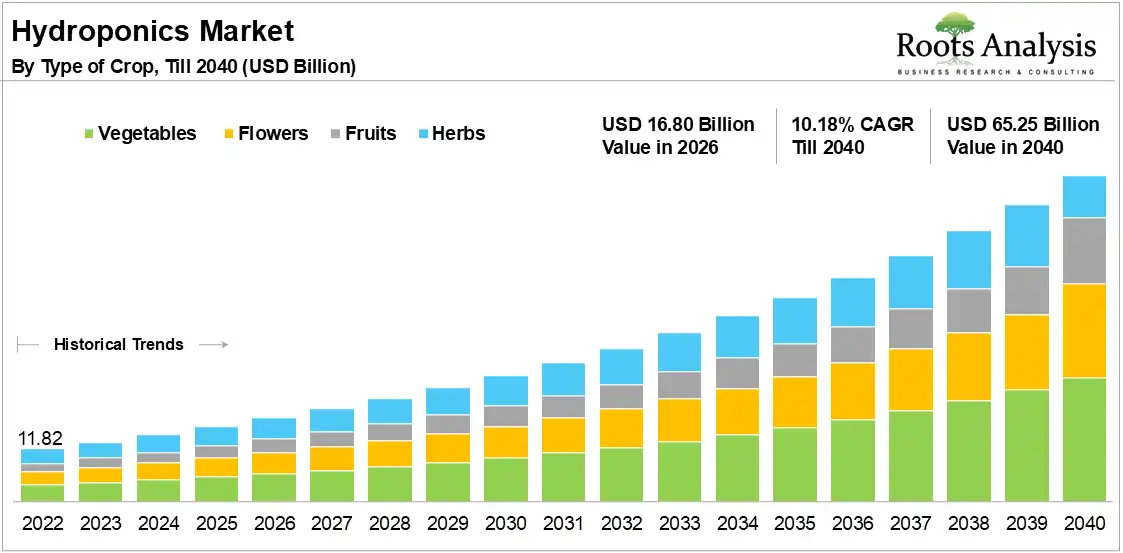
The global hydroponics market is projected to reach USD 16.80 billion in 2026 and USD 65.25 billion by 2040, representing a CAGR of 10.18% during the forecast period 2026 to 2040.
See What’s in the Full Report - Request Your Complimentary Insights!
Market Overview
The hydroponics market encompasses advanced soilless cultivation systems that enable plant growth through nutrient-rich water solutions instead of traditional soil, defining a distinct segment within sustainable agriculture. This innovative method is increasingly transforming commercial-scale production of high-value crops, as well as supporting pharmaceutical research, urban farming systems, and controlled environment agriculture models designed to enhance operational resilience, reduce supply chain dependency, and strengthen long-term food sustainability frameworks.
Market expansion is primarily driven by structural pressures on global food systems, including rising food security concerns, water scarcity, and limited arable land availability. Hydroponic cultivation enables consistent, high-yield production of crops such as leafy greens, herbs, and soft fruits throughout the year, minimizing exposure to seasonal fluctuations and reducing the need for long-distance transportation. Additionally, growing consumer preference for locally sourced, sustainably produced food continues to accelerate adoption, positioning hydroponics as a key enabler of resource-efficient and climate-resilient agriculture worldwide.
Innovation across the hydroponics industry is focused on improving efficiency and lowering operating costs, data-driven control, and system integration. Advances in LED lighting efficiency and nutrient film techniques are reaching maturity, expanding access to high-yield production models. The market is increasingly oriented toward integrated platforms that optimize inputs and incorporate renewable energy to offset high energy costs. This supports a positive industry outlook, with long-term growth tied to continued progress in energy optimization and supply chain integration.
Market Report: Key Takeaways
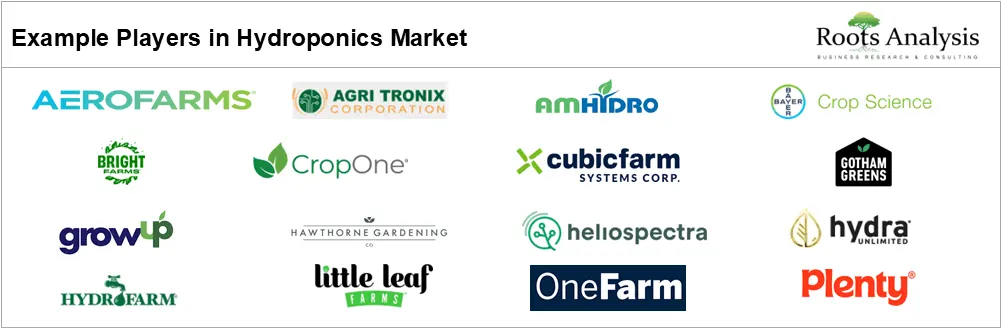
- Leading Players Competitive Footprint: Key players such as AeroFarms, Agri-Tronics, AmHydro, Bayer Crop Science, BrightFarms, Crop One, CubicFarm Systems Corp, Gotham Greens, GrowUp, Hawthorne Gardening, Heliospectra, Hydra Unlimited, Hydrofarm, Little Leaf Farms, OneFarm, and Plenty, hold strong market positions with extensive geographic presence in various regions.
- Startup Ecosystem and Innovation Hotspots: The startup ecosystem is pivoting toward autonomous scalability and decentralized modular networks to fortify urban food security. A prime example is Gardin, which integrated its optical phenotyping sensors with Priva in late 2025 to automate crop steering in large-scale facilities. Simultaneously, Growcer consolidated the urban sector by acquiring Freight Farms, creating a unified global platform for containerized food production.
- Regional Penetration and Adoption Trend: The Asia-Pacific region has emerged as the global engine for hydroponic adoption, driven by a convergence of rapid industrialization, urbanization, and urgent food security mandates. Governments and private developers are increasingly integrating Controlled Environment Agriculture (CEA) into major infrastructure projects (from smart city food parks to retrofitted industrial zones), effectively decoupling food production from arable land loss.
- Europe to Witness Rapid Growth Through 2040: Europe market, growing with a 13.5% CAGR through 2040 is catalyzed by the EU’s farm-to-fork mandate for sustainable intensification. Regional dominance is anchored by the Netherlands, where Looye Kwekers recently deployed Signify’s AI-driven dynamic lighting across its new 8.2-hectare facility to secure year-round winter production.
- Market Share by System Type: In 2026, the Nutrient Film Technique (NFT) retains market dominance with a 25.0% share, serving as the operational backbone for commercial leafy green production due to its superior flow-rate efficiency and low capital intensity. Industry leaders like AmHydro continue to solidify this position by deploying scalable, food-grade NFT channel bundles that maximize turnover for short-cycle crops like basil and lettuce in peri-urban clusters.
- Opportunities in Hydroponics Market: The sector’s most critical opportunity lies in decarbonization through renewable energy integration. For instance, Oishii recently operationalized a solar-powered vertical farm in New Jersey, effectively stabilizing long-term energy costs. Simultaneously, the adoption of artificial intelligence-driven autonomous crop steering (exemplified by Source.ag’s late-2025 Series B expansion) enables operators to leverage sensor data for precise yield prediction, reducing operational risks.
Recent Industry Developments
- October 2025: Brio Hydroponics operationalized its landmark "Unnati" project in Gujarat, a 100-acre climate-smart precinct designed to democratize access to resource-efficient, soil-less farming technologies for regional smallholder farmers.
- March 2025: Lyine Group secured an EU design patent for its automated hydroponic fodder container, strengthening the livestock sector. This IP milestone validates the system’s compliance with rigorous European agricultural standards for sustainable livestock feed production.
- February 2025: The European Union updated its Green Deal input mandates, incentivizing sustainable substrate adoption over peat-based media. Simultaneously, India extended its PM-KUSUM scheme to March 2026, directly subsidizing solar-powered hydroponic units to reduce operational energy costs.
- November 2024: Responding to commercial demand, GrowGeneration expanded its proprietary product line in late 2024, launching advanced LED spectrums and root-zone optimization tools. This rollout targets the efficiency-first commercial sector, offering integrated solutions for yield maximization.
Pay Only for What You Need – The Best Way to Optimize
Market Dynamics
Key Hydroponics Market Drivers
- Decoupling Food Production from Climate Volatility: The impact of climate change on the urban agriculture market is accelerating adoption of hydroponic systems, as controlled environments mitigate yield risks from extreme weather and ensure stable production and predictable supply chains.
- Accelerated Focus on Food Security and Urban Food Systems: Rapid urban expansion is intensifying the need for localized production models that shorten supply chains and reduce dependence on long-distance transport.
- Technological Advancements in CEA Infrastructure: Growth in the controlled environment agriculture (CEA) market size is supported by advances in LED lighting efficiency, automated climate control, and sensor-based monitoring, which improve hydroponic scalability, reduce operating intensity, and enhance commercial viability.
Market Challenges
- Supply Chain Logistics and Consumer Perception of Value: Despite positioning around freshness and locality, higher price points can limit adoption among cost-sensitive buyers. Effective last-mile logistics and clear value communication are required to justify premiums relative to conventional and organic alternatives.
- Zoning Hurdles for Urban Development and building regulations are not aligned with large-scale indoor farming. Navigating approval processes can extend project timelines, increase compliance costs, and introduce execution risk for urban hydroponic developments.
- Dependency on External Input Costs and Supply Chain Shocks operations depend on specialized nutrients and substrates sourced through global supply chains. Volatility in raw material pricing or disruptions in availability can materially increase operating costs, requiring disciplined procurement and inventory strategies to manage risk.
Market Share Insights
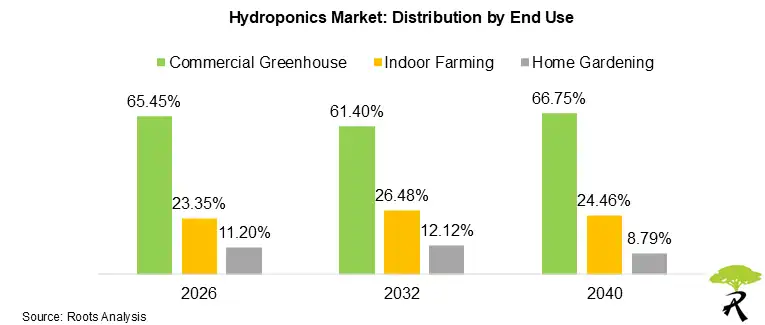
Market Share by End Use: Commercial Greenhouse Hold the Largest Market Share While Indoor Vertical Farming to Witness Fast Growth till 2040
- Commercial Greenhouses hold a dominant 65.45% market share in 2026, serving as the industry’s operational backbone due to established infrastructure and superior scale economies that enable consistent integration into global retail supply chains.
- Reinforcing this position, Mastronardi Produce added 48 acres of high-tech glass in mid-2025 to support its national network, while Revol Greens partnered with Nature Fresh Farms to consolidate North American leafy greens dominance.
- Conversely, the indoor vertical farming segment is projected to accelerate at a rapid 17.0% CAGR through 2040, driven by urbanization and government mandates for climate-resilient food security that prioritize land-independent production systems.
- This urban shift is validated by significant capital velocity, evidenced by Pure Harvest Smart Farms securing a record $350 million in March 2025 for hybrid expansion and Bustanica’s strategic entry into Dubai’s direct-to-consumer market.
Market Share by Geographical Regions: Asia-Pacific to Dominate Hydroponics Industry
- The Asia-Pacific region commands the global hydroponics landscape with a dominant 36.00% market share, a position solidified by the strategic divergence between China’s industrial automation and India’s frugal agri-tech innovation. This hegemony is driven not merely by population pressure, but by aggressive government mandates, such as China’s Smart Agriculture 2025 and India’s MIDH, that systematically decouple food security from shrinking arable land.
- China anchors the region’s volume leadership through high-capital, unmanned mega-factories. Sananbio continues to exemplify this trend, having widely deployed its UPLIFT autonomous vertical farming system across key metropolitan hubs throughout 2024 and 2025. These facilities, utilizing AI-driven robotics for seeding-to-harvest operations, have established a new industry benchmark for commercial production density, effectively eliminating labor dependency in urban food supply chains.
- In parallel, India has emerged as a powerhouse of decentralized innovation. Key player UrbanKisaan achieved a critical milestone by reporting corporate profitability in FY2024-25, validating the economic viability of its proprietary bowl-shaped vertical towers in peri-urban markets.
- Simultaneously, the market is witnessing financial democratization; for instance, Brio Hydroponics successfully operationalized its Unnati Hydroponic Park in Gujarat in late 2025. This project introduces a novel fractional ownership model, allowing retail investors to fund climate-smart infrastructure, thereby solving the sector’s capex liquidity challenges while rapidly scaling acreage.
Want Information on Specific Region / Segment?
Market Ecosystem Insights
Competitive Footprint of Top Active Companies in Hydroponics Industry
The global hydroponics market is characterized by a consolidated yet fiercely competitive landscape, where market dominance is driven by technological scalability and regional expansion. Leading operators, including AeroFarms, AmHydro, Bayer Crop Science, BrightFarms, Crop One, Gotham Greens, Hydrofarm, Little Leaf Farms, OneFarm, and Plenty, leverage proprietary Controlled Environment Agriculture (CEA) stacks to secure strong positions. These industry giants are increasingly differentiating themselves not just through product portfolios, but through aggressive infrastructure scaling and vertical integration designed to capture year-round market share in key urban centers.
Strategic alliances and facility expansions have emerged as the primary growth vectors as companies race to diversify beyond leafy greens. A prime example of this evolution is Plenty, which solidified its partnership with Driscoll’s by opening the world’s first commercial-scale vertical strawberry farm in Richmond, Virginia, in late 2024. This facility represents a paradigm shift in the industry, utilizing proprietary 30-foot growing towers to deliver peak-season flavor year-round, thereby validating the economic viability of fruiting crops in vertical systems.
Similarly, competition for regional dominance has intensified, with players like Little Leaf Farms executing massive footprint expansions. Following the opening of its newest greenhouse in McAdoo, Pennsylvania, in late 2025, Little Leaf Farms has staked its claim as the world’s largest CEA leafy greens producer, with further plans to penetrate the Midwest and Southern markets via a future Tennessee campus. This trend of "mega-campus" development is mirrored by BrightFarms, which recently operationalized new regional hubs in Georgia and Texas, underscoring a sector-wide pivot from pilot projects to industrial-scale food production networks.
Startup Activity and Innovation Hotspots
The agtech startup ecosystem within the hydroponics domain is accelerating rapidly, driven by early-stage companies pioneering disruptive Controlled Environment Agriculture (CEA) applications. Innovation is highly concentrated in vertical and hybrid indoor farming, alongside advanced data-driven crop management. Startups are increasingly deploying functionalized IoT sensors, cloud-based analytics, and machine learning to achieve autonomous climate and irrigation control.
Recent market initiatives reflect this technological pivot. IUNU, for instance, recently advanced its AI-powered LUNA platform (highlighted by its late-2025 integration with major operators like Finka Greenhouses) to deliver real-time yield forecasting and autonomous crop steering for large-scale facilities. Concurrently, addressing the demand for decentralized urban agriculture, startups such as India-based 4Climate recently introduced intelligent, fully automated IoT systems that democratize precision climate control for smaller commercial farms. Consequently, innovation hubs are aggressively expanding throughout the Asia-Pacific, fueled by urgent food security mandates that demand scalable, localized production.
Hydroponics Industry Trends: Funding & Investment Dynamics and Capital Flow
The financial landscape of the hydroponics market has matured into a phase of disciplined capital deployment, characterized by a flight to quality where investors prioritize operational profitability over sheer footprint expansion. While venture capital remains active, the primary investment vectors have shifted toward late-stage growth rounds, strategic mergers, and government-backed infrastructure grants designed to bolster food security. This recalibration is driving a wave of consolidation, favoring operators with proven unit economics and scalable technology stacks.
Key investment milestones in late 2024 and throughout 2025 underscore this trend. Oishii, the vertical farming leader known for its premium Omakase Berry, successfully closed a $150 million Series B funding round to accelerate the distribution of its new collaborative solar-powered facilities. This raise signals high investor confidence in hybrid-energy models that reduce operational expenditures (OpEx). Simultaneously, Little Leaf Farms continues to attract significant capital, recently securing a Pennsylvania Agriculture Innovation Grant in early 2026 to support automation upgrades at its McAdoo campus, reinforcing its status as the dominant CEA leafy greens producer in North America.
On the corporate front, strategic venture arms like Leaps by Bayer (of Bayer Crop Science) remain pivotal, directing funds into seed-stage startups developing next-generation seed varieties optimized specifically for indoor environments. In parallel, government initiatives in the Asia-Pacific and the Middle East are aggressively filling funding gaps, with sovereign wealth funds channeling billions into giga-projects to localize food production, while European investments are increasingly tied to renewable energy integration to mitigate power volatility.
Your Business is Unique – Why Shouldn’t Your Report Be?
Hydroponics Market: Scope of the Report
| Key Report Attributes | Details | |
| Historical Trend | Since 2022 | |
| Forecast Period | Till 2040 | |
| Market Size 2026 | $ 16.80 Billion | |
| Market Size 2040 | $ 65.25 Billion | |
| CAGR (Till 2040) | 10.18% | |
| Segments Covered |
|
|
Market Segmentation
Based on research, we have segmented the hydroponics market into system type, type of crop, equipment, end use, geographical regions, and key players.
Market Share by System Type
- Aeroponics
- Deep Water Culture (DWC)
- Drip System
- Ebb and Flow
- Nutrient Film Technique (NFT)
- Wick System
Market Share by Type of Crop
- Flowers
- Fruits
- Herbs
- Vegetables
Market Share by Equipment
- Growing Media
- HVAC Systems
- Irrigation Systems
- LED Grow Lights
- Meters and Controllers
- Pumps
Market Share by End Use
- Commercial Greenhouse
- Indoor Vertical Farming
- Home Gardening
Market Share by Geographical Regions
- North America
- US
- Canada
- Mexico
- Rest of North America
- Europe
- Austria
- Belgium
- Denmark
- France
- Germany
- Ireland
- Italy
- Netherlands
- Norway
- Russia
- Spain
- Sweden
- Switzerland
- UK
- Rest of Europe
- Asia-Pacific
- Australia
- China
- India
- Japan
- New-Zeeland
- Singapore
- South Korea
- Rest of Asia-Pacific
- Latin America
- Brazil
- Chile
- Colombia
- Venezuela
- Rest of Latin America
- Middle East and Africa (MEA)
- Egypt
- Iran
- Iraq
- Israel
- Kuwait
- Saudi Arabia
- UAE
- Rest of MEA


