
Lowest Price Guaranteed
Slides
188
Last Updated
February 2026
View Count
13486
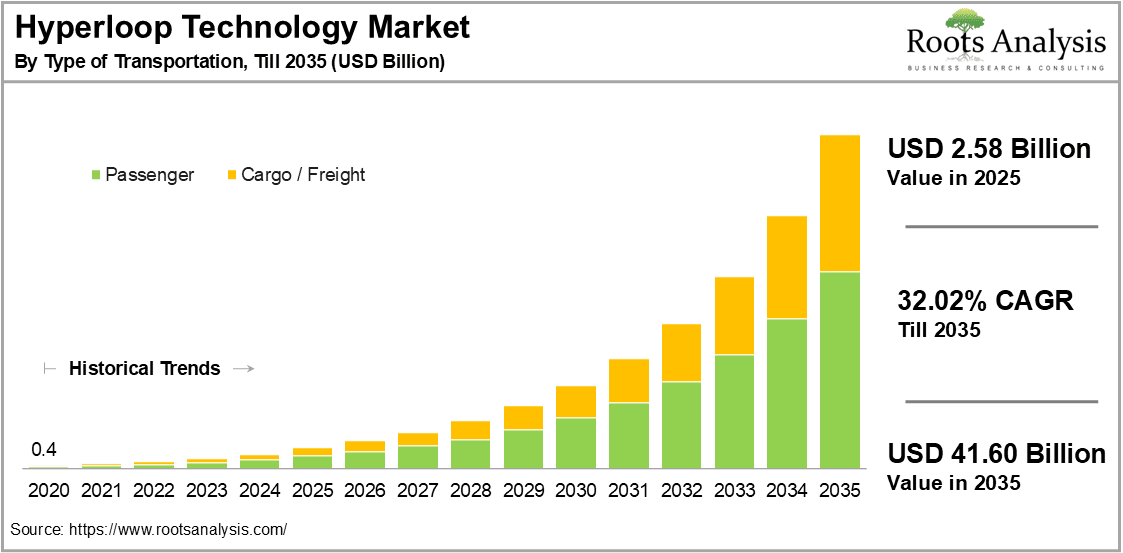
The hyperloop technology market size is projected to grow from USD 2.58 billion in 2025 to USD 41.60 billion by 2035, representing a CAGR of 32.02% during the forecast period till 2035.
 |
The new research study consists of hyperloop technology market and trends analysis, detailed market forecast analysis, and provide actionable strategic recommendations.
As every industry is witnessing technological advancements, so does the transportation sector with hyperloop technology. Hyperloop technology is a modern ultra-high-speed transportation system that is designed to move passengers and cargo at extremely high speeds through low-pressure tubes. The hyperloop concept for high-speed transportation systems in vacuum tubes was first introduced by Elon Musk in a 2013 white paper. This groundbreaking hyperloop technology aims to revolutionize transportation by offering faster, more efficient, and sustainable alternatives to traditional transportation modes. The technology encompasses several key hyperloop components such as low-pressure tubes, pods or capsules, and propulsion systems to accelerate the pods to high speeds up to 700 km/h to 1200 km/h and retain their motion throughout the journey.
With ongoing research and technological innovation, hyperloop technology is emerging as one of the most promising high-speed rail alternatives that can offer faster, more sustainable, and efficient transportation solutions. As an effect, the hyperloop technology market exhibits promising growth and is projected to sprout out vigorously during this forecast period. This growth is likely to continue excel owing to the mounting demand for faster and effective transportation for urban decongestion and reduced travel time. Beyond speed, the hyperloop technology is one of the most suitable energy-efficient transportation solutions as it has the potential to run on renewable energy.
As a result, governments, stakeholders, and emerging startups are investing in the development of the technology, initiating several pilot projects and increasing efforts for commercialization. For instance, in April 2024,Swisspod, a Swiss-American startup company introduced a new fundraising round, aiming to secure EUR 7 million after securing EUR 200 thousand so far to develop hyperloop transport. Overall, the market is poised to thrive exceptionally however, some challenges such as technological complexity, regulatory hurdles, and high initial costs are required to be addressed to harness the full power of the technology.
The hyperloop technology market report presents an in-depth analysis of the various companies that are involved in offering hyperloop technology, across different segments, as defined in the table below:
| Key Report Attributes | Details | |
| Historical Trend | Since 2020 | |
| Forecast Period | Till 2035 | |
| Current Market Size | $ 2.58 Billion | |
| Market Size Value by 2035 | $ 41.60 Billion | |
| CAGR (Till 2035) | 32.02 % | |
| Type of Component |
|
|
| Type of Transportation |
|
|
| Speed |
|
|
| Geographical Regions |
|
|
| Leading Market Players |
|
|
| PowerPoint Presentation (Complimentary) | Available | |
| Customization Scope | 15% Free Customization | |
| Excel Data Packs (Complimentary) |
|
|
This segmentation of the global hyperloop technology market is categorized into multiple components such as capsule, route, tube, and propulsion systems. According to our hyperloop industry analysis, tube components are projected to capture the largest (~48%) of the market share by 2035. The tube segment will likely continue to dominate owing to its core functionality that makes it backbone of the hyperloop systems in providing low-pressure for high-speed travel. Apart from this, capsules/pods are also evolving rapidly and are anticipated to experience the fastest (34.72%) growth rate during this projection period. This growth can be attributed to the need for passenger or cargo pods which are crucial for the systems.
Based on the type of transportation, the market for hyperloop technology is bifurcated into passenger and freight. As per hyperloop system market research, passenger transportation is projected to lift the segment growth with (~65%) of the market share by 2035. Exceeding demand for faster travel and efficient transportation for passengers is the leading factor behind the segment’s dominance.
Therefore, companies are emphasizing travelers and connecting metropolitan cities as the technology offers reduced travel time. Moreover, the cargo/freight segment is likely to grow at a substantial CAGR of (35.18%) in the upcoming years. Hyperloop systems are being explored for transporting goods and cargo especially, for high-value or time-sensitive shipments. Thus, the need for faster and more effective logistic solutions will lift the segment's growth.
The market features different speeds wherein less than 700 km/h sub-segment is predicted to capture the maximum (~62%) of the market share by 2035. This is due to the fact that achieving subsonic speed which is around 600-700 km/h is more technically feasible with current technology compared to supersonic speed which needs overcoming substantial engineering challenges. However, the more than 700 km/h segment is expected to gain traction in the future and will likely grow at (33.3%) CAGR in the upcoming decade as it is still under development and shows future potential.
This segment highlights the distribution of the hyperloop technology market across various geographical regions, such as North America, Europe, Asia, Latin America, the Middle East and North Africa, and the rest of the world. According to our projection, North America is estimated to hold (~43%) share and will continue to dominate the market.
Furthermore, the technology is gaining popularity in Asian market due to heightening demand for faster and more efficient transportation solutions driven by rapid urbanization and high population in the region. Therefore, governments particularly, in China and India are increasingly investing in hyperloop transportation technologies and smart infrastructure, reinforcing the market development.
For instance, In August 2024, the China Aerospace Corporation successfully tested its T-Flight maglev hyperloop system which was designed to reach speeds of 1000 kmph. Apart from this, with the rising emphasis on reducing carbon emissions, hyperloop is emerging as an attractive eco-friendly alternative technology, witnessing higher demand. Hence, the market for hyperloop technology in Asia is likely to thrive at an excellent (35.74%) growth rate during this forecast period.
The “Hyperloop Technology Market, Till-2035: Industry Trends and Global Forecasts “report features an extensive study of the current market landscape, market size and future opportunities within the hyperloop technology market, during the given forecast period. The market report highlights the efforts of several stakeholders involved in this rapidly emerging segment of the service providers industry. Key takeaways of the hyperloop technology market report are briefly discussed below.
Several key drivers are propelling the market growth such as soaring demand for faster and energy efficient transportation. Hyperloop technology promises to drastically reduce travel times between cities and make it an attractive alternative to traditional transportation methods, thereby boosting the market demand. The growth of the market is also accredited to the rapid urbanization and increasing traffic congestion in cities which augments the need for modern transportation solutions that can alleviate pressure on existing transportation infrastructure, inflating the demand for the technology.
Moreover, ongoing advancements in vacuum tube technology and magnetic levitation trains are supporting the industry by making hyperloop systems more feasible and scalable. Consequently, these significant key drivers are attributed to continuing to foster the hyperloop technology market growth throughout this projection timeframe.
Several prominent leading companies in the hyperloop technology market including Virgin Hyperloop, SpaceX, The Boring Company, Zeleros, and others are shaping the competitive landscape of the market. Key players are focusing on innovation, research and development, and sustainability to continue to retain their position in the global marketplace. Besides, market players are constantly striving to align with emerging trends of collaboration partnership, and integration with existing infrastructure in order to boost their competitive edge.
Although the market is promising, yet, it experiences some challenges such as high initial costs, regulatory and safety hurdles, and technical issues that might impact the market progress. Illustratively, the research, development, and construction of hyperloop infrastructure is extremely high. Also, designing and building a hyperloop system entails engineering complexity in maintaining a near-vacuum environment in the tubes ensuring the safety & reliability of high-speed capsules, and developing efficient propulsion and levitation systems. Therefore, these technological complexity and safety concerns raise challenges in regulatory approvals which can hinder the adoption of the technology.
North is anticipated to be the leading region in the global hyperloop technology market by capturing (~43%) of the market share by 2035. North America is one of the early adopters of the technology with several pioneering projects and test tracks that demonstrated success and feasibility to build momentum and attract investment and interest in hyperloop technology, redefining the future of transportation. Also, the world’s leading technology companies and innovators substantially are contributing to advance hyperloop technology for renewable energy transportation.
The region’s strong emphasis on R&D with universities, research institutions, and tech companies further drives the development of innovative technologies similar to the hyperloop. Additionally, the US plays a vital role with its robust venture capital ecosystem that provides significant funding for cutting-edge technologies, sustaining the leading position in the international marketplace.
Examples of key players involved in the market for hyperloop technology (which have also been captured in this market report, arranged in alphabetical order) include Arrivo Dinclix GroundWorks, Hardt B.V., Hyper Chariot, Hyperloop Transportation Technology, Nevomo, Space Exploration Technologies, The Boring Company, TRANSPOD, TUM Hyperloop, Virgin Hyperloop, and Zeleros. This market report includes an easily searchable excel database of all the companies who have adopted the hyperloop technology market.
The market report presents an in-depth analysis, highlighting the capabilities of various companies engaged in this domain, across different segments. Amongst other elements, the market report includes:
At Roots Analysis, we genuinely care about your success and understand that your business requirements are unique. While our market research reports provide valuable insights, we recognize that they might not cover every aspect you need to make well-informed strategic decisions. To account for that, we offer 15% free report customization tailored to your specific needs. Whether you require additional quantitative analysis, qualitative insights, or any other information related to the hyperloop technology market, reach out us today at: support@rootsanalysis.com