


 Download Free Sample
 Buy Now
Market Size
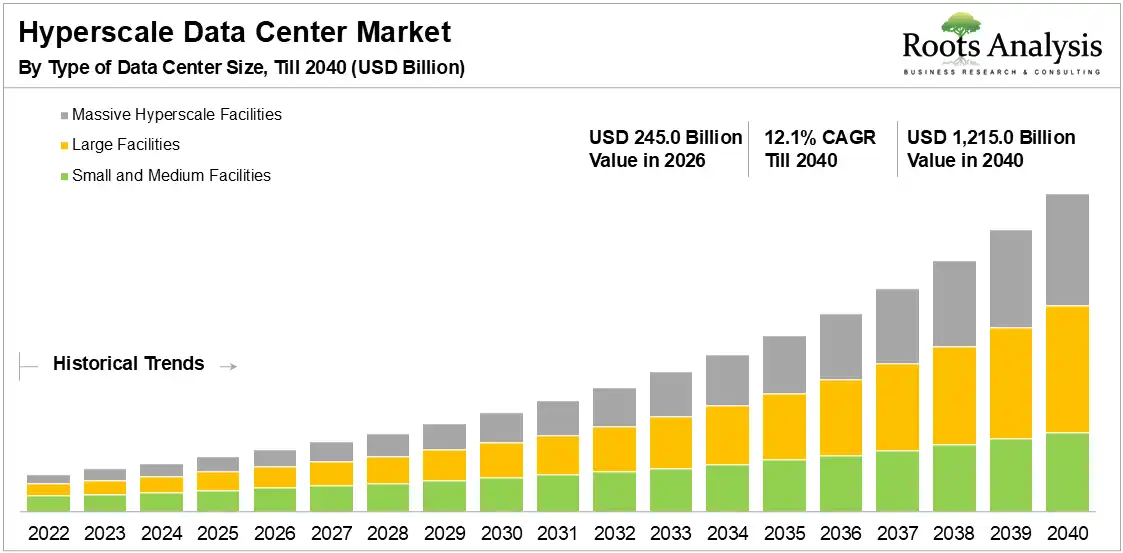
The global hyperscale data center market reached USD 245.0 billion in 2026 and is projected to grow to USD 1,215.0 billion by 2040, registering a CAGR of 12.1% over the forecast period 2026 to 2040, driven by accelerating AI infrastructure deployments and hyperscale cloud capacity expansion.
See What’s in the Full Report – Request Your Complimentary Insights!
Market Report: Key Takeaways
- Based on Component, IT Infrastructure captures 34.0% market share in 2026, whereas Liquid Cooling Systems registers a 16.8% CAGR through 2040, driven by accelerating AI rack density requirements.
- On the basis of Deployment Type, Cloud captures 46.0% market share in 2026, whereas Multi-Cloud registers a 14.7% CAGR through 2040, supported by enterprise workload diversification and resilience strategies.
- With respect to Data Center Size, Massive Hyperscale Facilities captures 49.0% market share in 2026, whereas Massive Hyperscale Facilities registers a 13.4% CAGR through 2040, fueled by large scale AI cluster consolidation.
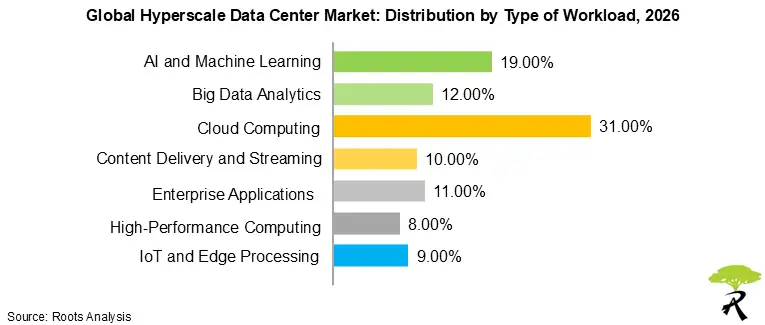
- Based on Workload Type, Cloud Computing captures 31.0% market share in 2026, whereas AI and Machine Learning registers a 17.2% CAGR through 2040, driven by generative AI training and inference demand.
- Based on Geography, North America captures 41.0% market share in 2026, whereas Asia-Pacific registers a 14.5% CAGR through 2040, supported by sovereign AI investments and rapid digital infrastructure expansion.
Hyperscale Data Center Market Outlook
AI infrastructure demand has shifted the hyperscale data center market from cloud capacity optimization toward power intensive GPU cluster expansion, creating unprecedented demand for liquid cooling systems, high speed networking equipment, and gigawatt scale campuses. Massive hyperscale facilities captured 49.0% market share in 2026 because generative AI training workloads increasingly require centralized compute density and scalable power availability. AI and machine learning workloads are projected to expand at a 17.2% CAGR through 2040, significantly outpacing conventional cloud computing infrastructure demand.
Cloud hyperscalers are accelerating infrastructure investments because enterprise AI adoption, sovereign data localization requirements, and sustainability regulations are increasing regional deployment complexity. North America accounted for 41.0% of global market share in 2026 due to mature cloud ecosystems and institutional capital availability, while Asia-Pacific is projected to register the fastest growth at 14.5% CAGR through 2040. In December 2025, Alphabet acquired clean energy developer Intersect to support hyperscale AI and data center expansion initiatives, highlighting growing integration between renewable energy procurement and hyperscale infrastructure scaling.
The market is expected to remain in a high growth but gradually moderating expansion cycle through 2040 as AI infrastructure deployment matures and operators optimize thermal efficiency, power utilization, and multi cloud orchestration strategies. Direct to chip liquid cooling is projected to grow at a 17.1% CAGR because rack densities increasingly exceed conventional airflow limitations. In October 2025, BlackRock, Microsoft, NVIDIA, and xAI joined a consortium to acquire Aligned Data Centers in a USD 40 billion infrastructure deal, reinforcing long term institutional confidence in hyperscale AI infrastructure assets.
Pay Only for What You Need – The Best Way to Optimize
Hyperscale Data Center Market Size Estimation Methodology
- As a starting point, the forecasting model evaluated hyperscaler capex disclosures, cloud infrastructure expansion announcements, and AI infrastructure investment activity across major operators, including AWS, Microsoft, Google, Meta, and Oracle. Historical market sizing was benchmarked against infrastructure deployment trends between 2022 and 2025 using regional cloud capacity expansion and hyperscale leasing activity.
- Moving forward, server shipment data, GPU infrastructure deployment volumes, and high density networking equipment demand were analyzed to estimate infrastructure scaling rates associated with AI and machine learning workloads. The analysis incorporated adoption growth for direct to chip liquid cooling, immersion cooling, and AI ready rack architectures across hyperscale campuses.
- Building on this, colocation leasing rates, hyperscale campus investments, and regional construction cost indices were normalized to estimate infrastructure deployment economics across North America, Europe, Asia-Pacific, Latin America, and the Middle East and Africa. Regional power infrastructure availability and sovereign AI investment programs were incorporated into growth weighting assumptions.
- Drawing upon these, deployment type modeling evaluated the relative expansion rates of cloud, colocation, hybrid, and multi cloud infrastructure environments. Workload allocation assumptions were calibrated using enterprise AI adoption trends, cloud computing utilization patterns, and hyperscale GPU cluster deployment trajectories.
- The projected value was then stress tested against utility billing data, power procurement trends, and long term cooling infrastructure adoption curves to avoid overstating hyperscale deployment capacity beyond realistic energy and construction constraints. Aggressive AI only projections were discounted where infrastructure bottlenecks or commercialization timing assumptions appeared unrealistic.
- Finally, consensus alignment was completed using multiple independent market references, including infrastructure focused and cloud ecosystem focused datasets, while excluding narrow construction only estimates that materially understated hyperscale ecosystem value. The final model reflects accelerated AI driven expansion through 2033 followed by gradual market maturation and infrastructure optimization after 2035.
Hyperscale Data Center Market Share Insights
Market Share by Type of Component
Presently, IT infrastructure dominates the market with a share of 34% in 2026. IT infrastructure remains the largest component category because hyperscale operators continue prioritizing GPU clusters, high density compute nodes, and high speed networking upgrades to support AI training and inference workloads. Large cloud providers maintain multi-billion dollar annual capex cycles focused on compute modernization and accelerated infrastructure deployment.
Meanwhile, liquid cooling systems will grow at a higher CAGR of 16.9% during the forecast period 2026-2040. Liquid cooling systems are expanding rapidly because traditional air cooling architectures cannot efficiently support rack densities exceeding 80-120 kW associated with generative AI workloads. Hyperscale operators are increasingly adopting direct to chip and immersion cooling to reduce energy consumption and improve thermal efficiency.
Market Share by Workload Type
According to our analysis, cloud computing secure 31% of the overall market share in 2026. Cloud computing remains the largest workload segment because enterprise digital transformation, SaaS expansion, and global migration away from legacy infrastructure continue driving baseline hyperscale demand. Large public cloud providers maintain broad multi-industry infrastructure utilization.
On the other hand, AI and machine learning will show robust growth, anticipated to register higher CAGR of 17.2% through 2040. AI and machine learning workloads are growing significantly faster than other workloads because generative AI training, inference serving, and autonomous agent architectures require extremely compute intensive environments. GPU deployment cycles and AI-specific infrastructure optimization are accelerating hyperscale investments.
Want Information on Specific Region / Segment?
Regional Analysis: North America Leads the Market and Asia-Pacific Growth at Higher CAGR
North America accounted for 41.0% of the global hyperscale data center market in 2026. The region maintains structural dominance due to deep hyperscaler concentration, mature digital infrastructure, strong institutional financing capabilities, and advanced semiconductor and cloud ecosystems. The US continues attracting the majority of global AI infrastructure investments because of large enterprise cloud demand, power market flexibility, and strong AI research commercialization.
In February 2025, Amazon Web Services announced multi-billion-dollar AI infrastructure and hyperscale expansion investments across multiple US states.
Asia-Pacific is projected to register a CAGR of 14.5% through 2040. Rapid enterprise digitalization, sovereign AI initiatives, expanding cloud ecosystems, and rising demand for localized data processing are driving hyperscale deployment momentum across the region. Governments are increasingly supporting domestic AI infrastructure development through digital economy policies, renewable energy expansion, and accelerated fiber connectivity investments.
In April 2025, Microsoft announced expanded cloud and AI infrastructure investments in Southeast Asia and India to strengthen regional hyperscale capacity.
Market Ecosystem Analysis
Hyperscale Data Center Market Competitive Landscape
The hyperscale data center market is increasingly dominated by vertically integrated cloud and AI infrastructure ecosystems where hyperscalers control compute, networking, accelerators, software stacks, and increasing energy procurement. The primary competitive force reshaping the market is the rapid scaling of AI infrastructure capacity, which is driving aggressive global expansion of AI ready data centers, GPU cloud platforms, liquid cooling deployments, and dedicated AI factories across North America, Europe, and Asia.
Top Hyperscale Data Center Companies and Their Initiatives
The hyperscale data center sector is in an unprecedented capital deployment cycle driven by AI infrastructure demand. The top five AI infrastructure providers, such as Amazon, Alphabet (Google), Microsoft, Meta, and Oracle have collectively committed to spending between $660–$690 billion in capital expenditure in 2026, nearly doubling 2025 levels, with the vast majority directed at AI compute, data centers, and networking.
- Amazon (AWS): Amazon Web Services is the most aggressive spender in the cohort. Amazon has projected $200 billion in annual CapEx for 2026, up from $125 billion the prior year. Its contracted backlog now stands at $244 billion, up 40% year-over-year, reflecting robust forward demand for AI infrastructure. AWS is also committed to 100% renewable energy powering its operations, with heavy investment in advanced cooling technologies.
- Microsoft (Azure): This company is channeling capital into AI-native infrastructure globally. Microsoft committed a record $80 billion in 2025 to build AI-optimized data centers, scaling Azure's OpenAI service offerings. It is also investing over $13 billion in 15 new data centers at the former Foxconn site in Mount Pleasant, Wisconsin. The company has simultaneously rationalized select developments to align power and cooling capacity with sustainable expansion.
- Alphabet (Google Cloud): Google Cloud is making its largest-ever capital bet on AI infrastructure. Google committed $75 billion in CapEx for 2025, its largest investment ever aimed at building next-generation AI-optimized data centers. For 2026, that figure escalates to $175-$185 billion. Google also continues to differentiate through custom Tensor Processing Units (TPUs) to accelerate AI workloads, and has partnered with the electrical training ALLIANCE (etA) to upskill 100,000 electrical workers and train 30,000 new apprentices addressing the critical talent bottleneck in data center construction.
Emerging Startup Companies and Key Initiatives
The hyperscale data center ecosystem is witnessing a strong wave of startup activity, with capital flowing into companies tackling AI infrastructure, sustainable compute, and next-generation power solutions. Among active data center companies with over $500M raised, roughly 70% closed their most recent equity round in 2024 or 2025, confirming that the deployment acceleration in data center infrastructure is concentrated in just the last two years.
- CoreWeave is the standout breakout player. Originally a crypto-mining startup, it pivoted to AI infrastructure and now operates 32 facilities with 250,000 GPUs and millions of square feet of compute space as of 2025, establishing itself as a leading GPU cloud provider for AI and high-performance computing.
- Vantage Data Centers is among the most heavily funded pure-play hyperscale developers. The company secured over $2 billion in Series C funding in January 2026 to expand its global data center footprint, on top of a $1.6 billion equity investment in November 2025. Its standardized campus model enables rapid, modular, high-density deployments with a strong sustainability focus including renewable energy procurement and waste-heat recovery.
- Emerald AI is addressing the power grid constraint — arguably the sector's biggest bottleneck. Its Conductor platform dynamically redistributes or pauses AI workloads based on real-time grid signals, transforming data centers into flexible energy assets that support grid stability while maintaining strict performance requirements. The company raised seed funding in 2025 and is positioned at the intersection of AI infrastructure and energy management.
Hyperscale Data Center Market Opportunities
Multi cloud orchestration and sovereign AI infrastructure programs are creating new opportunities for regional hyperscale expansion, colocation partnerships, and AI ready infrastructure specialization. Multi cloud deployment is projected to expand at a 14.7% CAGR through 2040 because enterprises increasingly require workload portability, resilience, and regulatory compliance across multiple cloud ecosystems. In August 2025, major hyperscalers including AWS, Microsoft, and Google accelerated new cloud region launches across Asia-Pacific and Europe, strengthening regional infrastructure ecosystems and creating new opportunities for networking, cooling, and power infrastructure suppliers
Your Business is Unique – Why Shouldn’t Your Report Be?
Market Access Considerations
Power Infrastructure Availability and Grid Interconnection Constraints
Power procurement capability has become one of the most significant determinants of hyperscale market access because AI ready facilities increasingly require gigawatt scale expansion capacity and stable long term electricity supply agreements. Operators with established utility relationships and renewable energy sourcing strategies can scale significantly faster than smaller entrants. Regional sustainability policies and data sovereignty regulations are increasing permitting complexity, particularly across Europe and Asia-Pacific. Hyperscalers investing in integrated energy infrastructure are strengthening long term competitive positioning while raising entry barriers for capital constrained participants.
Advanced Cooling Infrastructure Requirements
AI accelerator deployment is rapidly increasing thermal density requirements, making advanced cooling infrastructure a core market access factor rather than a secondary operational consideration. Direct to chip liquid cooling and immersion cooling adoption are expanding because conventional airflow systems cannot economically support high density AI clusters above 80-120 kW. Vendors capable of integrating thermal engineering, power optimization, and high density compute deployment are gaining strategic relevance within hyperscale ecosystems. The transition is increasing commercialization costs for operators dependent on legacy air-cooled infrastructure models.
Regional Data Sovereignty and Compliance Requirements
Data localization policies and sovereign AI initiatives are reshaping hyperscale deployment strategies across Europe, Asia-Pacific, and the Middle East. Operators increasingly require regional cloud infrastructure, localized storage capability, and jurisdiction-specific compliance frameworks to compete for government and enterprise AI workloads. European hyperscale operators expanded investments aligned with regional sustainability and sovereignty regulations in March 2025, demonstrating how regulatory alignment is directly influencing infrastructure allocation and expansion planning.
Capital Intensity and Long-Term Infrastructure Financing
Hyperscale infrastructure scaling increasingly favors operators with access to institutional capital, long term financing structures, and strategic infrastructure partnerships. Large AI focused campuses require multi-billion dollar investments across land acquisition, networking, power infrastructure, cooling systems, and renewable energy integration before commercialization begins. The October 2025 Aligned Data Centers acquisition consortium involving BlackRock, Microsoft, NVIDIA, and xAI demonstrated how institutional financing is accelerating infrastructure consolidation around large operators with proven scaling capability.
How Stakeholders Benefit from the Key Focus Areas of Our Hyperscale Data Center Market Report
AI infrastructure expansion, sovereign cloud deployment, and hyperscale GPU cluster investments are transforming global digital infrastructure economics. The hyperscale data center market now influences cloud scalability, enterprise AI commercialization, semiconductor demand, and power infrastructure planning simultaneously. This report supports infrastructure allocation decisions, regional expansion planning, technology roadmap prioritization, and long term investment strategy development across hyperscale ecosystems.
- Unmet Needs and Market Gaps in Hyperscale Data Center Market: The report identifies infrastructure gaps across liquid cooling deployment, regional power availability, sovereign AI capacity, and high density networking scalability. Stakeholders evaluating expansion opportunities can assess which geographic regions and infrastructure layers remain underpenetrated relative to projected AI demand growth. The analysis supports decisions related to market entry prioritization, colocation partnerships, and infrastructure specialization strategies. Buyers also gain visibility into where operational bottlenecks may create pricing power or competitive differentiation.
- Funding and Venture Investment Opportunities in Hyperscale Data Center Market: The report tracks capital inflows across hyperscale operators, AI native cloud providers, cooling infrastructure developers, and renewable-energy-linked infrastructure ecosystems. Investors and corporate development teams can evaluate which subsegments, including liquid cooling systems and AI-optimized campuses, demonstrate the strongest long term commercialization momentum. The analysis supports acquisition screening, infrastructure financing strategy, and regional investment allocation decisions. Institutional participants also gain insight into where consolidation activity may accelerate.
- Technology Innovation and Adoption Trends: The report evaluates adoption curves for direct to chip liquid cooling, immersion cooling, AI accelerator infrastructure, multi cloud orchestration, and zero water thermal management systems. Technology leaders can benchmark infrastructure modernization priorities against projected workload growth and rack density trends. The analysis supports procurement planning, infrastructure redesign decisions, and AI deployment scalability assessments. Infrastructure vendors also gain visibility into where hyperscalers are concentrating future capital expenditure cycles.
- Hyperscale Data Center Market Competitive Landscape and Industry Analysis: The report maps competitive positioning across hyperscale cloud operators, colocation providers, networking vendors, cooling infrastructure companies, and AI native cloud platforms. Strategic planning teams can evaluate which companies are strengthening regional dominance, ecosystem integration, and AI infrastructure specialization. The analysis supports partnership selection, competitor benchmarking, and long term expansion planning decisions. Readers also gain visibility into how infrastructure consolidation may reshape pricing leverage and market concentration.
- Mapping Strategic Partnerships and Ecosystem Synergies: The report analyzes strategic relationships between hyperscalers, semiconductor companies, cooling technology developers, utility providers, and infrastructure investors. Business development and partnership teams can identify where ecosystem collaboration is accelerating deployment speed or reducing infrastructure risk. The analysis supports channel strategy, infrastructure alliance planning, and joint commercialization decisions. Readers also gain insight into how vertically integrated infrastructure models are emerging around renewable energy and AI compute demand.
- Hyperscale Data Center Market CAGR and Growth Trends: The report provides detailed market sizing, CAGR analysis, and segment-level growth projections through 2040 across deployment types, cooling technologies, workloads, end users, and regional markets. Financial planners and growth strategy teams can identify which segments are expected to outperform broader hyperscale infrastructure expansion. The analysis supports long term revenue forecasting, regional prioritization, and infrastructure capacity planning decisions. Stakeholders also gain a realistic view of how market growth may moderate after peak AI infrastructure acceleration phases.
Hyperscale Data Center Market: Scope of the Report
| Key Report Attributes | Details | |
| Forecast Period | Till 2040 | |
| Market Size 2026 | USD 245.0 Billion | |
| Market Size 2040 | USD 1,215.0 Billion | |
| CAGR (Till 2040) | 12.1% | |
| Segments Covered |
|
|
| Geographical Regions Covered |
|
|
| Key Sections Covered |
|
|
Source: Roots Analysis
Market Segmentation
The hyperscale data center market report presents an in-depth analysis, highlighting the capabilities of various stakeholders, based on different segments such as component, deployment type, business model, enterprise size, application, end-user, geographical regions, and leading players.
By Type of Component
- IT Infrastructure
- Servers
- Storage Systems
- Networking Equipment
- Power Infrastructure
- UPS Systems
- PDUs
- Generators
- Cooling Infrastructure
- Liquid Cooling Systems
- Air-Based Cooling Systems
- Construction and Facility Infrastructure
- Security and Monitoring Solutions
By Deployment Type
- Cloud
- Colocation
- On-Premises
- Hybrid
- Multi-Cloud
By Data Center Size
- Small and Medium Facilities
- Large Facilities
- Massive Hyperscale Facilities
By End User
- Cloud Service Providers
- Colocation Providers
- Enterprises
- Government and Public Sector
- Telecommunications Providers
- Social Media and Digital Platforms
- BFSI
- Healthcare and Life Sciences
- Retail and E-commerce
By Workload Type
- AI and Machine Learning
- Big Data Analytics
- Cloud Computing
- Content Delivery and Streaming
- Enterprise Applications
- High-Performance Computing
- IoT and Edge Processing
By Cooling Technology
- Air Cooling
- Direct-to-Chip Liquid Cooling
- Immersion Cooling
- Hybrid Cooling
- Free Cooling Systems
By Geographical Regions
- North America
- US
- Canada
- Mexico
- Rest of North America
- Europe
- Austria
- Belgium
- Denmark
- France
- Germany
- Ireland
- Italy
- Netherlands
- Norway
- Russia
- Spain
- Sweden
- Switzerland
- UK
- Rest of Europe
- Asia-Pacific
- Australia
- China
- India
- Japan
- New-Zealand
- Singapore
- South Korea
- Rest of Asia-Pacific
- Latin America
- Argentina
- Brazil
- Chile
- Colombia
- Venezuela
- Rest of Latin America
- Middle East and North Africa (MENA)
- Egypt
- Iran
- Iraq
- Israel
- Kuwait
- Saudi Arabia
- UAE
- Rest of MENA
- Rest of the World


