
Lowest Price Guaranteed
Slides
185
Last Updated
April 2025
View Count
12267
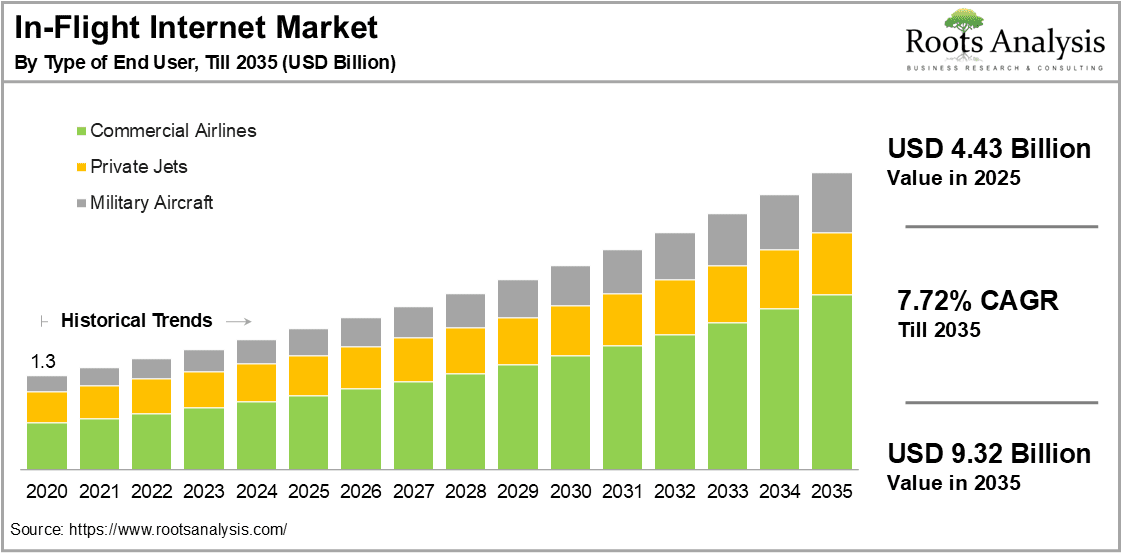
The In-flight Internet Market size is projected to grow from USD 4.43 billion in 2025 to USD 9.32 billion by 2035, representing a CAGR of 7.72% during the forecast period till 2035.
 |
The new research study consists of In-flight Internet Market and trends analysis, detailed market forecast analysis, and provide actionable strategic recommendations.
Innovations in wireless connectivity technology are not only gaining momentum on the ground but also revolutionizing the in-flight experience. Modern passengers’ expectations to stay connected even during flights have opened a new window for the in-flight internet market. This could be possible through technology such as satellite-based systems or air-to-ground connectivity systems that allow passengers to access the internet while on board an aircraft. Through this service air passengers can browse the web, stream content, send emails, and use messaging apps on their devices. With the growing integration of IoT in aviation services, the demand for high-speed in-flight Wi-Fi solutions has generated ample growth opportunities for the in-flight internet market globally. In this regard, satellite internet is also playing crucial role.
The in-flight internet has become a vital service due to the rising need to enhance the passenger experience, particularly, for business travelers and those who want to stay connected during their journey. Significantly, the ongoing innovation in satellite-based networks is offering faster internet speeds and great bandwidth that support high-demand activities from video streaming to real-time communication. Hence, service providers are collaborating with airlines and driving groundbreaking changes in the industry. For instance, in September 2024, United Airlines partnered with SpaceX to offer free, high-speed Starlink Wi-Fi across its mainline and regional aircraft, setting a new standard for inflight connectivity. Sharing this news, the CEO of United, Scott Kirby stated that this connectivity takes the inflight entertainment experience to the next level with more personalized content in every seatback. Apart from this, the impact of 5G on air travel is transforming connectivity on domestic flights by providing lower latency and higher data speed, augmenting the market scope.
However, regulatory challenges for in-flight services including varying aviation regulations, spectrum allocation issues, and cross-border compliance can hinder the seamless deployment of advanced connectivity solutions worldwide. Overall, continuous advancements in technology are shaping the future of in-flight internet market and is expected to flourish with an impressive growth rate during this forecast period.
The in-flight internet market report presents an in-depth analysis of the various companies that are involved in offering in-flight internet, across different segments, as defined in the table below:
| Key Report Attributes | Details | |
| Historical Trend | Since 2020 | |
| Forecast Period | Till 2035 | |
| Current Market Size | $ 4.43 Billion | |
| Market Size Value by 2035 | $ 9.32 Billion | |
| CAGR (Till 2035) | 7.72% | |
| Type of Technology |
|
|
| Type of Service Model |
|
|
| Type of Connectivity |
|
|
| Type of End User |
|
|
| Geographical Regions |
|
|
| Leading Market Players |
|
|
| PowerPoint Presentation (Complimentary) |
Available | |
| Customization Scope | 15% Free Customization | |
| Excel Data Packs (Complimentary) |
|
|
This segment of the global in-flight internet market highlights the type of technology such as air-to-ground, hybrid-based, and satellite-based. Among the categories, satellite-based technology has been a dominating segment and currently holds (~47%) of the market share. The importance of Ka-band and Ku-band satellites that enable high-speed, reliable internet connection even on long-haul flights over the ocean and remote areas primarily contributes to the segment’s growth. Also, advancements in Low Earth Orbit satellite networks maximize the growth potential with lower latency and higher data speed.
Further, the air-to-ground segment is expected to grow at a higher (9.51%) growth rate in the upcoming years. This system uses ground-based cellular networks to establish a connection with aircraft and allow internet access during flight. Being more cost-effective and reliable solutions particularly, for regional flights over land, the segment will likely rise faster. Besides this, hybrid connectivity solutions for airlines are gaining popularity that combine both air-to-ground and satellite systems to enhance coverage and speed.
The distribution of the market based on the type of service model is fragmented into free Wi-Fi, Freemium, and paid Wi-Fi. As per our in-flight internet industry analysis, the freemium segment is expected to lead the market with (~43%) of the market share by 2035. This model strikes a balance by offering internet access for free, ensuring wide adoption and passenger satisfaction while generating revenue through optional upgrades to premium services similar to faster speeds or streaming capabilities.
However, the paid Wi-Fi is growing steadily and is anticipated to experience (8.74%) CAGR over this forecast period. As this service model requires passengers to pay for internet access, typically through tiered pricing plans based on usage, remains popular among airlines looking to generate direct revenue and among passengers requiring high-speed connectivity for entertainment or work.
The global market for in-flight internet features a wide range of connectivity where high-speed connectivity drives the dominance in the market with (~48%) of the market by 2035. This segment offers a balanced solution with sufficient bandwidth for activities such as browsing, messaging, and streaming, meeting the growing demand for in-flight internet access. Furthermore, standard connectivity appeals to a wide range of passengers, providing a dependable experience without the limitations of low-bandwidth options. It is particularly favored by airlines aiming to enhance passenger satisfaction while maintaining cost efficiency. Hence, the standard connectivity segment is expected to grow at a CAGR of (9.16%) in the upcoming decade.
Based on the type of end user, the commercial airlines segment currently dominating the market with the largest (~50%) of the market share. Commercial airlines, incorporating regional carriers and low-cost airlines are increasingly adopting connectivity solutions to enhance passenger experience. Also, the rising demand for seamless in-flight connectivity among passengers, coupled with airlines' efforts to differentiate their services, drives this sector's dominance in the market. As a result, the segment will likely grow at a notable (11.23%) CAGR over this projection period.
This segment highlights the distribution of the In-flight internet market across various geographical regions, such as North America, Europe, Asia, Latin America, the Middle East and North Africa, and the rest of the world. Based on revenue, North America is expected to capture (~48%) of the market share and will likely continue to lead the global market for in-flight internet till 2035.
Furthermore, the in-flight internet market is emerging rapidly in Asia and is estimated to sprout out at an outstanding (12.3%) growth rate throughout this projection period. The speedy growth in air passenger traffic due to increasing disposable incomes and rise in the middle-class travelers are inflating the demand for in-flight connectivity and supporting the market expansion. Along with this, airlines in Asia are swiftly expanding their fleets with connectivity-ready aircraft. Adopting modernization strategies for in-flight internet aligns with trends in airline passenger connectivity, thus, reinforcing the market prospects. For instance, in November 2024, Fiji Airways presented a free full-flight messaging Wi-Fi service for Economy Class passengers that allows them to stay connected via messaging apps throughout their journey on Airbus A350 and Boeing 737MAX aircraft.
The “In-flight Internet Market, Till-2035: Industry Trends and Global Forecasts” report features an extensive study of the current market landscape, market size and future opportunities within the In-flight internet market, during the given forecast period. The market report highlights the efforts of several stakeholders involved in this rapidly emerging segment of the service providers industry. Key takeaways of the In-flight internet market report are briefly discussed below.
The heightening passenger expectations for in-flight Wi-Fi to stay connected to work, entertainment, or communication is the primary key driver of the market evolution. This is attributed to the increasing number of air travelers that are creating opportunities for the aviation industry to double their growth with Wi-Fi offerings on airlines. The increasing innovation in satellite technologies and the rollout of 5G air-to-ground networks, allow faster and more reliable connectivity. Therefore, the demand for satellite internet for flights is spurring the market progress. Additionally, the current growth of the aviation industry specifically, in emerging markets, raises the demand for customer satisfaction with in-flight connectivity and digital entertainment options during flights. Resulting in, the global in-flight internet market growth is estimated to multiply driven by these significant factors in the upcoming decade.
The competitive landscape of in-flight internet providers is shaped by several key players such as Gogo, Viasat, Panasonic Avionics, SpaceX's Starlink, and others. These service providers dominate the industry by holding a significant market share of in-flight internet services. Leading players are striving to maintain their market position through their offerings of faster speeds, lower latency, and broader coverage through advancements in satellite technologies. In addition, these key players are employing competitive strategies such as collaboration and partnership with airlines to expand market reach.
Although the market has great potential for long-term growth, however, the high installation and maintenance costs are significant challenges in the in-flight internet market due to its complexity and technical demands of implementing connectivity systems on aircraft. These systems typically include advanced satellite antennas, modems, and network equipment that must be integrated into the aircraft’s structure and avionics without compromising safety or aerodynamics. As a result, the factor can curb the expansion of the market.
In respect of regional insights, North America is predicted to maintain a dominant role in the in-flight internet market with (~48%) of the current market share. Primarily, the established commercial aviation industry with the presence of major airlines in the region is among the pioneer airlines, that offer entertainment and connectivity services. These airlines continue to invest heavily in upgrading their fleets with cutting-edge in-flight internet services, contributing to the region’s leading position. This is mainly attributed region’s extensive ground and satellite network infrastructure that ensures the deployment of reliable satellite-based internet services. Additionally, the strong partnership and collaboration between airlines and giant technology providers accelerate this growth of the market development. For instance, in December 2024, Skyservice Business Aviation formed a partnership with Starlink by SpaceX to bring Starlink's high-speed in-flight connectivity to more business aircraft owners and operators.
Examples of key players involved in the market for in-flight internet (which have also been captured in this market report, arranged in alphabetical order) include AirFi (Netherlands), Anuvu (US), Astronics (US), Cobham (UK), Collins Aerospace (US), Gogo Business Aviation (US), Inflight Media Digital (UK), Iridium (US), Panasonic Avionics (US), Safran (Paris, France), SmartSky Networks (US), Thales (France), UTC Aerospace Systems (US), ViaSat (US), and Zodiac Aerospace (France). This market report includes an easily searchable excel database of all the companies who have adopted the in-flight internet market.
The market report presents an in-depth analysis, highlighting the capabilities of various companies engaged in this domain, across different segments. Amongst other elements, the market report includes:
At Roots Analysis, we genuinely care about your success and understand that your business requirements are unique. While our market research reports provide valuable insights, we recognize that they might not cover every aspect you need to make well-informed strategic decisions. To account for that, we offer 15% free report customization tailored to your specific needs. Whether you require additional quantitative analysis, qualitative insights, or any other information related to the in-flight internet market, reach out us today at: support@rootsanalysis.com