Industrial Robotics Market Distribution by Type of Robot (Traditional Industrial Robots and Collaborative Robots), Payload, Mobility, Application Area (Handling, Welding, Assembling, Cleanroom, Dispensing, Processing and Other Application Areas), End-User, Geographical Regions and Leading Players – Trends and Forecasts 2026-2040
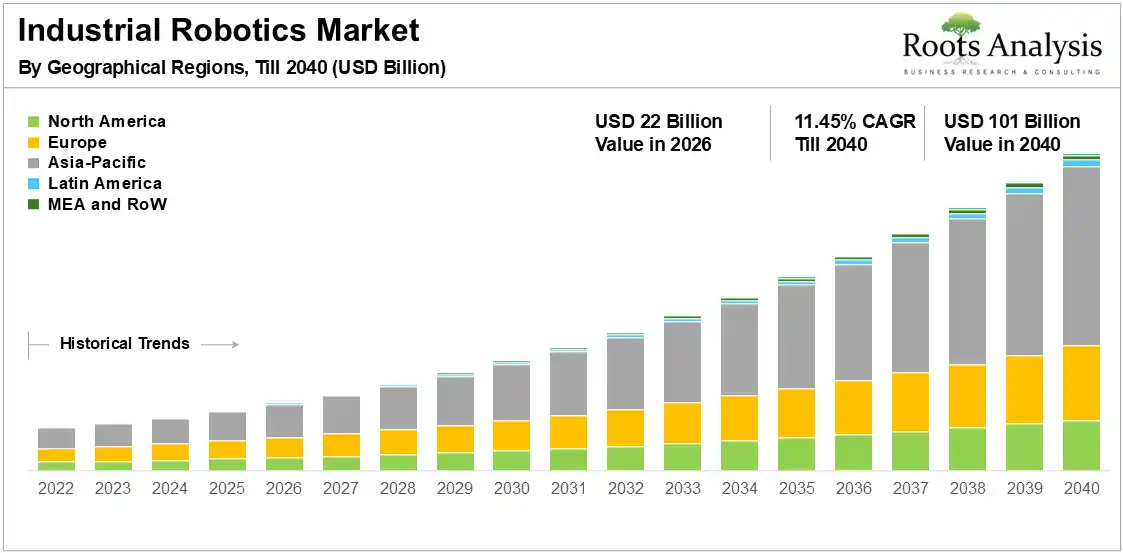
The industrial robotics market size is expected to rise from USD 22 billion in 2026 to reach USD 35 billion in 2030, and USD 101 billion by 2040, representing an overall CAGR of 11.45% till 2040.
See What’s in the Full Report–Request Your Complimentary Insights!
Industry 4.0 robotics integration is changing the way manufacturing processes are undertaken by various organizations through the use of automated solutions. Over the years, the global demand for consumer electronics and automobiles has also increased. Owing to this fact, manufacturers are incessantly utilizing assembly line robotics solutions to automate various manufacturing processes which require consistent process replicability.
Industrial robots are heavy-duty machines developed to speed up various manufacturing processes by automating them. These robots feature at least one robotic arm designed to orchestrate dangerous or repetitive tasks in factories. Industrial robot end effectors provide flexibility to operate under various strenuous conditions, including high pressure vacuum chambers and radiation chambers to prevent direct human exposure. Further, robotic arms can be added on with specialized grippers in order to enable the handling of delicate workloads and lift up to several tons.
According to the International Trade Administration (ITA), organizations utilizing automated labor witnessed an increase of over five percent in productivity. As a result, end users are increasingly seeking more versatile industrial robots with an increased capacity to lift a broad range of payloads and reduce the conventional labor costs. For instance, KUKA industrial robots can lift up to 500 Kgs, with an arm reach of over 2,500 mm.
Industrial Robotics Market: Report Attributes
Key Report Attribute
Details
Historical Trend
Since 2022
Forecast Period
Till 2040
Market Size 2026
$ 22 Billion
Market Size 2040
$ 101 Billion
CAGR (Till 2040)
11.45%
The market report features the likely distribution of the current and forecasted opportunity for manufacturers in the global industrial robotics market size across various segments, such as type of robot, type of traditional industrial robots, payload, mobility, application area, end-user, geography and key players. The industrial robotics market analysis also features the likely distribution of the current and forecasted opportunity within the robot-as-a-service (RaaS) model.
We have created three market forecast scenarios, conservative, base and optimistic, to account for future uncertainties in key parameters and enhance the robustness of our model. These scenarios represent different tracks of the industry's evolution.
In essence, using AI-enabled industrial robots along with similar technologically advanced robotics solutions, optimum outputs can be delivered in relatively shorter timeframes. Further, the need for robotic process automation (RPA) and replicability of repetitive tasks in industrial settings, drives the robotics market expansion and the demand for industrial robots, enabling faster production lines and satisfying the growing consumer demand.
Have Questions? Let’s Get Them Answered.
Recent Developments in Industrial Robotics Market
Several recent developments in the field of industrial robotics and collaborative robots market have occurred, and we outline some of these below. These developments, even if they arose after our market report’s release, support the overall industrial robotics market trends detailed in our analysis.
In June 2025, ABB launched three new heavy-duty robot arms and a compact mobile robot, expanding its portfolio to 11 robot families and 60 variants.
In June 2025, Amazon announced the deployment of over 1 million robots in its operations, alongside the launch of new AI technologies to make its industrial mobile robot fleet smarter and more efficient.
In April 2025, Boston Dynamics and Hyundai Motor expanded their collaboration to drive innovation in mobility manufacturing, with Hyundai investing USD 21 billion in the US and planning to purchase robots, including Spot and Atlas for factory automation.
In March 2025, ABB expanded its robotic solutions for logistics and e-commerce supply chains with two new AI-powered functional modules in its Item Picking family, enhancing automation for sorting and handling tasks in warehouses.
In June 2024, Neura Robotics entered into a strategic collaboration with OMRON in order to introduce AI enhanced cognitive robots into factory processes to improve efficiency and safety.
In January 2025, 1X purchased Kind Humanoid to accelerate humanoid robot development for industrial use, focusing on robots capable of human-level reach and navigation for tasks in dynamic production environments.
In April 2025, Intuitive Robots partnered with Boston Dynamics in order to plan a wider deployment and technical support for the Spot robot in Europe.
Industrial Robotics Market Segmentation Insights
The market research report presents an in-depth analysis of the various industrial robot manufacturing companies, across different segments, as defined in the table below:
Industrial Robotics Market: Market Segmentations
Market Segmentations
Details
Type of Robot
Traditional Industrial Robots
Collaborative Robots
Type of Traditional Industrial Robot
Articulated Robots
Cartesian Robots
SCARA Robots
Delta Robots
Other Robots
Payload
Low Payloads (<20 Kgs)
Medium Payloads (20 to 150 Kgs)
High Payloads (>150 Kgs)
Mobility
Stationary Robots
Mobile Robots
Application Area
Handling
Welding
Assembling
Cleanroom
Dispensing
Processing
Other Application Areas
End-User
Electronics Industry
Automotive Industry
Metal and Machinery Industry
Plastics Industry
Food and Beverages Industry
Other Industries
Key Geographical Regions
North America
US
Canada
Mexico
Rest of North America
Europe
Germany
France
Italy
Spain
Turkey
UK
Rest of Europe
Asia-Pacific
China
Japan
South Korea
Taiwan
Singapore
India
Thailand
Rest of Asia-Pacific
Latin America
Brazil
Argentina
Rest of Latin America
Markets in the Middle East and Africa, and Rest of the World
North Africa
South Africa
Rest of Middle East and Africa
Other Countries
Market in North America
US
Canada
Mexico
Rest of North America
Market in Europe
Germany
France
Italy
Spain
Turkey
UK
Rest of Europe
Market in Asia-Pacific
China
Japan
South Korea
Taiwan
Singapore
India
Thailand
Rest of Asia-Pacific
Market in Latin America
Brazil
Argentina
Rest of Latin America
Markets in the Middle East and Africa,
and Rest of the World
North Africa
South Africa
Rest of Middle East and Africa
Other Countries
Want Information on Specific Region / Segment?
As the global robot density in manufacturing increases, the demand for smart factory automation trends will increase as well. Additionally, due to growing end user preference for robot-as-a-service (RaaS) model, adoption of industrial robots across key industries, including the automotive, consumer electronics and the healthcare industry is also expected to grow.
According to Xiaogang Song, (Secretary General, China Robotics Industry Alliance (CRIA)), industrial robotics domain will mark a turning point in 2025 as, “The integration of AI and IoT is making robots smarter and more adaptive, enabling them to handle complex tasks in dynamic environments. This growth is not just about volume but also about the shift toward collaborative robots and humanoid form factors, which are expanding applications in logistics and warehousing.”
Industrial Robotics Market Share Insights
Market Share by Type of Robot: Traditional Industrial Robots Hold the Largest Share
In terms of type of robot, the global market is segmented into traditional industrial robots and collaborative robots. As per our market research, traditional industrial robots dominate the global industrial robotics market, holding a dominating revenue share of approximately 85.77% in 2026.
This highest share is driven by the rising adoption of automation due to their unmatched precision, high payload capacity, and throughput efficiency across heavy-duty manufacturing verticals such as automotive, metal fabrication, and electronics.
The segment's dominance is further reinforced by deep integration in high-volume production lines where speed, repeatability, and zero error tolerance are non-negotiable attributes that cobots currently cannot replicate at scale.
In the future, collaborative robots (cobots) represent the most strategically compelling growth opportunity in the industrial robotics, projected to expand at a CAGR of 14.85% through 2040.
This growth is primarily driven by accelerating Industry 4.0 deployment, labor shortages, and expanding use in precision assembly. Cobots are uniquely positioned to address the automation needs of SMEs, healthcare, logistics, and food & beverage sectors, industries where traditional robots are cost-prohibitive or operationally inflexible.
Market Share by Payload: Market Opportunities Associated with Low Payload Supporting Robots
The industrial robotics industry analysis features various sub-segments based on payload, such as robots supporting low payloads (<20 Kgs), medium payloads (20 to 150 Kgs) and high payloads (>150 Kgs).
Based on our projection, low payload robots (<20 Kg) hold the highest share, accounting for approximately 54.20% of revenue share in 2026. This largest share is due to their widespread utilization in the packaging of goods within the medical devices, pharmaceuticals, and cosmetics sectors industries where precision, cleanroom compliance, and compact form factors are non-negotiable.
The proliferation of consumer electronics, wearables, and semiconductor manufacturing, which demand sub-millimeter repeatability and high-cycle-rate automation, further entrenches this segment's lead.
On the other hand, medium payload robots (20–150 Kg) is likely to register the fastest CAGR of 11.2% through 2040. The medium payload robots address mid-range manufacturing needs across electronics, pharmaceuticals, and automotive industries. These robots occupy the operational places as they are capable of welding, painting, assembly, and flexible enough for rapid reprogramming in low-volume production environments.
Market Share by Mobility: Stationary Robots Hold the Largest Share
The global industrial robotics market share is further divided into various sub-segments based on mobility, such as mobile robots and stationary robots. As per our market report, stationary robots currently dominant revenue share, accounting for 65% of the overall revenue share in 2026.
Stationary robots are deeply integrated into high-volume manufacturing environments such as automotive assembly, electronics fabrication, and precision welding. These robots are indispensable for high-precision, repetitive tasks like welding, painting, assembly, and pick-and-place, where their fixed base ensures unmatched positional accuracy.
Notably, mobile robots represent the highest-growth sub-segment within the mobility classification, expected to grow at a CAGR of 16.5% during 2026-2040. This growth is driven by the explosive expansion of e-commerce, warehouse automation, and flexible intra-factory logistics, making this sub-segment highly valuable for logistics operators, and robotics OEMs assessing where next-generation capex is being deployed.
Market Share by Application Area: Industrial Robotics Market Growth Driven by Handling Operations
The global industrial robotics market share is divided across various application areas. Based on our analysis, handling is leading the market, accounting for 42.0% of the market share in 2026.
This dominance is largely because of industrial robotics superior versatility, universal application compatibility, straightforward deployment procedures, and broad industry acceptance. This highest share is also due to the global e-commerce surge that require warehouse and logistics automation.
On the other hand, dispensing segment is likely to grow at a higher CAGR of 12% during 2026-2040. This growth is potentially driven by increasing applications in food & beverages and agriculture, sectors where precise material deployment directly impacts product quality.
Market Share by End Users: Automotive Robotics Adoption to Fuel Market Growth
Based on the end user, electronics industry currently holds the largest share of the global industrial robotics market at 27.96% in 2026. This highest share is driven by the relentless demand for miniaturization, precision assembly, and high-throughput production across semiconductors, consumer electronics, and PCB manufacturing.
The proliferation of smartphones, wearables, EV battery management systems, and AI chips has further intensified the deployment of robotic automation across cleanroom assembly, inspection, and soldering applications.
Conversely, automotive industry is anticipated to grow at a higher CAGR of 15.9% during 2026-2040. This lucrative growth is due to the ongoing EV manufacturing transition, which requires entirely new robotic cell configurations for battery module assembly, laser welding, and high-payload operations.
The US has recently experienced a substantial rise in robot sales within the automotive sector, driven by an increase in purchase orders from automobile companies, which further fuels the growth of this segment in the future.
Market Share by Key Geographical Regions: Asia-Pacific to Propel in the Industrial Robotics Sector in the Coming Years
This segment highlights the distribution of market for industrial robotics across various geographies, such as North America, Europe, Asia-Pacific, Latin America, and Middle East and Africa and rest of the world. According to our projections, Asia-Pacific is likely to capture the majority (73.48%) of the industrial robotics market share in 2026, and this trend is unlikely to change in the future.
This is driven by the region's unmatched concentration of electronics, automotive, and heavy manufacturing capacity that collectively demands the highest volume of robotic automation globally.
Several reasons, such as India's production-linked incentive schemes spurring cobot adoption in smartphone and appliance plants, South Korea's smart factory investments, and the continued scale-up of semiconductor fabrication across Taiwan and South Korea, are driving growth of market in this region.
It is worth highlighting that the market in Latin America is likely to grow at a relatively higher CAGR (8.13%), during the forecast period 2026-2040. This is a result of the increasing adoption of automation solutions across assembly lines in the Brazilian automotive industry.
Further, the highest growth is further fueled by the automotive and food & beverages sectors where robotic deployment is accelerating as regional manufacturers seek to close the productivity gap with global peers.
Industrial Robotics Market: Report Deliverables
Report Deliverables
Details
Excel Data Packs (Complimentary)
Market Landscape
Start-up Ecosystem Analysis
Patent Analysis
Demand Analysis
Market Forecast and Opportunity Analysis
Key Industrial Robotics Companies Profiled
ABB
Daihen
FANUC
Kawasaki Heavy Industries
KUKA
Mitsubishi Electric
Nachi-Fujikoshi
Yamaha Motor
Comau
Denso
Epson America
Omron
Siasun
Staubli
Yaskawa
Hirata
Nordson
PowerPoint Presentation (Complimentary)
Available
Customization Scope
15% Free Customization
Your Business is Unique–Why Shouldn’t Your Report Be?
Industrial Robotics Market Key Takeaways
The “Industrial Robotics Market: Industry Trends and Global Forecasts, till 2040” market report features an extensive study of the current market landscape, start-up ecosystem analysis, patent analysis, demand analysis and market size and future opportunities within the industrial robotics industry, during the forecast period.
Competitive Landscape of Industrial Robot Manufacturers
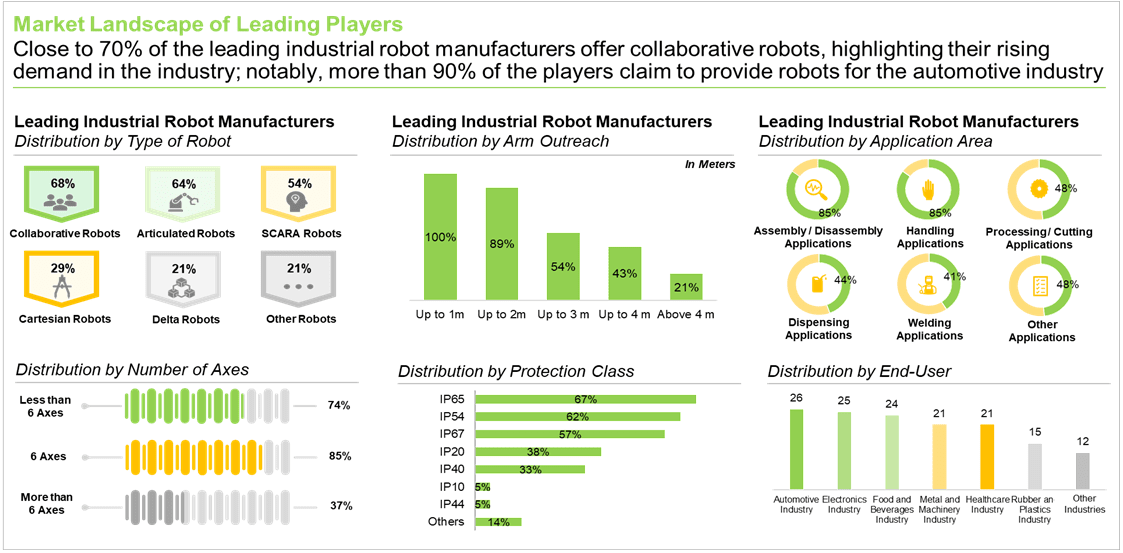
The market for leading players manufacturing industrial robots remains fragmented, with both new entrants and established players actively participating. The current market landscape features players with different company sizes, including large, mid-sized, and small companies.
Notably, close to 70% of the leading industrial robot manufacturers offer collaborative robots, highlighting their rising demand in the industry; further, more than 90% of the players claim to provide robots to be utilized in the automotive industry.
What are the Key Drivers of Industrial Robotics Market?
The global industrial robotics market size growth is primarily driven by the increasing human-robot collaboration over the last few years. Collaborative robots present a sound opportunity for organizations to incorporate automation without cutting down jobs. These robots carry out designated operations alongside humans in the same working space.
Further, industrial robots offer cost efficiency with lesser errors making them an ideal option for automating production processes. Also, evolution of smarter, AI-enabled industrial robots is also a contributing factor towards the increased adoption of industrial robots. These advanced robots feature the capability to self-learn and improvising the process while learning.
Market Size Analysis: What is the Opportunity for Industrial Robots?
The globalindustrial robotics market size is likely to be worth USD 22 billion in 2026 and will reach USD 101 billion by 2040. In terms of the type of robots, traditional industrial robots segment holds the largest share of the industrial robotics market due to rising adoption of automation. The market size for collaborative robots is likely to grow at a relatively higher CAGR of 14.85% during the forecast period.
The primary applications of industrial robots include product assembly and material handling in industries like automotive and electronics. Emerging areas like product dispensing are gradually growing over time.
Key Market Trend: Rising Patenting Activity Amongst the Robot Manufacturers to Foster Progress and Innovation
Companies engaged in the industrial robotics market have advanced their product portfolios by filing a number of patents over the years. In the past few years, nearly 1,500 patents were granted / filed, demonstrating substantial efforts of researchers in this domain. Notably, the majority of the patents in this domain include patent applications (58%), followed by limited patents. Interestingly, both industry players are leading the patent filing activity in this domain with the majority patents filed by Comau.
Frequently Asked Questions
How big is industrial robotics market?
The industrial robotics market size is likely to be USD 22 billion in 2026.
Why is the industrial robotics market growing so quickly?
The industrial robotics market is surging due to rising automation demand in industries like manufacturing, driven by efficiency and cost-saving needs.
What is the expected CAGR for industrial robotics through 2040?
The global market for industrial robotics is likely to grow at a CAGR of 11.45% till 2040.
Which manufacturing sectors are investing the most in industrial robots?
The automotive and electronics sectors are investing the most in industrial robots. Their demand for precision, efficiency, and high-volume production drives significant adoption.
Which regions are leading the demand for industrial robotics solutions?
Asia-Pacific is presently leading the demand for industrial robotics solutions, followed by rising inclination towards automation and human-robot collaboration in Latin America.
Who are the top companies in the global industrial robotics market?
ABB, Comau, Daihen, Denso, Epson America, FANUC, Hirata, Kawasaki Heavy Industries, KUKA, Mitsubishi Electric, Nachi-Fujikoshi, Nordson, Omron, Siasun, Stäubli, Yamaha Motor and Yaskawa.
What impact are regulatory or trade policies having on global robot markets?
Regulatory policies promoting automation and sustainability are driving global robot market growth, while trade restrictions, like U.S. limits on Chinese robotics imports, create challenges. These policies shape investment, innovation, and market access, with varying impacts across regions.
Industrial Robotics Market Distribution by Type of Robot (Traditional Industrial Robots and Collaborative Robots), Payload, Mobility, Application Area (Handling, Welding, Assembling, Cleanroom, Dispensing, Processing and Other Application Areas), End-User, Geographical Regions and Leading Players – Trends and Forecasts 2026-2040
Request Sample Pages
Industrial Robotics Market Distribution by Type of Robot (Traditional Industrial Robots and Collaborative Robots), Payload, Mobility, Application Area (Handling, Welding, Assembling, Cleanroom, Dispensing, Processing and Other Application Areas), End-User, Geographical Regions and Leading Players – Trends and Forecasts 2026-2040
Ask A Question
Industrial Robotics Market Distribution by Type of Robot (Traditional Industrial Robots and Collaborative Robots), Payload, Mobility, Application Area (Handling, Welding, Assembling, Cleanroom, Dispensing, Processing and Other Application Areas), End-User, Geographical Regions and Leading Players – Trends and Forecasts 2026-2040
Download Free Insights
Industrial Robotics Market Distribution by Type of Robot (Traditional Industrial Robots and Collaborative Robots), Payload, Mobility, Application Area (Handling, Welding, Assembling, Cleanroom, Dispensing, Processing and Other Application Areas), End-User, Geographical Regions and Leading Players – Trends and Forecasts 2026-2040
Describe Usage
How many people will be using this report?
To help us serve you better, please select the best option that
describes the usage of this report
Thank you for submitting the details. Your message has been sent to the relevant team. One
of our team members will shortly email you the relevant quotation. For any queries, please feel
free to reach out to us at support@rootsanalysis.com
Roots Analysis Customer Support
Open AI tool?
You are leaving Roots Analysis.
(Report title & URL will be shared)