


 Download Free Sample
 Buy Now
Market Size
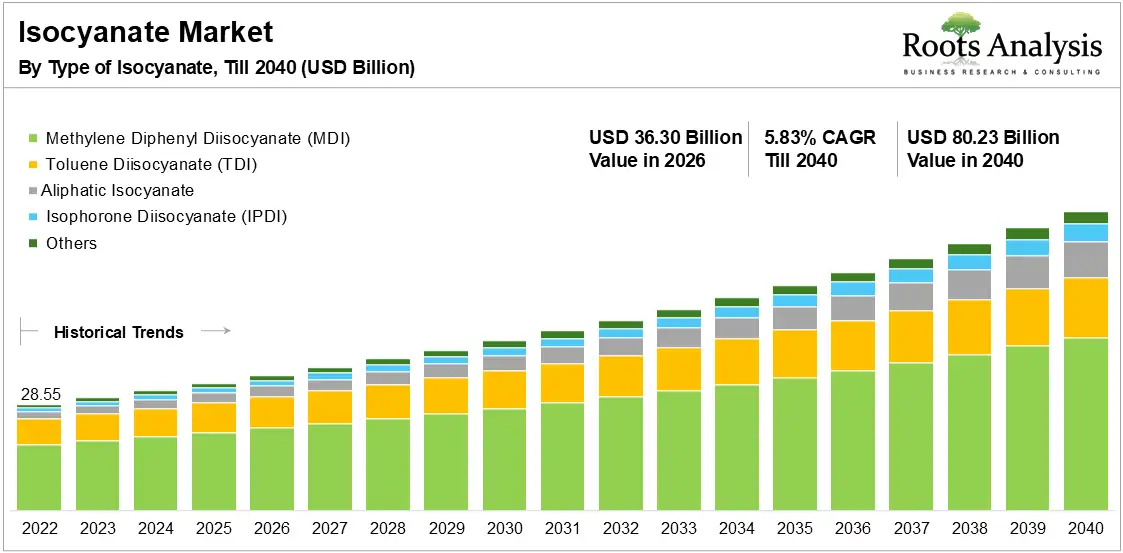
The global isocyanate market size is projected to reach USD 36.30 billion in 2026 and USD 80.23 billion by 2040, representing a CAGR of 5.83% during the forecast period 2026 to 2040.
See What’s in the Full Report – Request Your Complimentary Insights!
Market Overview
Isocyanate is a form of reactive chemical compound which contain a functional group (-N=C=O). The addition of functional group makes isocyanates extremely reactive, specifically with compounds containing hydroxyl groups (-OH). Isocyanates are extremely versatile due to their ability to adjust according to the final product properties. Key products that are made using isocyanate include methylene diphenyl diisocyanate (MDI) and toluene diisocyanate (TDI), along with various aliphatic and specialty isocyanates.
These compounds act as core building blocks for materials utilized across diverse end-use industries, particularly in the creation of rigid and flexible foams, coatings, adhesives, sealants, and elastomers (CASE). The value chain extends from basic petrochemical feedstocks to specialized chemical intermediaries used in advanced manufacturing processes.
Market expansion is primarily driven by increasing demand for high-performance polyurethane-based materials in end-use sectors like construction and automotive manufacturing. The emphasis on energy efficiency in building codes necessitates rigid foam insulation, while vehicle lightweighting relies heavily on polyurethane applications for seating and interior components.
Innovation in the sector increasingly centers on sustainability and circular economy principles, driven by regulatory pressure to reduce the environmental impact of chemical production. This includes research into bio-based feedstocks and non-isocyanate polyurethane (NIPU) technologies. For instance, several major players are actively developing and commercializing partially bio-based MDI alternatives for use in rigid foams to satisfy the growing demand in green buildings. Overall, the isocyanate market outlook remains positive, though constrained by volatile raw material costs and the ongoing need to balance regulatory compliance with cost-effective production of these essential industrial chemicals.
Market Report: Key Takeaways
- Isocyanate Market Giants: The market is highly consolidated with the presence of market giants, such as Wanhua Chemical, BASF, and Covestro. Wanhua Chemical announced ¥6.5 billion capex program and acquired Vencorex Aliphatics to expand portfolio breadth. On the other hand, BASF also maintains its leadership position as a diversified chemical conglomerate with substantial isocyanate operations integrated within polyurethane value chains encompassing coatings, adhesives, and elastomers.
- Startup Ecosystem and Innovations: The bio-based isocyanates market startups are introducing disruptive technologies to address sustainability, safety, and supply chain vulnerabilities. Startup companies, such as CYNiO and Algenesis Labs are actively manufacturing phosgene-free isocyanate and biogenic plant-based isocyanates. While CYNiO has raised €2+ million in Series A funding round to develop patented CO2-based isocyanate product technology, Algenesis Labs has achieved commercial milestone status with Bio-iso pilot facility commissioning, producing 100% carbon isocyanate without phosgene. Both companies are seeking collaborative and partnership arrangements to accelerate market penetration.
- Partnerships and Collaborations: The isocyanate market exhibits unprecedented partnership activity, reflecting industry transformation toward sustainability, specialization, and integrated polyurethane solutions. In November 2025, P2 Science and Algenesis entered a strategic partnership for the development and commercial deployment of 100% biobased polyurethane materials without performance compromise, targeting brand owners seeking measurable sustainability advantages.
- Isocyanate Market Share Analysis by Application: Flexible foams dominate the current global market, driven by the growing demand across all industries and their heavy use in bedding, furniture, automotive seating, and packaging. On the other hand, paint and coatings segment is likely to grow at the fastest CAGR in the future.
- Venture Capital Activity in Sustainable Isocyanates: The capital deployment in the isocyanate sector during 2025 and beyond demonstrates clear priority on sustainable technologies for the production of bio-based feedstocks, reflecting customer demand for green alternatives. Recently, Matereal Bio presented Polaris™, a decarbonized and non-isocyanate polyurethane alternative that is almost a million times less toxic than the conventional polyurethane and up to 100% biobased. The company has also partnered with leading companies to create custom Polaris™ formulations via Matereal™ AI platform. While specific funding amounts for Matereal were not disclosed, the breakthrough innovation and partnerships indicate substantial venture capital interest and validation.
- Isocyanate Industry Trends Analysis: The long-standing challenge of disposing of polyurethane waste (e.g., end-of-life furniture, mattresses, and construction debris) creates a significant opportunity for chemical recycling. Technology advancements in glycolysis and aminolysis are enabling the depolymerization of PU waste back into its constituent polyol and isocyanate derivatives. Commercialization of these processes allows the manufacturers to create closed-loop systems, reduce reliance on virgin materials, and address increasing regulatory demands for waste reduction.
Recent Industry Developments
- In October 2025, BASF invested in methylene diphenyl diisocyanate molecules in their polyurethane foam products to support their sleep products segment and other industrial segments.
- In August 2025, Algenesis Labs launched the world's first 100% biogenic carbon isocyanate made with plant. This breakthrough innovation in polyurethane chemistry marked as a key milestone setting the standards for safety, performance, and sustainability in this isocyanate industry.
- In August 2025, Convestro and Vencorex Holding signed an agreement to acquire two legal entities with stand-alone production sites for hexamethylene diisocyanate (HDI) derivates in Thailand, Rayong, Freeport, and Texas.
- In July 2025, CYNiO successfully raised over €2 million in investment capital funding to scale its sustainable technology for isocyanate production. CYNiO's placement within this ecosystem demonstrates policymaker confidence in sustainable isocyanate technologies as critical infrastructure for European chemical independence and environmental stewardship.
Get an Instant Quote in 10 Minutes. Lowest Price Guaranteed
Market Dynamics
Key Market Drivers
- Expansion of Global Construction and Infrastructure Sectors: The increasing demand for new residential and commercial buildings, coupled with public infrastructure projects in emerging economies, drives the need for high-performance building materials. MDI-based polyurethane foams are essential for insulation and structural components, meeting stricter energy efficiency codes (e.g., R-value standards) and reducing operational costs for new constructions. Notably, the polyurethane is also intensively used to produce insulated panels, automotive interiors, mattress, and furniture, which is likely to be one of the key polyurethane foam market drivers.
- Rising Demand for Isocyanates in Automotive Coatings and Adhesives: Specialty isocyanates like HDI and IPDI are crucial components in solvent-free and waterborne polyurethane coatings that offer superior durability, chemical resistance, and UV stability compared to standard epoxy or acrylic solutions. Therefore, these materials are widely adopted to produce marine paints, electronic encapsulants, industrial flooring and automotive coatings, which is one of the significant isocyanate market growth drivers.
- Regulatory Push for Energy Efficiency in End-Use Industries: Stricter government regulations mandating improved energy efficiency in appliances, vehicles, and cold storage facilities are increasing demand for advanced insulation solutions. Polyurethane foams derived from isocyanates offer superior thermal resistance compared to traditional alternatives, making them critical for compliance with efficiency standards like the Kigali Amendment's phase-down of high GWP blowing agents (HFCs).
Key Market Challenges
- Stringent Environmental and Health Regulations: Isocyanates, particularly MDI and TDI monomers, are classified as hazardous chemicals due to their respiratory sensitizing properties. Regulations such as REACH (Registration, Evaluation, Authorization and Restriction of Chemicals) in Europe impose significant costs related to risk assessment, handling protocols, and protective equipment, creating a barrier to entry for smaller firms and increasing operational expenditures for existing players. Therefore, the isocyanate producers are required to follow stringent safety regulations for isocyanates for safe handling, emission control, and occupational exposure.
- Cyclical Nature of Key End-Use Industries: Demand for environmentally friendly isocyanate alternatives is heavily dependent on the highly cyclical construction and automotive sectors. Economic downturns leading to higher interest rates can significantly reduce residential new builds and large infrastructure projects, causing sudden decreases in demand for MDI-based products and leading to price erosion or overcapacity in the short to medium term.
- Competition from Alternative Insulation Materials: While polyurethane foams offer high performance, they face price competition in low-cost construction and standard applications from materials like polystyrene (EPS / XPS), rock wool, and mineral fiber insulation. In regions where energy efficiency standards are less stringent, the higher cost of isocyanate-based insulation often prompts end-users to opt for cheaper, lower-performance alternatives.
Market Share Insights
Market Share by Type of Isocyanate: Methylene Diphenyl Diisocyanate Dominates the Market
- Based on the isocyanate market forecast estimates, MDI accounts for the largest share (62.50%). This dominance is due to MDI’s central role in manufacturing both rigid and flexible polyurethane foams for construction, appliances, furniture, and automotive uses.
- The fastest-growing sub-segment is aliphatic isocyanates that is estimated to grow at 8.0% CAGR till 2040, higher than the overall isocyanate market growth. This reflects rapid requirement for aliphatic isocyanates in high-performance coatings and adhesives, and in bio-based isocyanates. The market growth is further supported by tightening environmental regulations and OEM decarbonization goals.
Asia-Pacific Leads the Market Due to Rapid Industrialization
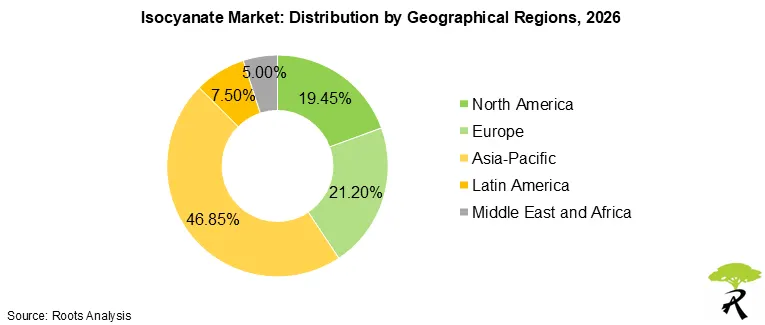
Asia-Pacific accounts for the largest share of the market in 2026, capturing 46.85% of global share. This growth stems from the rapid industrialization, robust construction, increasing manufacturing of automotive, furniture, and electronics in the region, all of which heavily rely on isocyanates for polyurethane production.
Within Asia-Pacific, China holds the highest share due to multiple synergistic factors, including the rapid industrialization across construction, automotive, electronics, and furniture sectors, government-backed infrastructure development initiatives, and competitive manufacturing cost structures enabling export market penetration.
Competitive Analysis of Key Isocyanate Suppliers in North America
The North American isocyanate market is characterized by concentrated competition among a handful of major chemical manufacturers. It is worth mentioning that due to the increasing technological advances in isocyanate synthesis methods, robust regulatory support for polyurethane applications is likely to propel the North American market in the future. Some of the active isocyanate companies in the region have been outlined below:
- Covestro: This company stands as one of the leading suppliers, leveraging its legacy from Bayer Material Science with substantial production capacity and strong vertical integration. The company maintains competitive advantages through technological innovation and established customer relationships across diverse end-use markets.
- Dow Chemical. This company competes aggressively through its materials science division, emphasizing sustainability initiatives and customized solutions for specific applications. Their market position benefits from diversified product offerings and strong presence in automotive and construction segments.
- Huntsman: This company maintains competitive positioning through specialized TDI production and strategic focus on flexible foam applications. They differentiate through technical service and regional market knowledge.
Want Information on Specific Region / Segment?
Key Market Insights
Isocyanate Industry Competitive Landscape
The isocyanate industry is immensely competitive, catering the attention of the industrial players for partnerships and collaborations. Some of the notable market players include BASF, Convestro, Mitsui Chemicals, Tosoh, Nippon Polyurethane Industry, and Kraton. The market demonstrates strong momentum toward sustainability, bio-based alternatives, and strategic acquisitions, with notable players investing heavily in phosgene-free production technologies and renewable feedstock development.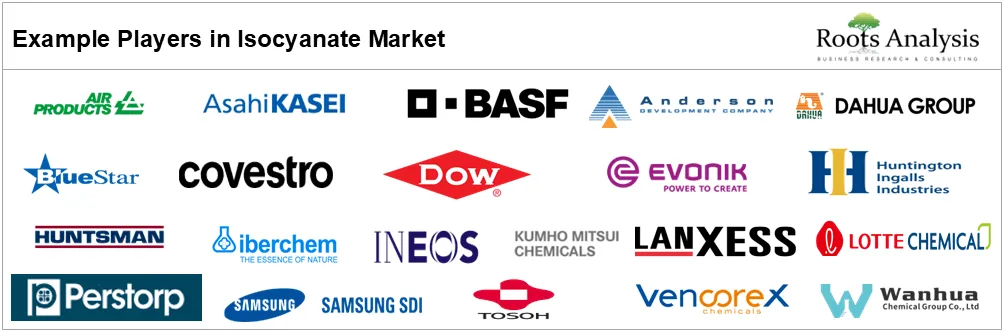
Isocyanate Market Future Trends
- Development of Bio-based and Recycled Isocyanates: Increasing corporate sustainability commitments and regulatory pressure to reduce reliance on fossil fuels are driving investment in green chemistry. Opportunities exist in developing and commercializing bio-based MDI alternatives derived from renewable feedstocks.
- Advancements in Non-Isocyanate Polyurethane (NIPU) Technologies: Research into NIPUs aims to mitigate the health and safety risks associated with traditional isocyanates by developing alternative chemistries that achieve similar performance characteristics. While NIPUs are currently limited in scale and performance, their successful development could unlock applications where stringent safety concerns prohibit traditional isocyanate use, offering a new pathway for market expansion.
- Integration into New Industrial Applications: Isocyanate derivatives are finding new uses beyond traditional foams and coatings in high-value industrial applications. These include 3D printing filaments, advanced composites for aerospace and sports equipment, and medical devices where precise material characteristics and durability are paramount. This expansion of isocyanate is diversifying the market beyond its core construction and automotive segments.
Your Business is Unique – Why Shouldn’t Your Report Be?
Isocyanate Market: Scope of the Report
| Key Report Attributes | Details | |
| Historical Trend | Since 2022 | |
| Forecast Period | Till 2040 | |
| Market Size 2026 | $ 36.30 Billion | |
| Market Size 2040 | $ 80.23 Billion | |
| CAGR (Till 2040) | 5.83% | |
| Segments Covered |
|
|
Market Segmentation
Based on our research, we have segmented the isocyanate market into type of isocyanate, type of formulation, purity grade, application, end use industry, geographical regions, and key players.
Market Share by Type of Isocyanate
- Methylene Diphenyl Diisocyanate (MDI)
- Toluene Diisocyanate (TDI)
- Aliphatic Isocyanate
- Isophorone Diisocyanate (IPDI)
- Others
Market Share by Type of Formulation
- Prepolymers
- Oligomers
- Monomers
Market Share by Purity Grade
- Technical Grade
- Specialty Grade
Market Share by Application
- Rigid Foam
- Flexible Foam
- Paint and Coatings
- Adhesives and Sealants
- Elastomers
- Binders
- Others
Market Share by End Use Industry
- Automotive
- Building and Construction
- Furniture
- Footwear
- Healthcare
- Packaging
- Others
Market Share by Geographical Regions
- North America
- US
- Canada
- Mexico
- Rest of North America
- Europe
- Austria
- Belgium
- Denmark
- France
- Germany
- Ireland
- Italy
- Netherlands
- Norway
- Russia
- Spain
- Sweden
- Switzerland
- UK
- Rest of Europe
- Asia-Pacific
- Australia
- China
- India
- Japan
- New Zealand
- Singapore
- South Korea
- Rest of Asia-Pacific
- Latin America
- Brazil
- Chile
- Colombia
- Venezuela
- Rest of Latin America
- Middle East and Africa (MEA)
- Egypt
- Iran
- Iraq
- Israel
- Kuwait
- Saudi Arabia
- UAE
- Rest of MEA


