Biologics Safety Testing Market Analysis: Key Trends and Growth Drivers

.png)

Published: August 2026
The biologics safety testing market has emerged as a critical component of the pharmaceutical and biotechnology industries, supporting the development, manufacturing, and regulatory approval of biologics, vaccines, and advanced therapies. It encompasses a wide array of analytical methods and technologies designed to detect contaminants, ensure product purity, and verify the absence of harmful agents in complex biological materials.
In the biologics safety testing market, ongoing innovations are driving higher sensitivity, faster turnaround times, and more sustainable practices for testing biologics, cell and gene therapies, and viral vectors. A key breakthrough comes from companies like Charles River Laboratories, which provides comprehensive custom services, in-vivo testing services, and virus safety testing services for modalities, such as antibodies and vaccines, leveraging PCR-based methods for rapid and specific detection of viral contaminants. Similarly, BioMerieux offers specialized endotoxin testing services for drug products, supporting a range of modalities, including biosimilars and other modalities through advanced, sustainable detection platforms.
The surge in cell and gene therapies, along with a robust pipeline of biologics, monoclonal antibodies, and biosimilars, stands as the primary catalyst for rising demand of biologics safety testing solutions. Each of these biologics requires multi-layered safety testing including sterility, endotoxin, mycoplasma, and viral clearance assays. This is to confirm safety, purity, and compliance with stringent regulatory standards from agencies like the FDA and EMA throughout development and commercialization. Moreover, ongoing technological innovations in bioanalytical methods, such as rapid microbiological testing, automated high-throughput platforms, and CRISPR-enhanced detection tools, have boosted testing precision, scalability, and ethical standards.
Roots Analysis has conducted an exhaustive study on biologics safety testing market featuring the current market landscape and future opportunity for the companies engaged in developing biological safety testing services, over a span of many years. In this article, we have highlighted biologics safety testing market analysis that are likely to shape the evolution of biologics safety testing market.
Want to explore the latest advancements in biological safety testing industry?
Latest Trends in Biologics Safety Testing Market That Are Likely to Shape the Market
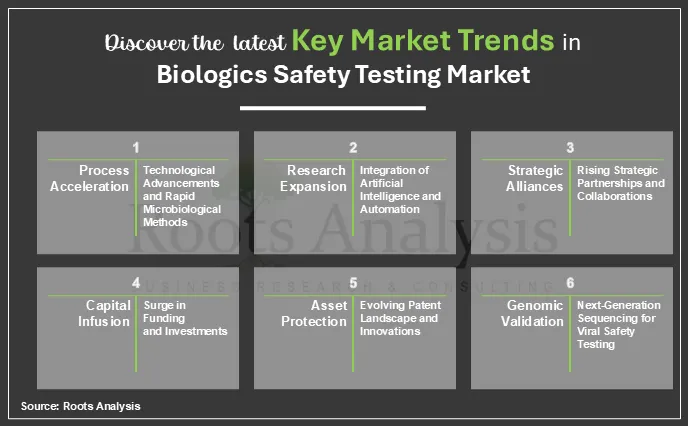
1. Technological Advancements and Rapid Microbiological Methods
In the biologics safety testing market, innovations in rapid microbiological methods are transforming sterility and endotoxin testing for biologics. These advanced approaches enable faster detection of microbial contamination without animal-derived reagents, which is remarkably important when dealing with complex molecules such as monoclonal antibodies. By enhancing speed and accuracy, this helps minimize production delays, permitting sponsors to accelerate development timelines during early manufacturing stages. As the pipeline for biologics is expanding rapidly, service providers are increasingly incorporating automated platforms, like real-time microbial detection sensors, to efficiently monitor contamination risks. At the same time, it ensures alignment with regulatory requirements for sustainable and ethical risk assessments.
2. Integration of Artificial Intelligence and Automation
Advancements in artificial intelligence and robotic process automation are revolutionizing data analysis and testing workflows for biologics. These intelligent systems facilitate predictive modeling of safety risks and high-throughput screening, which is remarkably important when handling delicate biologics such as vaccines. By reducing human error and processing vast datasets, this evolution helps optimize testing protocols, permitting sponsors to achieve more reliable outcomes in shorter timeframes.
3. Strategic Partnerships and Collaborations
In the biologics safety testing market, strategic partnerships and collaborations among CROs and biopharma firms are enhancing specialized testing capabilities for biologics. These alliances enable shared access to cutting-edge technologies. Notable example is the strategic alliance between TFBS Bioscience and U-Medico, which combines TFBS’s expertise in biosafety testing with U-Medico’s advanced analytical technologies to jointly launch GMP QC testing services in Japan, Taiwan, and the broader Asia-Pacific region. By pooling expertise and resources, this trend helps expand global service networks, permitting sponsors to access comprehensive safety evaluations more efficiently.
4. Surge in Funding and Investments
In the biologics safety testing market, increasing funding and venture capital investments are fueling expansion of testing infrastructure for biologics. These financial inflows support the development of advanced GMP-compliant platforms and global facility builds. This is important when addressing the safety needs of molecules, such as monoclonal antibodies and gene therapies.
5. Evolving Patent Landscape and Innovations
Rising patent filings for novel assay technologies are protecting advancements in immunogenicity and viral detection for biologics. As innovation in the biologics safety testing pipeline is intensifying, service providers and technology developers are increasingly leveraging patented platforms to differentiate their offerings. By securing intellectual property, the sponsors are able to adopt proprietary tools for more accurate safety predictions and risk mitigation.
6. Next-Generation Sequencing for Viral Safety Testing
Next-generation sequencing (NGS) is emerging as a transformative force in biologics safety testing by delivering unbiased, high-sensitivity detection of viruses and contaminants. NGS enables comprehensive screening of both known and unknown viral agents in a single workflow. This technology significantly shortens testing timelines, often reducing them from months to just weeks. This also offers superior breadth and sensitivity, allowing manufacturers to identify low-level infections, novel variants, and active viral transcripts that traditional assays might miss. Service providers and CDMOs are rapidly integrating GMP-qualified NGS platforms, such as transcriptomic approaches, into their viral safety programs to support cell bank qualification, bulk harvest testing, and lot release for complex biologics.
Conclusion
The biologics safety testing market is poised for strong and sustained growth in the coming years, driven by the rapidly expanding pipelines of complex biologics, monoclonal antibodies, and biosimilars that require highly sensitive, efficient, and compliant safety evaluations. While challenges such as assay complexity, stringent regulatory expectations, and the need for faster turnaround times persist, the industry is actively addressing them. This is being done through technological innovations like rapid microbiological methods, artificial intelligence-driven automation, and next-generation sequencing for viral safety.
Furthermore, strategic partnerships, increased venture capital funding, and a dynamic patent landscape are accelerating capability building, regional expansion, and competitive differentiation. These developments are enabling service providers to deliver integrated, high-throughput solutions that shorten development timelines while maintaining the highest standards of product purity and patient safety. Ultimately, these trends point toward more scalable, innovative workflows through collaborations, investments, and advanced technologies. This evolution is expected to support commercialization of transformative therapies and help meet the growing global demand for safe, high-quality biologics.
Browse our full report on Biologics Safety Testing Market: https://www.rootsanalysis.com/reports/biologics-safety-testing-market.html#overview
Sources:
- https://www.element.com/resources/articles/rapid-microbiological-methods-in-biologics-implementation
- https://www.biopharminternational.com/view/drug-safety-artificial-intelligence-large-language-models
- https://www.tfbsbio.com/new/1UlA2m2QiVu7H54Z
- https://www.fda.gov/news-events/otp-events-meetings-and-workshops/fda-scientific-public-workshop-next-generation-sequencing-adventitious-agent-detection-biologics