Biopharmaceutical Excipients Market Trends: Innovation in Biologics Formulation and Manufacturing


Published: October 2026
Biopharmaceutical excipients are functional, non-active ingredients used to stabilize, solubilize, buffer, protect and deliver biologic drug products. They are integral to the quality, safety and performance of monoclonal antibodies, recombinant proteins, vaccines, nucleic acid therapies and advanced drug-delivery systems.
The biopharmaceutical excipients manufacturing market is evolving as drug developers work with increasingly complex and sensitive modalities. High-concentration antibodies, subcutaneous biologics, mRNA vaccines, lipid nanoparticles and cell and gene therapy products require excipients with tightly controlled purity profiles, robust analytical documentation and proven compatibility with the drug substance and container-closure system.
Manufacturers are responding by expanding specialized excipient portfolios and formulation-development support. The market is moving beyond conventional ingredients toward higher-value services, including application expertise, risk assessment, regulatory support, supply assurance and customized grades. This shift is particularly relevant when an excipient is used in a parenteral product or a novel delivery platform.
Regulatory focus on excipient quality and the need to reduce formulation risk are also influencing investment decisions. The FDA’s Novel Excipient Review Pilot Program represents an important step toward earlier agency feedback for certain novel excipients, while global suppliers continue to strengthen quality systems, documentation packages and traceability.
Roots Analysis has conducted an exhaustive study on Biopharmaceutical Excipients Manufacturing Market featuring the current market landscape and future opportunity for the companies engaged in this domain, over a span of many years. In this article, we have highlighted various trends that are likely to shape the evolution of this market.
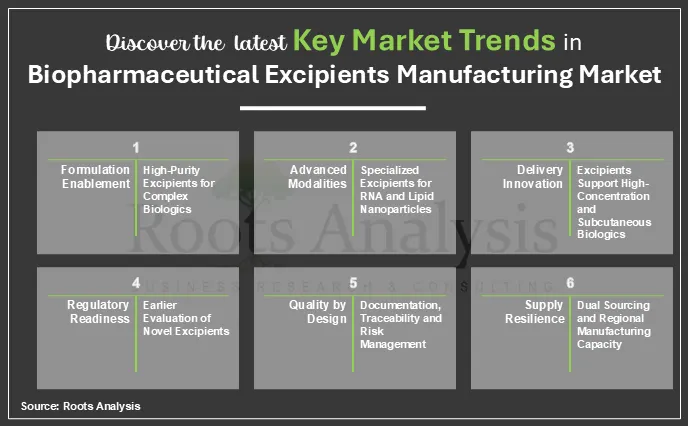
Want to explore the latest advancements in biopharmaceutical excipients manufacturing industry?
Latest Trends in Biopharmaceutical Excipients Manufacturing Market That Are Likely to Shape the Market
1. Formulation Enablement: High-Purity Excipients for Complex Biologics
Biologics are often sensitive to aggregation, oxidation, interfacial stress and other degradation pathways. This is increasing demand for high-purity sugars, amino acids, surfactants, buffers and stabilizers designed for injectable and other high-risk applications. Manufacturers are placing greater emphasis on tight impurity control and lot-to-lot consistency.
Croda’s Super Refined™ excipients and similar high-purity product platforms illustrate the importance of controlled impurity profiles for sensitive pharmaceutical formulations. The opportunity lies not only in supplying materials but also in demonstrating suitability through analytical characterization, stability support and comprehensive quality documentation.
2. Advanced Modalities: Specialized Excipients for RNA and Lipid Nanoparticles
The expansion of mRNA vaccines and RNA therapeutics has created a need for highly specialized lipid excipients and formulation components. Lipid nanoparticle systems depend on carefully selected ionizable lipids, phospholipids, cholesterol and polyethylene glycol-conjugated lipids to encapsulate and protect nucleic acid payloads.
This trend is extending the market beyond conventional protein formulations. Excipients manufacturers with lipid chemistry, controlled production capabilities and regulatory expertise are likely to benefit as developers advance RNA medicines and seek secure access to critical formulation components.
3. Delivery Innovation: Excipients Support High-Concentration and Subcutaneous Biologics
The shift from intravenous infusion toward subcutaneous administration is increasing formulation complexity. High-concentration biologics require excipients that can maintain stability while managing viscosity, protein-protein interactions and injection-volume constraints. These requirements are encouraging more intensive excipient screening during early formulation development.
The recent expansion of subcutaneous biologic formulations, including the 2025 US approval of subcutaneous pembrolizumab, underscores the strategic value of delivery-enabling formulation technologies. This direction is likely to increase demand for specialized surfactants, stabilizers and excipient-enabled delivery systems.
4. Regulatory Readiness: Earlier Evaluation of Novel Excipients
Historically, novel excipients have faced a difficult development path because they were reviewed only within a finished drug application. The FDA’s Novel Excipient Review Pilot Program is intended to allow earlier review of certain novel excipients before their use in a drug product, creating a more defined regulatory pathway for innovation.
For the biopharmaceutical excipients manufacturing market, this may reduce uncertainty around investment in new functional materials. It also elevates the need for manufacturers to generate robust safety, quality and manufacturing data early, particularly for excipients intended for parenteral, inhaled or other complex drug products.
5. Quality by Design: Documentation, Traceability and Risk Management
Excipient selection is increasingly integrated into quality-by-design and risk-management strategies. Biopharmaceutical companies require a detailed understanding of material origin, manufacturing controls, change management, elemental impurities, microbiological quality and compatibility with both the active ingredient and packaging components.
Merck’s Emprove® program reflects the growing value of documentation and risk-assessment support in pharmaceutical raw materials. Suppliers that offer transparent data packages and proactive change communication can help customers reduce qualification time and strengthen regulatory readiness.
6. Supply Resilience: Dual Sourcing and Regional Manufacturing Capacity
Supply disruptions can have an outsized effect on biologic drug manufacturing when an excipient is difficult to replace after a formulation has been validated. Drug developers are increasingly evaluating dual-sourcing feasibility, regional availability and the manufacturer’s business-continuity planning earlier in product development.
This is encouraging excipient manufacturers to invest in resilient quality systems, geographically diversified production networks and stronger customer-support models. Standardized grades and well-documented manufacturing processes can make secondary qualification more practical, while customized excipients may require closer long-term supplier partnerships.
Conclusion
The biopharmaceutical excipients manufacturing market is transitioning from a materials-supply model toward a formulation-enablement and risk-management model. Growth in complex biologics, RNA medicines and subcutaneous products is increasing demand for high-purity, specialized and well-documented excipients. Manufacturers that combine technical innovation with regulatory readiness, traceability and reliable supply are expected to be best positioned to support the next generation of biopharmaceutical development.
Browse our full report on Biopharmaceutical Excipients Manufacturing Market: https://www.rootsanalysis.com/reports/biopharmaceutical-excipient-manufacturing-market.html
Sources:
- https://www.fda.gov/drugs/drug-safety-and-availability/novel-excipient-review-pilot-program
- https://www.ema.europa.eu/en/documents/scientific-guideline/guideline-excipients-dossier-application-marketing-authorisation-medicinal-product-revision-2_en.pdf
- https://www.sigmaaldrich.com/US/en/life-science/pharma-biopharma-manufacturing/emprove-program