Decentralized Clinical Trials Market Trends

.png)

Published: November 2025
Clinical trials are prospective biomedical research studies designed to evaluate medical, surgical or behavioral interventions in people and investigate novel approaches for the diagnosis, prevention and treatment of diseases. Recent scientific advances in clinical trial industry, along with the introduction of sophisticated research platforms, have enabled medical researchers and healthcare practitioners to cater to the complex challenges within the pharmaceutical industry and deliver improved quality of care to patients.
However, clinical trials are prone to significant delays, primarily due to various constraints, such as insufficient patient recruitment, inefficient study protocols and low patient retention. Considering the fact that clinical research in itself is a highly expensive process, such delays further increase the cost of expenditure for both drug developers and sponsors, consequently making it difficult for them to meet the desired expectations.
Due to these limitations, the healthcare industry is shifting towards the adoption of decentralized clinical trials, also known as virtual clinical trials. Decentralized clinical trials are assessments where patient requirements in the hospital-based trial sites is reduced or eliminated completely. This allows clinical researchers to shift away from the traditional site-centric approach and conduct majority of trial-related activities in the home-care setting or at other convenient locations. These are direct-to-participants studies, utilizing virtual techniques such as telemedicine, sensory-based technologies, wearable medical devices, home visits, patient-driven virtual health care interfaces, and direct drug and material delivery to patients’ home. Interestingly, in September 2025, Mayo Clinic researchers announced the development of DCTs which will predict the possibility of drug repurposing for the treatment of heart failure.
Roots Analysis has conducted an exhaustive study on Decentralized Clinical Trials Market featuring the current landscape and future opportunity for the companies engaged in decentralized clinical trials domain. In this article, we have highlighted decentralized clinical trials market trends and key factors that are likely to shape the evolution of this sector.
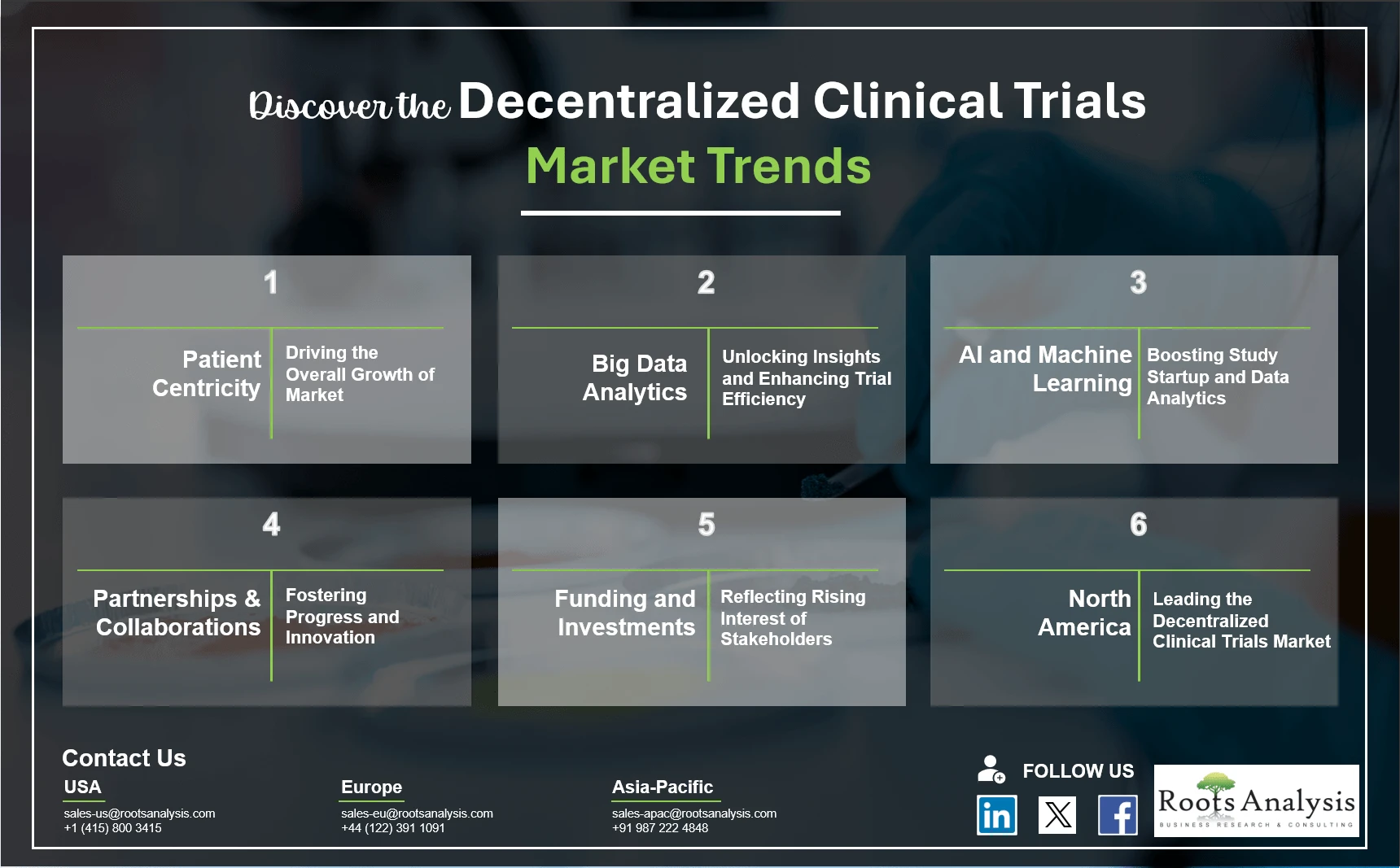
Decentralized Clinical Trials Market Trends and Key Factors Likely to Shape the Market Evolution
1. Patient Centricity: Driving the Overall Growth of Market
A research study demonstrated that patient-centric trials took almost half the time to recruit patients and increased the likeliness of the drug to be launched successfully (by 19%). Such trials aim to make participation journeys for patients as convenient and pleasant as possible. Apart from gaining insights from patients, the approach is focused on meeting patient’s requirements and translating the inputs into products that further improve the outcomes. To strike the right balance between the scientific acumen and feasibility of the conduct for the participants, real-time feedback and standpoint of the patient have also been incorporated in the trial design. This is likely to bring about a paradigm shift in the current decentralized clinical trials market trends, transforming the future landscape of clinical research in the coming years.
2. Big Data Analytics: Unlocking Insights and Enhance Trial Efficiency
As per the decentralized clinical trials market trends, a significant increase in the generation of data for healthcare sector has been observed due to the recent adoption of digital data monitoring and storage devices, and cloud-based applications. Patient-specific data generated through various applications can be used to yield valuable insights associated with the efficiency, deployment and performance of a therapeutic intervention; such insights then can be leveraged in therapeutic research and development initiatives. Further, experts believe that information mined from past medical records can be used to reduce re-admission rates, as well as improve overall performance within the healthcare industry. This decentralized clinical trial market trend is likely to accelerate the overall decision-making process associated with the trials, ultimately leading to more effective and efficient therapeutic developments.
3. Artificial Intelligence and Machine Learning: Boosting Study Startup and Data Analytics
The integration of machine learning and AI in clinical trials has simplified the process of patient enrollment, data analytics and prediction of trial outcomes for decentralized clinical trials. Further, this decentralized clinical trials market trend has enabled the stakeholders to effectively review and screen trial participants in a much shorter time duration (ten minutes). Notably, in 2016, a technology named Deep 6 AI enabled the identification of eligible participants (out of 2.1 million patient records) for a cardiac clinical trial in only a few minutes, which would otherwise have taken approximately 6 months, if done manually. Moreover, with the use of artificial intelligence, stakeholders can easily predict the participants who are likely to receive maximum benefit from the trial based on their genetic and environmental conditions. This indicates several opportunities for the healthcare professionals involved in conducting decentralized clinical trials.
4. Partnerships and Collaborations: Fostering Progress and Innovation
The virtual clinical trials service / platform providers have inked several partnerships with stakeholders engaged in this domain in order to enhance their current portfolios. This reflects the growing interest of pharmaceutical and biotechnology companies in conducting virtual clinical trials. As per the decentralized clinical trials market trends, majority of the deals in the last few years were inked by industry players headquartered in North America. Of these deals, platform / technology utilization agreements emerged as the most prominent type of partnership model. This can be attributed to the incessant efforts of stakeholders to further advance their current portfolios and expedite the development process across various phases of clinical trials. Such partnerships are expected to drive the virtual clinical trials market growth during the forecast period.
5. Funding and Investments: Reflecting Rising Interest of Stakeholders
Decentralized clinical trials market trends reflect that a cumulative amount of around USD 5 billion has been raised by players engaged in the domain, since 2019. This is indicative of the growing interest of players towards adoption of decentralized mode of clinical trials, worldwide.
Notable examples of funding / investments reported in 2024 (in reverse chronological order) include venture capital (series D) raised by Huma, other equity raised by Lightship and debt financing raised by AiCure. It is worth mentioning that foreseeing the growing need to overcome the disadvantages posed by traditional clinical trials, several virtual clinical trials companies are poised to raise capital across various funding rounds, thereby propelling the growth of this industry.
6. North America: Leading the Decentralized Clinical Trials Market
Based on the decentralized clinical trials market trends, North America holds the majority share within the decentralized clinical trials market and this trend is unlikely to change in the foreseen future. Numerous factors contribute to the region’s dominance in the industry, including technological advancements and robust research capabilities. Moreover, the advanced healthcare infrastructure and regulatory landscape in North America enables players to meet the required regulatory guidelines for conducting decentralized clinical trials, leading to their significant growth.
Conclusion
Decentralized clinical trials offer an innovative and novel approach to address several challenges associated with conventional trials, including patient recruitment, retention, travel requirements and data management. Virtual / decentralized clinical trials are more patient-centric, which decreases the number of individuals enrolling out from the trials, ultimately leading to reduced clinical drug development timelines. Consequently, this has also helped in addressing the matter of high capital investments required for the clinical development of pharmaceutical products. Moreover, with such technological advancements, it becomes easier to collect, transfer, and store electronic data and both patients and healthcare professionals are becoming more proficient and relaxed with the use of telemedicine. Considering the current decentralized clinical trials market trends and the rapidly increasing adoption for such trials, the virtual clinical trials market is likely to experience substantial growth in the near future.
Browse our full report on Decentralized Clinical Trials Market:
https://www.rootsanalysis.com/reports/virtual-clinical-trial-service-provides-market.html
Sources