Dental 3D Printing Market Trends: 6 Transformative Advances


Published:
Dental 3D printing is an advanced additive manufacturing process that builds precise dental restorations and models, layer by layer, from digital oral scans of patients and CAD designs using biocompatible resins or materials. It enables the development of customized patient-specific solutions with high accuracy and reduced production times as compared to traditional methods. Further, it offers improved fit, comfort and clinical outcomes by streamlining dental workflows, lowering costs and enhancing treatment planning across restorative, prosthodontics, orthodontics, and surgical applications in modern dental practices. Within these application areas, 3D printers are widely being adopted for production of crowns, bridges, dentures, surgical guides, clear aligners, orthodontic models, implants, temporary restorations, and educational anatomical replicas.
Digital additive manufacturing in dentistry allows production of highly precise dental products by permitting the fabrication of undercuts and lattice structures, that enhance mechanical retention and tissue integration. It enables same-day, chairside production of highly accurate definitive restorations with greater marginal integrity and occlusal precision. Specifically, surgical guides and orthodontic products produced this way enhance procedural predictability and implant positioning accuracy. Moreover, design modifications can be implemented rapidly without compromising structural integrity or biocompatibility standards, resulting in improved prosthesis fit, reduced chairside adjustments and elevated patient comfort.
Looking ahead, the dental sector is likely to witness wider use of AI-driven automation that can optimize tooth design, treatment planning, and printing parameters, enabling highly personalized and precise workflows. Cloud-based systems can facilitate secure data exchange between dental clinics and laboratories, supporting distributed production and seamless collaboration. Sustainable resin formulations and closed-loop recycling technologies are anticipated to reduce material waste while maintaining biocompatibility. Predictive analytics may enhance structural performance optimization, layer designs, and restoration longevity. Further, hybrid additive manufacturing systems combining 3D printing with robotic finishing are expected to enhance surface quality and fit verification. Meanwhile, harmonized regulatory pathways may accelerate global technology adoption and personalized dental care.
Roots Analysis has conducted an exhaustive study on Dental 3D Printing Market featuring the current market landscape and future opportunity for the dental 3D printing products and product providers. In this article, we have highlighted some of the recent trends in dental 3D printing market that are expected to shape the future of dental 3D printing, technologies and treatment approaches.
Want to Explore the Recent Trends in Dental 3D Printing Market?
Recent Trends in Dental 3D Printing Market
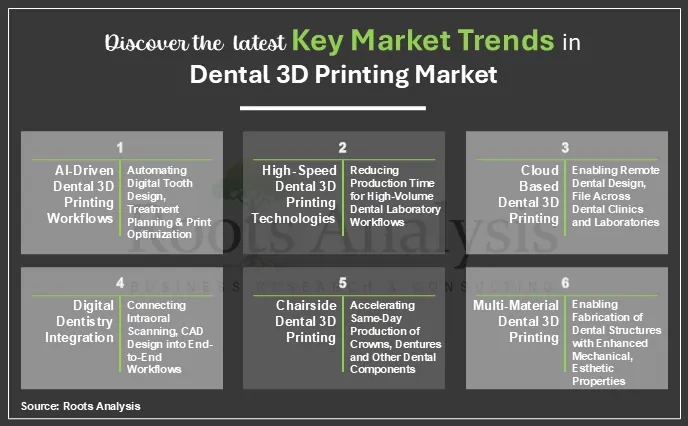
1. AI-Driven Dental 3D Printing Workflows: Automating Digital Tooth Design, Treatment Planning and Print Optimization
The integration of artificial intelligence in dental 3D printing enables greater automation across tooth design, prosthetic geometry generation, and print preparation. AI algorithms can analyze digital tooth morphology and occlusal relationships to generate patient-specific crown and restoration designs, reducing dependence on repetitive manual CAD modeling. These systems can also support automated build-orientation selection, support placement, and slicing parameters to prepare dental designs for more efficient 3D printing. A recent study published in April 2026 demonstrated a deep-learning framework combined with an AI algorithm, NSGA-III, to optimize 3D-printing angles for dental crowns and retainers by reducing support area and printing height.
2. High-Speed Dental 3D Printing Technologies: Reducing Production Time for High-Volume Dental Laboratory Workflows
The growing demand for high-volume dental production is accelerating the development of dental 3D printers with higher build speeds, larger build platforms, and automated material handling. These capabilities allow dental laboratories to produce multiple orthodontic models, denture components, surgical guides, and other dental products within a single print cycle, reducing the number of different machines and time spent in production. Companies and laboratories, processing large batches of patient-specific dental models, where printer throughput directly affects production capacity are employing the use of high-speed printers. For instance, Formslab Dental reports that its 3D dental printer Form 4B can print up to 400 dental models in eight hours. Such developments are encouraging dental laboratories to adopt scalable printer fleets and automated production workflows for continuous dental 3D printing.
3. Cloud-Based Dental 3D Printing: Enabling Remote Dental Design, File Management and Distributed Production Across Dental Clinics and Laboratories
The increasing availability of cloud-based dental 3D printing platforms represents another prominent trend in the dental 3D printing market. Traditionally, dental design files and production workflows were being managed within individual clinics or laboratories, limiting coordination across geographically separated facilities. Emergence of Cloud-based platforms has enabled dentists and dental laboratories to upload, store, review, and transfer intraoral scan files and CAD designs through centralized digital environments. This transition allows dental laboratories to receive production-ready files remotely and allocate manufacturing roles across connected 3D printers according to production capacity and workflow requirements. Such solutions are particularly relevant for dental service networks and laboratory groups managing high volumes of patient-specific crowns, dentures, aligners, surgical guides, and other 3D-printed dental components across multiple locations.
4. Digital Dentistry Integration: Connecting Intraoral Scanning, CAD Design and Dental 3D Printing into End-to-End Workflows
Advances in digital dentistry integration are shifting dental 3D printing workflows from isolated digital steps toward connected, end-to-end production processes. Intraoral scanners can capture patient-specific dentition and occlusal anatomy as digital datasets, which are then transferred directly into dental CAD platforms for designing 3D-printed dental components. This connected workflow reduces the need for physical impressions and manual data transfer while maintaining digital traceability from scanning through design and manufacturing. Further, integration between scanning systems, CAD software, and dental 3D printers is expanding as manufacturers develop interoperable platforms that streamline file transfer and production preparation. Such integration is strengthening the adoption of fully digital workflows across dental clinics and laboratories.
5. Chairside Dental 3D Printing: Accelerating Same-Day Production of Crowns, Dentures and Other Restorative Dental Components
The growing availability of compact, automated chairside 3D printers in dental practices is shifting dental fabrication towards same day production. These systems combine rapid photopolymerization, simplified material loading, and integrated post-processing to reduce the number of steps between digital design and implant placement. This approach is being adopted by product providers that are seeking to fabricate patient-specific restorations without transferring production to an external laboratory. In this context, in June 2026 SHINING 3D Dental launched the Ceramix-Nano, a capsule-based chairside printer that integrates printing and curing and can complete its scan-to-restoration workflow in as little as 30 minutes.
6. Multi-Material Dental 3D Printing: Enabling Fabrication of Dental Structures with Enhanced Mechanical, Esthetic and Functional Properties
The growing demand for dental products with differentiated mechanical, esthetic, and functional characteristics is accelerating the adoption of multi-material 3D printing. Unlike single-resin production, multi-material systems can deposit different dental materials on the build platform, allowing rigid, flexible, transparent, or tooth-colored regions to be incorporated into a digitally designed structure. This capability reduces the assembly requirements of anatomical structures with different material properties. For instance, 3D Systems’ NextDent Jetted Denture Solution uses multiple materials in a single printing process to fabricate monolithic dentures with tooth and base regions. Such developments are expanding the role of multi-material printing in digitally manufactured dental prostheses.
Conclusion
These six trends in the dental 3D printing market reflect the industry's transition toward connected, automated, and increasingly scalable digital manufacturing. AI-driven design reduces manual CAD effort, while high-speed systems are increasing laboratory throughput and chairside printing is enabling faster in-office fabrication. Integration of intraoral scanning, CAD, and 3D printing is creating continuous digital workflows, while cloud platforms are connecting dental practices and laboratories for remote production management. Multi-material printing is further expanding fabrication capabilities by combining distinct material properties within digitally designed dental structures. Collectively, these developments are strengthening digital manufacturing capabilities across dental clinics and laboratories, with future innovation likely to focus on greater automation, interoperability, production speed, and material versatility.
Browse our full report on Dental 3D Printing Market: https://www.rootsanalysis.com/reports/dental-3d-printing-market.html
Sources:
- https://www.sciencedirect.com/science/article/abs/pii/S0022391326002027
- https://www.taylorfrancis.com/chapters/edit/10.1201/9781042016075-63/3d-printing-new-era-hands-learning-conservative-dentistry-endodontics-narrative-review-heta-vaghasia-kundabala
- https://www.sciencedirect.com/science/article/abs/pii/S0300571226000400
- https://www.sciencedirect.com/science/article/abs/pii/S0109564126000618