Top 5 ADC Linker Technologies

.png)

Published: August 2026
Antibody drug conjugate (ADC) linker technologies critically influence therapeutic index, payload release kinetics, and clinical safety, making them a cornerstone of precision oncology. Advanced cleavable linkers (protease-sensitive, acid-labile, and disulfide) enable tumor-selective activation and bystander effect, while non-cleavable linkers provide exceptional plasma stability and reduced systemic toxicity, both essential for optimizing patient outcomes across hematologic and solid tumors.
Precision in site-specific conjugation and defined drug-to-antibody ratio (DAR) produces homogeneous ADCs with predictable pharmacokinetics and manufacturability. Spacer chemistry, hydrophilicity tuning, and cleavage-rate engineering optimize tumor penetration, circulation half-life, and intracellular release, enabling payload selection ranging from microtubule inhibitors to DNA-damaging agents, and facilitating combination regimens with immuno-oncology agents.
Market demand favors next-generation linkers featuring modular chemistries, dual-trigger mechanisms, and reversible or programmable release to expand indications and reduce adverse events. Robust linker R&D and scalable manufacturing are key commercial differentiators, offering developers opportunities to capture growth in the ADC market, accelerate regulatory approvals, and deliver targeted therapeutics that advance precision oncology.
Roots Analysis has conducted an exhaustive study on ADC Technology Market featuring the current market landscape and future opportunities for the companies engaged in healthcare, over a span of next 9 years.
ADC Linker Technologies
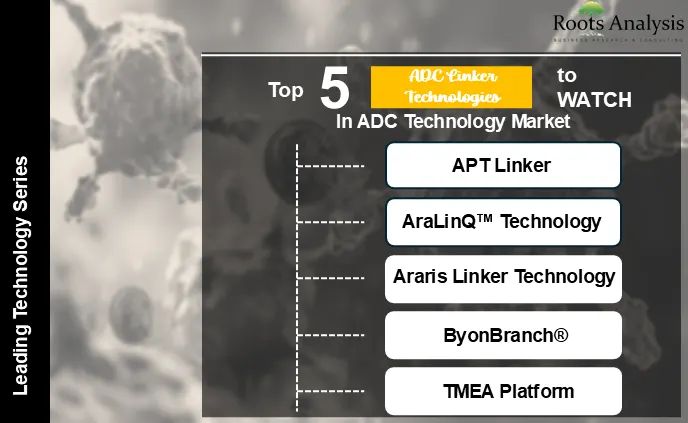
- APT Linker
- AraLinQ™ Technology
- Araris Linker Technology
- ByonBranch®
- TMEA Platform
The figure below highlights the ADC linker technologies:
Interested in exploring all 130+ ADC linker technologies, along with their developers?
Discover Below the Details on the ADC Linker Technologies
Let us dive deep into the details of the ADC linker technologies. It is essential to note that the selection of technologies can differ substantially according to the defined criteria.
1. APT Linker
APT linker is a proprietary protein-conjugation / linker platform of Advanced Proteome Therapeutics, designed to attach drugs, toxins, or other payloads to antibodies or proteins in a controlled manner. The section below provides information on the various parameters, with details on list of developer, type of technology, site specificity, and type of linker.
- Developer: Advanced Proteome Therapeutics
- Type of Technology: Linker Technology
- Site Specificity: Non-site Specificity
- Type of Linker: Cleavable
To know more about the recent initiatives of Advanced Proteome Therapeutics, access full report.
2. AraLinQ™ Technology
AraLinQ™ is Araris Biotech’s proprietary ADC linker-conjugation platform for making antibody-drug conjugates more precise, stable, and scalable. It is designed to attach one or multiple payloads to standard antibodies in a one-step process, without needing custom antibody engineering. The section below provides information on various parameters, with details on list of developer, type of technology, status of technology, availability of licensing, site specificity, type of conjugation, and nature of linker.
- Developer: Araris Biotech (a spin-off company from the Paul Scherrer Institute (PSI) and ETH Zurich)
- Type of Technology: Linker Technology
- Status of Technology: Patented / Proprietary
- Availability of Licensing: Yes
- Site Specificity: Site-specific
- Type of Conjugation: Enzymatic
- Nature of Linker: Dual-cleavage linker Platform / Multi-payload Technology
Recent Developments
In April 2026, the company along with Taiho Oncology announced that the U.S. Food and Drug Administration (FDA) has completed its Investigational New Drug (IND) review period for ARC-02, a CD79b-protein-targeting ADC based on Araris' proprietary AraLinQTM technology. Notably, this drug candidate is being developed for the treatment of non-Hodgkin lymphoma.
To know more about the recent initiatives of Araris Biotech, access full report.
3. Araris Linker Technology
It is an ADC platform designed to attach drug payloads to native, off-the-shelf antibodies in a site-specific, one-step process without re-engineering the antibody first. That makes the resulting antibody-drug conjugates more uniform, more stable, and easier to manufacture. The section below provides information on various parameters, with details on list of developer, type of technology, status of technology, availability of licensing, generation of technology, site specificity, type of conjugation, drug antibody ratio, conjugation chemistry, and conjugation site.
- Developer: Araris Biotech (a spin-off company from the Paul Scherrer Institute (PSI) and ETH Zurich)
- Type of Technology: Linker Technology
- Status of Technology: Patented / Proprietary
- Availability of Licensing: Yes
- Generation of Technology: Third Generation
- Site Specificity: Site-specific
- Type of Conjugation: Enzymatic
- Drug Antibody Ratio: DAR 2-4
- Conjugation Chemistry: Transpeptidation Using Enzymes
- Conjugation Site: Endogenous
Recent Developments
In February 2026, Araris Biotech and Chugai Pharmaceutical announced that Chugai has exercised its option under the research collaboration and option to license agreement previously announced by Araris in 2025. The exercised option grants the latter company a license to Araris’ proprietary AraLinQ® linker-payload platform for the generation of novel ADCs against one target selected by Chugai.
To know more about the recent initiatives of Araris Biotech, access full report.
4. ByonBranch®
ByonBranch® is a branched linker design that enables coupling of cytotoxic payloads to antibodies while distributing payload mass to lower overall hydrophobicity of the ADC molecule. The section below provides information on various parameters, with details on list of developer, type of technology, status of technology, and site specificity.
- Developer: Byondis
- Type of Technology: Linker Technology
- Status of Technology: Patented / Proprietary
- Site Specificity: Site-specific
Recent Developments
In April 2026, Byondis presented data from its novel ADC technology platforms at the American Society for Cancer Research Meeting 2026.
To know more about the recent initiatives of Byondis, access full report.
5. TMEA Platform
TMEA (Tumor MicroEnvironment Activated) platform is the core proprietary technology developed by Affinity Biopharma, a clinical-stage Chinese biopharma company focused on innovative anti-cancer drugs. TMEA is designed to selectively activate drugs in the tumor microenvironment (TME). It uses proprietary linkers and activation mechanisms to release the active payload primarily inside or around the tumor.
The section below provides information on various parameters, with details on list of developer, type of technology, site specificity, type of conjugation, drug antibody ratio, and type of linker.
- Developer: Affinity Biopharma
- Type of Technology: Linker Technology
- Site Specificity: Non-site Specific
- Type of Conjugation: Chemical
- Drug Antibody Ratio: DAR 8
- Type of Linker: Cleavable
To know more about the recent initiatives of Affinity Biopharma, access full report.
What About Other ADC Linker Technologies Around the World?
The above article features the ADC linker technologies selected from a pool of over 130 ADC linker technologies that we have compiled. If you're interested, you can download the Sample Report on this topic by Roots Analysis. For personalized assistance in identifying the most relevant solutions based on your specific criteria, please don't hesitate to reach out to us at sales@rootsanalysis.com.
Sources:
- https://www.businesswire.com/news/home/20260417253206/en/Byondis-to-Present-Data-from-its-Novel-ADC-Technology-Platforms-at-the-American-Society-for-Cancer-Research-Meeting-2026
- https://www.chugai-pharm.co.jp/english/news/detail/20260210173000_1227.htm
- https://www.taiho.co.jp/en/release/2026/20260428.html