Market Trends in Targeted Drug Delivery 2024

.png)

Published: March 2025
The industry is increasingly shifting towards biologics over traditional small molecule drugs due to their higher specificity and efficacy in treating complex diseases, particularly through targeted drug delivery devices. Despite the growing popularity due to various benefits offered, biologics presents significant challenges, including drug delivery-related complexities and immunogenicity concerns, which can lead to systematic toxicity following administration.
To overcome these challenges, the pharmaceutical industry is focusing on the development of targeted drug delivery devices aimed at improving the therapeutic safety index and enhancing the delivery of therapies to the targeted site. Additionally, these devices simplify the administration of therapies that are otherwise difficult to deliver to hard-to-reach organs in the human body.
With the growing adoption of these devices and ongoing advancements the global targeted drug delivery device market is likely to grow, in the foreseen future.
Roots Analysis has conducted an exhaustive study on Targeted Drug Delivery Device Market featuring the current market landscape and future opportunity for the companies engaged in developing these devices. In this article, we have highlighted some of the latest market trends in targeted drug delivery devices that are likely to shape the evolution of overall market.
Want to explore the market trends in targeted drug delivery devices and the competitive landscape?
LATEST ADVANCEMENTS IN TARGETED DRUG DELIVERY DEVICE MARKET
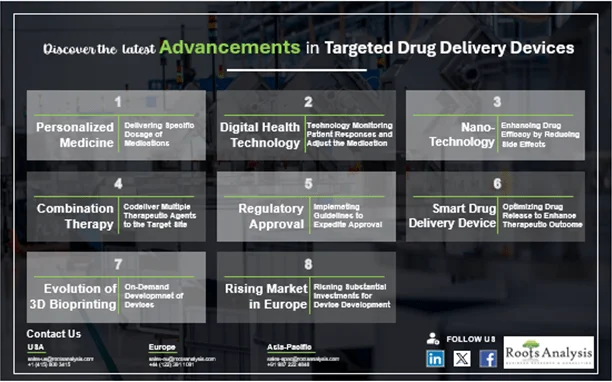
1. GROWING DEMAND FOR PERSONALIZED MEDICINES
With the ongoing shift towards personalized treatment approaches in healthcare, there is a growing need for drug delivery devices that can cater to individual patient profiles. These devices enhance treatment outcomes by delivering precise dosages of medications directly to specific organs, thereby improving therapeutic efficacy and patient compliance. Further it is worth highlighting that Johnson & Johnson has entered into strategic agreements with Roche and Illumina in order to ensure that diagnostic tests are available concurrently with new therapies, thereby optimizing the targeted delivery of personalized treatments to the patients.
2. INTEGRATION WITH DIGITAL HEALTH TECHNOLOGIES
The integration of digital health technologies with targeted drug delivery systems is becoming a significant trend. The integration involves connected devices that monitor patient responses and adjust the medication delivery, accordingly, thereby leading to better management of chronic diseases and improved patient outcomes through real-time data analysis. Additionally, Aptar Digital Health is working with SHL Medical to integrate targeted drug delivery devices with digital health technologies. Their main focus is to enhance the patient’s experience for self-injectable therapies by combining SHL Medical's advanced drug delivery systems, such as autoinjectors, with Aptar Digital Health's Software as a Medical Device (SaMD) platform.
3. ADVANCEMENTS IN NANOTECHNOLOGY AND BIOTECHNOLOGY
Advancements in nanotechnology and biotechnology are revolutionizing the market by enabling precise targeting of therapeutics to specific cells or tissues. The development of innovative nanomaterials enhances drug efficacy by reducing systemic side effects, as these materials specifically bind to cancer biomarkers and can be used across various therapeutic areas, from oncology to chronic disease management. Presently, AstraZeneca is actively developing lipid nanoparticles as vehicles for the intracellular delivery of nucleotide-based therapeutics. Their collaborative efforts across academia and industry focus on overcoming barriers to deliver new drug modalities for targeted drug deliveries.
4. INCREASED ADOPTION OF COMBINATION THERAPIES
Combination therapies present a significant market opportunity for targeted drug delivery device developers, particularly in the treatment of complex diseases such as cancer. By utilizing multiple therapeutic agents, these therapies enhance efficacy and minimize side effects, lowering the dose of individual drugs, while maintaining therapeutic effectiveness. By precisely co-delivering multiple therapeutic agents to the target site, developers can unlock the potential of combination therapies across various diseases.
5. RISING REGULATORY AND MARKET APPROVALS
As targeted drug delivery systems evolve and integrate more closely with digital health tools, the regulatory framework is adapting to maintain safety and efficacy. The approval process for combination products and advanced delivery systems is becoming more efficient. Regulatory bodies, such as the FDA, are working on new guidelines to expedite the approval of these advanced devices while ensuring their safety and dependability in clinical settings.
6. EMERGENCE OF SMART DRUG DELIVERY SYSTEMS
Smart drug delivery systems utilize advanced materials that can respond dynamically to physiological conditions. For example, stimuli-responsive hydrogels can release their drug payloads in response to changes in temperature, light, or biochemical signals, ensuring that medication is delivered precisely when and where it is needed. This technology enhances therapeutic outcomes by optimizing drug release profiles and minimizing side effects. A group of researchers at National University of Singapore have reengineered Saccharomyces cerevisiae as smart drug delivery system, with the aim to deliver drugs based on health signals.
7. EVOLUTION OF 3D BIOPRINTING IN DRUG DELIVERY DEVICES
3D bioprinting is an innovative manufacturing technique that utilizes human tissues to fabricate 3D structures. In targeted drug delivery devices this technology enables the precise administration of drugs tailored to the specific needs of patients, such as personalized dosages. It allows for the on-demand creation of devices that can release drugs at controlled rates, thereby improving treatment effectiveness and enhancing patient convenience. Recently, CELLINK has engaged in multiple partnerships to advance personalized medicine through 3D bioprinting. They are working with researchers to develop bio printed cardiac patches that deliver drugs to targeted sites.
8. EMERGING MARKET IN EUROPE
The market for targeted drug delivery devices in Europe is likely to grow at a faster pace in the coming years. This can be attributed to a combination of factors, including a large geriatric population, substantial investments in R&D, and increasing patient awareness about advanced drug delivery technologies. This allows more precise drug targeting and reduced side effects, leading to better treatment outcomes for patients.
CONCLUSION
The 8 latest advancements with the growing trends towards targeted drug delivery. Over the years, these devices have demonstrated significant potential by offering enhanced efficacy, improved patient compliance, overcoming biological barriers and optimizing biologics delivery. The growing need for personalized medicine across the globe has encouraged them to adopt such devices over conventional drug delivery systems. Owing to these advantages, companies are continuously developing these devices which have the capability to improve drug efficacy and safety by controlling the time, rate, and location of drug release in the body. Such drug delivery devices improve patient compliance and help to achieve the desired therapeutic effect.
Pharmaceutical industry is focusing on the development of targeted drug delivery devices aimed at improving the therapeutic safety index and enhancing the delivery of therapies to the targeted site. Additionally, these devices simplify the administration of therapies that are otherwise difficult to deliver to hard-to-reach organs in the human body. Hence, considering these benefits stakeholders are shifting their focus towards these devices to enhance the efficacy of biologic therapies and overall patient outcomes.
Browse our full report on Targeted Drug Delivery Device Market: https://www.rootsanalysis.com/reports/targeted-drug-delivery.html#overview
Sources
https://www.synbiobeta.com/read/bioengineered-yeast-are-the-future-of-drug-delivery
https://medicine.nus.edu.sg/news/bioengineered-yeast-microbes-as-targeted-drug-delivery-systems/