Medical Device Coating Industry Trends and Analysis

.png)

Published: November 2025
The medical device industry has recently experienced significant advancements, including the integration of improved tools and technologies. Moreover, the incorporation of artificial intelligence and machine learning, has boosted progress in the digital health sector and accelerated the use of biomedical devices like orthopedic implants, surgical instruments, and prosthesis. Every year, millions of people undergo surgeries and receive implanted medical devices, especially for implantable and prosthesis.
Although, there are a number of challenges associated with medical devices, including the risk of healthcare-associated infections (HAIs), implant rejection, osseointegration, degradation and wear, and loom over the prosthetic integration. Therefore, the medical device industry has recently witnessed a rise in the adoption of medical device coating solutions as a method to control these challenges. Medical device coatings provide properties such as biocompatibility, lubrication, anti-fouling nature, along with enhanced durability to the surface of the device.
Besides the above challenges, one of the other challenges associated with in-dwelling medical devices is their constant interaction with bodily fluids, including a wide variety of proteins and other biomolecules. This results in denaturization of biomaterials over time, thereby reducing the overall functional life of the device. As a counter to this problem, surface modifications can be utilized. Modifying the surface chemistry, water adhesion, or the surface layout has been shown to significantly influence protein adsorption and biological interaction with the device surface. Surface modifications, such as plasma spraying, vacuum depositions, etching, and electro-depositions, are some of the preferred procedures to achieve the necessary alterations on the wearable medical device surfaces.
With the growing adoption of surface coatings for medical devices and ongoing advancements in the surface modification technologies, the medical device coating market is likely to grow, in the foreseen future.
In May 2025, Surface Solutions announced the expansion of its production capacity through the addition of automated electrostatic robotic coating lines, so as to meet the growing demand from the MedTech customers across the globe.
Roots Analysis has conducted an exhaustive study on Medical Device Coating Market featuring the current market landscape and future opportunity for the companies engaged in providing medical device coatings, till 2035. In this article, we have highlighted some of the latest medical device coating industry trends that are likely to shape the evolution of medical device coating market.
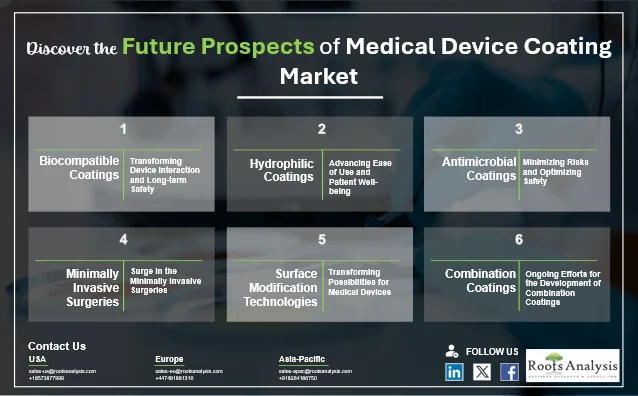
Want to explore the latest Medical Device Coating industry trends?
Latest Trends in Medical Device Coatings that Are Likely to Shape the Medical Device Coating Market
1. Biocompatible Coatings: Transforming Device Interaction and Long-term Safety
Biocompatible coatings represent a significant development in the medical device coating market by minimizing adverse reactions and ensuring the long-term safety and effectiveness of medical devices, particularly implants. They act as a barrier between the device and the body, allowing for a more favorable interaction and promoting tissue integration.
2. Hydrophilic Coatings: Advancing Ease of Use and Patient Well-being
Hydrophilic coatings are applied to medical devices to enhance their performance and patient comfort by creating a lubricious, water-attracting surface that reduces friction during insertion and movement through the body. These coatings make devices like catheters, guidewires, and stents more easily maneuverable and reduce the risk of tissue damage and discomfort; examples of key developers include Aculon, Biocoat, Freudenberg Group and Harland Medical Systems.
3. Antimicrobial Coatings: Minimizing Risks and Optimizing Safety
Antimicrobial coatings for medical devices are designed to prevent or reduce the growth of microorganisms on device surfaces, minimizing the risk of infections and improving hygiene. These coatings are applied to various medical devices like catheters, surgical instruments, and implantable devices. They offer benefits such as reducing healthcare-associated infections (HAIs), extending the lifespan of medical devices, and lowering the need for antibiotics. It is worth mentioning that AST Products, BioInteractions and Curtiss-Wright offers antimicrobial coatings.
4. Surge in the Minimally Invasive Surgeries
The increasing trend of minimally invasive surgeries (MIS) is driving the need for specialized medical device coatings. MIS procedures, which involve smaller incisions and reduced trauma, are becoming more popular due to their benefits such as faster recovery times and less pain. This surge in MIS is boosting the demand for coatings that enhance device performance, biocompatibility, and patient comfort.
5. Transforming Possibilities: Surface Modification Technologies in Medical Device Coatings
Surface modification technologies in medical device coatings aim to enhance durability and functionality, often by altering the surface properties of materials used in implants and other medical devices. These modifications can improve properties like lubricity, antimicrobial resistance, and cell adhesion, which also enhance corrosion resistance and stress resistance. Various techniques, including plasma treatments, chemical vapor deposition (CVD), and physical vapor deposition (PVD), are employed to achieve these improvements.
6. Ongoing Efforts for the Development of Combination Coatings
Combination coatings for medical devices involve layering or integrating multiple functionalities into a single coating to enhance performance and address specific needs. These coatings can improve biocompatibility, reduce friction, provide antimicrobial protection, and offer long-term stability. Emerging technologies for medical implants include antifouling surfaces that prevent biofilm formation, superhydrophobic coatings that repel fluids and reduce corrosion, and diamond-like carbon (DLC) coatings offering wear resistance and antimicrobial properties. These promising technologies represent significant opportunities for innovation and growth within the medical device coating market.
Conclusion
In recent years, medical device coatings have shown great promise by advancing safety and performance of medical devices. Globally, the growing prevalence of chronic diseases, technological advancements, and increasing focus on reducing hospital acquired infections has further encouraged the utilization of these coatings.
Additionally, the adverse reactions to medical devices and their low shelf life has propelled the demand for advanced medical device coatings. Consequently, innovations in biocompatible coatings are ensuring seamless device integration and long-term acceptance and hydrophilic coatings are revolutionizing patient comfort and device maneuverability by reducing friction. Concurrently, antimicrobial coatings are vital in combating healthcare-associated infections, improving device durability and reducing antibiotic reliance. This evolution is further propelled by the surge in minimally invasive surgeries, demanding higher performance and more specialized coatings.
Looking ahead, surface modification technologies and the development of combination coatings promise to unlock unprecedented functionalities, paving the way for safer, more effective, and durable medical devices that ultimately improve patient outcomes and redefine healthcare delivery.
These breakthrough innovations lay the foundation to address the immediate need for developing innovative solutions for medical devices. Further, it is worth mentioning that the introduction of state-of-the-art surface modification technologies has paved the way for safer, more effective, and durable medical devices that ultimately improve patient outcomes and redefine healthcare delivery. Given the growing adoption of medical coatings due to their ease of application, superior antimicrobial efficacy and promising biocompatibility, the medical device coating industry is anticipated to witness steady growth in the coming decade.
Browse our full report on Medical Device Coating Market: https://www.rootsanalysis.com/reports/medical-device-coatings-market.html#overview