Medical Device Contract Manufacturing Industry Trends

.png)

Published: May 2026
Owing to the cumbersome nature of product manufacturing, a rapidly evolving regulatory environment and complex supply chain networks, it is difficult for medical device developers to carry out product manufacturing operations in-house. Further, the establishment of dedicated manufacturing facilities for complex medical devices requires significant capital investment, a highly regulated / controlled environment, and skilled personnel. As a result, the medical device developers seek to outsource their manufacturing operations to contract service providers. Currently, there are several contract manufacturing firms that claim to offer specialized solutions to cater to the various device development and manufacturing needs of innovator companies. In addition to providing a wide range of services, other advantages offered by contract manufacturing organizations (CMOs) include medical device companies to efficiently manage project costs and product launch timelines, diminishing development risks and offering elaborate technical expertise to support the development of high quality, specialty products.
Roots Analysis has conducted an exhaustive study on Medical Device Contract Manufacturing Market featuring the current landscape and future opportunity for the companies engaged in the medical device contract manufacturing domain. In this article, we have highlighted some of the trends in medical device contract manufacturing industry that are likely to shape the evolution of MedTech sector during the forecast period.
Want to explore more about Medical Device Contract Manufacturing Market?
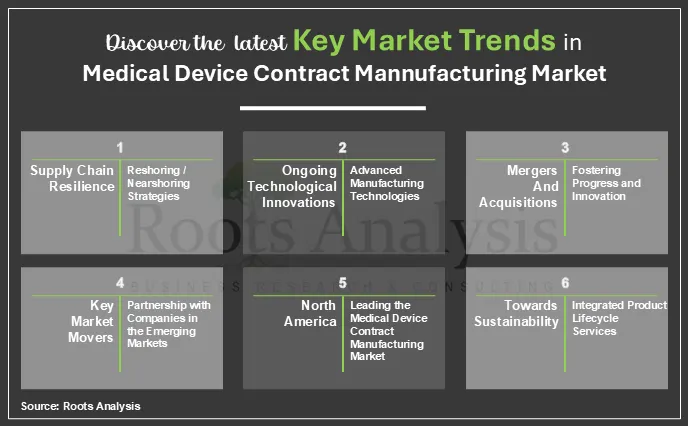
Medical Device Contract Manufacturing Industry Trends that are Likely to Shape the Future Potential of the Industry
1. Supply Chain Resilience: Reshoring / Nearshoring Strategies
The supply chain fragility in the medical device contract manufacturing domain, driven by over reliance on distant offshore suppliers and exposure to geopolitical, logistical, and regulatory disruptions, is prompting OEMs and CMOs to adopt reshoring and nearshoring strategies. By relocating or diversifying production closer to key markets, the medical device contract manufacturers are aiming to shorten lead times, strengthen quality oversight and enhance responsiveness to demand fluctuations or disruptions. At the same time, companies are integrating reshoring and nearshoring with supplier diversification, risk based vendor assessments, and digital platform driven supply chain visibility to build more agile and secure medical device supply networks.
2. Ongoing Technological Innovations: Advanced Manufacturing Technologies
The medical device contract manufacturing domain is undergoing a profound transformation through the rapid integration of Industry 4.0 technologies, including artificial intelligence (AI), robotics, machine learning, and additive manufacturing. These advancements enable contract manufacturers to achieve higher precision in complex assembly processes, real-time quality monitoring, predictive maintenance and rapid prototyping of patient-specific components, significantly reducing production costs and lead times while improving scalability for low-volume, high-mix production runs.
3. Mergers and Acquisitions: Fostering Progress and Innovation
In order to maintain a competitive edge, contract service providers are rapidly expanding their capabilities to offer multiple services, ranging from design development, manufacturing to post-market services of the final product. In addition, CMOs are actively trying to expand their service portfolio by acquiring the necessary infrastructure and expertise related to non-core services, such as product design and packaging, in addition to manufacturing. As a result, the domain has witnessed enhanced merger and acquisition activity to offer end-to-end solutions. Notably, in January 2026, NAMSA announced the acquisition of Early Development medical device testing business of Labcorp aimed to strengthen their services for the development and manufacturing of medical devices.
4. Key Market Movers: Partnership with Companies in the Emerging Markets
The design and manufacturing operations of medical devices are relatively complex as these demand highly advanced skills, relevant experience and knowledge. The emerging markets, such as China and India, act as a talent pool of skilled professionals required for the development of medical devices. It is important that medical device companies establish their footprint within emerging markets in order to expand their distribution network. Moreover, the establishment of innovation hubs in emerging markets enables MNCs to operate an autonomous company that helps them to gain deep market insights about the region.
5. North America: Leading the Medical Device Contract Manufacturing Market
Currently, North America captures majority (~45%) of the market share as per the medical device contract manufacturing industry analysis. This can be attributed to the presence of major market players, high healthcare expenditure, favorable patient demographics and a robust regulatory framework in North America. Further, the companies headquartered in the US are actively entering into mergers / acquisitions to further strengthen their capabilities. In January 2026, AbbVie, a US-based company acquired the manufacturing facility of West Pharmaceutical Services, to further strengthen its drug delivery device manufacturing capabilities and broaden access to the growing MedTech industry.
6. Towards Sustainability: Integrated Product Lifecycle Services
In the past few years, the medical device contract manufacturers have shifted their focus towards optimizing material utilization, implementing closed loop recycling, and shifting to recyclable or sustainable packaging to reduce environmental footprint while maintaining product quality and regulatory compliance. At the same time, these companies are strengthening sustainable supply chain governance by engaging suppliers that adhere to ESG standards and environmental certifications. These initiatives not only support corporate sustainability commitments and investor expectations but also help OEMs meet evolving regulatory and market demands for responsible manufacturing.
Conclusion
In this rapidly evolving environment, factors such as rising stringency in regulatory guidelines and cost fluctuations have compelled several companies to reshape their manufacturing strategies. Medical device manufacturing companies are increasingly outsourcing several operations to CMOs, owing to the various benefits offered, including enhanced capabilities, turn-key solutions and wide range of services. It is important to highlight that outsourcing to CMOs has increased significantly in the areas of orthopedics, cardiology and neurology. The penetration of CMOs within the industry is anticipated to expand further, driven by the dependence of small manufacturers on outsourced production and sponsors’ early-stage collaboration with CMOs during product design and development.
Browse our full report on Cancer Biologics Market: https://www.rootsanalysis.com/reports/medical-device-contract-manufacturing-market/258.html
Sources:
- https://www.cadenceinc.com/future-of-medical-device-manufacturing-is-changing/
- https://www.prnewswire.com/news-releases/namsa-announces-strategic-acquisition-of-select-assets-of-the-early-development-medical-device-testing-business-of-labcorp-302655606.html
- https://pharma-dept.gov.in/sites/default/files/Final%20Boosting%20of%20Medical%20Devices%20Industry%20-%20Report%20-%202023.pdf