Microbial Fermentation CMO Market Trends

.png)

Published: May 2026
Biopharmaceuticals represent one of the key therapeutic modalities in the modern healthcare industry, given their therapeutic potential and favorable safety profiles. Driven by several blockbuster products and burgeoning pipelines, biologics have become a key focus area for stakeholders in the pharmaceutical industry. Manufacturing of biologics, such as proteins, peptides, antibodies, enzymes, hormones and growth factors require an appropriate expression system. Notably, several types of microbes have been identified as versatile biomolecule expression systems. This can be attributed to the robustness of these microbial cell lines (compared to cells of higher eukaryotes), rendering them a popular choice for biopharmaceutical manufacturing. Moreover, the incremental evolution of the concept of microbial fermentation has driven significant advancements in microbe-based manufacturing technologies, aligning with emerging microbial fermentation CMO market trends in development and process optimization.
Presently, there are a number of traditional and innovative microbial expression systems / platforms, based on bacteria, fungi and yeast, which are used for manufacturing a variety of conventional and complex biologics, specifically smaller biologics such as cytokines, growth factors, plasmid DNA, nucleic acids, single-domain antibodies, peptibodies and non-glycosylated antibody fragments.
Given the rising demand for microbial fermentation products, along with the rise in partnerships and collaborations, and expansion activity, the microbial fermentation CMO market is likely to experience substantial growth in the coming years.
Roots Analysis has conducted an exhaustive study on Microbial Fermentation CMO Market trends featuring the current market landscape and future opportunity for the companies engaged in offering services for microbial fermentation contract manufacturing, till 2035. In this article, we have highlighted some of the latest microbial fermentation CMO industry trends that are likely to shape the evolution of the market.
Want to explore the latest Microbial Fermentation CMO Market Trends??
Latest Microbial Fermentation CMO Market Trends that are Likely to Shape the Market
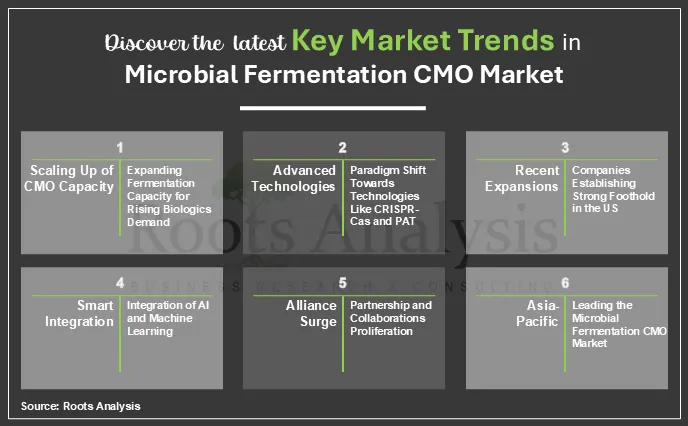
1. Scaling Up of CMO Capacity: Expanding Fermentation Capacity for Rising Biologics Demand
The expansion of contract manufacturing organization (CMO) capacity is becoming a critical priority as demand for biologics continues to surge. Microbial fermentation platforms are being rapidly scaled to support the production of recombinant proteins, enzymes, and other complex biologics. CMOs are investing in larger bioreactors, modular facilities, and advanced process optimization technologies to enhance throughput and flexibility. This capacity build-out is also driven by the need to reduce time-to-market and accommodate diverse client pipelines. At the same time, partnerships between biotech firms and CMOs are intensifying, enabling more efficient resource utilization and risk sharing. As a result, expanded fermentation capabilities are positioning CMOs as key enablers in meeting the growing global demand for biologics.
2. Advanced Technologies: Paradigm Shift Towards Technologies Like CRISPR- Cas and PAT
The adoption of advanced technologies, such as CRISPR-Cas editing, single-use bioreactors, process analytical technology (PAT), real-time monitoring, continuous manufacturing and AI-driven fermentation by contract manufacturers ensures process efficiency, traceability, and real-time quality control. Further, such advancements allow contract manufacturers to efficiently produce highly complex therapeutics, thereby helping them become a strong player in this highly competitive landscape. Moreover, these new technologies would help drug developers to meet the demand for this rapidly evolving industry with improved legislation and regulation.
3. Recent Expansions: Companies Establishing Strong Foothold in the US
According to recent microbial fermentation CMO market trends, several contract manufacturing organizations (CMOs) are expanding their local presence in the US to better serve the growing biologics market. These expansions are aimed at strengthening domestic supply chains, reducing dependency on overseas manufacturing, and improving responsiveness to client needs. Companies are investing in new fermentation facilities, upgrading existing sites, and establishing innovation hubs to support advanced biologics production. Overall, these expansions reflect a broader trend toward building resilient and scalable biologics manufacturing ecosystems within the US. Examples of players that have undergone a local expansion in the US include (in reverse chronological order) AGC Biologics (Facility Expansion), List Biological Laboratories (Capacity Expansion), VGXI (Facility Expansion) and Aldevron (Capacity Expansion).
4. Smart Integration: Intrgration of AI and Machine Learning
The integration of artificial intelligence and machine learning in microbial fermentation has significantly resulted in enhanced efficiency, quality, and agility across various processes. These technologies enable real-time process monitoring, predictive maintenance, and automated quality control, which thereby reduces the downtime and minimizes the defects in biopharmaceutical production. This helps in improving the overall yield of the product. Additionally, AI-driven data analytics also helps in ensuring smoother operations by anticipating equipment failures and streamlining supply chain logistics at an early stage. Due to these reasons, AI in Drug Discovery field is emerging in recent trends. Therefore, these technological integrations provide several opportunities for the CMOs involved in microbial fermentation CMO domain.
5. Alliance Surge: Partnerships and Collaborations Proliferation
Over the years, several microbial fermentation contract manufacturers have signed partnerships with different stakeholders in the industry to expand their service portfolio, gain additional capabilities and increase visibility in this domain. Notably, ~50 partnership and collaboration agreements are signed since 2020. For instance, Recipharm signed a partnership agreement with Infant Bacterial Therapeutics in December 2025.
6. Asia-Pacific: Leading the Microbial Fermentation CMO Market
Currently, Asia-Pacific captures majority (>40%) of the market share in the microbial fermentation CMO market trends. This can be attributed to well-established microbial fermentation CMO market, along with robust infrastructure and significant investments in research and development of manufacturing technologies within this region. Additionally, Asia-Pacific has a substantial demand for both generic and specialty drugs, which further drives the growth.
Conclusion
The microbial fermentation CMO market trends are moving toward a more innovative and efficient future as technology advances and the demand for new therapies grows. In this changing environment, CMOs are adapting to major industry trends, such as personalized medicine, precision therapeutics, continuous manufacturing, supply chain optimization, and digital health integration. At the same time, rising expectations for sustainability is pushing them to adopt greener manufacturing methods, while strict regulatory compliance and strong quality assurance remain essential. Driven by these initiatives, CMOs are expected to play an increasingly important role in shaping the future of healthcare.
Browse our full report on Microbial Fermentation CMO Market trends: https://www.rootsanalysis.com/reports/microbial-contract-biomanufacturing-market.html
Sources:
1. https://www.pharmasalmanac.com/articles/choosing-the-right-expression-platform-for-biologics
2. https://pmc.ncbi.nlm.nih.gov/articles/PMC11917392/