OSD Pharmaceutical Manufacturing Trends

.png)

Published: July 2026
The oral solid dosage (OSD) manufacturing landscape is undergoing a rapid and strategic transformation, driven by the industry's need for greater efficiency and patient-centricity. Conventional tablet and capsule production are now evolving through a combination of advanced manufacturing technologies, digital integration and expanding global capacity. Manufacturers are increasingly adopting continuous manufacturing to overcome long development cycles, scale-up risks and batch to batch variability. At the same time, the growing integration of digital tools, including automation, real-time analytics and AI-enabled monitoring is reshaping the way of designing and producing oral solid dosage forms.
A parallel shift towards patient-centric dosage formats, such as chewable tablets, orally disintegrating systems, and modified-release technologies, is pushing manufacturers to build more facilities designed for flexible and specialty applications. This transformation reflects a broader move to enhance patient compliance, improve bioavailability and align dosage forms with diverse demographic needs, including pediatric and geriatric populations.
This evolving demand pattern has also triggered a surge of expansion initiatives across the world, with CDMOs and pharma companies investing heavily in new OSD sites, pilot-scale development centers and high-throughput production lines. A significant portion of these expansions include new facility construction, technology upgrades, continuous manufacturing readiness and enhanced high-potency handling capability.
Overall, the combination of technological modernization, patient-centric product innovation and global capacity expansion is redefining the future of OSD pharmaceutical manufacturing trends.
Roots Analysis has conducted an exhaustive study on Oral Solid Dosage Contract Manufacturing Market featuring the current landscape and future opportunity for the companies engaged in OSD manufacturing domain. In this article, we have highlighted OSD pharmaceutical manufacturing trends and key factors that are likely to shape the evolution of this sector.
Want to Explore the Competitive Landscape, Technological Advancements and OSD Pharmaceutical Manufacturing Trends?
OSD Pharmaceutical Manufacturing Trends and Key Factors Likely to Shape the Overall Market Evolution
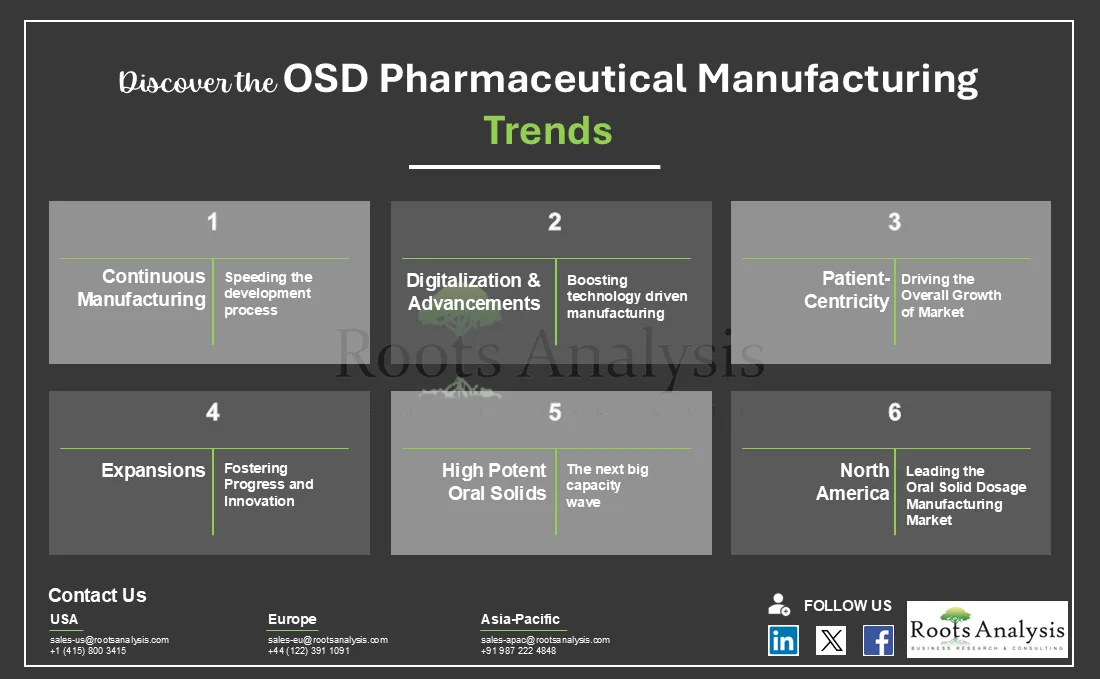
1. Continuous Manufacturing: Speeding the Development Process
OSD pharmaceutical manufacturing trends depict transition towards continuous manufacturing in oral solid dosage forms. Many key players in this domain have made direct announcements on their advancements related to continuous manufacturing. For instance, GEA and Hovione expanded their strategic partnership by launching the ConsiGma CDC Flex platform, a next-generation continuous manufacturing solution for oral solid dosage forms. Moreover, Syntegon Technology offers the modularly scalable “Xelum” platform for continuous direct compression and granulation, enabling seamless transfer from R&D to full-scale production. These advancements provide manufacturers with validated platforms to transition from conventional batch production to hybrid or fully continuous manufacturing, enabling improved quality control, reduced process variability, faster scale-up and a smaller manufacturing footprint.
2. Digitalization and Advancements: Boosting Technology Driven Manufacturing
Digitalization is reshaping oral solid dosage (OSD) manufacturing by enabling smarter, more connected, and data-driven production processes. The adoption of advanced technologies such as automation, artificial intelligence (AI), digital twins, and real-time process monitoring is enhancing manufacturing efficiency, product quality, and regulatory compliance. Among these innovations, 3D printing is emerging as a transformative technology, enabling greater design flexibility and paving the way for personalized oral dosage forms. Reflecting this trend, pharmaceutical companies are increasingly investing in 3D printing technologies and strategic collaborations to develop next-generation oral solid dosage forms that offer greater personalization, enhanced functionality, and improved patient outcomes. For instance, Adare Pharma Solutions partnered with Laxxon Medical to accelerate the commercialization of 3D-printed oral solid dosage forms. By combining advanced additive manufacturing with commercial OSD production capabilities, the collaboration aims to enable multi-drug tablets and tailored drug-release profiles, supporting the growing demand for patient-centric oral therapies.
3. Patient-Centricity: Driving the Overall Growth of the Market
Patient-centricity is driving oral solid dosage innovation away from the conventional “one tablet fits all” mindset. For instance, Lomapharm announced a €40 million investment to expand its Emmenthal site by enhancing production capacity for film-coated and coated tablets. The initiative strengthens company’s focus on advancing oral solid dosage manufacturing and delivering more patient-centric, easy to administer formulations, stating clearly growing demand for more user-friendly dosage forms. This underlines how manufacturers are actively responding to patient needs. Further, this OSD pharmaceutical manufacturing trend has enabled shift toward patient-centric dosage forms representing a significant trend in the oral solid dosage pharmaceutical manufacturing market, driving innovation, improving patient adherence, leading the evolution to targeted, patient-centric medication forms that simplify therapy.
4. Expansions: Fostering Progress and Innovation
Scaling up manufacturing capacity is a key strategic priority in oral solid dosage operations. As per the OSD pharmaceutical manufacturing trends, a significant wave of expansion has taken place over the past few years, with the majority of initiatives led by industry players headquartered in North America. Of these, majority of expansions were to establish new facilities exclusively dedicated to solid dose pharmaceuticals, this can be attributed to the persistent efforts of stakeholders to further advance their current portfolios and expedite the development process across various phases of clinical trials. For example, in March 2026, Forma Life Sciences launched as an independent CDMO focused on oral solid dosage formulation development and commercial manufacturing. The expansion strengthens the company's end-to-end OSD manufacturing capabilities, reflecting the growing demand for specialized outsourcing partners in the pharmaceutical industry. Such expansions are expected to drive the oral solid dosage manufacturing market growth during the forecast period.
5. Highly Potent Oral Solids: The Next Big Capacity Wave
One of the major OSD pharmaceutical manufacturing trends is the rapid expansion of high-potency and specialized OSD capacity. With the rise of targeted therapies and oncology drugs, manufacturers are investing in dedicated high-containment suites equipped with advanced isolation technologies, and high-precision compression systems. Pharmaceutical companies and CDMOs are increasingly building segregated facilities that support cytotoxic drugs and HPAPI manufacturing, low-dose formulations, fixed-dose combinations and modified-release tablets or formats that require stricter environmental controls and specialized engineering. This capacity shift not only enhances safety and compliance but also positions manufacturers to serve a growing pipeline of potent and complex oral drugs.
6. North America: Leading the Oral Solid Dosage Contract Manufacturing Market
North America continues to lead the oral solid dosage (OSD) contract manufacturing market, supported by its well-established pharmaceutical ecosystem, advanced manufacturing infrastructure and stringent regulatory framework led by the USFDA. Driven by the need for resilient supply chains, advanced manufacturing infrastructure, and increased local production of critical medicines, companies are strengthening end-to-end manufacturing networks across the region. This trend is exemplified by Novartis' recent investment in expanding its US manufacturing footprint. In April 2026, Novartis expanded its US manufacturing footprint by announcing a new API facility dedicated to solid dosage tablets and capsules in North Carolina. The investment reinforces North America's pharmaceutical manufacturing capabilities and supports a more resilient domestic supply chain for oral solid dosage products.
CONCLUSION
Oral solid dosage manufacturing is rapidly evolving from traditional batch-based production to a more advanced, technology-driven ecosystem. Continuous manufacturing, digitalization and flexible patient-centric formats are helping companies overcome challenges related to quality, scale-up and production speed. The combined influence of technology modernization, capacity expansion and evolving patient needs is transforming the future of OSD pharmaceutical manufacturing market, making it more efficient, resilient, and better suited to address the increasing complexity of today’s pharmaceutical pipeline. Considering these OSD pharmaceutical manufacturing trends and the rapidly increasing adoption of such dosages, the oral solid dosage contract manufacturing market is likely to experience substantial growth in the coming future.
To know more about the OSD pharmaceutical manufacturing trends, access full report: https://www.rootsanalysis.com/reports/oral-solid-dosage-contract-manufacturing-market.html#market-outlook
Sources:
- https://www.acg-world.com/news/osd-manufacturing-enters-new-era-key-trends-shaping-global-market-0
- https://www.piramalpharmasolutions.com/resources/blogs/innovations-in-oral-solid-dosage-forms
- https://pubmed.ncbi.nlm.nih.gov/41371320/
- https://www.pharmasalmanac.com/articles/technologies-enabling-personalized-and-patient-specific-oral-solid-dosage-drugs