Recent Advances in Automated DNA Extraction Systems

.png)

Published: August 2026
DNA extraction is a critical pre-analytical step across molecular diagnostics, genomics, biopharmaceutical research and forensic testing. The purity, yield and integrity of isolated DNA can directly affect the reliability of downstream applications such as polymerase chain reaction (PCR), digital PCR, genotyping and next-generation sequencing (NGS). As laboratories handle larger sample volumes and increasingly diverse specimen types, dependence on manual extraction can create bottlenecks through repetitive pipetting, multiple transfer steps and operator-dependent variability.
Automated DNA extraction systems address these challenges by standardizing key stages of nucleic acid purification, including lysis, DNA binding, washing and elution. Many current platforms use magnetic-particle or silica-based chemistries together with robotic sample handling, prefilled reagent formats and software-guided protocols. This reduces hands-on processing and helps laboratories improve reproducibility while also supporting walkaway operation and more consistent sample-to-sample handling.
Recent advances are broadening the role of these instruments beyond stand-alone purification. Newer platforms are being designed to accommodate higher throughput, integrate quantification and normalization, preserve high-molecular-weight DNA, and support specialized applications such as liquid biopsy and formalin-fixed paraffin-embedded (FFPE) tissue analysis. At the same time, laboratories are placing greater emphasis on sample traceability, connectivity with laboratory information management systems (LIMS), data integrity and remote workflow oversight.
The direction of technology development is visible in several recent product initiatives. In February 2026, QIAGEN showcased QIAsprint Connect, a compact benchtop system capable of processing up to 192 samples per run with minimal manual intervention. In April 2026, Invivoscribe announced the PrepQuant System, which combines nucleic acid extraction, concentration and quantification within a single automated instrument. These examples illustrate how automation is shifting toward higher-capacity, more integrated sample-preparation workflows.
Roots Analysis has conducted an exhaustive study on Nucleic Acid Isolation and Purification Market trends featuring the current advancements and future opportunity for the companies engaged in this domain.
Want to explore the latest Nucleic Acid Isolation and Purification Market Advances?
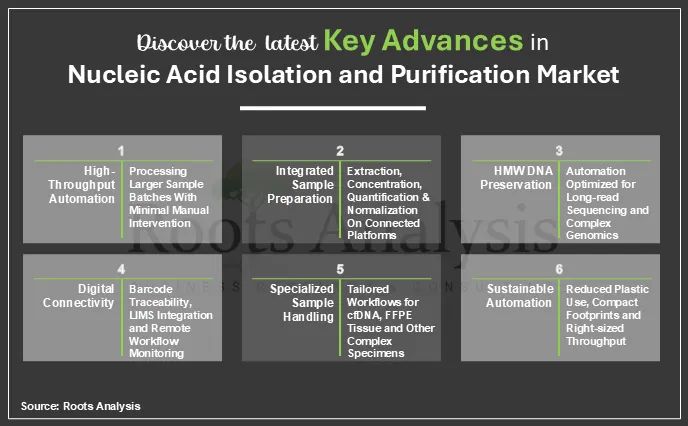
Latest Advances in Nucleic Acid Isolation and Purification Industry that are Likely to Shape the Market
1. High-Throughput Automation: Scaling Sample Processing with Less Hands-On Time
High-throughput capability is becoming an important differentiator as genomics laboratories, biobanks, clinical research centers and pharmaceutical laboratories seek to process larger sample batches without a proportional increase in manual labor. The newest systems are therefore combining higher sample capacity with compact footprints and configurable protocols. QIAGEN's QIAsprint Connect, showcased at SLAS 2026, can process up to 192 samples per run with minimal manual intervention and supports both tested and customizable workflows through a touch-based interface and modular chemistry. Such systems can help laboratories consolidate sample-preparation capacity on benchtop platforms while reducing repetitive handling. The trend also reflects a broader move toward throughput flexibility, where laboratories can scale automation according to workload rather than relying solely on large centralized robotic installations.
2. Integrated Sample Preparation: Combining Extraction, Quantification and Normalization
Automated DNA extraction is increasingly being integrated with adjacent pre-analytical steps that were traditionally performed on separate instruments. Invivoscribe's PrepQuant System, announced in April 2026, integrates nucleic acid extraction, concentration and quantification in one platform and is designed to generate genomic DNA and cell-free DNA for next generation sequencing, qPCR and digital PCR workflows. Tecan's DreamPrep NAP likewise combines magnetic-bead-based nucleic acid extraction with built-in quantification and normalization for batches of up to 96 samples. In September 2025, Beckman Coulter Life Sciences and HSE also announced the integration of on-deck absorbance and fluorescence measurement into Biomek i-Series workstations, enabling automated quantification and immediate decision-based liquid handling. Together, these developments point toward increasingly closed, data-driven sample-preparation workflows that reduce transfers between instruments and improve standardization before downstream analysis.
3. High-Molecular-Weight DNA Preservation: Supporting Long-Read Sequencing and Complex Genomics
The growth of long-read sequencing and other advanced genomic applications is creating demand for automated extraction methods that preserve longer, more intact DNA fragments. Conventional extraction workflows can introduce shearing or variability that compromises high-molecular-weight (HMW) DNA, making careful control of mixing and handling increasingly important. Thermo Fisher Scientific states that its MagMAX HMW DNA Kit can isolate DNA fragments up to 300 kb from blood, cells and tissue in less than 2.5 hours using manual workflows or KingFisher automation. Hamilton also supports automated HMW DNA extraction in the 50-250 kbp range on the NIMBUS Presto for long-read sequencing workflows. As structural-variant analysis, pan-genomics and complex genome characterization expand, the ability to automate extraction while maintaining DNA integrity is likely to become an increasingly valuable system capability.
4. Digital Connectivity and Traceability: Moving Toward Data-Integrated Extraction Workflows
Automation is increasingly extending beyond physical sample handling to encompass digital traceability and workflow connectivity. This is particularly important in clinical and regulated laboratories, where sample identity, auditability and data integrity must be maintained across multiple processing steps. QIAGEN's QIAsymphony Connect, introduced in 2025 ahead of wider commercialization, incorporates automated 2D barcode scanning for both sample and eluate tubes and is designed to integrate with LIMS and QIAsphere for remote monitoring and workflow optimization. QIAsprint Connect also incorporates connectivity and compliance-oriented features, including 21 CFR Part 11 readiness. These capabilities can help laboratories reduce transcription errors, strengthen chain-of-custody controls and improve visibility across high-volume sample-preparation workflows, making software integration an increasingly important component of automated DNA extraction system design.
5. Specialized Sample Handling: Expanding Automation to cfDNA, FFPE and Other Complex Specimens
As molecular testing becomes more specialized, DNA extraction systems are being optimized for specimen types that present distinct technical challenges. Liquid-biopsy workflows require efficient recovery of low-concentration cell-free DNA from relatively large sample volumes, whereas FFPE tissue can contain fragmented and chemically modified nucleic acids. Invivoscribe's PrepQuant System is designed for blood, plasma and bone marrow specimens and generates concentrated genomic DNA and cfDNA for downstream molecular assays. Promega's Maxwell CSC XtractAll FFPE DNA/RNA workflow provides automated extraction of DNA, RNA or total nucleic acid from FFPE tissue; the company states that DNA, RNA or total nucleic acid can be extracted in approximately 30 minutes, while sequential DNA and RNA extraction can be completed in less than one hour. Application-specific automation is therefore helping extend standardized extraction into oncology, pathology and liquid-biopsy workflows where sample quality is particularly consequential.
6. Sustainable and Right-Sized Automation: Reducing Consumables while Broadening Access
Laboratories are increasingly evaluating automation not only on throughput and analytical performance, but also on consumable use, footprint and fit-for-purpose capacity. This has encouraged developers to introduce both higher-throughput benchtop systems and compact platforms for lower-volume laboratories. QIAGEN reports that QIAsprint Connect consumables can reduce plastic use by up to 50% and packaging volume by 40%, while the system retains a compact benchtop design. The company is also developing QIAmini as an accessible walkaway automation option for lower-throughput laboratories, highlighting a wider trend toward scalable automation across different workload profiles. Such design changes can help laboratories avoid over-sizing instrumentation, reduce waste associated with routine sample preparation and make automation more practical for facilities that previously relied heavily on manual extraction.
Conclusion
Recent advances in automated DNA extraction systems are transforming sample preparation from a stand-alone purification step into a more integrated, scalable and digitally connected laboratory workflow. High-throughput systems are reducing manual handling across larger sample batches, while integrated platforms are bringing extraction closer to quantification, normalization and downstream assay preparation. At the same time, automation is being adapted to preserve high-molecular-weight DNA and to handle challenging specimens such as cfDNA and FFPE tissue.
Going forward, the competitive focus is likely to extend beyond extraction yield alone toward workflow completeness, traceability, specimen flexibility, data connectivity and sustainable consumable design. As genomic testing, precision medicine and high-volume molecular research continue to expand, automated DNA extraction systems are likely to become increasingly central to reproducible sample-to-answer workflows.
Browse our full report on Nucleic Acid Isolation and Purification Market Advances: https://www.rootsanalysis.com/reports/nucleic-acid-isolation-and-purification-market.html
Sources:
- https://corporate.qiagen.com/English/newsroom/press-releases/press-release-details/2026/QIAGEN-Showcases-QIAsprint-Connect-High-Throughput-Automation-System-for-Labs-Worldwide-at-SLAS-2026/default.aspx
- https://invivoscribe.com/invivoscribe-announces-the-prepquant-system-an-integrated-sample-preparation-platform-that-standardizes-and-streamlines-pre-analytical-workflows/
- https://lifesciences.tecan.com/