Recent Trends in Continuous Manufacturing of Pharmaceuticals

.png)

Published: December 2025
Continuous manufacturing involves the production of pharmaceutical products such as small molecules and biologics, in a single, uninterrupted run. This manufacturing process integrates all stages of production and transforms base ingredients into final products within a single facility. While continuous manufacturing has gained traction in other industries due to advancements in automation and process control, its adoption in pharmaceuticals remains at an infant stage.
The pharmaceutical industry has utilized batch processes for more than five decades. Over the years, this industry has relied on the standard operating procedures and process controls for each step of manufacturing, which requires multiple testing steps. However, the pharmaceutical industry cannot risk having any uncontrolled or variable processes when manufacturing various dosages continuously. To circumvent such challenges, the industry began implementing continuous manufacturing techniques, which not only resolved the end-point variable but also reduced the likelihood of errors during production.
In addition, continuous manufacturing streamlines the production processes, leading to considerable time saving. This technique also allows the processing of hazardous reactions, which is impossible / too dangerous to be conducted using traditional methods. Given the efficiency of continuous manufacturing, the adoption rate of this technology is expected to rise in the future.
Roots Analysis has conducted an exhaustive study on Continuous Manufacturing Market featuring the current landscape and future opportunity for the companies engaged in continuous manufacturing domain. In this article, we have highlighted recent trends in continuous manufacturing of pharmaceuticals and key factors that are likely to shape the evolution of this sector.
Want to Explore the Competitive Landscape, Technological Advancements and Recent Trends in Continuous Manufacturing of Pharmaceuticals?
Recent Trends in Continuous Manufacturing of Pharmaceuticals and Key Factors Likely to Shape the Market Evolution
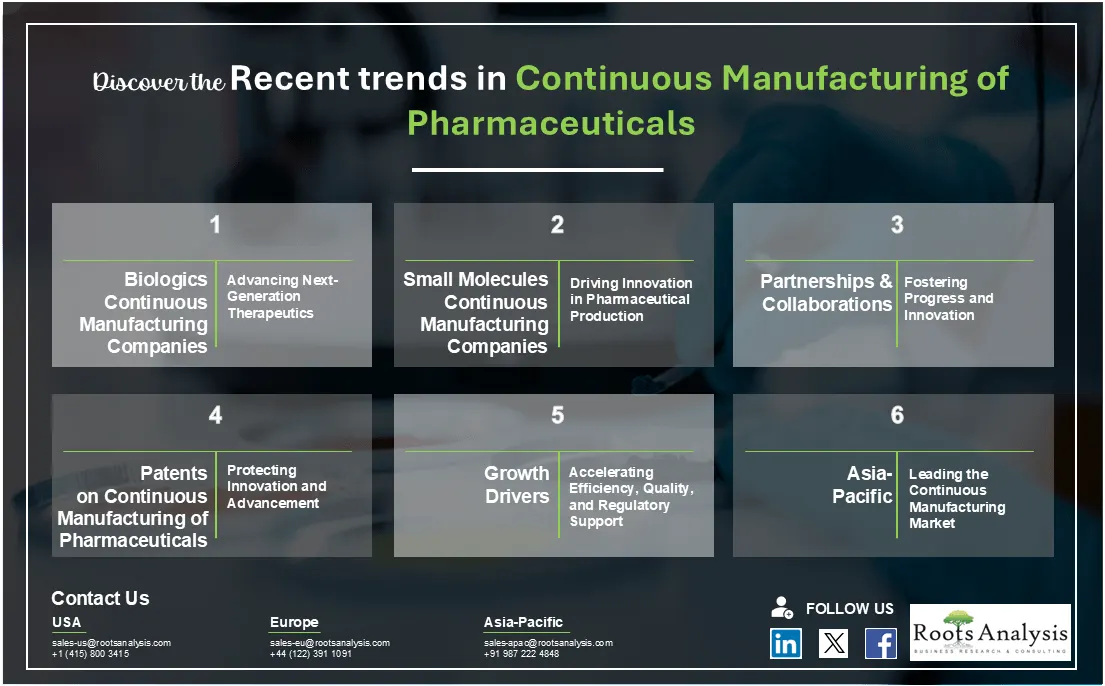
1. Biologics Continuous Manufacturing Companies: Advancing Next-Generation Therapeutics
Currently, close to 60 players in this domain are equipped to perform continuous and semi-continuous manufacturing for various types of biologics, including antibodies, enzymes, proteins / peptides, vaccines and viral vectors. Notably, majority of these players (~40%) are headquartered in North America, followed by those headquartered in Europe (37%) and Asia-Pacific (24%).
Further, more than 80% of these players have the capabilities for commercial production of pharmaceuticals; examples of such players include (in alphabetical order) ABL, AGC Biologics, Boehringer Ingelheim, Lonza and Patheon.
2. Small Molecules Continuous Manufacturing Companies: Driving Innovation in Pharmaceutical Production
Close to 50 companies in this domain claim to have the required capabilities for continuous manufacturing of pharmaceuticals (small molecules). These players are well-fragmented, featuring the presence of small, mid-sized, large, and very large companies. Notable, around 50% of these players are based in Europe, followed by those headquartered in North America (~35%).
Further, majority (~70%) of the players engaged in this domain are contract manufacturers. This is due to the increased adoption of continuous manufacturing processes amongst contract manufacturers, enabling them to conduct real-time monitoring and control the production process. Furthermore, implementing continuous manufacturing processes improves product quality control, allowing products to consistently meet desired specifications across different batches.
3. Partnerships and Collaborations: Fostering Progress and Innovation
There has been steady rise in the number of partnerships inked in this domain; such deals are inked to allow companies to expand their respective portfolios, and gain additional capabilities related to continuous manufacturing of pharmaceuticals. Notably, around 55% of the total partnerships and collaborations in this domain were inked in the past three years. Further, owing to the increasing technological innovations, and the need for sustainable production methods for continuous manufacturing of biologics and small molecules, more companies are likely to enter into partnerships and collaborations to expand their geographical reach and enhance their service / technology portfolios.
4. Patents on Continuous Manufacturing of Pharmaceuticals: Protecting Innovation and Advancement
The adoption of continuous manufacturing processes has revolutionized the production of pharmaceuticals by enabling faster, cost-effective, and efficient manufacturing of biologics and small molecules. As a result, there is growing interest from various industry and non-industry stakeholders in continuous manufacturing of small molecules and biologics, which has led to the expansion of intellectual capital in this domain. Notably, about 700 patents related to continuous manufacturing of pharmaceuticals have been registered since 2020. These patents primarily focus on advancement in perfusion technology, automatic or computerized tools, and integrated systems designed for introduction, extraction or recirculation of materials.
5. Growth Drivers: Accelerating Efficiency, Quality, and Regulatory Support
The continuous manufacturing market is experiencing steady growth, primarily driven by the rising prevalence of chronic diseases, which has significantly increased the demand for various biologics and small molecules. To meet this growing demand, pharmaceutical companies are adopting advanced manufacturing approaches such as, continuous manufacturing techniques that offers enhanced drug production capacity and efficiency. Further, continuous manufacturers use AI-driven systems to optimize production, monitor product quality in real time, and predict equipment failures, thereby improving consistency and reducing human error.
6. Asia-Pacific: Leading the Continuous Manufacturing Market
Interestingly, biologics continuous manufacturing market in Asia-Pacific is likely to grow at a higher CAGR of 10.5% during the forecast period. Likewise, small molecules continuous manufacturing market is likely to grow at a higher rate of 2.1%, during the forecast period till 2035. Companies in the Asia-Pacific region are rapidly adopting new technologies for the continuous manufacturing of pharmaceuticals, enabling them to produce high-quality continuous pharmaceuticals for the global market. Further, government initiatives such as China's "Made in China 2025" program, aims to reduce reliance on traditional batch processing methods, thereby driving the growth of market in this region.
Future Perspectives
The future of continuous pharmaceutical manufacturing is poised for substantial advancements driven by regulatory support and technological innovations. In the coming years, the USFDA will continue to support the use of continuous manufacturing of pharmaceuticals as a transformative approach to advance the drug production. Further, several draft guidelines highlighting the use of continuous manufacturing processes have been already published by the USFDA in recent years. These guidelines aim to streamline drug production in the future, by integrating advanced technologies such as artificial intelligence, with existing continuous manufacturing processes, thereby helping in predictive analytics and process optimization.
Moreover, there has been a surge in the number of new drug applications (NDA) related to novel manufacturing technologies. Some of these new technologies, such as PAT and hot melt extrusion, also facilitate the process of continuous manufacturing for a wide range of dosage formulations, including solid dosage forms, which are particularly important for poorly soluble APIs. Such innovations are expected to drive future growth and enhance the adoption rate of continuous manufacturing of pharmaceuticals.
Browse our full report on Continuous Manufacturing Market: https://www.rootsanalysis.com/reports/continuous-manufacturing/308.html#overview