Top 5 Foam Innovations Shaping 2026

.png)

Published: January 2026
Foam is a two-phase material in which gas bubbles are distributed throughout a liquid or solid matrix, forming a lightweight cellular structure that may be either rigid or flexible. Key characteristics of foams include bulk density, tensile strength, thermal conductivity, and sound-dampening performance. Because of these properties, foams are used in a wide range of products, from mattresses and pillows to building insulation and protective packaging. With the rising emphasis on sustainability and high performance, demand for innovative bio-based foams that provide environmentally friendly solutions, and improved functionality is expected to grow significantly over the coming decade.
It is worth highlighting that the foam industry is undergoing a shift from petroleum-based Styrofoam (which is non-biodegradable and releases harmful microplastics) to mycelium-based foams grown from the root networks of fungi on organic substrate, such as agricultural waste. Further, the mycelium-based foams provide same level of protective cushioning and insulation properties as conventional Styrofoam, utilizing less energy input and toxic chemicals. Also, mycelium foams are now being used in full-scale manufacturing and packaging operations due to the stringent regulations on eliminating usage of single-use plastics.
Roots Analysis has conducted an exhaustive study on Foam Market featuring the current market landscape and future opportunities for companies engaged in foam market. In this article, we have highlighted some of the latest foam innovations that are likely to shape the evolution of overall market.
Top Five Foam Innovations
- 3D-Printed Mycelium Foam
- Custom-Moldable Biodegradable Mycelium Foam
- Mycelium-Bound Bio-Foams
- Forager Foam
- MycoComposite
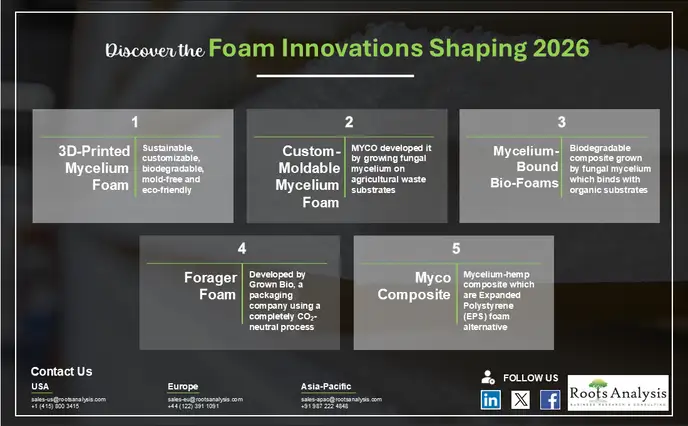
The figure below highlights the top five foam innovations:
Interested in exploring innovations in the foam market and its competitive landscape?
Discover Below the Details on Top 5 Foam Innovations
1. 3D-Printed Mycelium Foam
3D-printed mycelium foam is a sustainable, biodegradable biomaterial developed by utilizing 3D printer to shape an extrudable mixture of organic matter and fungal spores, which then grow into a solid structure. Further, these 3D-printed mycelium foams can be printed using extrusion, binderjet, or injection molding which can be manufactured in complex, custom shapes through additive manufacturing techniques. Also, these foams eliminate the need for individual molds having applications in packaging, insulation, and construction.
2. Custom-Moldable Biodegradable Mycelium Foam
These mycelium foams are moldable into specific shapes and sizes, making them highly customizable for biodegradable packaging and cushioning solutions. It is worth highlighting that MYCO, a Czech-based startup company, is involved in the development of mycelium-based biodegradable materials which are known to be the alternatives to expanded polystyrene (EPS) foam reducing the dependency on fossil fuel-derived plastics. This foam can be precisely shaped or molded to fit specific designs, making it highly versatile for protective and insulating applications. Further, these foams have a low carbon footprint, consuming significantly less energy and emitting fewer greenhouse gases during production as compared to EPS foam.
3. Mycelium-Bound Bio-Foams
Mycelium-bound bio-foams are lightweight, biodegradable composites where fungal mycelium acts as a natural binder to fuse organic substrates, like agricultural waste into foam-like structures. These bio-foams have the ability to offer high compressive strength, thermal insulation, and fire resistance, derived from the mycelial matrix's cellular structure. It is important to highlight that these mycelium-bound bio-foams are porous materials filled with soft and dense hyphae which allow bio-foams to recover from stress and makes them capable of absorbing additional stress as well. Additionally, their ability to get molded into custom shapes makes them a choice for various applications, such as packaging and electronics.
4. Forager Foam
Forager foam is a high performance, biobased and biodegradable mycelium material developed by Forager, subsidiary of Ecovative. Since these foams are derived completely from the filamentous root structure (mycelium) of mushrooms, they function as a high-performance, plastic-free foam alternative to synthetic foams, such as polyurethane and ethylene-vinyl acetate foam and others.
5. MycoComposite
With the aim of combatting the pollution generated from styrofoam and plastic waste, Ecovative developed a new compostable packaging material by growing mycelium along with the hemp hurd. It is natural, eco-friendly, naturally flame-resistant and water-resistant (hydrophobic) making it suitable for thermal applications and shipping with ice packs that are subject to melting. Despite being lightweight, it is strong and durable, providing excellent shock absorption. Further, it serves as a high-performance, regenerative alternative to petroleum-derived foams, such as expanded polystyrene, offering similar protective qualities while being fully biodegradable.
What About Other Innovations in the Foam Market Around the World?
The above article features the top five innovations in foam industry. If you're interested, you can download the Sample Report on this topic by Roots Analysis. For personalized assistance in identifying the most relevant solutions based on your specific criteria, please don't hesitate to reach out to us at sales@rootsanalysis.com.
Conclusion
The foam industry is likely to be propelled by innovations, such as custom-moldable biodegradable mycelium foam, mycelium-bound bio-foam, forager foam and others which are acting as regenerative solutions having the capability to surpass petroleum-based alternatives. It is worth mentioning that these foams have applications in protective packaging, acoustic panels and automotive interiors, which enable mass customization without having severe impact on the environment. Such innovations mark a significant and positive transformation in the foam industry.
Sources:
1. https://www.liebertpub.com/doi/10.1089/3dp.2023.0342
2. https://www.mdpi.com/2313-7673/8/2/257
3. https://www.packnode.org/en/sustainability/myco-mushroom-biodegradable-eps-replacement
4. https://www.hautematter.com/product-deck/foragerfoam
5. https://www.sciencedirect.com/science/article/pii/S0959652625005566
6. https://www.grown.bio/
7. https://mushroompackaging.com/