


 Download Free Sample
 Buy Now
Market Size
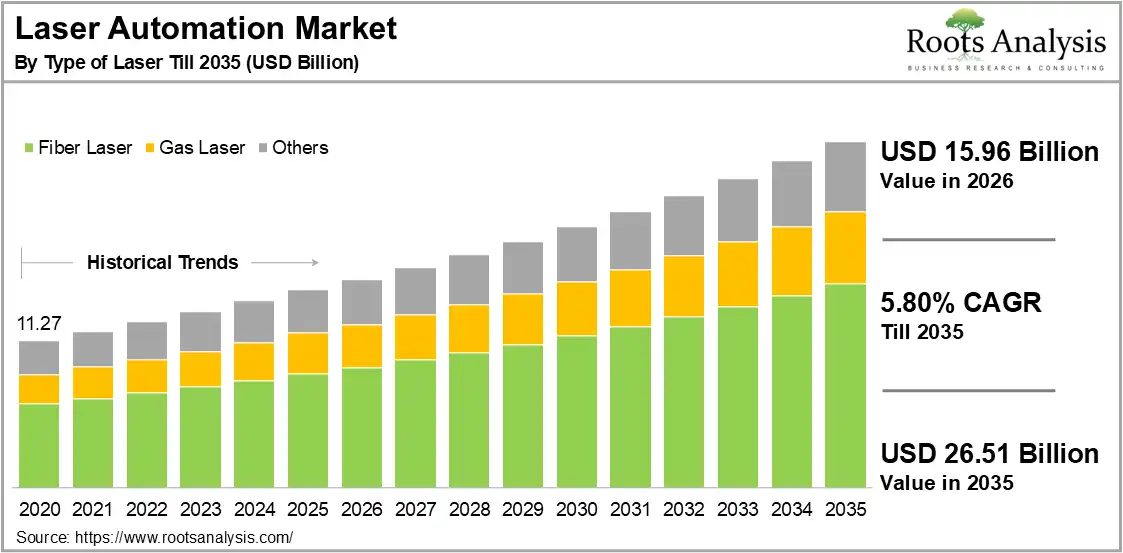
The global laser automation market, valued at USD 15.20 billion in 2025, is projected to reach USD 15.96 billion in 2026 and USD 26.51 billion by 2035, representing a CAGR of 5.80% during the forecast period 2026 to 2035.
See What’s in the Full Report - Request Your Complimentary Insights!
Market Report: Key Takeaways
- Industries like automotive, electronics, and healthcare are embracing laser technologies for their ability to deliver precision, speed, and flexibility in manufacturing processes.
- In terms of technology, the laser cutting machine secures the highest (35.78%) overall revenue share due to advances in laser technology such as fiber lasers and CO2 lasers.
- Based on end users, the automotive sector is contributing the maximum (31.60%) to the overall laser automation market size due to their ability to utilize sophisticated laser technology in manufacturing processes.
- North America dominates the industry (accounting for 36.28% of the share) in terms of geographical distribution of the market.
Market Overview
Laser automation is the integration of lasers into automated industrial processes to increase efficiency, accuracy, and productivity. These systems are made up of laser sources, robotic arms, conveyors, sensors, and control software that collaborate to perform precise and repetitive operations at high speed and precision. Laser technology enables tasks that would be challenging or impossible to carry out using traditional methods since it is adaptable and simple to automate. It is applicable to many metals and alloys as well as several other materials. While the conventionally used instruments are susceptible to wear and the risk of breaking, the laser technology welds, cuts, drills, and marks without any mechanical touch, guaranteeing a constant result.
Several key factors are fueling the expansion of the laser automation market. The rising need for high-quality production processes and the ability to enhance operational efficiency are significant drivers. Additionally, advancements in laser technologies, such as fiber lasers and ultrafast lasers, are enabling more versatile applications across different sectors. The push towards Industry 4.0 and the integration of smart manufacturing practices are also contributing to the growing adoption of laser automation solutions.
Recent Developments
- In September 2025, Universal Robots elevated next-generation laser welding finish and plasma cutting at FABTECH 2025 in Chicago.
- In August 2025, Monport launched AutoForge, the world’s first laser engraver with an automatic loading system, on Kickstarter. This advanced machine combines MOPA fiber laser color marking, dual-laser versatility, and US crystal engraving with a large 230 x 230 mm workspace to deliver precision, unmatched speed, and hands-free productivity for small businesses.
- In March 2025, HSG Laser unveiled its next-gen fabrication solutions at its latest partner conference, the Store Pro automation system, the all-new GH Series high-power laser cutting machine, and the TS2 Tube Laser, where the Store Pro is an optimized laser automation.
- In September 2024, Markem-Imaje highlighted its newly launched Laser Coder and advanced laser marking machines in a recently concluded Pack Plus.
Pay Only for What You Need – The Best Way to Optimize
Market Share Insights
Laser Cutting Machine Will Dominate the Laser Automation Market
When it comes to the global laser automation market, the laser cutting machine segment is set to take the lead, holding a significant market share of over 35.78% for the next decade. The laser cutting machine market is playing a critical part in pushing the automation business towards growth with their properties of precision, adaptability and efficiency.
Laser cutting automation has decreased labor costs and production time greatly by automating the cutting process, while also minimizing waste. Furthermore, advances in laser technology such as fiber lasers and CO2 lasers have improved the performance and capacities of these devices, broadening their application across a wide range of sectors and fueling their market growth.
Fiber Laser is Expected to Witness the Fastest Growth Rate
When it comes to the laser automation market analysis, the fiber laser segment is expected to grow the fastest with a projected CAGR during the forecast period. They are highly efficient and offer excellent beam quality, making them perfect for tasks like cutting, welding and marking. Industries such as automotive, aerospace, and electronics are embracing fiber lasers as they can easily handle reflective materials like aluminum and copper with great precision. Plus, as technology advances, fiber lasers are becoming even more powerful and cost-effective.
Automotive Sub-Segment is Gaining the Most Traction
According to our analysis, the automotive segment is clearly the most popular choice. It’s expected to boost the market share of laser automation by an impressive 31.60% during the forecast period. What exactly makes them appealing is their ability to utilize sophisticated laser technology in manufacturing processes. Laser automation systems are transforming car manufacturing by providing precision, speed and flexibility.
The use of laser-based sensors and vision systems is enabling improved automotive laser automation and robots for assembly and inspection operations, which is further increasing productivity and lowering labor costs. Finally, the automotive market’s quest for efficient production solutions is pushing the growth of the laser automation market.
North America is Expected to Lead the Regional Landscape of the Laser Automation Sector
According to our regional analysis, the North American laser automation market currently exhibits dominance with 36.28% of overall market share. This is mainly because the region is thriving with advanced laser automation technology. The increased investment in North America’s defense system is also playing a crucial role in increasing the region’s market share. Further, the significant contributions made by the Mexican market to the North American laser technology sector has also fueled the market growth.
Want Information on Specific Region / Segment?
Market Dynamics
Key Drivers for Demand in the Laser Automation Industry
The laser automation market is primarily driven by several key factors. Industries like automotive, electronics, and healthcare are embracing laser technologies for their ability to deliver precision, speed, and flexibility in manufacturing processes.
Lasers are being used for cutting, welding, and marking with incredible accuracy, making them essential for improving production efficiency. The push toward smart manufacturing and Industry 4.0 is also fueling demand, as companies look for advanced automation solutions to stay competitive. In the automotive sector, the focus on lightweight, fuel-efficient vehicles is further driving the adoption of laser systems.
On top of that, the impact of advancements in AI on the laser automation market growth is prominent. This technology is enabling smarter process control and real-time optimization of laser parameters. Additionally, benefits of integrating robotics with laser systems for enhanced productivity are becoming a major driver as robotic laser automation streamlines processes by improving precision.
What Strategies are Companies Using to Gain Laser Automation Market Share?
The competitive landscape of the laser automation market is shaped by key players employing smart strategies such as partnerships, acquisitions, joint ventures, and robust R&D investments to drive innovation and expand market share. Prominent companies like TRUMPF, IPG Photonics, and Han’s Laser lead the market by offering advanced laser technologies for applications including cutting, welding, marking, and engraving across sectors such as automotive, electronics, and aerospace. These players focus on launching novel products and expanding into regions with growing innovations in laser automation, materials science, and signal processing, strengthening their global positions through technological leadership and regional expansion.
Challenges in the Laser Automation Market
There are several challenges faced by manufacturers in adopting laser automation solutions. One major obstacle is the high initial investment required for laser systems, which includes costs for equipment like cutting or welding machines, robotic arms, safety measures, and infrastructure setup such as dedicated workstations and ventilation systems. These expenses can be prohibitive for small and medium-sized enterprises (SMEs) with limited budgets, forcing them to rely on less automated alternatives.
Additionally, integrating laser automation systems into existing production lines can be complex and costly, requiring specialized training for personnel. The perceived financial risks associated with these upfront investments often deter potential buyers. Furthermore, the market struggles with a shortage of skilled professionals capable of operating and maintaining advanced laser systems, adding another layer of difficulty for widespread adoption.
Your Business is Unique – Why Shouldn’t Your Report Be?
Laser Automation Market: Scope of the Report
| Key Report Attributes | Details | |
| Historical Trend | Since 2020 | |
| Forecast Period | Till 2035 | |
| Market Size 2026 | $ 15.96 Billion | |
| Market Size 2035 | $ 26.51 Billion | |
| CAGR (Till 2035) | 5.80% | |
| Segments Covered |
|
|
| Key Players Profiled |
|
|
| PowerPoint Presentation (Complimentary) | Available | |
| Customization Scope | 15% Free Customization | |
| Excel Data Packs (Complimentary) |
|
|
Market Segmentation
Based on research, we have segmented the laser automation market into type of technology, type of lasers, end users, type of enterprise, geographical regions, and leading players.
Market Share by Type of Technology
- Laser Cutting Machine
- Laser Marking Machine
- Laser Welding Machine
- Precision Laser Processing System
- Other Technologies
Market Share by Type of Lasers
- Diode Lasers
- Fiber Lasers
- Gas Lasers
- Solid-State Lasers
Market Share by End User
- Aerospace & Defense
- Automotive
- Food & Medicine
- Machine Industry
- Oil & Gas
- Semiconductor & Electronics
- Other End-Users
Market Share by Type of Enterprise
- Large Enterprises
- Small and Medium Enterprises
Market Share by Geographical Regions
- North America
- US
- Canada
- Mexico
- Rest of North America
- Europe
- Austria
- Belgium
- Denmark
- France
- Germany
- Ireland
- Italy
- Netherlands
- Norway
- Russia
- Spain
- Sweden
- Switzerland
- UK
- Rest of Europe
- Asia-Pacific
- Australia
- China
- India
- Japan
- New-Zeeland
- Singapore
- South Korea
- Rest of Asia-Pacific
- Latin America
- Brazil
- Chile
- Colombia
- Venezuela
- Rest of Latin America
- Middle East and Africa (MEA)
- Egypt
- Iran
- Iraq
- Israel
- Kuwait
- Saudi Arabia
- UAE
- Rest of MEA


