
Lowest Price Guaranteed
Slides
179
Last Updated
November 2024
View Count
19701
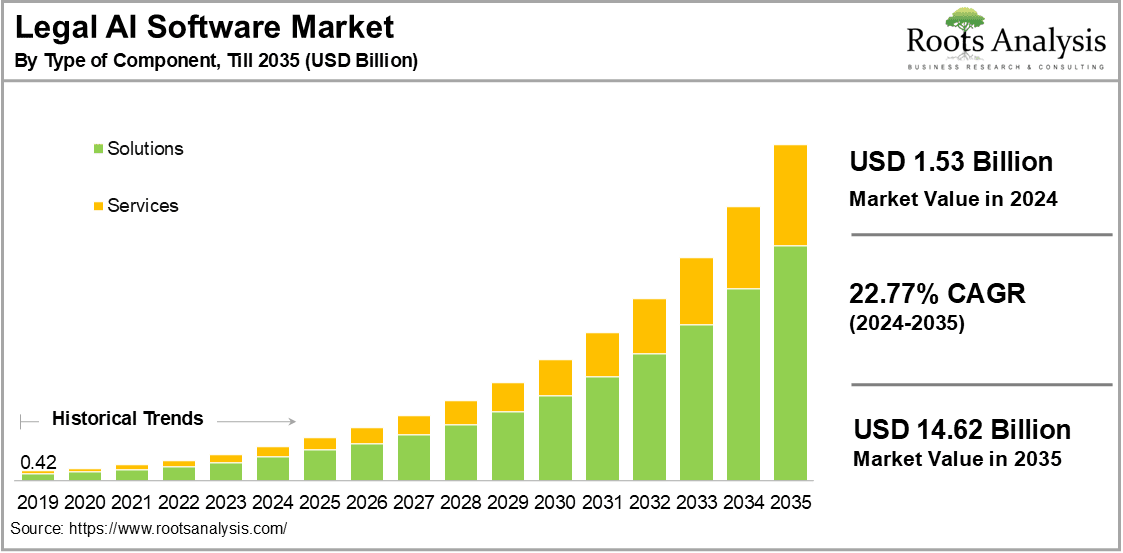
The legal AI software market size is projected to grow from USD 1.53 billion in 2024 to USD 14.62 billion by 2035, representing a CAGR of 22.77%, during the forecast period 2024-2035.
 |
To learn more about this report, request a free sample copy
The new research study consists of legal AI software market trends analysis, detailed legal AI software industry forecast analysis, and providing actionable strategic recommendations.
Legal AI software refers to the use of artificial intelligence technologies in the legal industry which automates and enhances various legal processes. This software utilizes AI techniques like machine learning, natural language processing and others to perform tasks including contract analysis, AI legal research, due diligence, document review, and predictive analytics. Apart from this, these tools can also automatically identify relevant changes, as well as provide alert to legal teams so that they can stay informed. The AI-powered legal software tools are capable of automatically extracting and analyzing contract terms, clauses, and provisions to identify potential compliance issues.
The global legal AI software market is witnessing significant growth, fueled by several key drivers. The increasing adoption of artificial intelligence (AI) technologies in the legal industry is one prominent market growth factor. The demand of AI in legal services is culminating in a massive demand for legal AI software globally. This is resulting in the reduction of the time taken in hearing legal cases and providing decisions based on the urgency of lawsuits hearings and legal framework within a given timespan. Furthermore, the exponential increase in the need for automation in attorney and clerical work is also leading to the surge in the legal AI software market. New product launches are also becoming a contributing factor for legal AI software growth. For instance, in November 2023, Thomson Reuters Corporation, came forward to launch generative AI-driven solutions for assisting the work of legal professionals.
The market report presents an in-depth analysis of the various service providers that are involved in legal AI software market, across different segments, as defined in the table below:
| Key Report Attributes | Details | |
| Historical Trend | 2019-2023 | |
| Base Year | 2023 | |
| Forecast Period | 2024-2035 | |
| Market Size Value in 2024 | $ 1.53 Billion | |
| Market Size Value by 2035 | $ 14.62 Billion | |
| Growth Rate | CAGR of 22.77% from 2024 to 2035 | |
| Type of Component |
|
|
| Type of Deployment |
|
|
| Type of Pricing Model |
|
|
| Type of Technology |
|
|
| Areas of Application |
|
|
| Type of End Users |
|
|
| Company Size |
|
|
| Type of Business Model |
|
|
| Geographical Regions |
|
|
| Leading Market Players |
|
|
| PowerPoint Presentation (Complimentary) |
Available | |
| Customization Scope | 15% Free Customization | |
| Excel Data Packs (Complimentary) |
|
|
The global legal AI software market is segment ed into two types of components; these include services and solutions. According to our analysis, the solutions segment will dominate with the largest market share during this forecast period. This segment is witnessing a rapid growth as the necessary legal tasks/process require deploying AI software platforms and solutions in end user systems. Whereas, on the other hand market-available AI software provide users with tools to create applications. With the rapid growth in automation of various legal tasks, more opportunities are emerging to deploy legal AI solutions across end-users. To safeguard the sensitive information used in the processes, governing bodies need to work on fully regulating the AI integrated legal software. However, it is worth mentioning that the services segment will be experiencing the fastest CAGR in the forecasted period which can be owed to the increasing need to perform various legal tasks efficiently.
The global legal AI software market is split into different types of deployment, such as cloud, hybrid and on-premises. Among the categories, the cloud legal AI software segment is expected to gain the maximum market share. This can be attributed to the flexibility, scalability and cost-effectiveness offered by cloud-based solutions. The increasing priority being given to accessibility and efficiency by law firms is increasing the cloud segment’s market share as they have the capability to access vast databases of legal documents and case law from any location and at any time, which is highly essential for dynamic legal practices.
The global legal AI software market is fragmented into multiple types of pricing models namely one-time license, pay-per-use and subscription. The subscription pricing model segment is anticipated to dominate with over 45% market share by 2035. This can be attributed to its flexibility and ongoing revenue generation capabilities. This segment allows users to access software with regular updates and support, attracting law firms and corporate legal departments to invest in this segment. On the other hand, the pay-per-use model is expected to witness the fastest CAGR in the forecasted period. This can be owed to this segment’s capability in catering to organizations that prefer pay only for the services they utilize, providing a cost-effective solutions for smaller firms.
The global legal AI software market is fragmented into multiple types of technology namely machine learning (ML), natural language processing (NLP), predictive analytics, and robotic process automation (RPA). The machine learning (ML) segment is anticipated to dominate with the highest market share over this forecast period. This growth is driven by the rising adoption of machine learning in legal to develop sophisticated algorithms that analyze large volumes of legal data, extract insights, and automate various legal processes. However, the natural language processing (NLP) in legal is expected to witness relatively higher CAGR of 26.56% till 2035. Significant factors contributing to this growth are the need to save time and improve legal research efficiency as this legal AI technology is a subfield of artificial intelligence focusing on interaction between computers and human language.
The global legal AI software market is fragmented into multiple areas of application namely case prediction, compliance, contract review and management, e-billing, e-discovery and legal research. The e-discovery segment is anticipated to dominate with the over 30% current market share. This legal AI software application involves identifying, collecting, processing, reviewing and producing electronic documents and data during litigation discovery. The growth of the legal e-discovery software segment is mainly being driven by the increasing volume of electronic data due to the digitization in the legal industry. In addition to this, several factors like proliferation of digital communication channels and the growth of cloud computing are also contributing to this segment’s growth.
The global legal AI software market is fragmented into multiple types of end-users namely corporate legal departments, government agencies, and law firms. The law firms’ segment is anticipated to dominate with more than 45% market share as well as the fastest CAGR over the forecast period. This can be attributed to the increased expenditure on AI in law firms. Moreover, AI for law firms has proven to be immensely valuable due to its ability to process and analyze vast amounts of legal data with speed and accuracy, contributing to the segment’s growth.
The global legal AI software market is fragmented into multiple types of enterprise namely large and small and medium enterprise. The large enterprise segment is anticipated to dominate the segment with the highest market share over this forecast period. However, small and medium enterprise segments are expected to witness the fastest growth rate until 2035. This is ascribable to their agility, innovation, focus on niche markets, and ability to adapt to changing customer preferences and market conditions.
This segment highlights the distribution of the legal AI software market across various geographical regions such as North America, Europe, Asia, Latin America, Middle East, North Africa, and the rest of the world. According to our legal AI software analysis, this growth can be attributed to the increasing need for efficiency, and cost-effectiveness in legal operations, the growing volume of legal data, and advancements in artificial intelligence and natural language processing technologies.
The “Legal AI Software Market, Till-2035: Industry Trends and Global Forecasts” report features an extensive study of the current market landscape, market size and future opportunity within legal AI software market, during the given forecast period. The market report highlights the efforts of several stakeholders involved in this rapidly emerging segment of the service providers industry. Key takeaways of the legal AI software market report are briefly discussed below.
The expansion of the legal AI software market trends is being fueled by several factors, including increasing incorporation of predictive analytics capabilities by legal AI software which is enabling legal professionals to make data driven decisions and forecast case outcomes. Furthermore, predictive analytics uses historical data, machine learning algorithms and statistical models to predict success likelihood in litigation, risk identification and providing insights. This trend is additionally enhancing the decision-making processes as well as increasing the efficiency and accuracy of legal services.
With the presence of several small and large chemical companies, the market is experiencing intense competition and changing market dynamics. From large multinational companies to local players, companies are striving to enhance their competitive edge. In terms of market share, large enterprises and multinational companies are dominating the market. The key players are using strategies such as partnerships, acquisitions, ventures, legal AI software innovations, novel product launches, R&D and geographical expansions in an attempt to solidify their position in the industry. For instance, in May 2023, LexisNexis announced the launch of their new tool ‘Nexis Hub’ which supports and streamlines research workflows to accelerate time to insight.
Despite the exceptional growth, the legal AI software market is facing a few challenges. The most prominent one includes ethical and regulatory implications of using AI in the legal industry. The ethical concerns in this scenario can revolve around bias in AI algorithms, privacy and data protection and the potential impact on the job market for legal professionals. As far as the regulatory implications are concerned, they are still in the evolving stage and ensuring compliance with existing regulations and ethical standards is highly essential for widespread legal AI software adoption.
North America currently holds over 40% share in the legal AI software industry. This dominance can be attributed to the concentration of the legal tech market, law firms, and legal departments in the region. The trend of extensive adoption of legal AI software in North America across various legal processes is being driven by the increasing need for improved efficiency, cost-effectiveness, and enhanced decision-making abilities.
Examples of key service providers involved in the legal AI software market (which have also been captured in this market report, arranged in alphabetical order) include Blue J Legal, Brainspace, Casetext, CosmoLex Cloud, CS Disco, DocuSign, EY Riverview Law, Everlaw, Filevine , IBM, Icertis, Kira Systems, Klarity, Knovos, LawGeex, LAWYAW, LegalSifter, LexisNexis, Legalsifter, Luminance, Nalanda, Neota Logic, OpenText, Omni, Pensieve, Practice Insight, ROSS Intelligence, Smokeball, Themis Solutions, Text IQ, TimeSolv, and Veritone. This market report includes an easily searchable Excel database of all the companies who legal AI software products.
The market report presents an in-depth analysis, highlighting the capabilities of various companies engaged in this domain, across different segments. Amongst other elements, the market report includes:
At Roots Analysis, we genuinely care about your success and understand that your business requirements are unique. While our market research reports provide valuable legal AI software insights, we recognize that they might not cover every aspect you need to make well-informed strategic decisions. To account for that, we offer 15% free report customization tailored to your specific needs. Whether you require additional quantitative analysis, qualitative insights, or any other information related to the legal AI software market, reach out us today at: support@rootsanalysis.com