


 Download Free Sample
 Buy Now
Market Size
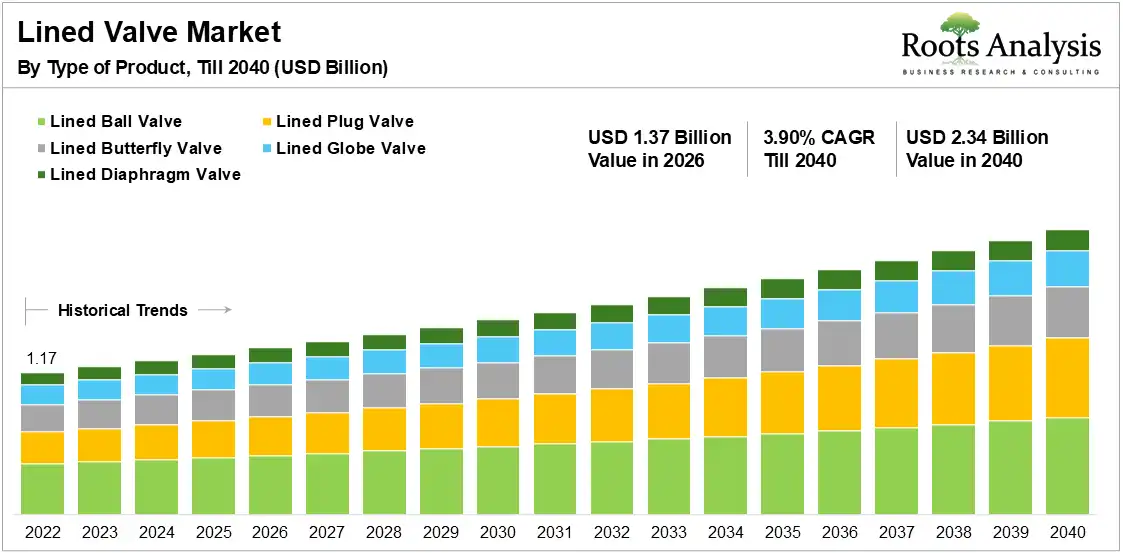
The global lined valve market is projected to reach USD 1.37 billion in 2026 and USD 2.34 billion by 2040, representing a CAGR of 3.90% during the forecast period 2026 to 2040.
See What’s in the Full Report – Request Your Complimentary Insights!
Market Overview
The lined valve market encompasses a specialized segment of industrial flow control solutions featuring non-metallic internal liners, primarily utilizing fluoropolymers like PTFE and PFA. These components, including lined ball, butterfly, and plug valves, are engineered to deliver exceptional corrosion resistance and high-purity media management across demanding environments. By isolating process media from metal surfaces, these valves prevent contamination and extend equipment longevity, serving as critical infrastructure within the chemical and pharmaceutical manufacturing sectors where abrasive or corrosive conditions are standard.
Global market momentum is currently propelled by rigorous regulatory mandates regarding fluid purity and containment in the petrochemical and pharmaceutical industries. This demand is further intensified by the necessity of replacing aging chemical plant infrastructure and increasing capital investment in specialized production facilities. These valves are essential for managing aggressive acids, bases, and abrasive slurries. For instance, recent PFAS restrictions have significantly accelerated research and development into advanced lining materials, reflecting an industry-wide pivot toward material science to satisfy evolving high-purity compliance standards.
Future market evolution centres on improving liner durability under extreme temperature and pressure conditions to meet more intensive processing requirements. The industry's strategic direction increasingly favors digital integration, specifically the adoption of smart valves that facilitate proactive condition monitoring. As a concrete example, manufacturers are currently developing non-intrusive sensors capable of tracking liner integrity and fluid quality in real-time. This global lined valve market outlook remains robust, supported by steady industrial expansion and a continuous need for reliable corrosion protection in complex systems.
Market Report: Key Takeaways
- Leading Players: The top five players, such as Emerson Electric, Flowserve, Crane Company, KSB SE, and KITZ are collectively holding significant but non-dominant share, leaving meaningful room for regional specialists and emerging technology players. Competitive differentiation centers on lining material expertise, digital integration capabilities, and aftermarket service networks.
- Startup Ecosystem: Emerging firms like Bueno Technology innovate in niche lined valve linings. Moreover, these companies represent attractive acquisition targets for global players seeking cost-efficient Asian manufacturing or regional distribution networks.
- PTFE Material Holds the Largest Share: Based on the lined valve market share and competitive analysis, PTFE holds the largest (46.5%) market share in 2026, driven by its universal chemical inertness and established cost curve in legacy chemical plants. However, its share is expected to contract to 39.8% by 2040 due to increasing PFAS regulatory pressure, evidenced by Solvay’s January 2026 progress report on phasing out PFAS-based surfactants and a structural shift toward melt-processable alternatives.
- Funding and Investment Momentum: Venture capital trends in 2026 show a shift toward "clinical readiness" and "scalable platforms”. Saudi Aramco and SABIC capital programs aligned with Vision 2030 maintaining 5-year spending trajectory, creating sustained lined valve procurement pipeline for Middle East suppliers.
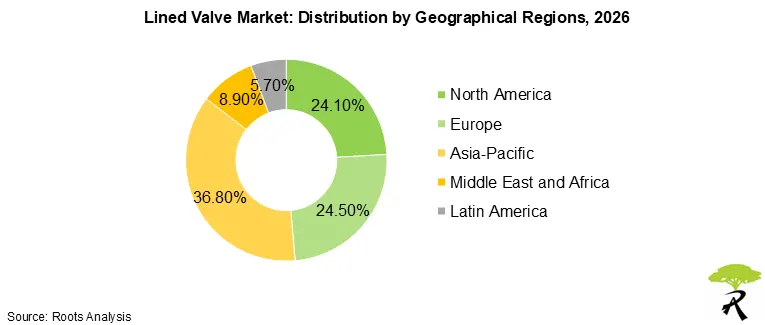
- Regional Analysis: Asia-Pacific remains the largest market, accounting for 36.8% of global share in 2026. The region's dominance is supported by the rapid industrialization of China and India, as well as the emergence of Southeast Asia as a critical hub in the global supply chain.
- Future Opportunities: Lined valves with built-in sensors or standardized mounting for smart actuators prevents future obsolescence.
Pay Only for What You Need – The Best Way to Optimize
Recent Developments in Lined Valve Market
- February 2026: Summit Valves successfully delivered six 36-inch knife gate valves to the Alberta oil sands, demonstrating the scale of demand for specialized valves in the midstream and upstream sectors.
- February 2026: Fluro got selected as engineering, procurement and construction partner (EPCP) for the Expansion of Centrus' Uranium Enrichment Plant in Ohio. This selection represents a major multi-year contract that will drive demand for nuclear-grade lined valves.
- February 2026: Halliburton and Pertamina signed a Memorandum of Understanding (MOU) for a massive fracturing project in Indonesia, which will require significant deployments of high-pressure lined valves.
Market Dynamics
Key Market Drivers
- Rising Demand Within Complex Chemical Manufacturing Ecosystems: As the global chemical industry shifts toward specialty chemicals and advanced petrochemicals, processing environments are increasingly defined by aggressive, high-purity, and highly corrosive media. These conditions exceed the performance threshold of standard metallic components, driving the adoption of lined valves. By providing a robust barrier against chemical attack, these solutions preserve process integrity and offer a superior operational lifespan compared to conventional materials.
- Economic Optimization Over High-Cost Exotic Alloys: In highly corrosive service environments, plant operators face a strategic choice between lined valves and components fabricated from expensive exotic metals like Hastelloy, Monel, or titanium. Lined valves, typically featuring a ductile iron or cast steel foundation protected by PTFE or PFA deliver equivalent chemical resistance at a fraction of the capital expenditure. This makes them the primary economic driver for non-severe service applications where temperature and pressure limits permit.
- Rigorous Environmental Mandates and Fugitive Emission: Mitigation Global regulatory frameworks, spearheaded by the EPA and equivalent regional bodies, have intensified requirements for leak detection and the reduction of fugitive emissions. This is particularly critical in the petrochemical and chemical sectors where safety and compliance are paramount. Lined valves, engineered with specialized sealing mechanisms for zero-leakage performance, are essential infrastructure components for meeting these evolving environmental standards.
- Escalating High-Purity Benchmarks in Life Sciences: The pharmaceutical and biotechnology sectors demand process equipment that eliminates media contamination risks to ensure strict product purity. Lined valves utilizing non-leaching polymers, such as PTFE or PFA, prevent contact between process fluids and metallic surfaces. This isolation is critical for adhering to Good Manufacturing Practice (GMP) standards, ensuring that high-value batch production remains untainted and compliant with safety regulations.
Market Restraints
- Thermal and Barometric Operational Constraints of Polymers: The functional envelope of polymer linings, specifically PTFE and PFA, is structurally limited by inherent temperature and pressure thresholds. These materials cannot withstand high-temperature steam or extreme high-pressure cycles where metallic alloys remain the industrial standard. Consequently, lined valves are largely excluded from severe service environments in upstream oil and gas, capping their total addressable market.
- Elevated Initial Capital Requirements Relative to Standard Valves: While lined valves frequently offer a superior Total Cost of Ownership (TCO) through extended service life, they require a higher initial capital outlay than standard stainless steel or ductile iron options. This upfront price premium acts as a barrier in price-sensitive projects or in organizations where procurement strategies prioritize immediate CAPEX over long-term maintenance and reliability gains.
- Structural Risks of Liner Delamination and Mechanical Degradation: The performance of a lined valve is entirely dependent on the mechanical bond between the liner and the valve body. Inadequate manufacturing precision or extreme fluctuations in temperature and pressure can trigger delamination. Such failures expose the base metal to catastrophic corrosion and process contamination, introducing significant operational risks that can deter adoption in high-stakes environments.
- Competitive Pressure from All-Plastic Thermoplastic Alternatives: In less demanding service applications, characterized by moderate temperatures, lower pressures, and diluted chemical concentrations lined valves compete with all-plastic (thermoplastic) valves made from PVC, CPVC, or FRP. These non-metallic alternatives offer a lower entry cost and are often the preferred specification for non-critical water treatment or general utility applications where high-pressure tolerance is unnecessary.
Your Business is Unique – Why Shouldn’t Your Report Be?
Market Share Insights
Lined Valve Market Share Analysis by Type of Product
Based on the market forecast estimates for lined valve, lined ball valve holds the highest current market share at an estimated 36.5% in 2026 and is projected to be the fastest-growing category with a CAGR of 4.6% through 2040. This dominance is driven by superior high-cycle reliability and the versatility of PFA-lining, which facilitates the "bubble-tight" shutoff required for ESG-compliant facilities.
As chemical processing expands and plants transition to Industry 4.0 standards, the quarter-turn operation and full-bore flow of ball valves offer critical advantages in energy efficiency and automation over legacy architectures. This growth trajectory is further evidenced by strategic refinements from major players like Crane Company, which has optimized its XOMOX and Saunders portfolios to meet the aggressive demands of ultra-corrosive lithium-ion battery recycling.
Conversely, lined butterfly valves also show strong gains, reaching an estimated 26.5% share by 2040 due to their weight-saving benefits and efficiency in large-bore desalination projects. In contrast, lined plug valves (18.0% current share) and lined globe valves (7.5% current share) are expected to see share erosion, losing ground due to high actuation torque, abrasive wear issues, and the inherent difficulty of maintaining lining integrity within complex internal geometries.
Similarly, Lined Diaphragm Valves face a projected share loss (dropping to 12.0% by 2040) as the biopharma sector shifts toward single-use technologies and the market increasingly favors the durability of fluoropolymer-lined metallic bodies over maintenance-heavy, elastomer-based designs.
Regional Insights: Asia-Pacific Leads the Market
Asia-Pacific: The Center of Gravity
According to the current lined valve market analysis, Asia-Pacific holds a leading 36.8% market share in 2026 and is projected to be the fastest-growing region with a CAGR of 5.1% through 2040. This sustained expansion is driven by massive industrial capacity growth in China and India, fueled by domestic production incentives like India’s PLI schemes and China’s "dual circulation" strategy. These initiatives have accelerated the production of specialty chemicals and active pharmaceutical ingredients (APIs), which require high-integrity PTFE / PFA lined valves for contamination control and the management of aggressive media.
North America and Europe: Reshoring and Regulatory Rigor
Mature lined butterfly valve markets like North America and Europe holding 2026 shares of 24.1% and 21.5%, respectively are transitioning into replacement-driven landscapes. North America’s growth is tempered by its status as a mature market focused on EPA emissions monitoring, while Europe faces a projected 2.7% CAGR due to high energy costs, strict REACH compliance, and the relocation of primary production to lower-cost hubs.
The Middle East: Vision 2030 and Localized Manufacturing
The MENA region represents a notable growth outlier with an estimated 4.6% CAGR, bolstered by desalination scaling and downstream petrochemical diversification, such as the chemical complex expansions aligned with Neom infrastructure. Conversely, Latin America and the Rest of the World are expected to see share losses due to political volatility affecting CAPEX and a lower adoption rate of high-performance fluid control solutions compared to the rapid industrial build-out in the Asian and Middle Eastern hubs.
Want Information on Specific Region / Segment?
Market Ecosystem Insights
Lined Valve Competitive Landscape Assessment
The competitive landscape is characterized by high concentration among top-tier global players, who are aggressively using mergers and acquisitions to acquire digital capabilities and expand their geographic footprint.
- Emerson Electric maintains its lead by positioning itself as an "autonomous future" engineer. Its 2025 acquisition of Aspen Technology has allowed it to offer an AI-enabled autonomous operations stack that is unmatched in the industry. Moreover, its Fisher brand remains the benchmark for digital valve controllers, and the company was honored as the "2026 Industrial IoT Company of the Year".
- Flowserve continues to focus on extreme-service applications, participating in multiple global investor conferences in late 2025 to highlight its advancements in real-time analytics and energy-efficient designs.
- Crane Company is focusing on the intersection of materials and sensing. In January 2026, it finalized the acquisition of Precision Sensors & Instrumentation (PSI) from Baker Hughes, a move that strengthens its capabilities in advanced sensor solutions for aerospace, nuclear, and chemical markets.
This competitive analysis of top lined valve manufacturers indicates that market will remain competitive in the future, offering unprecedented opportunities to the industrial players and startups for innovations.
Startup Ecosystem, Funding, and Technical Disruption
While the incumbents dominate the hardware, a new generation of startups is capturing the "software layer" of the lined valve market, attracting significant venture capital.
In addition, the startup landscape in 2026 is dominated by AI-driven machine health and digital twin platforms. Startups like Twinsity (Germany) and AIOTEL (India) are creating immersive 3D digital twins of industrial environments, integrating IoT data with generative AI to provide real-time operational insights. For an investor, these companies represent the "high-beta" play on the industrial lined valve market, with the potential for massive returns if they become the operating system for the smart factories of the future.
Lined Valve Market Trends
- Shift of Chemical Processing Capacity to Emerging Markets: The migration of chemical manufacturing hubs toward Asia and the Middle East creates a massive window for new-build installations. As these regions establish modern industrial clusters, they are increasingly adopting advanced process technologies that specify lined valves as the baseline for corrosion-resistant infrastructure, providing a steady pipeline for market expansion.
- Lifecycle Management and Brownfield Modernization Trends: A significant portion of global industrial infrastructure is currently operating with legacy valve technology that is prone to inefficiency and leaks. As facilities move toward plant modernization to improve safety and reliability, there is a clear opportunity to replace aging assets with high-performance lined solutions. This aligns with modern corporate goals regarding emissions reduction and extended equipment durability.
- Material Science Innovations in Polymer Formulations: The lined valve industry overview highlights that, continuous R&D in polymer science and lining techniques presents a pathway to expand the functional range of lined valves. The development of modified PTFE or advanced PFA formulations with heightened thermal stability and chemical resistance allows these valves to penetrate aggressive process environments previously dominated by exotic alloys, effectively capturing new market share.
- Emerging Applications in Renewables and the Circular Economy: The global transition toward green energy, including geothermal power (which involves corrosive brines) and advanced chemical recycling (utilizing complex solvents), is creating niche application areas. These emerging sectors require specialized corrosion-resistant flow control solutions that can reliably handle novel and aggressive chemical streams, offering a high-growth frontier for lined valve manufacturers.
Lined Valve Market: Scope of the Report
| Key Report Attributes | Details | |
| Historical Trend | Since 2022 | |
| Forecast Period | Till 2040 | |
| Market Size 2026 | $ 1.37 Billion | |
| Market Size 2040 | $ 2.34 Million | |
| CAGR (Till 2040) | 3.90% | |
| Segments Covered |
|
|
Market Segmentation
Based on the research, we have segmented the lined valve market into type of product, type of line material, sales channel, end use industry, geographical regions, and key players.
Market Share by Type of Product
- Lined Ball Valve
- Lined Plug Valve
- Lined Butterfly Valve
- Lined Globe Valve
- Lined Diaphragm Valve
Market Share by Type of Line Material
- PTFE
- PFA
- FEP
- PVDF
- UHMWPE
Market Share by Sales Channel
- Direct Sales
- Distributors / Indirect Sales
Market Share by End Use Industry
- Chemical Processing
- Pharmaceuticals
- Water Treatment
- Food & Beverage
- Pulp & Paper
- Mining
Market Share by Geographical Regions
- North America
- US
- Canada
- Mexico
- Rest of North America
- Europe
- Austria
- Belgium
- Denmark
- France
- Germany
- Ireland
- Italy
- Netherlands
- Norway
- Russia
- Spain
- Sweden
- Switzerland
- UK
- Rest of Europe
- Asia-Pacific
- Australia
- China
- India
- Japan
- New Zealand
- Singapore
- South Korea
- Rest of Asia-Pacific
- Latin America
- Brazil
- Chile
- Colombia
- Venezuela
- Rest of Latin America
- Middle East and Africa (MEA)
- Egypt
- Iran
- Iraq
- Israel
- Kuwait
- Saudi Arabia
- UAE
- Rest of MEA


