Load Balancer Market by Type of Load Balancer (Global Load Balancer and Local Load Balancer), Type of Component (Hardware, Software, and Services), Type of Service (Integration and Deployment, Support and Maintenance, and Training and Consulting), Type of Deployment (Cloud-Based and On-Premise), Enterprise Size (Large Enterprises, and Small and Medium Enterprises), Type of Industry Vertical, Geographical Regions and Leading Players: Trends and Forecast, 2026-2035
Load Balancer Market Size
The global load balancer market size, valued at USD 7.84 billion in 2026, is projected to reach USD 13.41 billion by 2030 and USD 24.44 billion by 2035, with a CAGR of 13.56% during the forecast period 2026 to 2035.

See What’s in the Full Report - Request Your Complimentary Insights!
Load Balancer Market Report: Key Takeaways
- In terms of type of load balancer, the global load balancer holds the largest share (68.3%) of the market.
- Based on the type of component, the hardware lead the market by holding 56.07% of the overall revenue share.
- With respect to type of deployment, the on-premise accounts for the highest share (52.4%) of the market.
- On the basis of type of industry vertical, the IT & Telecom dominate the market by holding 22.4% of the market share.
- Based on geographical region, North America lead the market by securing 33.03% of the overall revenue share.
Load Balancer Market Outlook
Load balancer is a device / software that helps to distribute network traffic across multiple servers to enhance performance and single server network overloading. It simply acts as a proxy to direct network request to available servers to improve reliability and interrupted supply. The heightened digital infrastructure across diverse industrial sectors demands robust connectivity for agility, reliability, and scalability for uninterrupted workflow.
However, due to increasing dependency on networks, there is a high risk of single point server failure, scaling challenges, and security vulnerability. To mitigate these challenges, there is a surge in the demand for load balancers to enhance scalability and meet modern IT environments network demand. The integration of load balancers with network servers reduce the chances of hardware failure and reduce downtime, making it a significant addition to hosting networks.
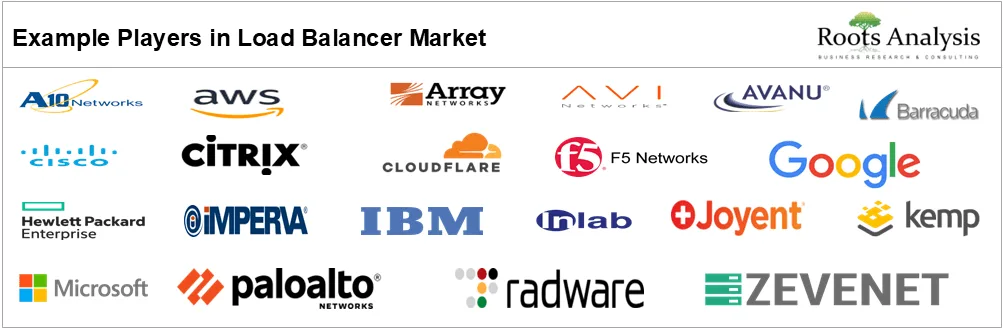
Owing to the ongoing digital infrastructure demand, several companies, such as Amazon Web Services, Avi Networks, Cisco Systems, and Google are investing heavily to develop advanced load balancers. For instance, in June 2025, Cisco launched isovalent load balancer tool that help to spread out data and tangled internet traffic that business mange across multiple platforms. Owing to the consistent demand and industrial players efforts, the load balancer market is anticipated to grow at a steady rate in the future.
Get an Instant Quote in 10 Minutes. Lowest Price Guaranteed
Recent Developments
- In October 2025, IBM and Groq entered into a strategic go-to-market and technology market deal, which give clients immediate access to Groq’s inference technology, and Groq Cloud on watsonx Orchestrate. This partnership also aims to integrate Red Hat open source vLLM technology with LPU architecture to address key AI developer needs, including load balancing, inference orchestration, and hardware to streamline inference process.
- In August 2025, Palo Alto Network introduced advanced security solutions that enhance network security, risk associated with quantum computing, artificial intelligence, and multi-cloud strategies. These enhancements also include integrated load balancing that eliminate the need for additional point products and streamline cloud operations.
- In March 2025, Arista Networks introduced a load balancing for AI workloads with advanced observability that incorporates third-party network equipment. The company also upgrades EOS Smart AI suite innovations to advanced ethernet cluster management for AI networks.
Load Balancer Market Dynamics
The industry is set to witness an exponential growth, driven by the several drivers, restraints, opportunities, and challenges that will influence its trajectory in the coming years.

Key Market Drivers
- High Adoption of Cloud, Multi-Cloud, and Hybrid IT Architectures: Businesses are upgrading to cloud, multi-cloud, and hybrid IT architectures to streamline workflow. This shift to cloud-based networks demand highly secured network and load balancers that distribute traffic equally to multiple servers to avoid overloading. Load balancing for cloud applications also helps to manage distributed traffic, high availability of network, and support scalability across diverse environments, making it important tool for cloud services users.
- Surge in Online Services, and E-Commerce Services: The rapid growth in online services, e-commerce platform, internet banking, and SaaS platforms has surged the requirement of robust and reliable application delivery controllers with integrated load balancing software. The integration of load balancing algorithms in online services assure seamless user experiences and optimize resource usage.
- Applications Complexities and Microservices: It is worth noting that microservices involves break down of one large application into dozens of small / independent services. This division of applications fundamentally change the traffic patterns which underscore the demand for software-based load balancers in microservices architectures for traffic routing, performance enhancement and security.
Key Market Challenges
- Managing Rapidly Changing Application and Network Topologies: The modern applications require frequent updates and reconfigurations to handle workload and business requirements, such as A / B testing, and blue / green deployment. These frequent updates in applications may require advanced cloud-native load balancer solutions for scalable deployments. However, the regular deployment is resource intensive and poses a risk of service outages due to configuration drifts.
- Talent Shortage in Cloud and Network Engineering: Lack of skilled personnel in cloud security, cloud networking, advanced traffic routing / management, and DevOps can limit the adoption of advanced load balancers. Moreover, lack of skilled professionals may increase the operational risks.
- Maintaining Security Against Sophisticated Threats: Advanced load balancers are increasingly used as traffic chokepoints. Therefore, it is essential to add advanced safety features to ensure they are properly protected against protocol exploits, DDoS, and insider threats. However, the deployment of security features in modern load balancer appliances may requirement continuous investment which can make load balancing integration expensive for small businesses.
Load Balancer Market Share Insights
Global Load Balancer Sub-Segment Dominates the Market
Based on the load balancer market forecast estimates, the global load balancer is set to take the lead by securing 68.30% of the market share. This can be ascribed to the rapid globalization of businesses that demands secured traffic management and failover strategies in enterprise load balancing for smooth operation and traffic distribution across multiple data centers.
It is important to note here that the global load balancer will continue to dominate and is likely to grow at a higher CAGR in the future. The need for optimized traffic distributors to enhance performance due to the expansion of multi-region cloud applications on global level has necessitated the demand for load balancer innovations for real-time application performance.
IT & Telecom Holds the Largest Share by Industrial Vertical Type
According to the load balancer market report, the IT & telecom accounts for the largest share (22.40%) of the market. This can be attributed to the IT & telecom industry run on complex networks, cloud computing services, and internet-based services that require scalable load balancing solutions to manage massive data traffic efficiently.
Interestingly, the IT & telecom sub-segment is likely to remain dominant, anticipated to grow at a higher CAGR during the forecast period. This sub-segment benefit from the continuous digital transformation, adoption of big data analytics, expansion of 5G networks, and cloud services that further surge the need for advance load balancers.
North America Leads the Load Balancer Market
Currently, North America lead the market, accounting for 33.03% of the load balancer market share. This region benefits from the increasing digitization, advanced IT infrastructure, and the fastest growing e-commerce in this region. Owing to the growing digitization, there is a high demand for load-balancing solutions to ensure seamless user experience and online transactions.
Conversely, the market for load balancer is likely to grow at a higher CAGR in the Asia-Pacific region. This region benefits from the rising adoption of digital technologies, and stringent regulatory guidelines from government to integrate security features in load balancers, such as DDoS protection and SSL / TLS encryption.
Have Questions? Let’s Get Them Answered.
Load Balancer Market Trends and Key Insights
Competitive Landscape of Leading Players in Load Balancer Industry
The global load balancer market is immensely competitive, featuring the presence of several small, mid-sized, and large companies. Notably, the market players, such as A10 Networks, Citrix Systems, Google, Microsoft, and IBM are actively focusing on load balancer innovations for real-time application performance. Furthermore, the market players are incorporating advanced security features to reduce the risk of cyber threats.
In order to leverage competitive edge, load balancer industrial players are encouraging innovations, investments, partnerships, and collaborations. For instance, F5 introduced an advanced F5 application delivery and security platform that joins high-performance load balancing and traffic management with advanced API security and app capabilities into a single platform.
Key Load Balancer Market Trends in Hybrid and Multi-Cloud Environments
- Increasing Focus on Application Security and Compliance Solutions: The market players are widely emphasizing on combining load balancing platforms / software with Web Application Firewalls, zero-trust architectures, and advanced security features, such as DDoS mitigation, SSL offloading, and application-layer filtering. These advanced safety features will help organizations to mitigate the risk of cyber threats and optimize network traffic.
- Demand for Software Defined, Cloud-Native, and API-Centric Load Balancer: With evolving digital enterprises architectures, there will be high demand for container-integrated, cloud-native, and programmable load balancer with automation, orchestration support and RESTful APIs.
- Expansion into Edge Computing and 5G Networks: The introduction of ultra-fast 5G networks, IoT deployment, and Edge data centers has increased the demand for application delivery controllers with integrated load balancing to manage geographically dispersed workloads and support ultra-low latency requirements.
Your Business is Unique – Why Shouldn’t Your Report Be?
How Integration with AI and Machine Learning Can Optimize Traffic Routing?
The future focus of market players is on the integration of AI and analytics in load balancer technologies to predict resource demand and auto-tune performance for complex application landscapes. Notably, the AI-driven analytics when embedded in load balancer can also help to optimize traffic routing and identify anomalies in real-time. Therefore, this integration of load balancers with AI can help to direct traffic to multiple networks and prevent server overloading.

Load Balancing Market: Scope of the Report
| Key Report Attributes | Details | |
| Historical Trend | Since 2020 | |
| Forecast Period | Till 2035 | |
| Market Size in 2026 | $ 7.84 Billion | |
| Market Size in 2035 | $ 22.44 Billion | |
| CAGR (2026-2035) | 13.56% | |
| Segments Covered |
|
|
Unlock Deeper Insights – Schedule Your Personalized Workshop Today!
Load Balancer Market Segmentation
The market report on load balancer presents an in-depth analysis of the various companies that are involved in offering software-defined load balancers, across different segments, as mentioned below:
By Type of Load Balancer
- Global Load Balancer
- Local Load Balancer
By Type of Component
- Hardware
- Software
- Services
By Type of Service
- Integration and Deployment
- Support and Maintenance
- Training and Consulting
By Type of Deployment
- Cloud-Based
- On-Premise
By Enterprise Size
- Large Enterprises
- Small and Medium Enterprises
By Type of Industry Vertical
- BFSI
- Government
- Healthcare
- IT and Telecom
- Manufacturing
- Media and Entertainment
- Retail
- Others
By Geographical Regions
- North America
- US
- Canada
- Mexico
- Rest of North America
- Europe
- Austria
- Belgium
- Denmark
- France
- Germany
- Ireland
- Italy
- Netherlands
- Norway
- Russia
- Spain
- Sweden
- Switzerland
- UK
- Rest of Europe
- Asia-Pacific
- Australia
- China
- India
- Japan
- New-Zealand
- Singapore
- South Korea
- Rest of Asia-Pacific
- Latin America
- Brazil
- Chile
- Colombia
- Venezuela
- Rest of Latin America
- Middle East and Africa (MEA)
- Egypt
- Iran
- Iraq
- Israel
- Kuwait
- Saudi Arabia
- UAE
- Rest of MEA
- Rest of the World
- Austria
- New Zealand
- Other Countries


