


 Download Free Sample
 Buy Now
Market Size
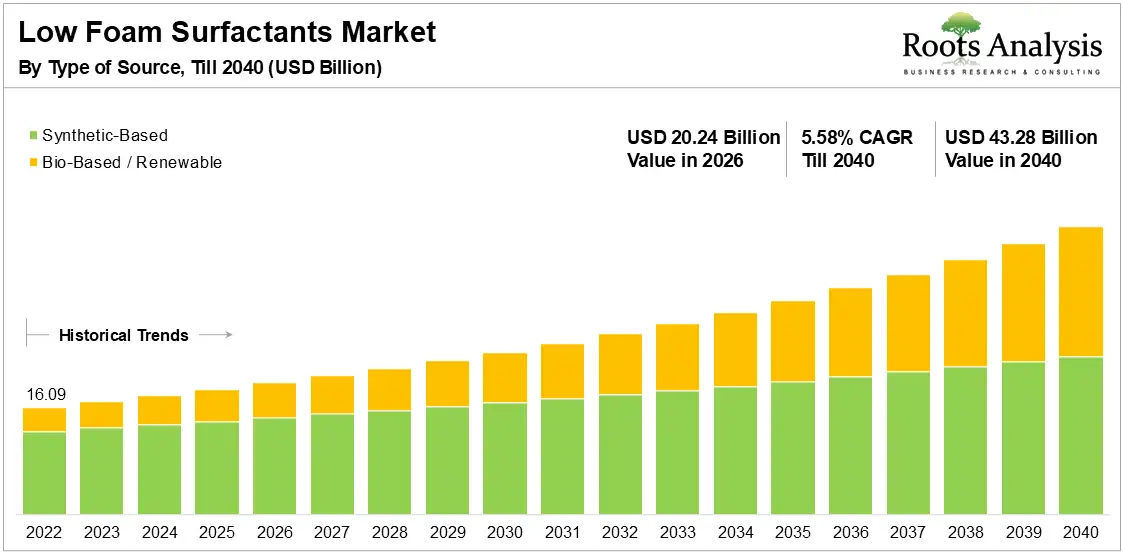
The global low foam surfactants market is projected to reach USD 20.24 billion in 2026 and USD 43.28 billion by 2040, representing a CAGR of 5.58% during the forecast period 2026 to 2040.
See What’s in the Full Report – Request Your Complimentary Insights!
Market Overview
The low foam surfactants market represents a specialized segment of the chemical industry focused on agents that provide essential wetting and emulsification without excessive sudsing. These surfactants have emerged as indispensable components across diverse industrial ecosystems where conventional high-foaming solutions compromise operational efficiency. From automated cleaning systems in food processing facilities to precision agricultural applications, these specialized formulations enable manufacturers to achieve superior performance while minimizing process disruptions, water consumption, and environmental impact.
These scenarios illustrate why low foam surfactants have evolved from niche specialty products to mission-critical components across industrial value chains. The current market landscape includes diverse chemical classes such as non-ionic, amphoteric, cationic, and anionic surfactants, each engineered to facilitate high-speed cleaning or processing.
Market momentum is currently fueled by the rapid adoption of automation in industrial processing, where precise foam management is vital to prevent costly downtime and cavitation. This growth is particularly evident in the food and beverage sector, where clean-in-place systems rely on controlled foam levels to maintain spray nozzle efficiency and hygiene standards. In addition, rising consumer demand for advanced automatic dishwashing detergents also contributes to steady capital investment and product deployment.
Presently, the low foam surfactants market has reached an inflection point where three powerful forces converge, including technological advancement in manufacturing automation, regulatory mandates for sustainable chemistry, and cost pressures driving operational efficiency. Manufacturers are prioritizing the development of bio-based, green solutions, such as glucamide-based surfactants that maintain high performance under extreme temperature and alkalinity without leaving harmful residues, ideal for both industrial and consumer-facing cleaning portfolios. This convergence creates unprecedented opportunities for investors who understand technical nuances and market dynamics.
Market Report: Key Takeaways
- Market Leaders: Industry giants, such as BASF, Evonik Industries, Dow, Stepan Company, and Clariant are aggressively expanding product portfolio, specifically high-performance non-ionic surfactants, such as EO / PO block copolymers, sophorolipids, and sensor-friendly surfactants, specifically designed for IoT-enabled Clean-in-Place systems in food & beverages, personal care products, and pharma.
- Emerging Startup Ecosystem: The global low foam surfactants market analysis highlights the emergence of startup companies, with rising venture capital support to accelerate biosurfactants production by using fermentation technologies, and waste feedstocks. Companies like AmphiStar received €12.5 million from European Innovation Council, comprising €2.5 million grant and €10 million equity investment. This investment will be used to scale-up their sustainable, waste-based microbial biosurfactants for personal and home care products.
- Geographic Expansion and Localization: Companies are establishing regional production facilities particularly in Asia Pacific to reduce logistics costs, improve supply chain resilience, and capture high-growth emerging markets. BASF's Thailand expansion and planned Cincinnati facility exemplify this strategy. Local production enables faster customer response, customization capabilities, and competitive positioning against regional players.
- Emerging Market Penetration: Based on low foam surfactants demand forecast, Brazil, Mexico, Turkey, and GCC countries demonstrate growing demand for low foam surfactants driven by industrial development, infrastructure investment, and rising consumer standards. These markets currently exhibit lower penetration rates compared to developed regions, offering first-mover advantages for companies establishing distribution networks and technical service capabilities. Cost-competitive production leveraging regional raw material availability can support market entry strategies.
- Technology and Innovation Frontier: The global surfactants industry trends and forecast highlight that the future focus will be on next-generation biosurfactant platforms, multifunctional and hybrid formulations along with AI-driven development. Strategic investments in biosurfactant startups or in-licensing breakthrough technologies represent high-potential opportunities.
- Low Foam Surfactants Market by End-User Industry: The consumer goods secured nearly 35% of the global low foam surfactants market share. This is potentially due to the fact that low foam non-ionic and amphoteric surfactants are preferred for facial cleansers, baby care, and premium shampoos because they provide effective cleaning with lower skin irritation and a "controlled" lather that consumers now associate with luxury and safety.
Recent Industry Developments
- November 2025: Locus Fermentation Solutions secured oversubscribed USD 20 million investment to scale up production of its biosurfactants, including non-toxic, low foam sophorolipids for use in agricultural adjuvants and oilfield chemicals, supporting a move away from traditional petrochemical surfactants.
- November 2025: BASF announced the expansion of its Alkyl Polyglucosides (APGs) footprint by establishing a new plant at the Bangpakong site in Thailand. This strategic expansion strengthens regional supply and meets the rising need for sustainable surfactants.
Pay Only for What You Need – The Best Way to Optimize
Market Dynamics
Low Foam Surfactants Market Drivers
- Structural Adoption of High-Efficiency (HE) Consumer Appliances: The global transition toward front-loads washing machines and automated dishwashers necessitates surfactants with controlled foam profiles. Standard high-sudsing agents interfere with HE sensor arrays, triggering excessive rinse cycles and risking mechanical failure. Consequently, the proliferation of water-efficient consumer hardware is a primary catalyst for specialized low-foam chemistry.
- Industrial Automation and High-Velocity Process Optimization: In modern manufacturing environments including clean-in-place (CIP) systems and high-speed metal finishing, foam accumulation acts as a process inhibitor. Excessive suds cause pump cavitation and disrupt automated production flows. Low foam surfactants mitigate these operational bottlenecks, ensuring consistent cleaning performance and minimizing maintenance-related downtime in high-throughput industrial lines.
- Regulatory Displacement of Alkylphenol Ethoxylates (APEOs): Stringent environmental mandates, such as the REACH framework in Europe, are accelerating the phase-out of traditional APEOs due to their ecological persistence and endocrine-disrupting profiles. This shift toward sustainable alternatives favors low-foam surfactants, which are increasingly engineered to meet both high-performance specifications and rigorous non-toxicity standards.
- Critical Foam Management in Water Treatment and Industrial Processing: Effective foam control is essential for maintaining aeration efficiency and preventing overflows in wastewater treatment and cooling tower operations. As environmental discharge regulations tighten and industries like pulp and paper or textiles increase water recycling rates, the demand for low-foam solutions grows to ensure system integrity and regulatory compliance.
Market Restraints
- Premium Pricing and Sensitivity in Commodity-Driven Segments: The production of high-performance or bio-based low foam surfactants often involves higher manufacturing costs than conventional alternatives like LAS or SLES. In cost-sensitive industrial sectors where cleaning chemicals are viewed as bulk commodities, this price disparity remains a significant barrier to widespread adoption and market penetration.
- Technical Reformulation Complexity and Performance Trade-offs: Transitioning to low-foam systems often requires comprehensive reformulation to preserve detergency and product stability. Formulators frequently encounter a performance-cost tension, where achieving low-sudsing characteristics may necessitate the use of expensive co-surfactants or result in a perceived reduction in overall cleaning efficacy.
- Feedstock Volatility and Upstream Supply Chain Dependencies: The manufacturing of low foam surfactants is heavily reliant on precursors like ethylene oxide (EO), propylene oxide (PO), and oleochemical derivatives. Vulnerability to crude oil price fluctuations and geopolitical disruptions creates significant margin pressure for producers and complicates long-term procurement strategies for industrial end-users.
Get an Instant Quote in 10 Minutes. Lowest Price Guaranteed
Market Share Insights
Non-ionic and Amphoteric Low Foam Surfactants Market to Drive Industry Growth Through 2040
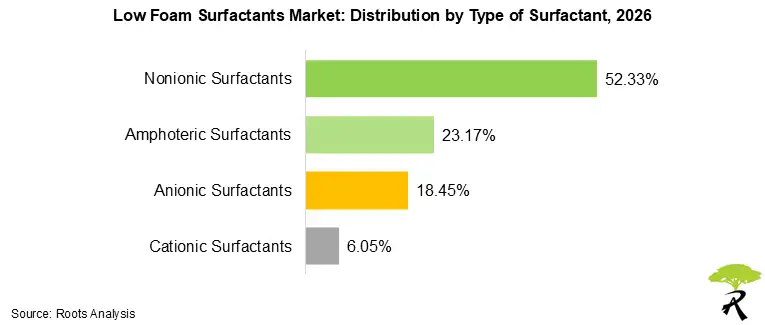
- Our market forecast estimates suggest that the non-ionic low foam surfactants are expected to dominate the current market with a share of 52.33%. This leadership is sustained by the superior emulsification properties and low-temperature stability of alcohol ethoxylates and block copolymers, which are essential for high-pressure industrial cleaning and automated dishwashing (ADW). Despite its maturity, this sub-segment is projected to expand to 74.8% by 2040, driven by high regulatory compliance and the industry's pivot toward cold-water processing.
- In contrast, the amphoteric low foam surfactants category is likely to grow at a higher CAGR through 2040. This rapid growth reflects a strategic shift toward bio-based feedstocks and the increasing use of amphoteric surfactants as boosters to enhance mildness in industrial hand care. Evidence of this transition toward sustainable, high-performance chemistry was signalled in May 2025, when BASF expanded its biodegradable specialty surfactant production in Europe to meet Ecodesign for Sustainable Products Regulation (ESPR) requirements, prioritizing low-foam non-ionic alkoxylates.
Key Opportunities in Low Foam Surfactants Market by Regional Outlook (APAC and North America)
The demand for low foam technology is expanding most rapidly in regions undergoing significant industrial modernization.
Asia-Pacific: The Dominant Growth Engine
On the basis of low foam surfactants market segmentation analysis, Asia-Pacific region currently dominates the global landscape with a 40% market share and is positioned as the primary growth engine through 2040, expanding at a sector-leading CAGR. This rapid ascension is driven by a non-linear leapfrogging effect, where emerging industrial hubs in India and ASEAN bypass traditional surfactants in favor of high-efficiency, low-foam specialized formulations to meet modern ESG standards.
North America: Precision and High-Efficiency
North America held a 44.8% share in 2023, characterized by performance-driven adoption. The US market is anchored by strict hygiene protocols in healthcare facilities and the presence of global detergent giants like Procter & Gamble, who are focusing on high-efficiency, concentrated formulations. The "EPA Safer Choice" label acts as a primary catalyst, encouraging manufacturers to shift toward sustainable, low-environmental-impact surfactant architectures.
Want Information on Specific Region / Segment?
Market Ecosystem Insights
Low Foam Surfactants Market Competitive Landscape
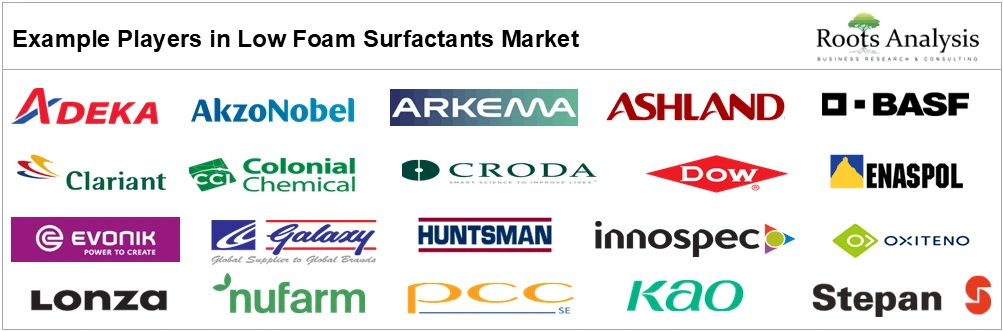
The low foam surfactants industry exhibits moderate to high concentration with multinational chemical companies commanding dominant positions through integrated operations, extensive product portfolios, global distribution networks, and substantial R&D capabilities. Competitive dynamics increasingly revolve around sustainability credentials, technical service capabilities, and application-specific formulation expertise rather than commodity pricing alone.
Top players, such as BASF, Dow, Evonik Industries, Stepan Company, and Clariant are adopting innovative strategies to stay ahead of competitive edge. Some of the key strategies are mentioned below:
- Sustainable Portfolio Development: All major players are systematically expanding bio-based and biodegradable product offerings to capture growing demand for sustainable alternatives. Strategies include in-house R&D programs, acquisitions of biosurfactant technologies, and partnerships with fermentation specialists. Companies with established bio-based portfolios gain competitive advantages through eco-label certifications, regulatory compliance, and alignment with customer sustainability commitments.
- Application-Specific Differentiation: Rather than competing solely in commodity pricing, leading manufacturers develop specialized formulations optimized for specific applications including food processing, pharmaceutical manufacturing, agricultural adjuvants, and personal care. This approach creates switching barriers, enables premium pricing, and deepens customer relationships through technical service and co-development partnerships.
- Digital Transformation and Technical Service: Leading companies invest in digital tools including formulation modeling software, online technical resources, and customer portals to enhance service delivery. AI-driven process optimization, predictive maintenance, and quality control systems improve manufacturing efficiency. Meanwhile, technical service capabilities differentiate suppliers in complex applications requiring formulation support and performance validation.
Low Foam Surfactants Market Trends and Outlook
- Pioneering Sustainable and Bio-Based Low Foam Chemistries: The market is ready for the development of renewable surfactants derived from glucose (APGs), fatty acids, and amino acids. These bio-based alternatives align with corporate ESG goals and provide a strategic pathway for penetrating premium green chemical segments that prioritize high biodegradability and low environmental toxicity.
- Specialization for High-Tolerance Niche Applications: Increasing demand for surfactants that perform under extreme conditions, such as high thermal stress, varying pH levels, or hard water environments offers a path for market differentiation. Developing tailored solutions for these technical performance gaps allows manufacturers to capture high-margin segments that commodity products cannot serve.
- Value-Added Service Models and Integrated Process Solutions A significant opportunity exists in shifting from product sales to integrated cleaning protocols. By bundling low-foam surfactants with technical expertise and equipment compatibility audits, suppliers can establish deep strategic partnerships within high-compliance sectors like pharmaceutical and food and beverage processing.
- Next-Generation Laundry Formulations for Cold-Water Cycles: Modern consumer habits, specifically the trend toward cold-water washing and ultra-concentrated detergents, require surfactants with enhanced solubility and detergency at lower temperatures. Innovating low-foam systems that maintain high performance under these conditions is a key growth area for the consumer laundry segment.
Your Business is Unique – Why Shouldn’t Your Report Be?
Low Foam Surfactants Market: Scope of the Report
| Key Report Attributes | Details | |
| Historical Trend | Since 2022 | |
| Forecast Period | Till 2040 | |
| Market Size 2026 | $ 20.24 Billion | |
| Market Size 2040 | $ 43.28 Billion | |
| CAGR (Till 2040) | 5.58% | |
| Segments Covered |
|
|
Market Segmentation
Based on our research, the low foam surfactants industry report forecast is segmented into type of surfactant, type of source, type of form, foam performance mechanism, type of functionality, application area, distribution channel, end use industry, geographical regions, and key players.
Market Share by Type of Surfactant
- Non-Ionic Surfactants
- Amphoteric Surfactants
- Anionic Surfactants
- Cationic Surfactants
Market Share by Type of Source
- Synthetic-based
- Bio-based / Renewable
Market Share by Type of Form
- Liquid Form
- Powered / Solid Form
Market Share by Foam Performance Mechanism
- Low Foaming by Structure
- Low Foaming via Antifoam Additives
- Low Foam Under Mechanical Agitation
Market Share by Type of Functionality
- Antistatic Agents
- Dispersing agents
- Detergents / Cleaners
- Emulsifiers
- Solubilizers
- Wetting Agents
Market Share by Application Area
- Agrochemicals
- Coatings & Inks
- Food Processing
- Home Care & Industrial / Institutional (I&I) Cleaning
- Industrial Processes
- Oil & Gas
- Personal Care & Cosmetics
- Paints
Market Share by Distribution Channel
- Supermarkets / Hypermarkets
- Drugstores / Pharmacies
- Online Retail
- Wholesalers / Distributors
- Other Channels
Market Share by End Use Industry
- Agriculture
- Consumer Goods
- Manufacturing & Industrial
- Energy & Oilfield
- Food & Beverage
- Healthcare & Pharmaceuticals
- Textiles
Market Share by Geographical Regions
- North America
- US
- Canada
- Mexico
- Rest of North America
- Europe
- Austria
- Belgium
- Denmark
- France
- Germany
- Ireland
- Italy
- Netherlands
- Norway
- Russia
- Spain
- Sweden
- Switzerland
- UK
- Rest of Europe
- Asia-Pacific
- Australia
- China
- India
- Japan
- New Zealand
- Singapore
- South Korea
- Rest of Asia-Pacific
- Latin America
- Brazil
- Chile
- Colombia
- Venezuela
- Rest of Latin America
- Middle East and Africa (MEA)
- Egypt
- Iran
- Iraq
- Israel
- Kuwait
- Saudi Arabia
- UAE
- Rest of MEA


