
Lowest Price Guaranteed
Slides
184
Last Updated
November 2025
View Count
12360
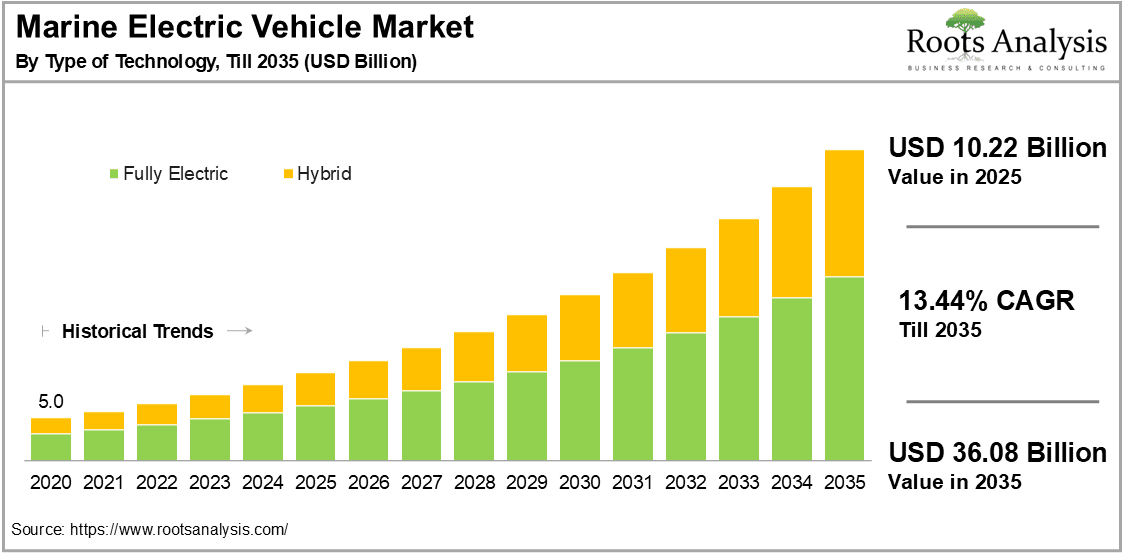
The marine electric vehicle market size is projected to grow from USD 10.22 billion in 2025 to USD 36.08 billion by 2035, representing a CAGR of 13.44% during the forecast period till 2035.
 |
The new research study consists of marine electric vehicle market and trends analysis, detailed market forecast analysis, and provide actionable strategic recommendations.
According to a report of the World Economic Forum, maritime transport accounts for 2-3% of carbon emissions. Due to this, the shipping industry is increasingly transitioning towards marine electric vehicles to decrease carbon emissions. Marine electric vehicles are vessels or watercraft that use electric propulsion systems. Unlike traditional internal combustion engines fueled by diesel or gasoline, these vehicles are powered by energy-stored batteries or generated through renewable energy sources. The purpose of these electric vehicles is to reduce environmental impact by serving various marine EV applications such as transportation, cargo, tourism, and leisure activities. A variety of marine electric vehicles ranging from fully electric vessels to hybrid electric vessels is available in the market.
The global push for decarbonization, exemplified by the International Maritime Organization’s 2050 emission reduction targets, has forged new pathways for electrification in the maritime industry, broadening the marine electric vehicle market prospects. As a consequence, the market is going through a transformative phase with heightened sustainability initiatives. This is due to the fact that the environmental impact of marine EVs is significantly positive, as they reduce greenhouse gas emissions and minimize water pollution. Along with the environmental advantages of marine electric vehicles, these EVs offer operational benefits as well as energy efficiency.
Additionally, ongoing innovation in marine battery technology is driving the adoption of electric vessels as they provide enhanced energy density, better efficiency, and extend operational ranges. After recognizing the market potential, several industry players and battery manufacturers are joining hands to take the electric vehicle industry in maritime to the next level. For instance, in January 2025, Germany’s Lehmann Marine, a leading company in lithium ferrophosphate battery systems, formed a partnership with Greece’s Sunlight Group to scale up the production and meet the growing demand for safe and efficient maritime energy storage systems. Additionally, the market for marine electric vehicles faces a few challenges including high initial costs and limited battery range that can potentially hold the market growth. Overall, these significant aspects of the industry are shaping the future of maritime transportation and indicating a noteworthy acceleration in growth during this forecast period.
The marine electric vehicle market report presents an in-depth analysis of the various companies that are involved in offering marine electric vehicles, across different segments, as defined in the table below:
| Key Report Attributes | Details | |
| Historical Trend | Since 2020 | |
| Forecast Period | Till 2035 | |
| Current Market Size | $ 10.22 Billion | |
| Market Size Value by 2035 | $ 36.08 Billion | |
| CAGR (Till 2035) | 13.44% | |
| Type of Vehicle |
|
|
| Type of Technology |
|
|
| Type of Vessel Size |
|
|
| Type of Range |
|
|
| Geographical Regions |
|
|
| Leading Market Players | ||
| PowerPoint Presentation (Complimentary) |
Available | |
| Customization Scope | 15% Free Customization | |
| Excel Data Packs (Complimentary) |
|
|
This segmentation of the global market for marine electric vehicles comprises several vehicles wherein the leisure and tourist surface ships sub-segment is projected to hold the highest (~46%) of the market share by 2035. The key driving factors of the segment growth are the high demand for eco-friendly tourism and government support for green tourism. While the military vehicle sub-segment is estimated to grow at a substantial (15.86%) growth rate during this forecast period due to the high demand for stealth and quiet operations and the growing adoption of autonomous underwater vehicles.
Based on the technology, the fully electric segment is leading the segment by capturing (~66%) of the current market share. The advanced battery technology in marine vehicles is becoming efficient with higher energy density, faster charging, and longer lifespan. Also, its widespread applications such as ferries, leisure boats, and workboats are fueling the segment’s growth.
Moreover, the hybrid segment is witnessing an ever-exceeding (16.74%) growth rate and is likely to foster market development driven by the perpetuated growth of hybrid electric boats. The rising demand for hybrid marine vehicles boasts the mounting popularity of hybrid technology owing to its ability to balance efficiency, range, and versatility which makes it suitable for a wide range of applications.
The distribution of the market based on the type of vessel size is split into small electric boats, medium-sized electric boats, and large electric ships. As per marine electric vehicle market research, the small electric boat segment is augmenting the segment growth and is poised to occupy (~43%) of the market share by 2035. Smaller boats or vessels can operate within the limitations of current battery technology which offer sufficient range and performance for shorter routes or missions. Whereas, large electric ships are gaining traction in the market and are likely to rise at a notable CAGR of (14.87%) in the upcoming decade. This surge in popularity can be attributed to the continuous innovation in battery management systems where renewable energy in maritime transport is maximizing the market outlook as sustainable energy resources such as wind, solar, and biofuels can provide enough energy to optimize power usage that allows large ships to operate more efficiently.
Based on the type of range, <50 Km range dominates the segment and is predicted to capture (~47%) of the market share by 2035. Most marine EVs such as ferries, leisure, boats, and workboats operate on sort routes and are high in demand. Their batteries' efficiency and cost-effectiveness push the market demand. Further, 50-10 km range is also experiencing higher demand as it caters to vessels similar to hybrid ferries, passenger boats, and some workboats that operate on slightly longer routes such as regional inter-island travel or coastal transport. As a result, the 50-10 km segment is anticipated to exhibit (14.92%) throughout this forecast period.
This segment highlights the distribution of the marine electric vehicle market across various geographical regions, such as North America, Europe, Asia, Latin America, the Middle East and North Africa, and the rest of the world. Based on the market demand for electric boats, Europe is predicted to capture the largest (~49%) of the market share till the forecast period.
Additionally, Asia is emerging at a fast pace and is estimated to register (15.56%) growth rate during this forecast period. Primarily, China’s leadership in manufacturing and exports plays a critical role in the growth of this market in Asia. Chinese manufacturers such as BYD and others are expanding into the marine sector and producing electric boats and vessels for exports. For instance, in January 2024, BYD’s first charted vehicle vessel BYD Explorer No.1 departed from China, carrying 5000 electric vehicles to Europe for Flushing Port in the Netherlands and Bremerhaven in Germany.
The “Marine Electric Vehicle Market, Till-2035: Industry Trends and Global Forecasts” report features an extensive study of the current market landscape, market size and future opportunities within the marine electric vehicle market, during the given forecast period. The market report highlights the efforts of several stakeholders involved in this rapidly emerging segment of the service providers industry. Key takeaways of the marine electric vehicle market report are briefly discussed below.
The growing government regulations on marine emissions and demand for sustainable maritime solutions are some of the major key drivers, lifting the market growth. Governments across the globe are imposing stricter emissions regulations to minimize greenhouse gas emissions and better air quality which has surged the adoption of cleaner technologies similar to electric propulsion in marine transport. The impact of climate change on the maritime industry such as increasing sea levels, and more extreme weather events like hurricanes and storms affected the ocean current. Thus, to mitigate these adverse environmental challenges, the demand for electric boats and vessels will likely continue and drive the marine electric vehicle market growth in the future as well.
Currently, several established companies, regional players, and emerging startups are shaping the market dynamically. Leading companies such as ABB, Siemens, Corvus Enger, BAE, and many more are dominating the market with advanced sustainable marine technologies. These companies are leveraging their expertise in electric propulsion systems for vessels and focusing on hybrid-electric systems and energy management for marine vehicles. Simultaneously, emerging players are emphasizing electric propulsion systems for smaller leisure boats with innovation in technology. These companies are adopting several strategies to stay competitive in the industry and expand their market reach through collaboration, partnership, and acquisition.
The adoption of marine electric vehicles can be hindered by the significant upfront investment needed for electric propulsion systems, batteries and related infrastructure. These technologies are more expensive than traditional marine technologies. Coupled with this, the limited range and battery capacity can be a drawback specifically, for large cargo vessels that require extended periods of operation. Besides this, insufficient charging stations in ports and waterways is alsoa notable challenge in marine electrification that may curb the adoption of marine electric vehicles across many regions.
As per regional analysis of marine electric vehicle adoption, Europe stands as a leader in the global marketplace. The European Union’s stringent environmental policies such as Green Deal and regulations to decrease carbon emissions have pushed the adoption of electric and hybrid propulsion systems in marine transport. This is also attributed to the government support that provides grants and subsidies for adopting clean energy technology in marine applications which encourage shipbuilders and operators to transition to electric systems. In addition, several key players headquartered in Europe foster market growth through their technological advancements. Besides, the region’s rising emphasis on sustainable public transportation and consumer preferences for eco-friendly boats has led to increased demand for electric ferries and other eco-friendly vessels, strengthening the market position.
Examples of key players involved in the market for marine electric vehicles (which have also been captured in this market report, arranged in alphabetical order) include ABB (Switzerland), Andaman Boatyard (Thailand), BAE Systems (UK), Boeing (US), Boesch Motorboote (Switzerland), Corvus Energy (Canada), Duffy Electric Boats (US), Echandia Marine AB (Sweden), ElectraCraft Power Boats (US), General Electric (GE) (US), Kongsberg Gruppen (Norway), Leclanché (Switzerland), Norwegian Electric Systems (Norway), Rand Boats (Denmark), Ruban Bleu (France), Saft (France), and Siemens (Germany). This market report includes an easily searchable excel database of all the companies who have adopted the marine electric vehicle market.
The market report presents an in-depth analysis, highlighting the capabilities of various companies engaged in this domain, across different segments. Amongst other elements, the market report includes:
At Roots Analysis, we genuinely care about your success and understand that your business requirements are unique. While our market research reports provide valuable insights, we recognize that they might not cover every aspect you need to make well-informed strategic decisions. To account for that, we offer 15% free report customization tailored to your specific needs. Whether you require additional quantitative analysis, qualitative insights, or any other information related to the marine electric vehicle market, reach out us today at: support@rootsanalysis.com